
If Profound's pricing is the problem, the cheapest credible replacements for a small business are Listable Labs at $15/month, Rankscale at $20/month and Otterly.ai at $29/month for monitoring, Peec AI at $95/month when you need depth, and tools like Frase or Neverdrafts when you want gaps fixed rather than just reported. The reason to look elsewhere is simple: Profound's $99/month Starter tier covers one answer engine, 50 prompts and one seat, and real multi-engine coverage starts at $399/month. Every tool below undercuts that number, and several include unlimited seats.
Key takeaways
- Profound's entry plan tracks ChatGPT only; the jump to three engines costs $399/month with 100 prompts and three seats.
- Sub-$100 monitoring is a real category: Listable Labs ($15), Rankscale ($20), Otterly.ai ($29), Nightwatch (from $32), Frase ($49), HubSpot AEO (from $50), Knowatoa ($59), SE Ranking (~$79), Peec AI ($95).
- Watch the seat model, not the sticker price. Peec AI and Otterly.ai include unlimited team members, while Semrush's AI Toolkit adds roughly $99 per extra user and Ahrefs Brand Radar adds $199 per engine index.
- Most cheap tools are diagnostic only. Appscribed rates Frase and AthenaHQ as the alternatives that actually help you fix gaps, and Listable Labs argues raw visibility scores are worthless without content guidance.
- If nobody on your team will log into a dashboard weekly, measurement alone changes nothing — buy remediation or a service instead.
- Pricing in this category moves fast, and many round-ups are published by competing vendors. Verify current rates on each vendor's site before you sign up.
Why do small businesses outgrow Profound's pricing so quickly?
Profound is the deepest product in the category and was an early mover on tracking brand mentions in AI answers, including real-user prompt volume data and an Amazon Rufus shopping module most competitors do not offer. The problem for a five-person business is the tier structure, not the product quality.
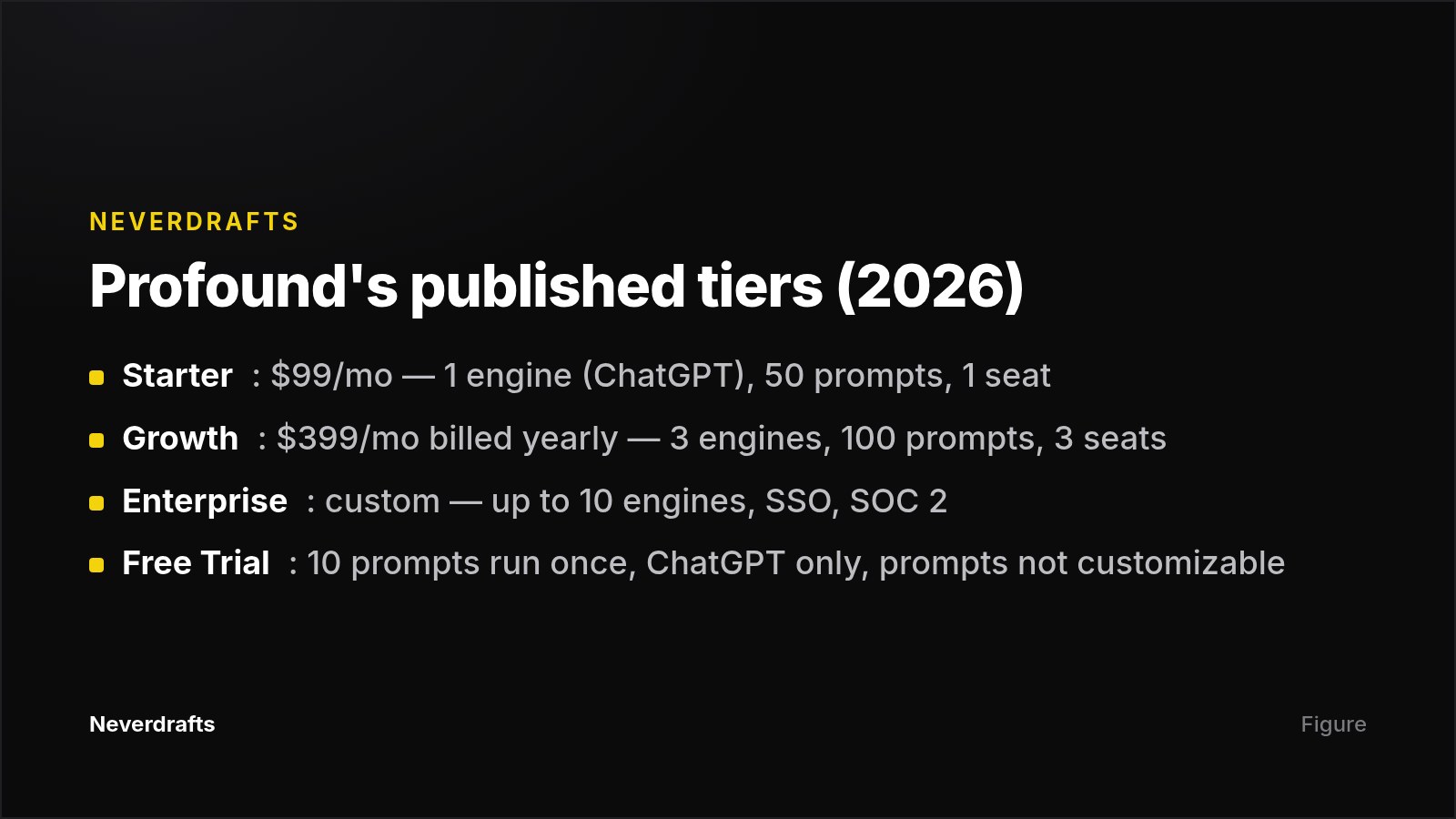
As documented in 2026, the published self-serve plans were Starter at $99/month (one engine, 50 prompts, one seat), Growth at $399/month billed yearly with two months free (three engines, 100 prompts, three seats), and Enterprise at custom pricing with up to 10 answer engines, SSO and SOC 2. Profound's own pricing page currently shows a free Trial with 10 prompts run once on ChatGPT only, and an Enterprise tier with daily tracking, up to 9 answer engines, SSO/SAML and SOC 2 compliance — so check the live page before assuming a mid-tier exists.
Two other constraints matter for owner-operators. Profound is built for large brands with an analytics team and assumes onboarding time, and no tier includes anyone doing the work for you — you get measurement; the fixes are on you.
Affordable Profound alternatives at a glance
| Tool | Best for | Standout feature | Entry price (as published in sources) |
|---|---|---|---|
| Listable Labs | Lowest-cost citation analytics | Citation Path Analysis mapping third-party URLs feeding AI engines | $15/mo |
| Rankscale | Widest engine list on a small budget | 17+ engines, credits roll over | $20/mo (Essentials) |
| Otterly.ai | Cheapest easy entry point | 15 prompts across four engines, 7-day trial, no card | $29/mo (Lite) |
| Nightwatch | SEO rank tracking plus AI | Traditional SEO and AI visibility in one platform | From $32/mo (+$99/mo per 100 AI prompts) |
| Frase | Turning gaps into content tasks | Briefs and an SEO/GEO editor; five-engine coverage on the $239/mo Scale plan | $49/mo |
| HubSpot AEO | Teams already in HubSpot | AI visibility connected to CRM data | From $50/mo; included in Marketing Hub Pro+ |
| Knowatoa | B2B and SaaS marketers | Free 60-second audit, no card | $59/mo (Starter) |
| SE Ranking | Value all-in-one SEO + AI | “No cited” view showing prompts where only competitors appear | ~$79/mo |
| Peec AI | Deepest metrics per dollar | Gap analysis, competitor quadrants, query fan-out, unlimited seats | $95/mo |
| Neverdrafts | Monitoring plus auto-remediation | Auto-generated articles published to your CMS, plus AI crawler tracking | $99/mo (Starter) |
Which sub-$100 monitoring tools are worth testing?
Listable Labs — cheapest way to see which pages feed AI answers
Listable Labs tracks brand mentions, analyses citations and generates optimised content, starting at $15 per month. Its differentiator is Citation Path Analysis: rather than a bare visibility score, it traces the exact third-party URLs an engine followed, so if Perplexity cites a Reddit thread or a niche directory you see that URL and can target it with PR.
It calculates visibility across Gemini, ChatGPT and Perplexity, and connects to Google Analytics 4 and Google Search Console for traffic attribution. Limitations: narrower engine coverage than Rankscale, and the company states it is not a fit for procurement teams requiring SOC 2 Type II compliance. The pricing and positioning above come from Listable Labs' own comparison post.
Rankscale — most engines for the least money
Rankscale's Essentials tier starts at $20 per month on flexible credits, with Pro at $99 per month, coverage spanning 17+ engines and unused credits rolling over. For a small business that wants to know whether it appears anywhere at all — across a long list of assistants rather than the big three — it casts the widest net at the lowest price.
The model is credit-based rather than prompt-capped, so check the current credit rates on Rankscale's site before committing. Like the other budget trackers, it assumes you will read prompt-level results and act on them yourself.
Otterly.ai — the simplest sub-$30 starting point
Appscribed calls Otterly.ai the cheapest genuine tracker on its list and the easiest to use, with unlimited seats so the sticker price is the whole price. Coverage includes ChatGPT, Google AI Overviews, Perplexity and Copilot, with Claude, Gemini and AI Mode as add-ons, plus citation monitoring, sentiment analysis, an on-page audit tool and multi-country support.
The honest caveat from the same review: it is diagnostic-only monitoring. Fifteen prompts also goes fast if you sell more than one service line.
Peec AI — the step-up when budget tools get limiting
Peec AI is the usual step-up when a sub-$30 plan runs out of prompts; Appscribed ranks it as the tool offering deep metrics at a lower price, with gap analysis, competitor quadrants, query fan-out, unlimited seats and an Actions queue that prioritizes citation gaps. It covers ChatGPT, Perplexity and Google AI Overviews with add-ons available, and the Berlin company reached $10M ARR sixteen months after launch.
It remains monitoring-first, so you still supply the fixes, and higher prompt volumes cost more — one review cites $245 per month for 150 prompts. Price it at your real prompt count.
Bolt-ons for teams already paying for a suite
If you already run SEO or CRM software, the cheapest route may be an add-on rather than a new vendor:
- Nightwatch combines AI visibility and traditional SEO rank tracking in one platform from $32/month, with AI prompts at $99/month per 100 prompts, covering ChatGPT, Claude, Perplexity and Google AI Overviews. The add-on is the real cost: a 100-prompt setup lands around $131/month, above Otterly.ai and Peec AI on total spend.
- HubSpot AEO offers prompt tracking, competitive intelligence and monitoring across ChatGPT, Gemini and Perplexity from $50/month, included in Marketing Hub Pro+, with the argument that visibility data belongs next to CRM and campaign reporting. That only holds if you already pay for HubSpot; its free AI Search Grader is a sensible zero-cost baseline either way. Both claims come from HubSpot's own comparison page.
- SE Ranking pairs five-engine AI-answer tracking with a full SEO suite for around $79/month and a free five-checks-a-day tool. Its "No cited" view is a work queue rather than a score.
- Knowatoa runs Starter at $59/month and Growth at $199/month with a free 60-second audit, though positioning skews toward B2B and SaaS marketers — test it first if you sell locally to consumers.
What if you need fixes, not just a dashboard?
Frase — a monitor-to-fix workflow
Frase links AI-visibility tracking to content briefs and an SEO/GEO editor, so a gap becomes an optimization task inside one tool. For a small business where the same person does the reporting and the writing, that loop matters more than an extra engine. Two constraints: full five-engine coverage sits on the $239/month Scale plan, generated fixes need a human check, and Frase includes a handful of seats then charges for more. Treat the entry tier as a single-operator plan.
Neverdrafts — monitoring plus the content that closes the gap
Disclosure: Neverdrafts is our product.
Neverdrafts monitors where ChatGPT and Claude recommend competitors instead of you, auto-generates articles targeting the prompts you are losing, publishes them to WordPress, Webflow, Shopify, Framer or an API-first stack, and tracks AI crawlers hitting those pages as evidence they were read. Plans are Starter at $99/month (1 brand, 50 prompts, 30 articles), Growth at $199/month (3 brands, 150 prompts, 100 articles) and Agency at $399/month (10 brands, 500 prompts, 300 articles), with a $1 three-day full-access trial and no contracts.
Scope it honestly. We track two engines — ChatGPT and Claude — on their real web interfaces, not APIs or extrapolated scores, so if you need Gemini, Perplexity or Google AI Overviews in the same dashboard, Rankscale, Otterly.ai or Peec AI cover more ground. We fit better when your bottleneck is producing content and getting it live. Our side-by-side with Profound sets out where its enterprise scale still wins.
How should a small business choose between them?
Score candidates on the six criteria Appscribed uses — engine coverage, metric depth, actionability, data accuracy, price and setup — then apply these filters.
- Engines that actually matter to you. Three engines cover most cases: ChatGPT, Gemini and Perplexity. A 17-engine list is only worth paying for with evidence of long-tail traffic.
- Seat model. Price it at your real seat count. Peec AI and Otterly.ai include unlimited members; Semrush's $99/month AI Toolkit adds roughly $99 per extra user; Ahrefs Brand Radar adds $199 per engine index.
- Prompt allowance. Fifteen prompts on Otterly Lite, or 50 on Profound Starter and Neverdrafts Starter, suits one product line — not a multi-location or multi-service business.
- Monitoring or remediation. Ask which tool produces a task list. Frase and AthenaHQ help you fix gaps; Profound is monitoring-first.
- Free checks first. AthenaHQ has a genuine free tier, and both SE Ranking and Semrush offer free AI-visibility checkers — run your brand and three competitors through one before paying.
- Who operates it. If no one will live in a dashboard, measurement alone changes nothing.
If you outgrow budget tooling, the usual next tier is AthenaHQ (free tier, then $295/month, up to eleven engines with an action layer), Scrunch AI from $250/month, or an SEO-suite route such as Ahrefs Brand Radar, whose 243M+ prompts come from real "People Also Ask" search data rather than constructed queries. That data-architecture claim is Ahrefs' own and is not independently quantified elsewhere.
What is the fastest next step?
Pick one free checker and one paid trial, and run them on the same ten buyer prompts so the numbers are comparable. If your gap is production rather than reporting, our $1 three-day full-access trial shows the ChatGPT and Claude prompts you are losing, generates articles for them, and publishes to your CMS inside the trial window. If you are weighing us directly against the enterprise option, the Profound alternatives page lays out the trade-offs.
Frequently asked questions
What is the cheapest alternative to Profound?
By published price, Listable Labs at $15 per month and Rankscale's Essentials tier at $20 per month are the lowest entry points, while Appscribed calls Otterly.ai at $29 per month the cheapest genuine tracker on its list. All three are self-serve monitoring: you read prompt-level results and act on them yourself.
Does Profound have a free plan?
Yes. Profound's pricing page lists a free Trial with limited AI Marketer credits and 10 prompts run once on ChatGPT only. Trial users receive a recommended prompt set based on their industry and cannot customise prompts; editing, disabling or adding prompts requires Enterprise, which also adds daily tracking and up to 9 answer engines.
Do small businesses need to track every AI engine?
Rarely. Listable Labs argues a platform must cover three primary engines — Gemini, ChatGPT and Perplexity, and most budget tools hit that. Broader lists help if you see referral traffic from Copilot, Claude or Grok. Check your analytics for AI referrers first, then buy coverage that matches, since several tools gate engines behind higher tiers.
Is a cheaper tool as accurate as Profound?
Not on depth. Appscribed describes Profound as having the deepest data of any tool it tracks, and its real-user prompt volume data and Amazon Rufus shopping module are features most competitors still do not offer. Budget tools give you enough signal to spot citation gaps and competitor wins, which is usually what a small business needs to act.
How do I switch without losing my reporting history?
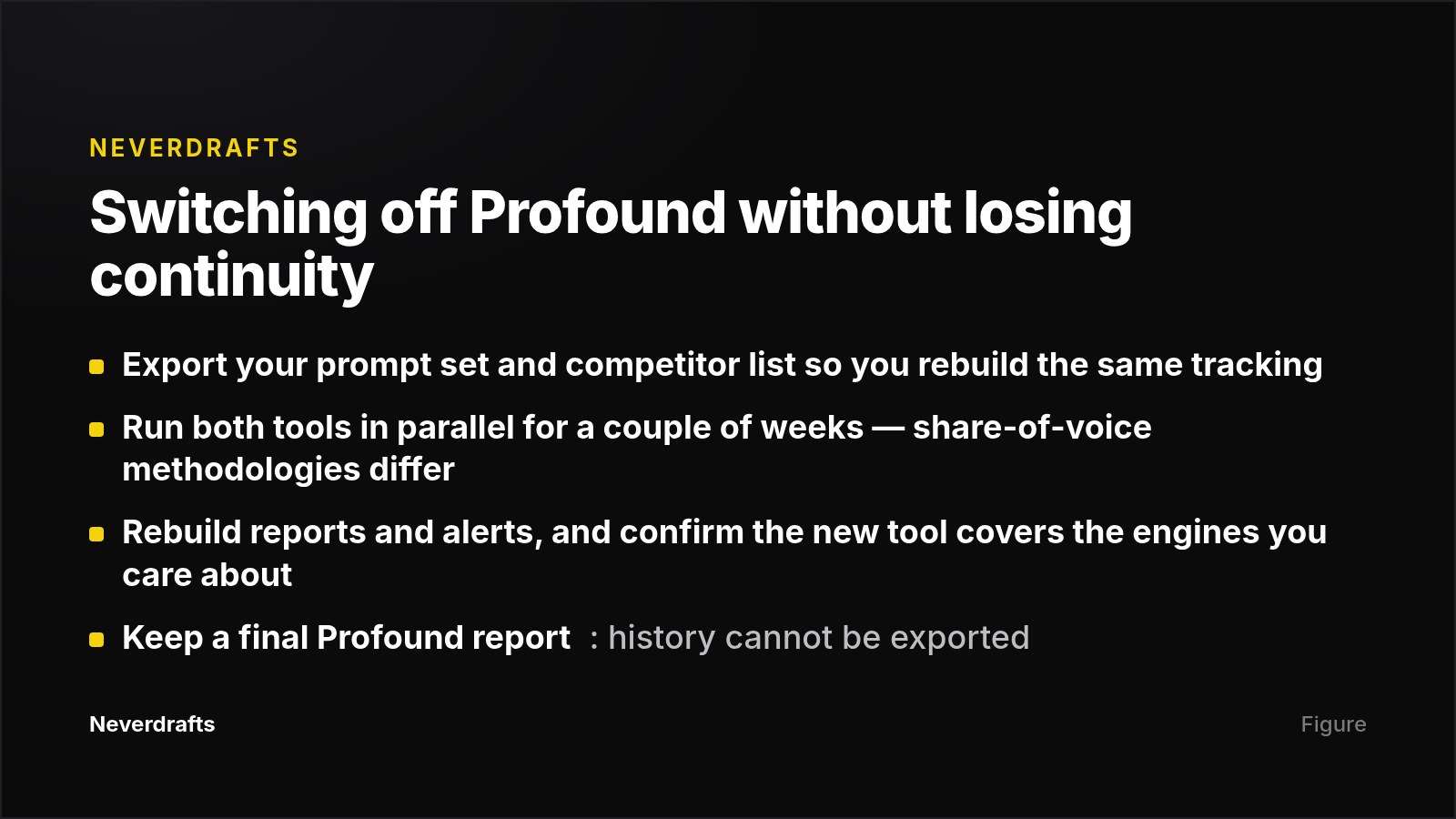
Export your Profound prompt set and competitor list, run both tools in parallel for a couple of weeks to reconcile numbers, rebuild reports and alerts, then cancel. History cannot be exported, so keep a final Profound report as your baseline. Expect share-of-voice figures to differ between tools because methodologies differ.
Why does AI visibility matter for a small business now?
Because intent is shifting. HubSpot's 2026 State of Marketing Report found 58% of marketers say traditional search traffic is declining while AI referral traffic carries significantly higher intent, and 75% now use five or more marketing channels. If an assistant recommends three competitors and not you, you lose the evaluation before a click happens.
Sources
- Profound alternatives: 9 best tools for AI search (2026) — HubSpot Blog
- 14 Profound AI alternatives for AI search visibility tracking (2026) — Tim Soulo's Blog
- The 8 Best Profound Alternatives for 2026 — Appscribed
- Profound pricing — Profound
- Profound Alternatives for Small and Local Businesses — AI Find My Business
- Best affordable alternative to Profound for AI search tracking — Listable Labs
- Neverdrafts pricing