
AI visibility monitoring tools run prompts across ChatGPT, Perplexity, Claude, Gemini and Google AI Overviews on a schedule, then record whether your brand appears, where it sits in the answer, how it's described, and which sources the model pulled from. For enterprise breadth, Profound tracks 10 AI engines — the widest coverage in the market; for mention-level detail on a small budget, Beamtrace starts at $20/month annually; for agencies running many brands, WorkDuo starts at $33 per project/month. Neverdrafts, the tool we build, adds auto-generated remediation content and one-click publishing on top of daily ChatGPT and Claude tracking.
Key takeaways
- Monitoring AI answers is a separate discipline from SEO rank tracking: there is no results page to climb and ChatGPT gives you no impressions data or Search Console equivalent.
- Scale justifies the spend: ChatGPT users send roughly 2.5 billion prompts per day and the platform reaches 900 million weekly users.
- Entry pricing ranges from about $20/month to $99/month, with enterprise platforms on custom pricing.
- A brand mention (your name inside the generated answer) is not the same as a citation (a link to your page) — the fixes for each are different.
- Reddit accounted for about 40.1% of citations in a Semrush analysis of roughly 150,000 AI citations, yet most tools do not track it.
- You can start free: log out, use incognito, and run a fixed prompt set manually before committing to a subscription.
What do AI brand monitoring tools actually measure?
Four different things get sold under the same label, and mixing them up is the most common buying mistake.
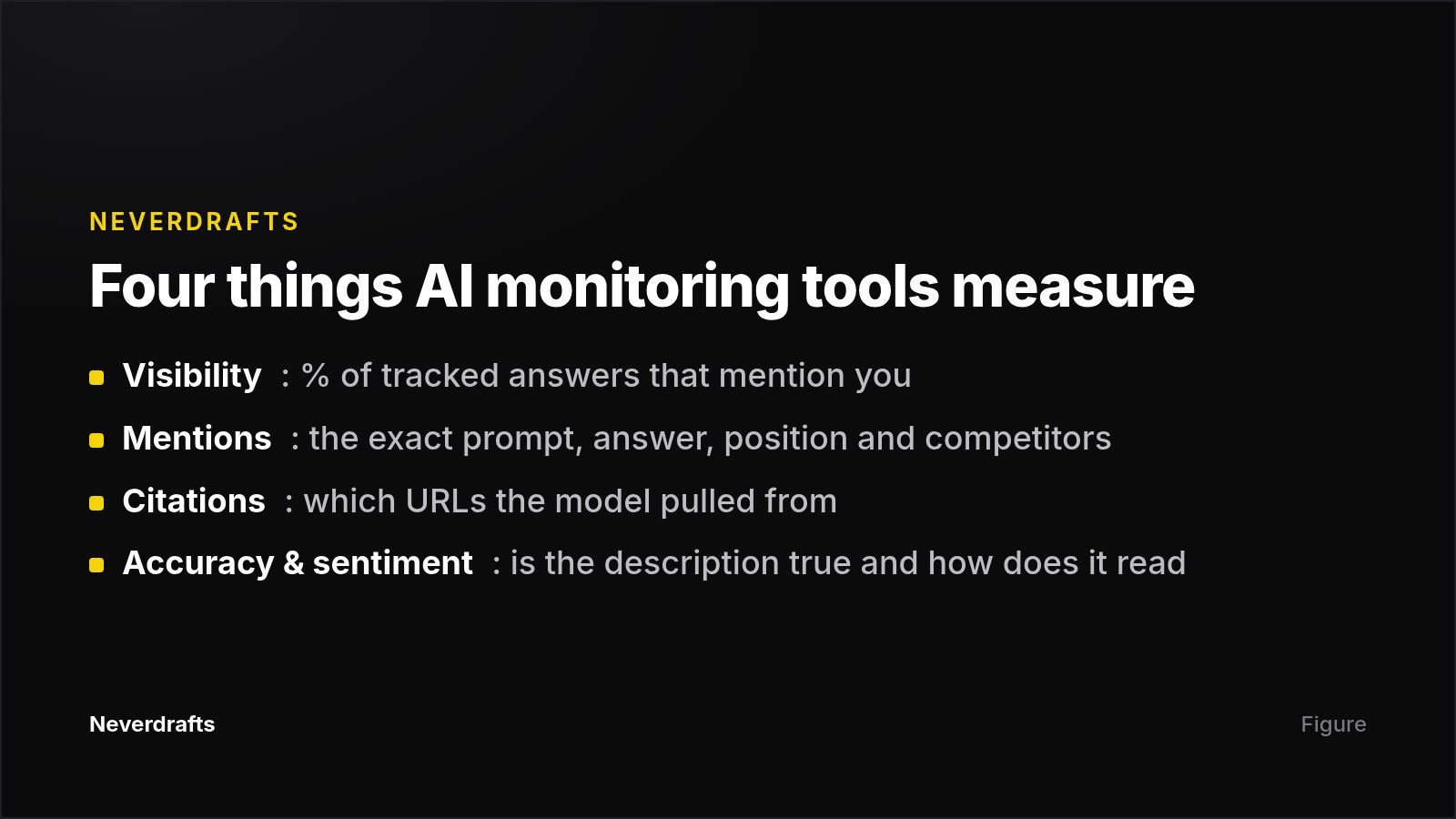
Visibility tracking aggregates many responses into a single metric — for example, the percentage of monitored answers where your brand appears. It's good for trend lines and executive reporting, weak for diagnosis.
Mention tracking goes one level deeper into the individual occurrences behind that score: which prompt triggered it, whether the model recommended you or merely referenced you, which competitors appeared alongside, and whether the description was positive or critical. As Beamtrace puts it, a visibility score tells you presence moved from 25% to 35%; mention tracking explains what changed inside those extra answers.
Citation intelligence shows which websites and pages the model pulled from when it talked about you. Ahrefs draws the strategic line clearly: fixing missing inline mentions is mostly about expanding your footprint in authoritative third-party content — roundups, comparisons, publications that feed training data — while fixing missing citations looks more like traditional SEO: crawlable, current, front-loaded pages.
Accuracy and sentiment checks whether what the model says is true. AI platforms can attribute features to you that don't exist — a phenomenon called hallucination — and a mention that misrepresents your product can do more damage than no mention at all.
Which AI brand monitoring tools compare best at a glance?
| Tool | Best for | Standout feature | Starting price (per sources) |
|---|---|---|---|
| Neverdrafts | Teams that want monitoring plus the fix | Auto-generated remediation articles tied to losing prompts | $99/mo Starter |
| Profound | Enterprise, multi-region, compliance-heavy teams | 10-engine coverage, broadest in the market | Custom enterprise pricing |
| Mentionova | Brands that care about Reddit citations | Integrated Reddit monitoring and reply workflows | $99/mo annual |
| WorkDuo | Agencies and multi-brand teams | Real-time front-end browser results, not API-only | $33/project/mo |
| Beamtrace | SMBs wanting mention-level context | Exact prompt, full answer, position, sources per mention | $20/mo annually |
| Otterly.AI | Budget-conscious SMBs | Fast setup and prompt-based monitoring | $29/mo |
| Knowatoa | Brands tracking products, people and misinformation | Monitors brand variations, products and executives | $59/mo |
| Nightwatch | Unified AI plus traditional SEO tracking | Tracks the search queries LLMs execute | $32/mo |
| Frase | Teams moving from monitoring to publishing | Tiered engine coverage plus CMS publishing | $39/mo billed yearly |
| Ahrefs Brand Radar | Existing Ahrefs users | A documented workflow for monitoring ChatGPT mentions | Not stated in sources |
| Amplitude | Connecting AI mentions to conversions | Session Replay and behavioural analysis of AI-referred traffic | Free tier; paid pricing not stated in sources |
Pricing and packaging in this category change quickly, and published figures already disagree — Profound, for instance, is listed at $99/month by WorkDuo, $82/month annually by Beamtrace, and as custom enterprise pricing by Integrate.io. Confirm current plans directly before buying.
Neverdrafts: monitoring plus the content that fixes the gap
Disclosure: Neverdrafts is our product.
Neverdrafts monitors which AI systems recommend your competitors instead of you, then auto-generates content aimed at winning those specific answers back and reports whether it worked. It tracks real ChatGPT and Claude answers daily against up to 500 monitored prompts depending on plan.
What's distinct: visibility is scored 0–100 per response based on position in the answer, not just whether your name appeared. That matters because being named ninth in a list is not the same outcome as being named first. When a prompt is losing, Neverdrafts generates a remediation article targeted at that prompt, publishes it with one click to WordPress, Webflow, Shopify or Framer (or via API), and then reports before/after citation lift. An AI bot-traffic tracker records ChatGPT and Claude crawlers actually visiting the published pages, and the platform also surfaces top citing domains and sentiment across mentions.
Who it's for: small businesses, marketing teams and agencies who don't want a dashboard that ends at diagnosis. Content generation and publishing are supported in 150+ languages.
Limitations: engine coverage is ChatGPT and Claude — narrower than the 10-engine spread Profound offers. Reddit engagement workflows are not part of the product. If you need multi-region governance or enterprise procurement paperwork, look at an enterprise-tier vendor instead.
Pricing: Starter $99/month (1 brand, 50 prompts, 30 articles/month), Growth $199/month (3 brands, 150 prompts, 100 articles/month), Agency $399/month (10 brands, 500 prompts, 300 articles/month). A $1 three-day full-access trial is available, with no contract. Head-to-head breakdowns are published on the Neverdrafts vs PromptWatch and Neverdrafts vs Searchable comparison pages.
Profound: the enterprise standard for engine breadth
Profound tracks 10 AI engines including ChatGPT, Perplexity, Claude, Gemini, Copilot, Meta AI, Grok, DeepSeek, Google AI Overviews and Google AI Mode — the broadest coverage in the market. Public enterprise customers include Indeed, MongoDB, Ramp and Zapier.
Strengths: Answer Engine Insights with sentiment intelligence, Agent Analytics for AI crawler tracking, Agency Mode with pitch environments, automated content workflows, and SOC 2 Type II certification. Beamtrace's review also credits it with real-user prompt research alongside daily answer capture.
Who it's for: large organisations with complex compliance requirements and multi-region needs.
Limitations: pricing is opaque — Integrate.io reports custom enterprise pricing requiring a sales conversation, and other reviewers cite conflicting entry figures. WorkDuo, a competitor, positions itself explicitly on having a lower entry point than Profound, which tells you something about where Profound sits on cost.
Mentionova: the one that tracks Reddit
Mentionova tracks brand mentions across six engines — ChatGPT, Perplexity, Claude, Gemini, Google AI Overviews and Reddit — and is described as the only platform with integrated Reddit monitoring and reply workflows.
That matters for one reason: Reddit accounted for about 40.1% of citations in a Semrush analysis of roughly 150,000 AI citations, and most tools in this category ignore it entirely.
Who it's for: B2B SaaS, fintech, developer tools and DTC brands where Reddit threads shape category opinion.
Pricing: plans start at $99/month on annual billing, with a 14-day card-required trial.
WorkDuo: built for agencies running many brands
WorkDuo tracks ChatGPT brand mentions at scale across Perplexity, Gemini, Google AI Overviews, DeepSeek, Claude and Copilot, measuring visibility, share of voice, position and sentiment.
Strengths: it pulls real-time front-end browser results rather than relying only on the ChatGPT API, which it argues reflects what users actually see. Sentiment is grouped into themes rather than left as raw polarity. Citation intelligence reports rank, citation type and citation share by URL or domain. Workspaces handle users, permissions and billing while projects keep clients separate, and a reporting API with Basic Authentication exposes queries, responses, citations and metrics for internal dashboards.
Limitations: WorkDuo describes itself as a no-servicing architecture — it supplies the data layer and automation while you handle creative execution. Product feed readiness is listed as coming soon.
Beamtrace: the cheapest way to inspect individual mentions
Beamtrace's ChatGPT Brand Mentions Tracker is built around individual responses rather than an aggregate number. When ChatGPT names your business, you see the exact prompt that triggered it, the complete answer, your position, sentiment, competitors in the same answer, and the citation sources.
Its Visibility Score is calculated from the share of tracked prompt runs where AI mentions the business, and the prompt-level views sit underneath it — a clean separation between the metric and the evidence.
Who it's for: SMBs and marketing teams that want mention monitoring wired into competitor analysis, citations, reputation and an action plan.
Pricing: from $20/month annually — the lowest entry point listed across the WorkDuo, Integrate.io and Beamtrace comparison tables used for this article.
Otterly.AI: simple, prompt-based, budget-friendly
Otterly.AI appears in multiple comparisons as the straightforward option for smaller teams. WorkDuo's roundup scores it as best for SMBs wanting a simple, budget-friendly way to track ChatGPT mentions and citations, with fast setup and prompt-based monitoring as its standout trait. It also appears in Amplitude's twelve-tool list and Integrate.io's sixteen-tool comparison, so it's a well-established, widely reviewed choice.
Pricing: from $29/month.
Limitations: simplicity is the trade-off. Expect prompt tracking and citation visibility rather than deep governance, workflow automation or content production.
Knowatoa: track products, executives and misinformation, not just the brand name
Knowatoa stands out because of the breadth of entities it watches. It can monitor company, product and executive mentions, with sentiment, accuracy, sources, competitors and full answers — including brand variations and misinformation, not only the company name.
Who it's for: brands with multiple product lines, spokespeople with public profiles, or a history of AI models getting facts about them wrong.
Pricing: $59/month per Beamtrace's comparison. Knowatoa also appears in Integrate.io's sixteen-tool list.
Nightwatch: AI answers plus the searches the models run
Nightwatch is described as the only platform tracking both LLM responses and the search queries that LLMs execute for real-time answers. That dual layer is useful if you want to understand the retrieval step, not just the output — which pairs directly with the RAG mechanism Ahrefs describes, where models actively search Google and Bing for current information.
Strengths: citation-level sentiment analysis, prompt research, and traditional SEO rank tracking in the same product.
Who it's for: teams that don't want a separate AI tool bolted onto an existing rank tracker.
Pricing: from $32/month with a 14-day free trial.
Frase: monitoring that hands off to content production
Frase combines AI visibility tracking with a content creation pipeline, so gaps you find can be closed without switching tools. Coverage is tiered: ChatGPT and Google AI on Starter, Perplexity on Professional, Claude and Gemini on Scale.
Limitations: you need a higher tier to see the engines many buyers care about most.
Pricing: from $39/month billed yearly, with a 7-day free trial that requires no credit card.
Ahrefs Brand Radar and the free manual method
Ahrefs documents a Brand Radar workflow for monitoring ChatGPT brand mentions, which is worth a look if you already pay for Ahrefs. The same guide is also the best free starting point in this category.
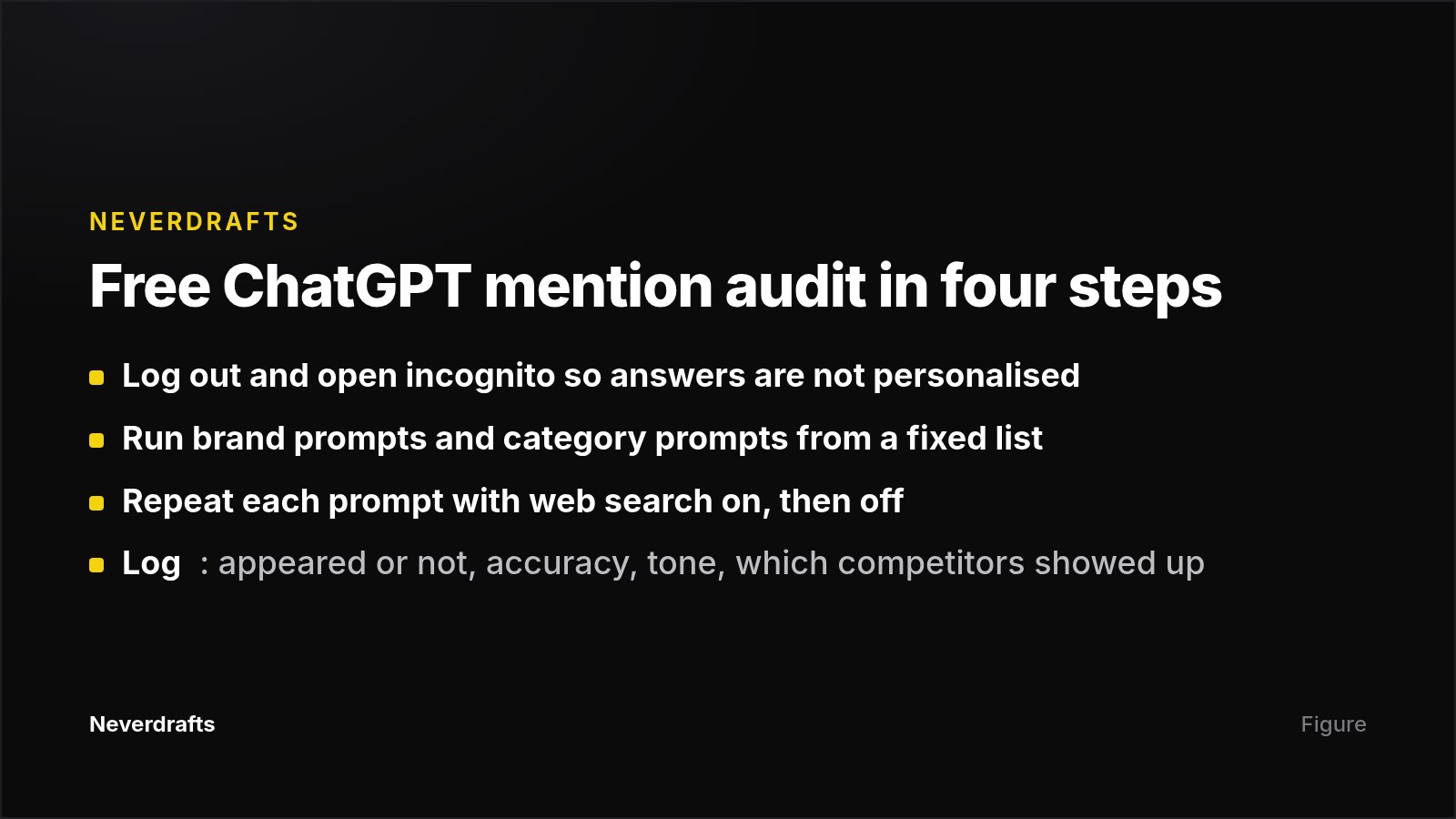
The manual approach costs nothing: log out of ChatGPT and prompt in incognito mode so responses aren't personalised by your chat history, memory or custom instructions. Run two prompt families — brand prompts ("What is [brand] and what is it used for?", "How does [brand] compare to [Competitor A]?") and category prompts ("What are the best tools for [category]?", "Give me a shortlist of options for solving X").
Ahrefs also recommends the DEJAN methodology from Dan Petrovic: Brand-to-Entity ("List ten things you associate with a brand called [X]") to see what concepts stick to you, and Entity-to-Brand ("List ten brands you associate with [keyword]") to see who owns the category in the model's head.
One diagnostic worth copying: run every prompt with web search on and off. With search off you're reading training data; with search on, live sources drive the output. Different results tell you whether you have a branding problem, a content problem, or both.
Amplitude: connecting AI mentions to what visitors do next
Amplitude approaches the problem from analytics rather than SEO. It monitors brands across ChatGPT, Claude, Perplexity and Google Gemini with accuracy verification, then links those mentions to downstream behaviour through Product Analytics and Web Analytics.
Strengths: you can see whether AI-referred traffic activates and converts, watch sessions with Session Replay, see which pages AI platforms cite most, and use heatmaps to compare AI-referred behaviour against other channels. A free tier is available.
Limitations: Amplitude itself acknowledges that the platform includes capabilities beyond basic AI monitoring, and that teams wanting only mention tracking may prefer simpler point solutions.
Other tools worth shortlisting
- Peec AI — quick ChatGPT visibility snapshots, prompt monitoring and competitor comparisons; €89/month.
- Semrush AI Visibility Toolkit — prompt research and mention tracking for teams already inside Semrush; $99/month.
- ZipTie — answer audits and competitive gaps framed as practical insights rather than raw metrics; $69/month.
- Siftly — separates ChatGPT Search from conversational answers and accounts for response variability; $63/month annually.
- LLM Pulse — response-level data with highlighted mentions, entities, alerts and workflow automation; $50/month annually.
- MentionedOn — monitoring built around local businesses and location-based recommendations; $83/month annually.
- GrowthOS, SE Visible, AthenaHQ, Writesonic GEO and Gumshoe.AI — all covered in Integrate.io's sixteen-tool comparison, worth checking if the shortlist above doesn't fit.
How should you choose between these tools?
Work through these criteria in order. Most buying regret in this category comes from paying for breadth you don't need or depth you can't act on.
1. Engine coverage against where your buyers actually ask. Integrate.io's checklist puts multi-engine tracking first: ChatGPT, Perplexity, Claude, Gemini, Google AI Overviews and Reddit. If your category lives in Reddit threads, that 40.1% citation share should decide the shortlist on its own.
2. Aggregate score or individual mention? If you need to explain a change to a stakeholder, you need the prompt and the full answer, not a percentage. Beamtrace's five evaluation questions are a good test to run on any vendor demo: can you inspect the actual mention, does it capture context, does it handle answers that change between runs, can it track more than the company name, and can a mention trigger action?
3. Sampling frequency. ChatGPT does not necessarily return the same brands each time a prompt is run, so a single generated response is not a measurement. Look for recurring checks and historical data — Mentionova offers two-hourly, daily or weekly schedules, and Neverdrafts runs tracked prompts daily.
4. Accuracy, not just presence. Ask whether the tool verifies that the description is correct. Amplitude's framing is that some tools simply tally mentions while others check whether the information is right — and a confident hallucination about your pricing tier is a problem a mention counter will never surface.
5. What happens after the alert. Integrate.io's conclusion is blunt: the best platforms combine monitoring with actionable recommendations rather than leaving teams with raw data and no clear next steps. Decide whether you want a dashboard plus your existing content process, or a tool that drafts and publishes the fix.
6. Integration with your stack. GSC and GA4 connections, CMS publishing and API access determine whether the data reaches the people who act on it. Integrate.io lists Google Search Console and Google Analytics 4 connections as a core selection criterion, and Frase, WorkDuo and Neverdrafts each expose publishing integrations or APIs of their own.
7. Budget realism. At the low end you can monitor for the price of a lunch; at the enterprise end you're in custom-quote territory. Start with the manual audit, prove there's a gap worth closing, then buy the smallest tool that closes it.
Next step
Run the free audit first: log out, open incognito, and ask ChatGPT the three questions your buyers actually ask about your category. If competitors come up and you don't, that's your prompt list. You can then feed those exact prompts into a $1 three-day Neverdrafts trial to see daily ChatGPT and Claude tracking, position-weighted scores, and the remediation articles generated for the prompts where you're losing.
Frequently asked questions
What is the difference between a brand mention and a citation in ChatGPT?
A brand mention is your name appearing inside the generated answer; a citation is a link to one of your pages used as a source. They require different fixes. Missing mentions usually mean you're absent from authoritative third-party content like roundups and comparisons. Missing citations look more like a traditional SEO problem: crawlable, current, clearly structured pages.
Can I monitor AI brand mentions for free?
Yes, manually. Open ChatGPT logged out and in incognito mode so responses aren't personalised by your chat history or memory, then run a fixed set of brand and category prompts and log the results in a spreadsheet. Repeat each prompt with web search on and off. It won't scale or run daily, but it will tell you whether you have a gap worth paying to close.
How much do AI visibility monitoring tools cost?
Entry points in current comparisons range from about $20/month annually for Beamtrace and $29/month for Otterly.AI up to $99/month for Mentionova, $99/month for Semrush's AI Visibility Toolkit and $99/month for Neverdrafts' Starter plan. Enterprise platforms such as Profound use custom pricing. Published figures conflict between reviews, so confirm plans with the vendor directly.
Why does Reddit matter for AI brand monitoring?
A Semrush analysis of roughly 150,000 AI citations found Reddit accounted for about 40.1% of them. If AI engines are pulling that heavily from Reddit threads when answering category questions, what gets said there shapes what gets said about you. Most monitoring tools don't track Reddit at all, which leaves a large blind spot in your citation picture.
How often should I check how AI chatbots describe my brand?
More often than you'd check search rankings, because AI answers vary between runs even for identical prompts. One response is a sample, not a measurement. Tools handle this with recurring checks — schedules range from two-hourly to weekly — plus historical data so you can distinguish a real trend from normal output variance.
What should I do if an AI chatbot says something inaccurate about my brand?
Confirm it's repeatable across several runs and both with and without web search, which tells you whether the error sits in training data or in retrieved sources. If it comes from retrieval, correct the underlying pages and publish clear, current, authoritative content on the point. If it comes from training data, the longer fix is expanding accurate third-party coverage.
Sources
- 7 Best Tools to Monitor ChatGPT Brand Mentions in 2026 — WorkDuo
- Best AI Visibility Tracking Tools (2026) — Integrate.io
- How to Monitor Brand Mentions in ChatGPT — Ahrefs
- The 12 Best AI Visibility Monitoring Tools in 2026 — Amplitude
- Best Tools for Monitoring ChatGPT Mentions — Beamtrace
- Neverdrafts pricing
- Neverdrafts vs PromptWatch
- Neverdrafts vs Searchable