
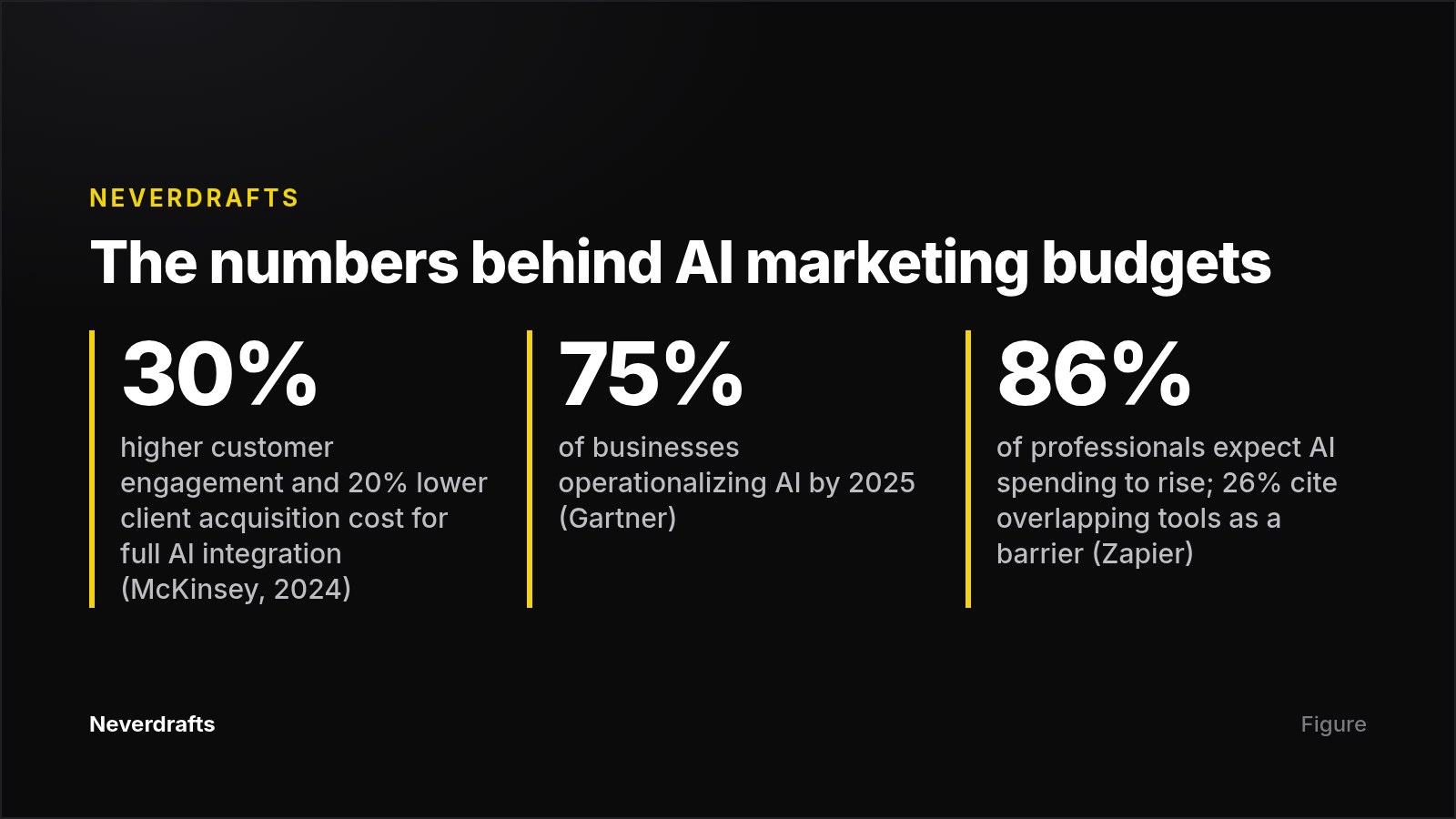
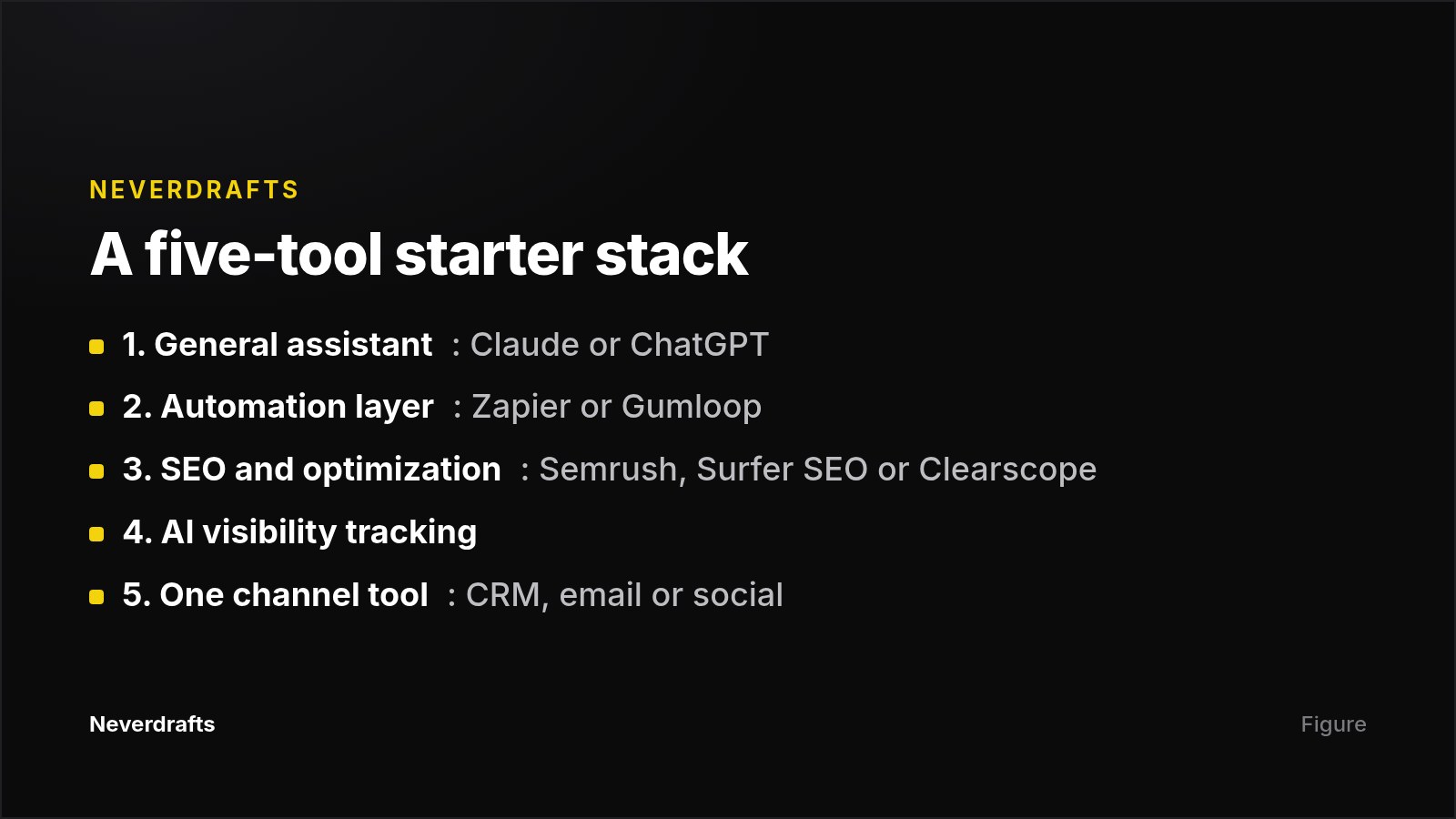
The best AI marketing tools in 2026 are the ones that replace work inside a workflow you already run, not the ones with the longest feature list. For most teams that means a general assistant (Claude or ChatGPT), an automation layer (Zapier or Gumloop), an SEO and content optimization tool (Semrush, Surfer SEO or Clearscope), and one channel tool for social, email or CRM. Zapier's 2026 round-up adds a fifth job most stacks still miss: tracking whether ChatGPT, Gemini and Perplexity recommend you when someone asks about your sector. Its research also found 86% of professionals expected AI spending to increase over the next year, while 26% already cited overlapping tools as a barrier to value — so the goal is consolidation, not accumulation.
Key takeaways
- Buy by workflow, not by category. Overlapping subscriptions are already the most cited barrier to getting value from AI spend, per Zapier's research.
- The business case is real: companies that fully integrate AI into marketing operations see a 30% increase in customer engagement and a 20% reduction in client acquisition costs (McKinsey, 2024).
- Adoption has crossed from pilot to production. Gartner projects 75% of businesses will have operationalized AI by 2025, with 5x growth in streaming data and analytics infrastructure.
- Published pricing is scarce across this market. Of the tools below, sources state figures only for ChatGPT ($8/month Go, $20/month Plus) and Neverdrafts.
- Understanding gaps are the real constraint: 98% of leaders agree companies need to better understand AI and machine learning for long-term success.
The best AI marketing tools at a glance
Disclosure: Neverdrafts is our product.
| Tool | Best for | Standout feature | Pricing (where sources state it) |
|---|---|---|---|
| Claude | Research, writing, analysis | Conversational generation, brainstorming and market research | Not stated in sources |
| ChatGPT | Image generation and general assistance | Business-ready visuals from simple prompts | Go $8/mo; Plus $20/mo |
| Gumloop | Agentic AI automation | Connects any LLM to internal tools without code | Not stated in sources |
| Zapier | Workflow orchestration | Automates across 9,000+ apps | Not stated in sources |
| Semrush | SEO and competitor analysis | AI Toolkit monitors brand mentions across AI | Not stated in sources |
| Neverdrafts | AI answer tracking plus remediation content | Position-weighted 0–100 scoring on real ChatGPT and Claude answers | $99 / $199 / $399 per month; $1 3-day trial |
| Clearscope | Content optimization | Improving content quality and SEO rankings | Not stated in sources |
| HubSpot CRM | Marketing–sales alignment | CRM with built-in AI tools | Not stated in sources |
| Canva | Graphic design | AI-generated design templates | Not stated in sources |
| GWI Agent Spark | Consumer insights | Answers built on real survey data, not scraped web data | Not stated in sources |
Claude: the default for research, writing and analysis
Claude is a conversational AI used for content generation, brainstorming and market research, and it is Zapier's pick for research and writing. Marketer Milk's Omid G, who previously ran content marketing at Webflow, lists it as his pick for any marketing task, including automating and presenting reports with Claude Artifacts.
Best for: content teams and solo marketers wanting one assistant for briefs, drafts, analysis and reporting. Limitations: output quality depends on the data you feed it, and no cited source publishes independent benchmarks against alternatives on identical tasks.
ChatGPT: the easiest route to on-demand visuals
Zapier names ChatGPT the best AI marketing tool for image generation, citing how easy it is to produce business-ready blog illustrations, ad concepts and social assets. The trade-off it flags: fine-grained control still feels limited compared with specialized tools. The free plan gives limited image generation; ChatGPT Go is $8/month and Plus is $20/month, with Plus offering higher caps and faster speeds.
Best for: teams that need volume and speed over pixel-level control. If you need editing precision, Zapier points to Adobe Photoshop, while noting its steep learning curve.
Gumloop and Zapier: the automation layer that ties the stack together
Zapier is an AI orchestration platform that automates workflows across your tech stack and connects to over 9,000 apps, which matters when you want an AI output to land in Drive, Slack or your CMS without tab-switching.
Gumloop takes a more agentic approach. Marketer Milk describes it as "like if Zapier and ChatGPT had a baby" — connect any LLM to your internal tools without writing code — and notes it is used by teams at Webflow, Instacart and Shopify.
Best for: Zapier when you want breadth of integrations; Gumloop when the workflow itself needs reasoning, such as sentiment analysis on social reviews. Limitations: neither source details how much technical skill integrations require, so budget setup time before you count the hours saved.
SEO, content optimization and creative production
Semrush is Zapier's pick for SEO and competitor analysis, with an AI Toolkit that monitors brand mentions across AI alongside full SEO coverage. Clearscope is listed separately for content optimization — improving content quality and SEO rankings. Surfer SEO plays the same role in Marketer Milk's stack, listed as its pick for content optimization.
On the creative side, Zapier's list covers Canva for AI-generated design templates, Runway for video generation, Descript for transcript-based video editing, ElevenLabs for text-to-audio and Gamma for slide generation. Creative tools multiply fast, so pick one per output type — this is exactly where the 26% overlapping-tools problem shows up.
Limitations: optimization tools grade content against competitors; they do not tell you whether an AI assistant will cite you.
Neverdrafts: tracking where AI recommends competitors, then fixing it
Neverdrafts sits in the AI visibility category and goes one step further than monitoring. It checks real ChatGPT and Claude answers daily, scores visibility position-weighted 0–100 per response (so a first recommendation counts differently from a passing mention), diagnoses which sources the models cite instead of you, then auto-generates remediation content aimed at the exact prompts you are losing and publishes it to WordPress, Webflow, Shopify, Framer or via API.
Best for: B2B SaaS teams and agencies who already rank in search but are missing from AI answers.
Pricing: Starter $99/month (1 brand, 50 prompts, 30 articles), Growth $199/month (3 brands, 150 prompts, 100 articles), Agency $399/month (10 brands, 500 prompts, 300 articles), plus a $1 three-day full-access trial with no contract.
Limitations: it tracks ChatGPT and Claude, not every assistant; volumes are capped by plan tier; and it is a GEO and content tool, not a replacement for a full SEO suite or CRM. Named alternatives include PromptWatch, Searchable and Profound.
Channel execution: HubSpot CRM, ActiveCampaign and FeedHive
Zapier names HubSpot CRM its AI CRM pick for aligning marketing and sales, ActiveCampaign for email automation covering drip campaigns and behavior-based journeys, and FeedHive for social media management with AI-powered content recycling and conditional posting. Sprout Social frames social as the channel that benefits most from automation, because it both relieves manual workload and surfaces the content your audience wants.
Limitations: these are platform commitments with data migration costs, not tools you swap monthly.
GWI Agent Spark: insights grounded in survey data
Agent Spark is an AI insights analyst built on real survey responses from nearly a million consumers across 50+ markets, rather than scraped public data. It answers plain-English questions, generates custom charts and works inside the GWI platform or through ChatGPT, Claude and Copilot.
Best for: validating product ideas, sizing segments or adding original data to content. Limitations: value depends on GWI's panel covering your markets, and pricing is not published in the source.
How to choose between AI marketing tools
- Workflow fit first. Zapier's explicit advice: prioritize tools that fit an existing workflow and replace work rather than add another disconnected subscription.
- Overlap audit. List what each candidate replaces. If nothing gets cancelled, you are adding cost, not capacity.
- Integration, learning curve and support. Check all three as Outgrow recommends before any significant investment.
- Measurable output. Decide in advance what "working" means. Accenture (2024) puts time-to-market for new marketing assets at 75% faster with AI tools; check whether you actually see that.
- Pilot small, then scale.
Next step
If your gap is AI visibility — buyers asking ChatGPT or Claude for a recommendation in your category and hearing a competitor's name — measure it rather than guess. Neverdrafts runs a $1 three-day full-access trial, enough to track a set of buyer prompts and see the position-weighted scores and cited sources behind each answer. Our comparison pages show where monitor-only tools stop and content generation begins: see how it compares to PromptWatch, Searchable and Profound.
Frequently asked questions
How many AI marketing tools should a small team use?
Fewer than you think. Zapier's research found 26% of professionals cite overlapping tools as a barrier to value, even as 86% expect AI spending to rise. Start with one general assistant, one automation layer, one SEO or optimization tool, and one channel tool. Add a fifth only when a recurring task justifies it.
What is the ROI of AI marketing tools?
McKinsey (2024) reports companies fully integrating AI into marketing operations see a 30% increase in customer engagement and a 20% reduction in client acquisition costs, and Accenture puts asset time-to-market at 75% faster. None of the published round-ups explain how to attribute those gains to specific tools, so set your own baseline before you buy.
What is AI visibility tracking and do I need it?
It means checking whether assistants like ChatGPT, Gemini and Perplexity recommend you when someone asks about your category. It matters if buyers research via AI assistants before reaching your site. Semrush's AI Toolkit covers brand mentions across AI as part of a wider suite; dedicated tools go deeper on per-prompt scoring and source diagnosis.
Are free AI marketing tools good enough to start?
Often, yes, for evaluation. ChatGPT's free plan includes limited image generation, with paid tiers at $8/month for Go and $20/month for Plus. For shortlisting, G2 is free for buyers to browse verified reviews and build comparisons, and Capterra plays a similar directory role with clearer pricing information — though sponsored placements can influence what surfaces first.
How do I keep AI-generated content on brand?
Give the model real inputs — first-party analytics, competitor data, customer language — rather than generic prompts, which is how Marketer Milk frames AI marketing in 2026. Layer editing on top: Grammarly supports brand style guide configuration, and Originality AI is listed for AI content detection. Human review before publishing remains the control that matters most.
Sources
- 7 Best AI Marketing Tools in 2025 — Outgrow
- 29 Best AI Marketing Tools for Smarter Workflows — Sprout Social
- 30 best AI marketing tools I'm using to get ahead in 2026 — Marketer Milk
- The 17 Best AI Marketing Tools in 2026 — Zapier
- 25 AI marketing tools you need to get ahead in 2026 — GWI
- 12 Best AI Tools for Marketers to Use in 2025 — PromptDen
- Neverdrafts vs. PromptWatch
- Neverdrafts vs. Searchable
- Neverdrafts vs. Profound