

Most teams weighing a full-service GEO retainer have nine concrete alternatives, falling into four buckets: run the work in-house against a published framework (GEO is 80% traditional SEO plus 20% AI-specific work), buy software that closes the monitor-fix-prove loop yourself, reuse or right-size an agency relationship you already have, or purchase one fixed-scope slice instead of a 6–12 month contract. Full-service GEO retainers run $5,000–$15,000+ per month with six- or twelve-month commitments, and almost no agency publishes pricing, so the comparison is rarely apples to apples. The honest test: if you already have someone who can write, edit and ship a page, most of the retainer is buying process you can build.
Key takeaways
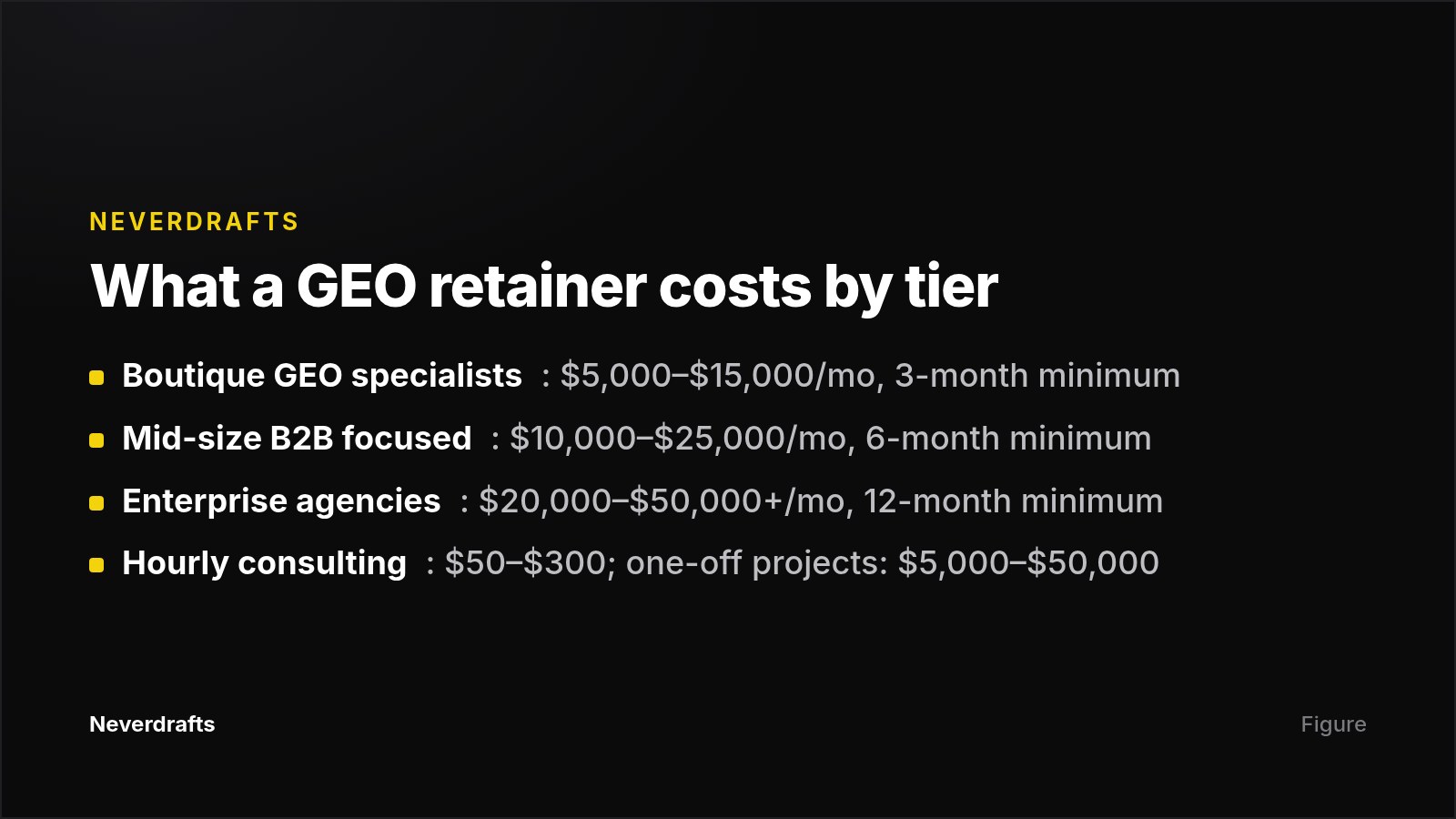
- A credible mid-market GEO retainer costs $2,000–$10,000/month, with enterprise programs at $10,000–$25,000+; boutique specialists sit at $5,000–$15,000/month on 3-month minimums.
- Every GEO engagement reduces to five jobs: prompt research, source mapping, on-site structure, off-site mentions, and measurement. An agency doing only on-site work is selling on-page SEO with a new name.
- Off-site is where most of the leverage is: branded web mentions correlate with AI visibility at 0.664 versus 0.218 for backlinks, and 84% of AI citations come from earned media.
- Paying a second retainer for "GEO" on pages your SEO agency already manages is usually double-billing, not extra work.
- Cheaper entry points exist inside the agency market too: Foundgrove from $2,500/month month-to-month, WebFX and The Digital Elevator from $3,000/month, and hourly consulting at $50–$300.
- The upside is real enough to justify doing something: LLM visitors are worth 4.4 times as much as traditional organic visitors per Semrush, and one agency case study found AI referral traffic converting at 15.9% versus 1.76% for organic.
What agencies like The Prompting Company actually sell
The Prompting Company sits in the category of full-service generative engine optimization agencies — vendors that take on the whole job of getting a brand mentioned, cited and recommended inside ChatGPT, Perplexity, Gemini and Google's AI Overviews, typically on a monthly retainer. Foundgrove describes that job as four buckets: entity optimization so models know who you are, structured content and JSON-LD schema machines can quote, third-party mentions and digital PR on the sources assistants actually cite, and ongoing measurement of citation share across engines.
Two things are worth knowing before you compare quotes. First, the research reviewed here contains no published pricing for The Prompting Company specifically — which is normal rather than suspicious, because very few firms publish their numbers and almost no agency publishes pricing at all. The public benchmarks you can budget against come from the handful of firms that do disclose, listed below. Second, the underlying work is the same set of tasks regardless of which specialist shop you're talking to, which is exactly why substitutes exist. Every alternative in this guide is a different way of getting those same tasks done — by your own team, by software, by a vendor you already pay, or by buying one slice at a time.
The nine alternatives at a glance
| Alternative | Best for | Standout feature | Cost (where a source publishes one) |
|---|---|---|---|
| 1. In-house with a published framework | Teams with at least one SEO or content person | You already own 80% of the skill set | Tooling and staff time only |
| 2. Neverdrafts (our product) | Small teams and agencies wanting monitor → fix → prove in one subscription | Tracks live ChatGPT and Claude answers daily, auto-drafts and publishes remediation articles | $99–$399/month; $1 for a 3-day trial |
| 3. Monitoring-only AI visibility tools | Teams with writing capacity but no citation data | Prompt-level tracking across multiple engines | No published pricing in the sources reviewed — request quotes; this is a documented gap in the category's public data |
| 4. Your existing SEO or content agency | Anyone already on an SEO retainer | Avoids paying twice for overlapping work | No second retainer |
| 5. One-off audit or 30-day diagnostic | Testing a vendor before a long contract | Fixed scope, no 6–12 month lock-in | Project fees of a few thousand dollars; Digital Elevator's AI Visibility program from $3,000/month |
| 6. Fractional consultant or solo specialist | Strategy without adding headcount | Senior direction, you execute | Hourly consulting $50–$300 |
| 7. Digital PR / off-site mentions specialist | Brands whose gap is third-party mentions | Targets the sources engines already cite | Siege Media reported at ~$12–15k/month for PR (third-party figure) |
| 8. Lower-cost full-service agency with GEO built in | Owner-operators and mid-market teams wanting one vendor | Month-to-month terms exist in this tier | Foundgrove from $2,500/month; WebFX from $3,000/month |
| 9. Hybrid split (agency + in-house) | Mid-market teams with writers but no PR reach | Pay outside help only for the part you can't do | Varies by split |
Why a GEO retainer is optional for most companies
The category is barely two years old. Two years ago no agency sold GEO; by August 2026 most SEO agencies list it, a dozen have built a practice around it, and only a few have published real work. That timeline matters when you're being asked to sign a twelve-month contract for a discipline whose rules are still being written.
The work itself is not mysterious. GEO is 80% traditional SEO — topical authority, quality content, technical optimization — plus 20% new considerations like citation formatting, AI visibility monitoring and brand mention building. The mechanical core comes from the original Princeton and Georgia Tech research paper, which found that adding citations, statistics and quotable sourcing improved a page's visibility in generative responses by up to 40%. That is a content instruction, not a proprietary algorithm.
Agencies selling "proprietary GEO frameworks" are typically selling process documentation with trademarks, and agencies claiming to have cracked LLM algorithms are selling confidence. What is genuinely new and useful is AI visibility monitoring — and that is a software purchase, not a retainer.
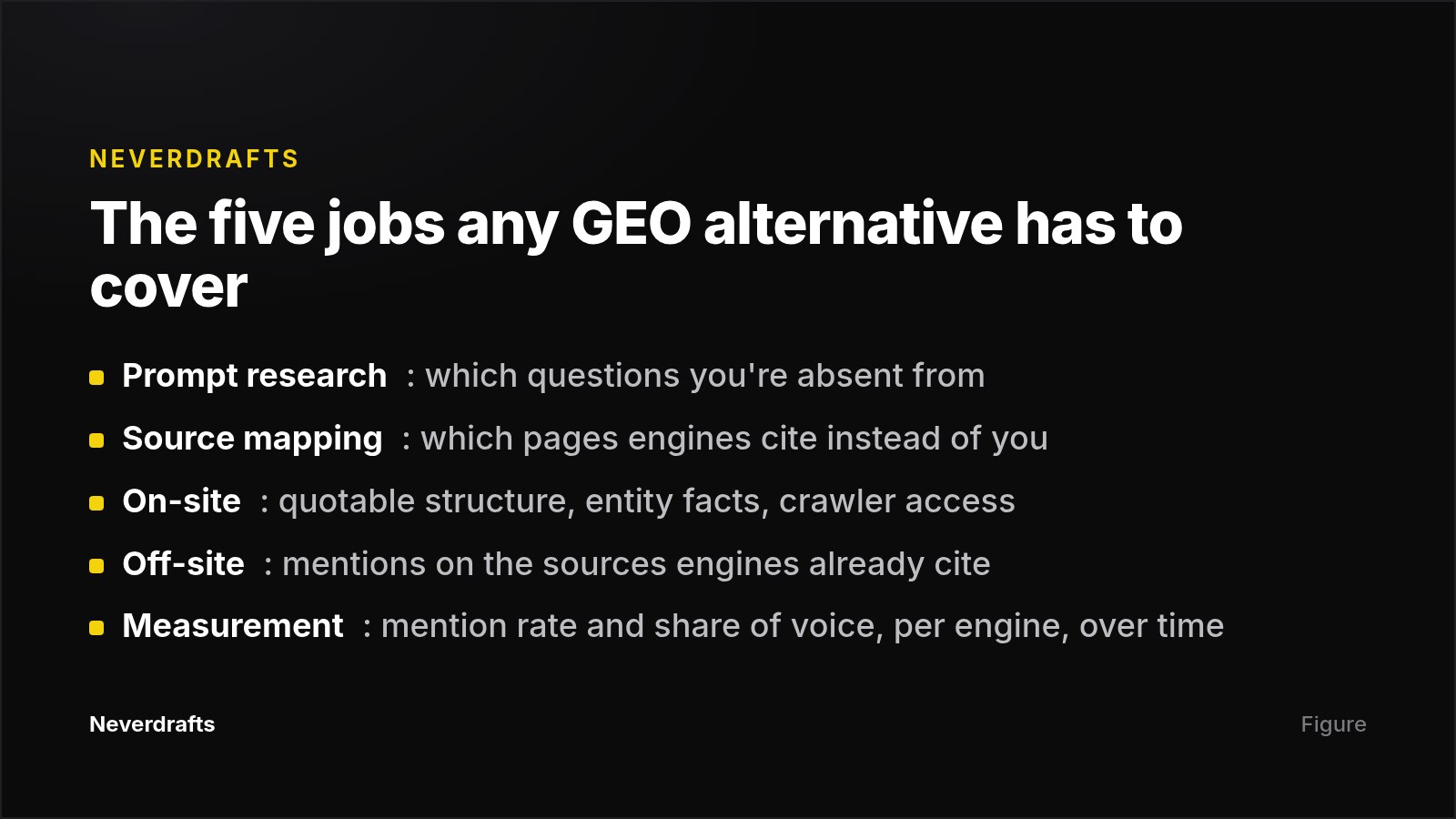
Before you shortlist any alternative, know what you're replacing. Every GEO engagement is some mix of five jobs: prompt research (which questions buyers ask AI assistants and where you're absent), source mapping (which pages engines cite for those prompts), on-site work (definitions up top, question-shaped headings, tables, FAQs, crawler access), off-site work (getting mentioned on the cited sources), and measurement (mention rate, citation rate and share of voice per prompt set, per engine, over time).
Price each alternative against those five jobs rather than against a monthly number. A $12,000 retainer that covers all five may beat a $3,000 one that covers two; a $99 tool that covers three may beat both if you can staff the other two.
Alternative 1: Run GEO in-house against a published framework
What it is. You assign the five jobs to existing marketing staff and work from public frameworks instead of buying one. The skeptical case for this is made by agency-review publishers themselves: Miniloop's guide advises asking whether you could build this in-house before signing a retainer, and Sightivo's list ends with the section most agency round-ups omit — when you don't need one, noting that at a startup budget the answer is usually a tool and a loop, not a retainer.
Who it's for. Companies with at least one competent SEO or content person, a CMS they control, and a founder or subject expert who can supply original data and opinions.
Strengths. No minimum commitment, no onboarding lag, and the institutional knowledge stays with you. Because the on-site half is standard content best practice — clear structure, extractable answers, entity consistency — the learning curve is short for anyone who has done SEO. The structural checklist is public too: definitions up top, question-shaped headings, tables, FAQs, consistent entity facts, and crawler access for OAI-SearchBot and friends.
Limitations. The off-site half is harder to fake. Getting mentioned on the listicles, comparison posts, review sites and publications that engines already cite is digital PR with a different target list, and most small teams have no relationships there. Measurement also breaks down quickly by hand: the same prompt returns different answers on different days, so spot-checking ChatGPT once a month tells you almost nothing.
Cost. Staff time plus tooling. No published benchmark exists for in-house GEO program cost in the sources reviewed, which is itself a gap in the category's public data — agencies publish case studies, not execution playbooks with hours attached.
Alternative 2: Close the monitor → fix → prove loop on software
Disclosure: Neverdrafts is our product.
What it is. Neverdrafts monitors which AI answers recommend your competitors instead of you, auto-generates content to win those prompts back, publishes it to your CMS in one click, and tracks AI crawler visits as proof it worked. It tracks real ChatGPT and Claude answers on their live web interfaces daily — not API extrapolations — against up to 500 custom prompts depending on plan, scores each response 0–100 with position weighting (unmentioned = 0), and diagnoses which source domains the models cite instead of you.
Who it's for. Small businesses, in-house marketers and agencies who want prompt tracking, source diagnosis, on-site remediation and measurement handled in one subscription, and who are willing to handle off-site mentions separately. The white-label client reporting makes it workable for agencies that want to add a GEO line without hiring a specialist.
Strengths. Mapped against Sightivo's five jobs, it handles prompt tracking, source diagnosis, on-site remediation and measurement in one place rather than stitching a monitoring dashboard to a separate content workflow; off-site outreach is not included. One-click publishing supports WordPress, Webflow, Shopify, Framer and custom APIs across 150+ languages. Before/after citation re-measurement and the AI bot-traffic tracker give you evidence a page was actually crawled by AI systems, which is the part most monitoring tools leave to inference. Sentiment tracking splits mentions into positive, neutral and negative counts, so a rising mention rate that hides a reputation problem is visible rather than averaged away. We use it to track our own GEO prompts.
Limitations. It tracks ChatGPT and Claude, so if Perplexity, Gemini or Google AI Overviews are your priority surfaces you will need additional coverage — and engine coverage is a fair question to ask any vendor, since nine engines on the pitch and one on the invoice is a known red flag. It does not do digital PR or outreach, which is the highest-leverage off-site job. And auto-drafted articles still need a human who knows the subject to add the original data and specifics that make a page worth citing.
Pricing. Starter $99/month (1 brand, 50 prompts, 30 articles/month), Growth $199/month (3 brands, 150 prompts, 100 articles/month), Agency $399/month (10 brands, 500 prompts, 300 articles/month). A $1 three-day full-access trial is available, with no contracts. If you are comparing this route against a specific specialist shop, our alternatives to The Prompting Company page lays the options out side by side.
Alternative 3: Buy monitoring only and keep execution in-house
What it is. You subscribe to an AI visibility tracker — options include Peec AI, which Omniscient Digital partners with, alongside Profound, Otterly, Scrunch AI and Athena, plus AI-visibility features inside Ahrefs and Semrush — and use the data to direct your own content and PR work. Agencies frequently run on the same third-party stack they'd sell you access to.
Who it's for. Teams that already publish consistently and only lack the diagnostic layer: which prompts they're absent from, which domains get cited instead, and whether anything is moving.
Strengths. Monitoring is the part of GEO that is genuinely new and useful, and it's the cheapest thing to buy. It also gives you the baseline you'd otherwise pay an agency to establish in week one — a baseline you should demand from any vendor, since "we watch rankings" is a failing answer when the question is citation share. Third-party tracking has a secondary use as well: it lets you audit an incumbent agency's reporting against an independent measurement.
Limitations. A dashboard doesn't write anything. You still need a content pipeline and an outreach motion, and the gap between "we can see we're losing" and "we fixed it" is where most DIY programs stall. None of the sources reviewed publish these tools' prices, so budget by requesting quotes rather than assuming they're all cheap.
Alternative 4: Fold GEO into the SEO or content agency you already pay
What it is. Instead of adding a second vendor, you extend your current retainer's scope to cover entity work, quotable page structure, citation-earning content and AI visibility reporting. This is how several agencies already operate: SeoProfy embeds GEO into full SEO programs rather than selling it separately, and Foundgrove includes GEO and AEO inside its base SEO retainer.
Who it's for. Anyone already spending on SEO or content who is being pitched a separate GEO line item by a specialist shop.
Strengths. It eliminates the most common overcharge in the category. The two disciplines share most of their foundations — crawlable architecture, schema, authoritative content — so a separate GEO line item on identical pages is usually double-billing. Your existing agency also already knows your product, your customers and your CMS, which removes months of onboarding.
Limitations. Many agencies added GEO as a service line without adding capability. The tell is simple: compare their GEO deliverables list to their SEO deliverables list, and if the only difference is the letters "AI," it's the same retainer with a new label. Ask which engines they track, how many prompts, and how often they re-run them — weekly across at least ChatGPT and Google's AI surfaces is the floor.
Alternative 5: Buy a one-off audit or 30-day diagnostic instead of a retainer
What it is. A fixed-scope engagement — a prompt-research sprint, a visibility audit, or a set of pillar pages — rather than an ongoing contract. Project fees for this kind of work run a few thousand dollars and are the cheapest way to test an agency before committing. Productized versions exist: Digital Elevator sells a 30-day AI Visibility Report that maps how a brand appears across ChatGPT, Perplexity, Gemini and Google AI Overviews and prescribes the citation and authority work to close the gaps, with its AI Visibility program published from $3,000/month. Larger one-off projects in the category run $5,000–$50,000.
Who it's for. Teams that can execute but don't know where to start, and buyers who want to sample an agency's thinking before a long commitment.
Strengths. You get the strategy deliverable — prompt set, engine list, baseline mention rates, target-source list — without a twelve-month obligation. Sightivo advises asking for exactly that package as the first month's deliverables under any pricing model, which means a fixed-scope purchase buys the same artifact a retainer's month one would. Digital Elevator's own reasoning for the 30-day format is that running 12-month contracts in a market this immature doesn't make sense, since the rules are still being written.
Limitations. A diagnostic that nobody acts on is a PDF. Budget for execution before you buy the audit, and confirm the deliverable includes the target-source list and baseline numbers rather than a generic scorecard.
Alternative 6: Hire a fractional consultant or solo specialist
What it is. A senior independent practitioner sets strategy, reviews work and troubleshoots, while your team executes. Hourly GEO consulting runs $50–$300. Solo operators with real frameworks exist in this market — iBeam Consulting, for example, is a solo consultant serving SMB and B2B clients with an AI Search Visibility Matrix framework.
Who it's for. Companies with execution capacity and no senior search strategist, and small businesses priced out of the $1,500–$5,000 small-business agency tier.
Strengths. You pay for judgment, not for account management. Ten hours a month at consulting rates costs a fraction of a boutique retainer, and you can scale hours up during a build phase and down during maintenance.
Limitations. Single points of failure: one person gets sick, takes another client, or leaves the market. Solo consultants also rarely bring the media relationships needed for off-site mention building, so you may still need a PR partner. Ask for a before/after on mention rate for a named client with the prompt set — traffic charts don't count.
Alternative 7: Hire an off-site mentions or digital PR specialist only
What it is. You skip the full-stack GEO retainer and buy the single job with the strongest evidence behind it: getting mentioned on the sources AI engines already cite. Some firms sell exactly this slice — Above Apex works off-page only, on links and brand mentions for AI visibility — while content-led shops like Siege Media are known for data journalism and digital PR that LLMs cite.
Who it's for. Brands whose own pages are already clean and well-structured, and whose real gap is third-party coverage. Foundgrove makes the same fit call for Go Fish Digital: brands whose gap is third-party mentions.
Strengths. This is where the correlation data points. Ahrefs' study of 75,000 brands found branded web mentions correlate with AI visibility at 0.664 against 0.218 for backlinks, and Muck Rack's analysis of 25 million links found 84% of AI citations come from earned media. Buying only this job concentrates spend on the highest-signal activity. Foundgrove's closing test makes the same point from the other direction: a program that lives entirely on your own website is optimizing the one domain AI trusts least.
Limitations. It's the most expensive slice. Third-party review sites report Siege Media around $8k/month for content and $12–15k/month for PR — figures that come from comparison sites rather than the agency's own pricing page, so confirm before budgeting. Also watch for reciprocal or network link schemes described as "citation building," which does nothing for models that learn from real mentions.
Alternative 8: Choose a lower-cost full-service agency with GEO already included
What it is. If you want a vendor but not a specialist shop's pricing, the published end of the market is cheaper than the quote-only end. Foundgrove lists from $2,500/month, month-to-month, cancel anytime, aimed at owner-operator service businesses. WebFX lists from $3,000/month with GEO bundled into a full-service stack with LLM monitoring. Digital Elevator positions itself for SMBs and lean in-house teams that don't want to choose between a six-figure retainer and a content mill.
Who it's for. Businesses that need one accountable vendor across technical, content and authority work, and that value published pricing over a bespoke quote.
Strengths. Transparency and terms. Month-to-month cancellation removes the main risk of a young discipline, and published rates let you compare before a sales call — which matters because very few firms publish their numbers. At the enterprise end, the published outlier is First Page Sage at $8,000–$20,000+/month on annual contracts with 6–12 month minimums; Omniscient Digital's Clutch profile lists a $5,000+ minimum project size.
Limitations. Full-service breadth can mean shallow GEO depth. Verify with hard questions: which surfaces they optimize for and how retrieval differs across them, since AI Overviews pulls from Google's live index, Perplexity cites in real time, and ChatGPT blends training data with browsing. Also note that list rankings are self-interested — Foundgrove openly ranks itself first on its own list, as First Page Sage and Thrive do on theirs.
Alternative 9: Split the work between in-house execution and outside help
What it is. A hybrid: you keep the jobs you can do and buy only the ones you can't. The common split is in-house for on-site structure and content production, outside for off-site mentions and measurement — or the reverse if you have a PR function but no writers.
Who it's for. Mid-market teams with writers on staff who are being quoted $10,000–$25,000/month for a six-month mid-size retainer that includes content production they already pay for internally.
Strengths. You stop paying agency rates for commodity work. Because GEO is mostly systematizable, the durable parts — prompt sets, source lists, page templates — stay in your team's hands even if the outside partner changes.
Limitations. Split accountability. When mention rate doesn't move, the agency blames your content and you blame their outreach. Fix this at contract time by defining, in writing, which of the five jobs each side owns and what monthly report each side produces — including the sources earned, not just the score.
How to choose between these alternatives
Work through five criteria in order. They're drawn from the evaluation frameworks the agency round-ups themselves publish.
1. Which of the five jobs is your actual gap? If you can't name it, buy a diagnostic first. If your pages are already structured well and you're still absent from AI answers, your gap is off-site, and a content-only solution won't fix it.
2. Do you have execution capacity? Software and consultants both assume somebody on your side ships the work. If nobody will, a retainer is the honest answer despite the cost.
3. What is the spend relative to the outcome? LLM visitors are worth 4.4 times a traditional organic visitor, and Seer Interactive's case study found AI referral traffic converting at 15.9% against 1.76% for organic — but those are quality multipliers on small volumes. A $15,000/month retainer needs a large pipeline to justify; a sub-$500/month tool does not.
4. Can the vendor pass the six-question test? Ask which surfaces they optimize and how retrieval differs; what tool tracks citation share and what baseline they set in week one; how GEO deliverables differ from SEO deliverables; whether they guarantee citations; why GEO is a separate line item on the same pages; and their plan to earn mentions on domains they don't own. A rebadged SEO retainer usually fails three or more.
5. Check the vendor's own AI visibility. SeoProfy analyzed 50 agencies through Ahrefs across AI Overviews, ChatGPT, AI Mode, Gemini, Perplexity, Copilot and Grok, and the scores ranged widely — WebFX at 9.0/10 and SeoProfy at 7.0/10 at the top, several well-known names at 1.0–3.0/10. An agency selling AI visibility that has none is worth a question.
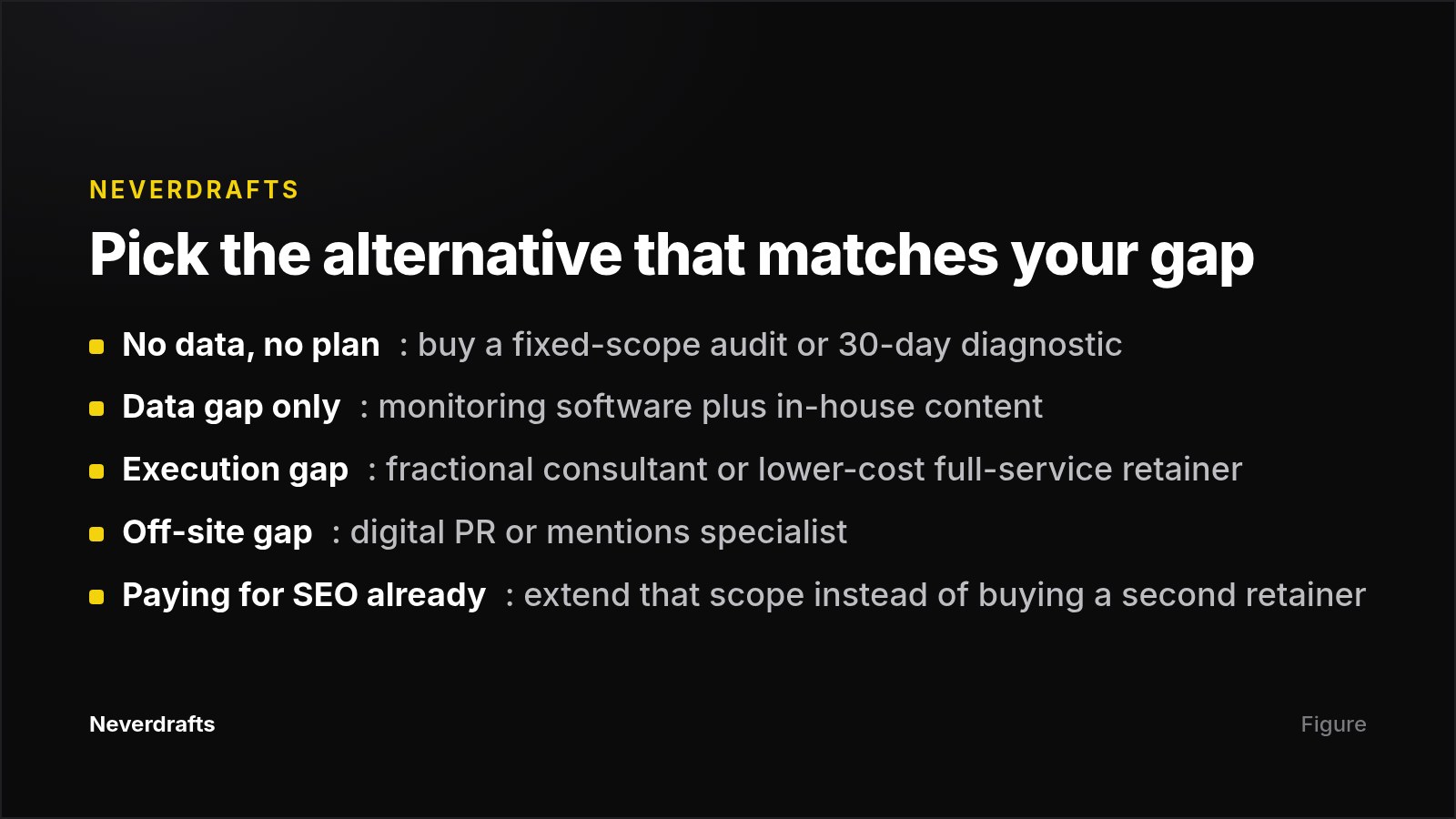
Two red flags override everything else. Any promise of "guaranteed mentions" or a "#1 spot in ChatGPT" is false — nobody controls what a model says, and model outputs are probabilistic. And any vendor with no published research or case studies in a two-year-old discipline has nothing to show because there is nothing to show.
Next step
If you want to test the software route before committing to a retainer, start by measuring where you actually stand: which prompts in your category name a competitor instead of you, and which domains the models cite when they do. Neverdrafts runs that check daily against real ChatGPT and Claude answers and drafts the pages aimed at the prompts you're losing, from $99/month on the Starter plan, with a $1 three-day full-access trial and no contract. If you're evaluating it against a monitoring-only platform, the Neverdrafts vs Profound comparison covers the difference between tracking visibility and closing the loop.
Frequently asked questions
What are the alternatives to hiring a GEO agency like The Prompting Company?
Nine, in four buckets: run GEO in-house against a published framework; buy software that monitors, fixes and proves (Neverdrafts) or monitoring-only trackers; reuse or right-size an agency relationship (extend your existing SEO retainer, pick a lower-cost full-service firm, or split work hybrid-style); or buy one slice — a fixed-scope audit, a fractional consultant, or a digital PR specialist. The reason substitutes work is that every retainer is the same five jobs in different packaging.
Is a GEO agency worth it for a small business?
Often not at specialist pricing. The small-business agency tier runs $1,500–$5,000/month, while boutique GEO specialists start around $5,000/month on three-month minimums. With GEO being 80% traditional SEO, a small business with one marketing hire usually gets further with monitoring software, a consultant for direction, and disciplined publishing.
How much does a GEO agency cost per month in 2026?
Expect $2,000–$10,000/month for credible mid-market work and $10,000–$25,000+ for enterprise programs. Published examples include Foundgrove from $2,500/month, WebFX and The Digital Elevator from $3,000/month, and First Page Sage at $8,000–$20,000+/month. Hourly consulting runs $50–$300 and one-off projects $5,000–$50,000. Most firms quote rather than publish.
Can I do generative engine optimization myself?
Yes, for most of it. The on-site half — definitions up top, question-shaped headings, tables, FAQs, consistent entity facts and crawler access — is standard structure work, and adding citations, statistics and quotable sourcing improved generative visibility by up to 40% in the original research. The harder DIY piece is earning mentions on third-party sources engines already cite.
Should I pay separately for GEO if I already have an SEO agency?
Usually no. The two disciplines share crawlable architecture, schema and authoritative content, so a separate GEO line item on the same pages is typically double-billing. Ask your current agency to add prompt tracking, entity work and citation reporting to the existing scope, then compare their GEO and SEO deliverable lists to confirm the work genuinely differs.
What should I measure instead of rankings?
Mention rate, citation rate and share of voice per prompt set, per engine, over time — plus AI referral traffic and the specific sources you earned. Rankings are not citations. Because the same prompt returns different answers on different days, track prompts repeatedly rather than spot-checking, and re-run at least weekly.
Are monitoring tools enough on their own?
Only if you can act on what they show. Monitoring is the genuinely new and useful part of GEO, but a dashboard doesn't write pages or earn mentions. Pair a tracker with a publishing workflow and some form of off-site outreach; otherwise you'll have precise data on a visibility problem nobody is fixing.
Sources
- The 12 Best Generative Engine Optimization (GEO) Agencies of 2026 — Digital Elevator
- The 13 Best GEO & AEO Agencies in 2026 (And When to Skip One) — Sightivo
- Best GEO Agencies in 2026: Generative Engine Optimization Ranked — Miniloop
- Top Generative Engine Optimization Agencies 2026 — Foundgrove
- Top 13 Generative Engine Optimization (GEO) Agencies for 2026 — SeoProfy
- Neverdrafts
- Neverdrafts vs Profound
- Alternatives to The Prompting Company — Neverdrafts