
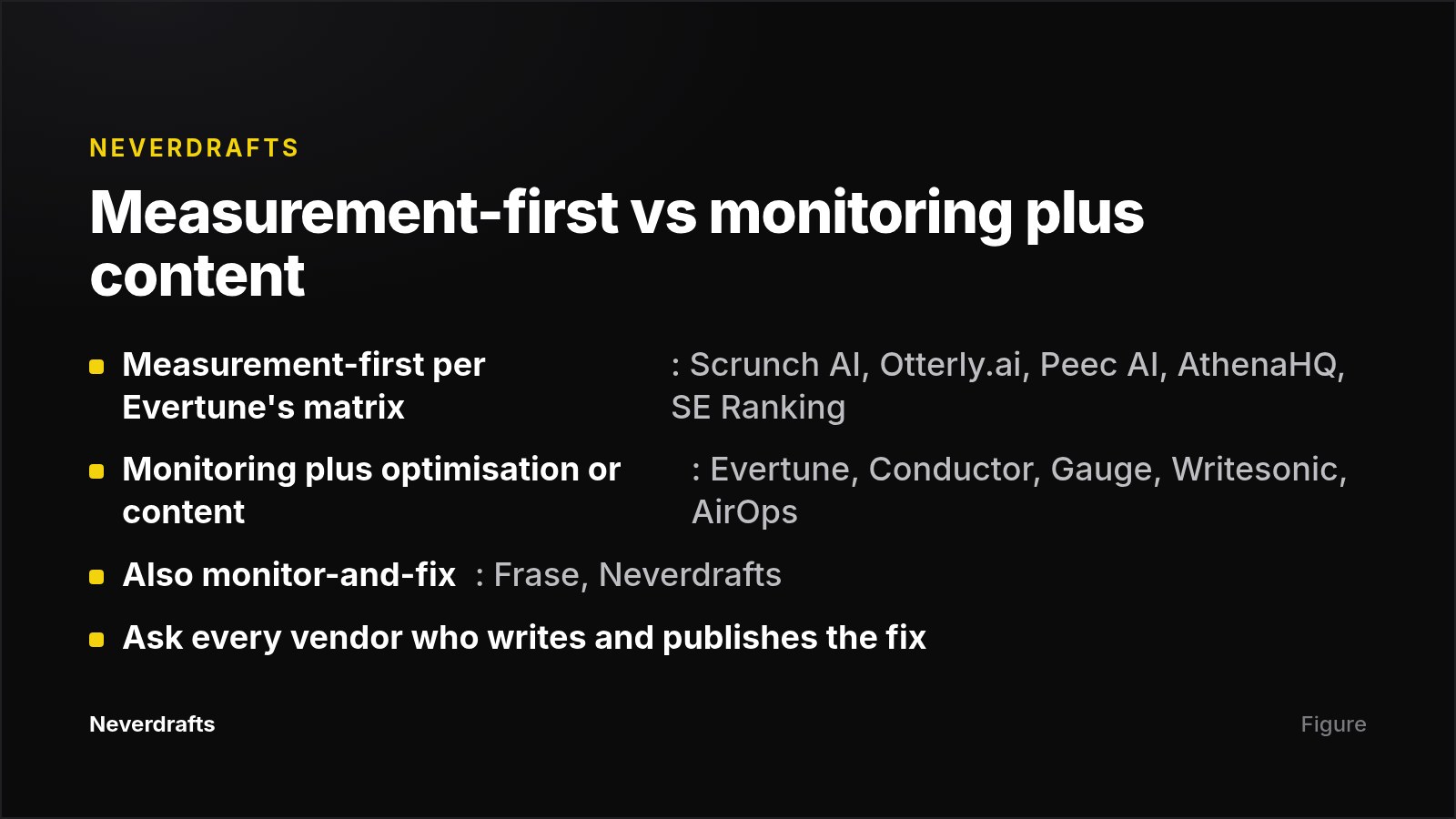
The strongest AI visibility monitoring tools in 2026 split by budget and job: Profound for enterprises that need the widest engine coverage, Peec AI for mid-market teams that want competitor gap analysis at a mid-tier price, Otterly.ai as the cheapest credible entry point, and the Semrush AI Visibility Toolkit for teams already running SEO inside Semrush. The real dividing line in the category is whether a tool stops at a dashboard or connects tracking to the content work that fixes the gap — Frase and Neverdrafts pair monitoring with content production, and Evertune's own feature matrix lists Gauge, Writesonic, Conductor and AirOps as combining monitoring with optimisation while Scrunch AI, Otterly.ai, Peec AI and AthenaHQ are measurement-first.
Key takeaways
- Engine coverage is the first filter. Profound tracks more than ten generative engines; Semrush's toolkit currently covers ChatGPT, AI Overviews, AI Mode and Gemini but not Perplexity.
- Prices span roughly 17x. Otterly.ai starts at $29/month while Profound's public Lite plan runs about $499/month.
- The market exists because clicks are disappearing. About 68% of Google searches ended without a click in early 2026, and ChatGPT reached roughly 900 million weekly active users in February 2026.
- Monitor-only tools leave the hardest part to you. Frase argues the deciding question is whether a tool stops at the alert or helps you fix the gap.
- Accuracy matters as much as frequency. Amplitude is one of the few sources that raises hallucinated or misattributed mentions as a monitoring requirement.
- Most of these products are 1–2 years old. Profound, Otterly.ai, Gauge and Evertune were founded in 2024, Peec AI and AthenaHQ in 2025, so long-run performance data does not exist yet.
Which AI visibility monitoring tools lead in 2026?
| Tool | Best for | Standout feature | Entry pricing (per sources) |
|---|---|---|---|
| Profound | Enterprises needing the broadest engine coverage | Agent Analytics; 10+ engines | ~$499/mo Lite |
| Peec AI | Mid-market teams and agencies | Competitor gap analysis | ~$89/mo |
| Otterly.ai | Small teams measuring GEO for the first time | GEO Audit Tool | $29/mo |
| Neverdrafts | Mid-market B2B SaaS and agencies wanting monitor + fix | Auto-generated remediation articles plus AI bot-traffic proof | $99/mo Starter |
| Semrush AI Visibility Toolkit | Existing Semrush users | AI Strategic Opportunities | $99/mo add-on per domain |
| Frase | Content teams that want tracking tied to drafting | Monitoring feeding research, writing and publishing | Starter to Enterprise, scoped per org |
| Scrunch AI | Teams thinking about AI agent experience | Agent Experience Platform | ~$250/mo |
| AthenaHQ | Growth-stage SaaS wanting GEO analytics | Ask Athena and ACE citation engine | ~$295/mo Starter |
| Gauge | Small teams pairing tracking with content output | Monitoring coupled to a content engine | ~$99/mo Starter (ChatGPT only) |
| Evertune | Brands focused on perception and statistical rigour | AI Brand Index; claimed 25M-person consumer panel | Not public (contact) |
| Amplitude | Teams linking AI mentions to conversion | Session Replay and product analytics integration | Free tier available |
| ZipTie | Technical GEO and crawlability audits | Citation tracking plus AI crawlability checks | ~$69/mo Basic |
Disclosure: Neverdrafts is our product. Prices above come from the sources cited in each section and are described by those sources as subject to change — re-verify on the vendor's page before buying.
Why did AI visibility monitoring become its own software category?
Generative engines do not hand you a results page. They read and summarise multiple documents to synthesise a single answer, and they cite only some brands — with results that vary by model and session. A marketer asking ChatGPT the same question five times is working from a sample too small to reproduce.
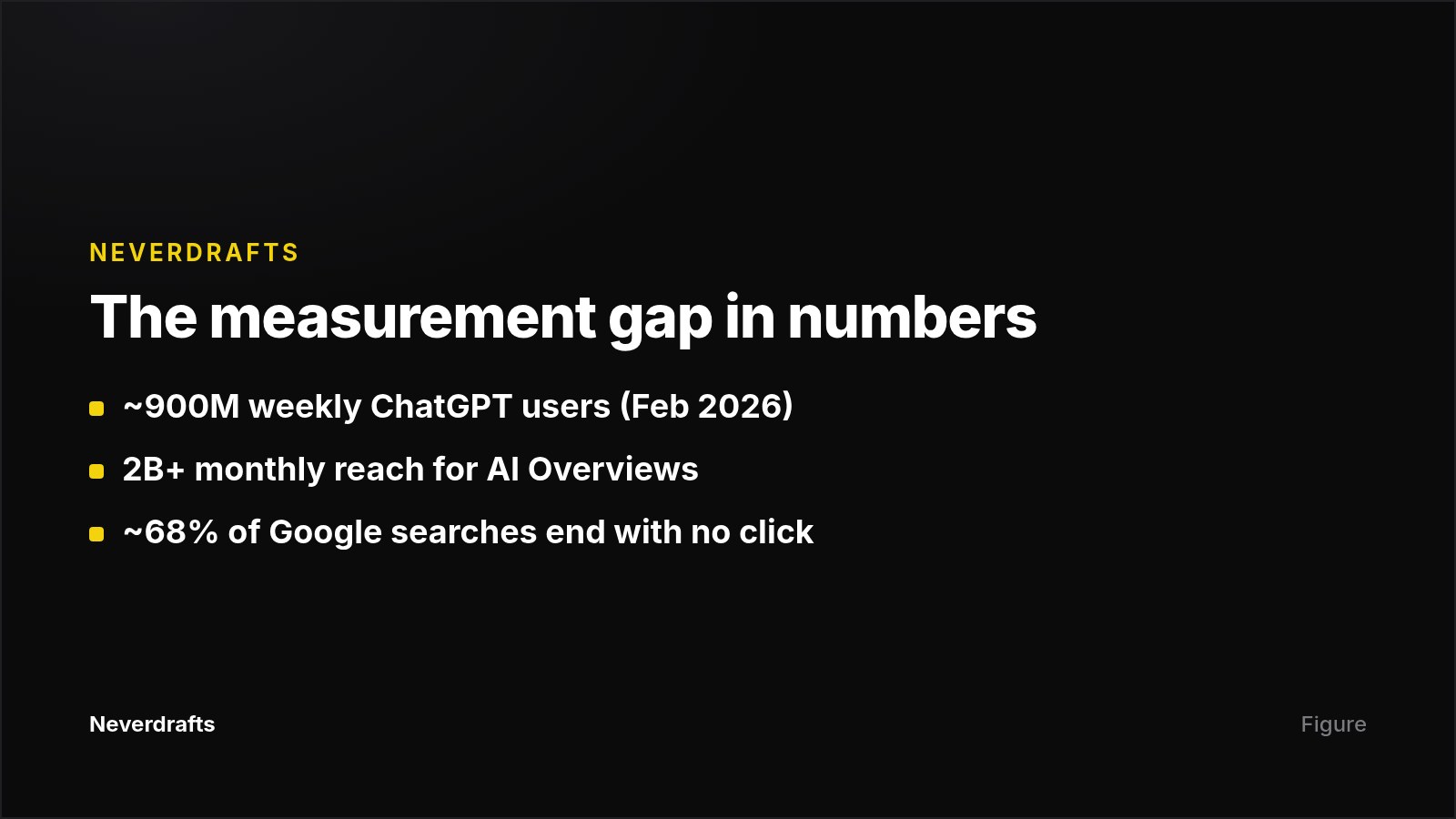
The audience behind those answers is now large enough that invisibility has a price. ChatGPT hit roughly 900 million weekly active users in February 2026, Google's Gemini app passed 750 million monthly active users, and Gemini-powered AI Overviews reach an estimated 2 billion-plus people each month. Meanwhile about 68% of Google searches ended with no click in early 2026, according to SparkToro's analysis of Similarweb clickstream data.
Monitoring tools close the gap by repeatedly querying many prompts across multiple engines and aggregating mention rate, cited sources, sentiment and competitor share of voice. That baseline is what lets you prove whether a GEO change worked.
Which AI visibility tool is best for enterprises?
Profound: the widest engine coverage
Profound launched in New York in 2024 and is built for enterprise buyers. It covers more than ten generative engines and adds Agent Analytics, which watches how AI agents visit your site. Exposure Ninja's testing lists supported platforms as ChatGPT, Google AI Overviews, Google AI Mode, Gemini, Microsoft Copilot, Meta AI, Grok and Perplexity, calling it the most comprehensive platform tracker they reviewed.
Feature depth includes visibility scoring against named competitors, sentiment analysis, citation share with top citing domains, topic-level rank and citation share, and AI referral traffic reporting. It raised a Series C of $96M at a valuation of roughly $1B, which makes it the most heavily funded product in the category.
Who it suits: large organisations with a dedicated search or brand team, and anyone who genuinely needs every major engine tracked in one place. Frase also frames it as the fit for enterprises needing depth and compliance.
Limitations: the public Lite plan sits around $499/month, and Exposure Ninja flags it as the most expensive option to access the full value and notes its strategic opportunities lack prioritisation. It reports and analyses; the content work stays with you.
Which tools suit mid-market teams and agencies?
Peec AI: competitor gap analysis at a mid-tier price
Peec AI launched in Berlin in 2025 and tracks ChatGPT, Gemini, Perplexity, Copilot and AI Overviews. Its lead feature is competitor gap analysis: a clear view of which prompts you lose to named rivals. It raised a Series A of €18M and lists a public price around $89/month.
Exposure Ninja rates it the most affordable of its three picks with a simple, easy-to-understand interface. Frase positions it as a fit for teams tracking large prompt sets, and independent round-ups repeatedly name it as an agency reporting pick.
Limitations: Exposure Ninja notes it currently lacks strategic opportunities, with Actions in beta, and that prompt-tracking volume is plan-dependent — so check the prompt cap against your topic list before committing.
Neverdrafts: monitoring plus auto-generated remediation content
Neverdrafts monitors which AI answers recommend your competitors instead of you, auto-generates content aimed at winning those prompts back, and tracks AI crawler visits to the published pages as a proof layer. It tracks real ChatGPT and Claude answers daily on buyer-intent prompts and applies position-weighted visibility scoring from 0 to 100 per answer, rather than reporting an extrapolated score.
The workflow is deliberately end-to-end: identify losing prompts and competitor citation gaps, see top citing domains, generate remediation articles, publish in one click to WordPress, Webflow, Shopify, Framer or via API, then watch AI bot traffic hit those pages. It also offers white-label reporting and dashboards for agencies and supports content output in 150+ languages.
Pricing: Starter is $99/month (1 brand, 50 tracked prompts, 30 articles/month), Growth is $199/month (3 brands, 150 prompts, 100 articles/month), and Agency is $399/month (10 brands or clients, 500 prompts, 300 articles/month). There is a $1 three-day full-access trial with no contract.
Limitations, stated plainly: Neverdrafts monitors only two engines — ChatGPT and Claude. If Perplexity, Gemini, AI Overviews, Copilot, Meta AI or Grok matter to your category, you will need broader coverage such as Profound's 10+ engines or Peec AI's five. Prompt and article caps are per plan, so large prompt libraries push you up a tier. It is also newer than the SEO suites in this list.
AthenaHQ: GEO analytics for growth-stage SaaS
AthenaHQ is a San Francisco product founded in 2025 out of the Y Combinator W25 cohort. It tracks 8+ engines including ChatGPT, Perplexity, Gemini, Claude and Grok, and ships Ask Athena plus a citation engine (ACE). Starter is around $295/month with a separate free tier, and Frase positions it for growth-stage SaaS wanting GEO analytics with an action centre. Evertune's matrix lists it as GEO monitoring without optimisation or content creation.
Which tool is the cheapest way to get a baseline?
Otterly.ai: $29/month entry
Otterly.ai is a bootstrapped product that started in Austria in 2024 and has the lowest barrier to entry in the category at $29/month. Its structure is four base engines with Claude and Gemini available as add-ons, and it includes a GEO Audit Tool for light diagnosis.
Who it suits: small teams, solo practitioners and consultants measuring GEO for the first time, where the goal is a defensible baseline rather than a full programme. Frase groups it under small teams starting out on a budget and Amplitude includes it among its main twelve options.
Limitations: add-on pricing for Claude and Gemini means the headline figure is not the all-in figure, and Evertune's feature matrix classes it as monitoring without optimisation or content creation.
Which tool is best if you already pay for an SEO suite?
Semrush AI Visibility Toolkit
Semrush, founded in Boston in 2008, extended its SEO platform into AI answer monitoring. The AI Visibility Toolkit benchmarks how often your brand appears in AI answers, shows which competitors are appearing in AI answers instead of you, and prioritises opportunities across ChatGPT, Google AI Overviews, AI Mode and Gemini.
Its reporting set is unusually complete for an add-on: an AI Visibility Score with mentions, monthly audience and cited pages; competitor research at prompt and topic level; Prompt Research with AI volume, difficulty and intent; Brand Performance covering AI share of voice, sentiment and narrative drivers; daily prompt tracking; and an AI Search Site Audit that flags AI-crawl issues.
Exposure Ninja founder Tim Cameron-Kitchen singles out the AI Strategic Opportunities report, which groups actions by what to do now, what takes time, and what is urgent because it is actively hurting perception.
Pricing: $99/month per domain as an add-on to Semrush plans starting at $139.95/month for Pro, or Semrush One at $199/month bundling SEO and AI features.
Limitations: the coverage gap is real — Exposure Ninja notes it does not currently track Perplexity. And the add-on only makes economic sense if you already pay for the base subscription. Ahrefs offers a comparable layer in Brand Radar, and WikiAP groups both as low-incremental-cost routes for teams already inside those suites.
Which tools connect monitoring to content fixes?
Frase: tracking wired into drafting and publishing
Frase frames the category around a single test: does the tool stop at the alert, or does it help you close the gap? It tracks brand mentions across ChatGPT, Perplexity, Claude, Gemini and Google AI, then feeds that signal into research, drafting, scoring and publishing in the same product. Frase also offers a free AI Visibility Checker and a GEO Score that grades a page for citability, neither requiring a card.
Limitations: Frase names itself the category leader on its own list, so treat the ranking as vendor positioning and test the monitoring depth yourself. Frase's own comparison lists plans from Starter up to Enterprise, scoped to your org rather than a published entry rate for the visibility features.
Gauge: monitoring coupled to a content engine
Gauge is a San Francisco product founded in 2024 out of Y Combinator S24. Its official listing shows seven engines including ChatGPT, Claude, Gemini and Perplexity, and it couples monitoring with a content engine — Evertune's matrix confirms it as one of the platforms doing both GEO monitoring and optimisation/content creation. Starter is around $99/month but covers ChatGPT only, so budget for a higher tier if you need multi-engine data.
Which tools cover agent experience and technical GEO?
Scrunch AI: an Agent Experience Platform
Scrunch AI launched in Salt Lake City in 2023 — making it one of the older dedicated AI-visibility products here — and tracks ChatGPT, Claude, Gemini, Perplexity, AI Mode and Meta. As the name suggests, it focuses on how AI agents experience a site rather than exposure counts alone. It raised a Series A of $15M and lists a public price around $250/month.
Who it suits: teams whose site is complex enough that agent crawl behaviour and machine readability are genuine risks. Limitations: Evertune's matrix lists Scrunch as GEO monitoring without optimisation or content creation, so remediation is your job.
ZipTie: citation tracking plus crawlability checks
ZipTie was built by SEO agency Onely and tracks Google AI Overviews, ChatGPT and Perplexity, pairing citation tracking with AI crawlability checks. Basic is about $69/month; Frase lists it as usage-based from $35.63/mo and positions it for teams prioritising technical GEO audits. Best used alongside a broader tracker, not instead of one.
Which tools focus on brand perception and business outcomes?
Evertune: perception data and statistical rigour
Evertune (New York, founded 2024) tracks nine engines including ChatGPT, Gemini, Claude, Perplexity, Meta AI and DeepSeek, and leads with an AI Brand Index plus source attribution at scale. It claims a proprietary 25-million-person consumer panel combined with foundational model intelligence and daily consumer app data to produce statistically significant readings, and Amplitude notes its attention to regional variation in AI responses. Pricing is not published; you contact them. Its own round-up ranks Evertune first, so read it as vendor material.
Amplitude: linking AI mentions to conversion
Amplitude approaches the problem from analytics. It monitors ChatGPT, Claude, Perplexity and Google Gemini with automated tracking and accuracy verification, then connects those mentions to downstream behaviour through Product Analytics, Web Analytics, Session Replay and Heatmaps — so you can see whether AI-referred visitors activate, explore features and convert. A free tier is available. Its own listed trade-off: teams that want only mention tracking may find the platform broader than they need.
Amplitude is also the source that takes hallucination seriously, warning that AI platforms can mention your brand incorrectly or attribute features you do not have — a mention that misrepresents your product can hurt more than help.
How should you choose an AI visibility monitoring tool?
Work through these criteria in order. The first two usually eliminate most of the shortlist.
- Engine coverage. List the assistants your buyers actually use, then match. Coverage varies significantly between products and is widely described as the first evaluation step. A tool watching one engine leaves blind spots.
- Prompt-level tracking and volume. You need the exact prompts that trigger your brand, which competitors appear beside you, and which answers you miss entirely — plus a prompt cap that fits your topic list. None of the published comparisons disclose sample sizes or query volumes per tool, so ask directly.
- Competitive benchmarking. AI visibility is relative; share-of-voice views make the gap concrete.
- Sentiment, context and accuracy. A mention is not a win if the engine describes you wrongly. Check whether the tool verifies correctness or only counts.
- Citation source attribution. Knowing which pages and third-party domains earn your citations tells you where to invest next.
- A path from insight to action. Decide honestly whether your team will write and ship the fixes. If not, buy a tool that does part of that work.
- Proof of change. Look for a way to confirm a fix landed — referral traffic reporting, crawler logs, or before-and-after prompt tracking.
- Reporting fit. Agencies need white-label output and multi-client seats; in-house teams often need less.
Two practical cautions. First, most published prices carry a "subject to change" note and quote-based pricing is common, so verify before you buy. Second, these products are young: comparisons routinely treat six-month-old tools as equals of more established ones, so weight your own trial over any list — including this one.
What is the fastest next step?
If you want the monitoring and the remediation in one place, start with the Neverdrafts $1 three-day full-access trial: add your brand, load the buyer-intent prompts you care about, and see which ChatGPT and Claude answers name competitors instead of you. If you are comparing against a monitor-only platform, our Neverdrafts vs PromptWatch breakdown lays out where each one stops. Pair it with a broader tracker if Perplexity, Gemini or AI Overviews are core to your category.
Frequently asked questions
What is an AI visibility monitoring tool?
It is software that repeatedly queries AI assistants such as ChatGPT, Claude, Perplexity and Gemini with a set of prompts, then aggregates how often your brand appears, which sources get cited, the sentiment of each mention, and your share of voice against competitors. It replaces manual spot-checks, which use samples too small to reproduce.
How much do AI visibility tools cost in 2026?
Published entry prices range from $29/month for Otterly.ai to roughly $499/month for Profound's Lite plan. Mid-tier options cluster between $89 and $295/month, including Peec AI ($89), Gauge ($99 for ChatGPT only) and AthenaHQ (~$295). Semrush's toolkit is $99/month per domain on top of a base plan from $139.95/month. Enterprise tiers are typically quoted.
Which AI visibility tool is best for a small business?
Otterly.ai is the usual value pick for small teams because of its $29/month entry price and included GEO Audit Tool. If you also need the content that closes the gaps, look at tools that pair tracking with publishing rather than buying a dashboard plus a writer separately. Existing Semrush subscribers usually get the best value from the add-on.
Do I need a separate tool if I already use Semrush or Ahrefs?
Not necessarily. Both offer AI visibility layers — Semrush's AI Visibility Toolkit and Ahrefs' Brand Radar — and adding AI tracking to a suite you already pay for is the low-incremental-cost route. The catch is coverage: Semrush's toolkit does not currently track Perplexity. Check the engine list against your audience before deciding.
What is the difference between AI visibility monitoring and GEO?
Monitoring measures; GEO, or Generative Engine Optimization, is the practice of changing content and sources so AI models are more likely to recommend you. Evertune describes AI visibility tools as the instruments that make GEO possible. Monitoring without follow-through produces dashboards; GEO without monitoring produces guesses.
Can these tools prove AI visibility drives revenue?
Only partly, and that is the biggest open gap in the category. Most platforms treat mentions as a standalone metric; Amplitude is the main exception, connecting AI mentions to downstream behaviour through product analytics, session replay and conversion data. Profound also reports AI referral traffic. If ROI attribution is your priority, insist on a path from mention to conversion.
Sources
- WikiAP+1 — AI Visibility Monitoring Tools Compared 2026
- Exposure Ninja — The 3 Best AI Search Visibility Tools for 2026
- Frase — The 10 Best AI Visibility Tools in 2026
- Evertune — The 10 Best AI Visibility Tools for 2026
- Amplitude — The 12 Best AI Visibility Monitoring Tools in 2026
- UseGrowthOS — Best AI Visibility Tools
- Neverdrafts
- Neverdrafts vs PromptWatch