
Profound, Peec AI, and Ahrefs Brand Radar are the most-named Semrush AI Toolkit alternatives, each cited by 7 of 11 AI platforms in Rankability's October 2026 test. Profound suits teams that need deep multi-model citation data, Peec AI suits SEO teams that want a standalone analytics scoreboard, and Ahrefs Brand Radar is the natural switch if you already pay for Ahrefs. Otterly.ai is the cheapest dedicated entry point at $29/month. If you want monitoring to end in published content rather than a report, look at Frase or Neverdrafts. Disclosure: Neverdrafts is our product.
Key takeaways
- Semrush's AI Toolkit is a $99/month add-on tracking 25 prompts and leans heavily on Google AI Overviews. Teams usually leave because they need ChatGPT, Perplexity, and Claude coverage, or because they object to per-domain pricing.
- In an October 13, 2026 test of 11 AI platforms, Ahrefs, Peec AI, and Profound tied as the most-named alternatives at 7 of 11. For agencies, Ahrefs and SE Ranking led at 8 of 11.
- Entry prices range from about $20/month to sales-led enterprise contracts. Prompt caps, per-engine add-ons, and single-engine entry tiers often push the real cost above the advertised price.
- Most dedicated tools only monitor. Frase and Neverdrafts also generate and publish content to close visibility gaps, and AthenaHQ adds content gap analysis.
- Before you buy, track three real buyer prompts for a week and check which engines the price actually covers.
Why teams look beyond Semrush's AI Toolkit
Three problems come up again and again in the sources reviewed for this article.
Engine coverage. AIRankAudit describes the Toolkit as focused primarily on Google AI Overviews, with less depth on ChatGPT, Perplexity, and Claude citation tracking. Much buyer research now happens in those engines, so the gap matters.
Packaging and price. Sources describe Semrush's AI pricing in different ways, which tells you how often it changes:
- AIRankAudit lists a standalone $99/month toolkit with 25 prompts, 300 daily AI analysis queries, and 1,000 daily prompt research queries, billed separately from your core subscription.
- Frase reports that the entry SEO plan ($117.33/month billed annually) excludes AI-visibility features, and that tracking starts on the Starter plan at $165.17/month billed annually with a 50-prompt daily cap.
- Industry-Lens lists Starter SEO + AI Search at $199/month with 50 tracked prompts.
Whichever package applies to you, the AI-visibility line on the invoice is real money before you have acted on anything.
Timing. Adobe completed its acquisition of Semrush on April 28, 2026. A change of ownership at a core vendor is a natural moment to re-evaluate your stack.
It is fair to say what Semrush still does well. If your team already uses it for keyword research and site audits, the Toolkit sits next to that data and inherits your existing competitor lists and tracked keywords. For a rough directional read, that convenience has value.
Semrush AI Toolkit alternatives at a glance
| Tool | Best for | Standout feature | Entry pricing (per sources) |
|---|---|---|---|
| Ahrefs Brand Radar | Existing Ahrefs users | Pre-collected AI Visibility Index plus custom prompts | Prompt packages from ~$50/mo; requires Ahrefs plan ($129+/mo) |
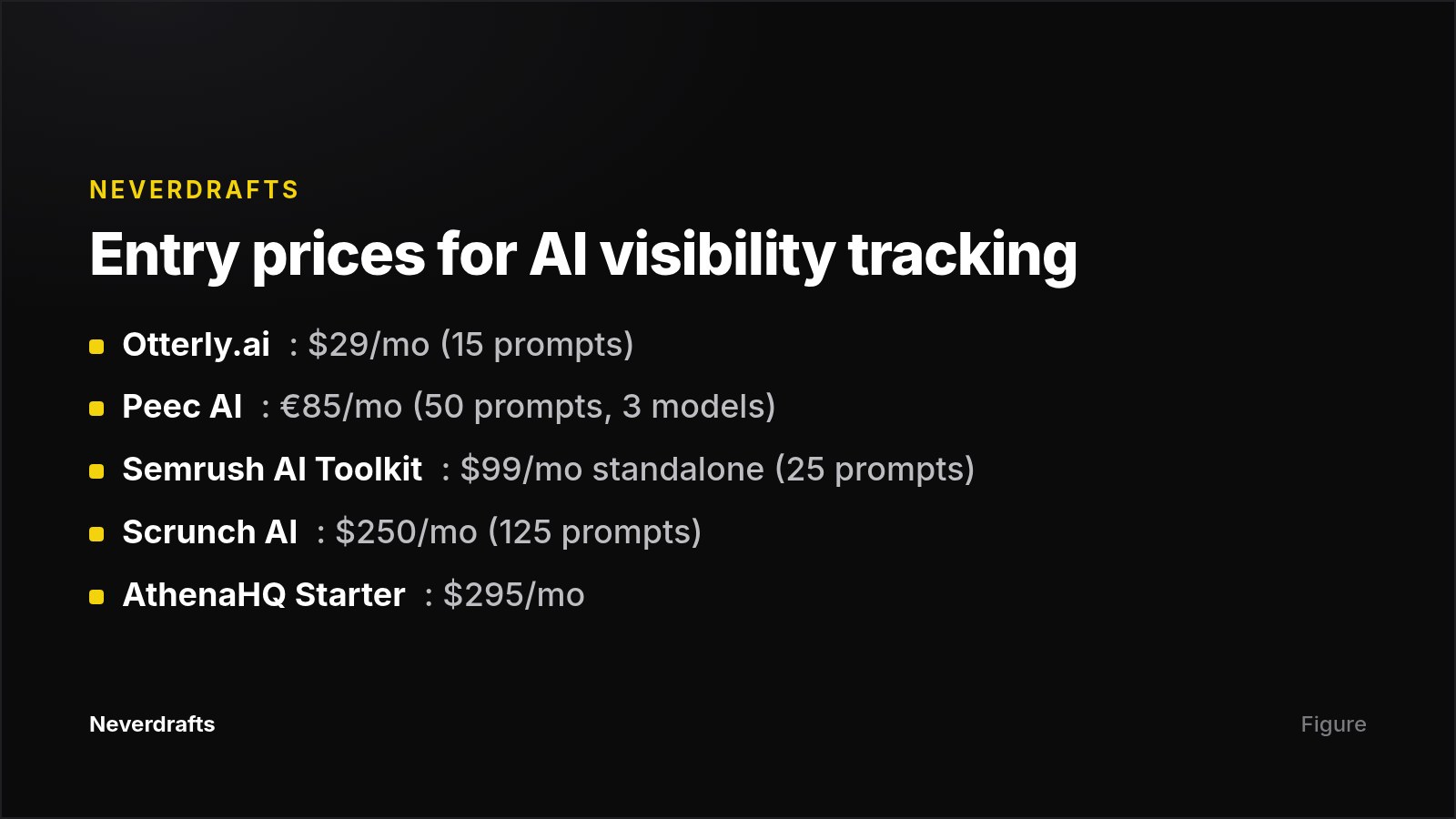
| Peec AI | SEO teams wanting a standalone scoreboard | Visibility, position, sentiment, citations with API and Looker Studio | €85/mo Starter (50 prompts, 3 models) |
| Profound | Mid-market and enterprise AEO programs | Source-level citation analytics across models | Custom quote after 7-day trial; Frase reports a $99/mo ChatGPT-only entry tier |
| SE Ranking | Agencies reporting on SEO and AI search together | AI visibility reportedly included in base plan | Confirm AI-feature scope in quote |
| AthenaHQ | Teams wanting GA4/Search Console context | Up to 11 models on Starter | Free Essential; $295/mo Starter |
| Otterly.ai | Solo marketers and first-time buyers | Lowest-cost dedicated monitoring | $29/mo Lite (15 prompts) |
| Frase | Content teams closing gaps in one workspace | Tracking, drafting, GEO scoring, publishing | From $39/mo billed yearly |
| Neverdrafts | B2B SaaS teams and agencies that want fixes published | Monitor, generate, and publish remediation content | $99/mo Starter (1 brand, 50 prompts) |
| Scrunch AI | Brands watching AI bot traffic | Bot-traffic plus brand monitoring | $250/mo Core (125 prompts) |
| Nightwatch | Small teams wanting rank tracking plus AI | Classic rank tracking with five AI engines | €79/mo; 14-day trial |
Order reflects Rankability's mention count where a tool appeared in that study; Neverdrafts (our product) and Nightwatch were not named in that study and are placed by use case instead. Prices per Industry-Lens, AIRankAudit, and Frase; checked August–October 2026.
1. Ahrefs Brand Radar: the natural switch for Ahrefs users
What it is. Brand Radar pairs Custom Prompts for questions you choose with an AI Visibility Index of pre-collected responses. AIRankAudit lists coverage of Google AI Overviews, AI Mode, ChatGPT, Gemini, Perplexity, and Copilot, with Claude available through custom prompt tracking.
Who it is for. SEO teams already built around Ahrefs data. Ahrefs tied for the top spot in Rankability's overall test at 7 of 11 platforms and led the agency question outright at 8 of 11. Zapier also names it the pick for existing Ahrefs users.
Strengths:
- The pre-collected index lets you research competitors' AI visibility without first setting up prompts
- Ahrefs leadership emphasizes proprietary data infrastructure as its moat
- Broad engine list across Google's AI surfaces
Limitations. It requires an existing Ahrefs plan ($129+/month). Prompt packages start at about $50/month, with the full Brand Radar AI index around $199/month. Frase notes that execution stays with you. Niche B2B questions may not appear in the index, so confirm where you would need custom tracking.
2. Peec AI: a standalone analytics scoreboard
What it is. Peec AI tracks visibility, position, sentiment, and citations, with CSV, API, and Looker Studio reporting. AIRankAudit lists its coverage as ChatGPT, Perplexity, Gemini, Google AI Mode, and Claude, describing it as the tool with the broadest model coverage claim.
Who it is for. SEO teams who want a dedicated reporting layer and will act on the data in other tools. It tied with Ahrefs and Profound at the top of Rankability's overall results.
Strengths:
- Clean reporting exports for client or executive dashboards
- Peec AI competes directly with Semrush on data accuracy, running an aggressive comparison campaign against the larger vendor
- Additional models available as add-ons
Limitations. The Starter plan lists 50 prompts, a choice of 3 models, and 1 project, so count your buying questions before deciding it fits. Frase describes it as analytics and reporting where acting on the data happens in your other tools.
Pricing. Sources vary: €85/month, $80/month billed annually, and $95/month. The difference likely reflects currency and billing cycle. Check the live page.
3. Profound: the deepest multi-model citation data
What it is. Profound tracks brand and competitor mentions across ChatGPT, Perplexity, Google AI Overviews, and Claude, with citation-level detail on which sources each model pulled from. Industry-Lens notes that its Answer Engine Insights include Citation Analytics, Prompt Volumes, and Agent Analytics, and that Profound now positions itself as a broader AI marketing platform rather than a point solution.
Who it is for. Teams that need to answer "why did a competitor get cited here and not us," not just "were we mentioned." It was named by 7 of 11 AI platforms in Rankability's overall test.
Strengths:
- Source-level citation tracking rather than mention counts
- Competitor share of voice broken down by platform
- API access for pulling data into your own dashboards
Limitations. Pricing is not public. AIRankAudit describes a free 7-day trial (50 prompts a day across ChatGPT, Gemini, and Google AI Overviews) followed by Enterprise pricing by custom quote, with no self-serve monthly plan. Frase, checking on August 31, 2026, listed a $99/month entry tier that tracks ChatGPT only. Confirm current packaging directly. For solo consultants or single-location businesses, it is likely more tool than you need.
4. SE Ranking: AI visibility inside a familiar SEO suite
What it is. SE Ranking combines conventional SEO research and tracking with AI search capabilities. AIRankAudit describes its AI visibility features as included in the base plan, rather than billed as a separate add-on the way Semrush's Toolkit is.
Who it is for. Agencies that report on traditional and AI search side by side and want to drop Semrush entirely rather than add a second tool. It tied Ahrefs for first place on Rankability's agency question at 8 of 11, up from 6 of 11 on the general question.
Strengths:
- One login for rank tracking and AI visibility
- AI features reportedly bundled rather than priced as a separate per-domain add-on
- A practical choice if per-domain AI add-on pricing is what pushed you away from Semrush
Limitations. The sources reviewed don't detail SE Ranking's engine coverage or prompt caps. Rankability recommends checking the quote for AI features, agency reporting, API access, and white labeling before assuming any specific capability is included. Suite tools also tend to offer less citation depth than dedicated platforms. If you manage many client brands, our guide to AI search visibility tools for multiple client websites covers seat and reporting trade-offs in more detail.
5. AthenaHQ: the widest model coverage with analytics context
What it is. AthenaHQ tracks up to 11 models on Starter: ChatGPT, Claude, Gemini, Perplexity, Google AI Overviews, AI Mode, Copilot, Grok, DeepSeek, Meta AI, and Mistral. It connects to GA4 and Search Console. Rankability describes it as combining visibility measurement, citation tracking, and content gap analysis.
Who it is for. Teams that care about long-tail engines such as Grok or DeepSeek, and that want AI visibility next to their web analytics.
Strengths:
- The broadest engine list of any tool here
- A free Essential plan covering 5 platforms, which is useful for a no-cost baseline
- Content gap analysis points toward what to write next
Limitations. The jump from free to $295/month for Starter is steep for small teams. Rankability suggests checking who reviews and implements its recommendations, because the gap analysis still needs a person to act on it.
6. Otterly.ai: the cheapest dedicated entry point
What it is. Otterly.ai tracks mentions across ChatGPT, Google AI Overviews, Perplexity, and Microsoft Copilot, with simple share-of-voice comparisons and a weekly email digest. Zapier names it the best pick for affordability after reviewing nearly 50 LLM monitoring tools.
Who it is for. Solo marketers, small teams, and anyone moving off a bundled tool who wants to answer "are we showing up" before committing a bigger budget.
Strengths:
- Lite plan at $29/month for 15 prompts, well below Semrush's add-on price
- Tracks answers and citation sources, with prompt research and optimization tools
- The weekly digest suits teams that won't log into another dashboard
Limitations. Fifteen prompts covers only a narrow slice of buyer questions. Frase notes that several engines cost extra per engine, so the sticker price may not cover everything you need. AIRankAudit says it won't match Profound's depth. Rankability advises checking whether your plan covers every client, engine, and refresh you need.
7. Frase: tracking, drafting, and publishing in one workspace
What it is. Frase tracks prompts daily across ChatGPT, Perplexity, Claude, Gemini, and Google AI and benchmarks share of voice against competitors you choose. When an answer turns against you, the same workspace researches, drafts, applies GEO scoring, and publishes. It also logs AI crawler visits and offers approval-gated fixes.
Who it is for. Content teams that want a writing and optimization tool with visibility tracking built in. It appeared in 3 of 11 AI answers on both the overall and agency questions.
Strengths:
- Low entry price, from $39/month billed yearly
- Five engines covered, including Claude and Gemini
- Adjustable automation, from manual review queues to auto-applied low-risk edits
Limitations. Frase ranks itself first in its own comparison, so treat that list as vendor content. Rankability suggests checking supported publishing destinations, reporting access, and editorial approval controls. Teams that only want monitoring may find the content suite more than they need.
8. Neverdrafts: monitoring that ends in published content
Disclosure: Neverdrafts is our product. It did not appear in the third-party studies cited elsewhere in this article; it is grouped here alongside Frase because both close the loop from alert to published fix.
What it is. Neverdrafts monitors real ChatGPT, Claude, Google AI Mode, and Perplexity answers daily on their actual web interfaces. It scores visibility from 0 to 100 per response based on where your brand appears in the answer. It then auto-generates remediation content aimed at the exact prompts you're losing and publishes it in one click to WordPress, Webflow, Shopify, or Framer, with an API for custom stacks.
Who it is for. B2B SaaS teams and agencies that would otherwise take each monitoring alert, open a ticket, and wait for a writer. The workflow is Monitor, Diagnose, Fix, Prove.
Strengths:
- Position-weighted scoring, so a fifth-place mention doesn't count the same as a first-place recommendation
- Citation analysis showing which domains AI names most, plus sentiment and trending mentions
- Share of voice against named competitors and average ranking across tracked prompts
- AI bot traffic tracking on your pages, so you can see whether a fix was crawled
- Content generation in 150+ languages
Limitations. Engine coverage is four platforms. Gemini, Copilot, Grok, and Google AI Overviews (as distinct from AI Mode) are not on the list, while AthenaHQ covers up to 11 models. Auto-generated content still needs editorial review if your brand voice or compliance rules are strict. Entry point is a free audit (no card required); paid plans start at $99/month.
Pricing. Starter at $99/month covers 1 brand, 50 tracked prompts, and 30 remediation articles a month. Growth at $199/month covers 3 brands and 150 prompts. Agency at $399/month covers 10 brands and 500 prompts. All plans bill monthly with no annual commitment.
9. Scrunch AI: brand monitoring plus AI bot traffic
What it is. Scrunch AI pairs brand monitoring with AI bot-traffic data. The Core plan tracks 4 LLMs (ChatGPT, Perplexity, Google AI Overviews, Copilot). Enterprise expands to 9 by adding Claude, Gemini, Meta AI, Google AI Mode, and Grok.
Who it is for. Brands that want to see both what AI engines say and how AI crawlers interact with their site.
Strengths:
- 125 prompts on the $250/month Core plan, a higher allowance than most entry tiers
- Bot-traffic monitoring alongside mention tracking
- A 7-day trial
Limitations. Claude and Gemini are only available on Enterprise. If Claude matters to your buyers, the Core plan won't replace what you need. It was named by only 2 of 11 platforms in Rankability's overall test, so it has less AI-answer visibility than the leaders above.
10. Nightwatch: rank tracking with AI visibility attached
What it is. Nightwatch is a rank tracker that adds AI visibility across ChatGPT, Claude, Gemini, Perplexity, and Copilot.
Who it is for. Small teams that want to replace Semrush's rank tracking and AI Toolkit with a single cheaper product, without adopting a full SEO suite.
Strengths:
- €79/month entry price
- A 14-day trial with no card required
- Covers Claude and Perplexity, which Semrush's Toolkit reportedly lacks
Limitations. The sources reviewed give little detail on citation depth, sentiment, or prompt allowances. Expect a rank-tracking product with AI features added, not a dedicated GEO platform. Nightwatch did not appear by name in Rankability's 11-platform study, so treat its market position as less independently verified than the tools above it.
Honorable mentions worth a look
A few other tools come up in the research and may fit narrower needs:
- Conductor for enterprise AEO programs, sold through demo or sales
- Rankscale from $20/month on annual billing
- LLMrefs, positioned on "Track Keywords, Not Prompts" at $79/month for 500 prompts
- Yext Scout, which Zapier picks for local tracking
- Clearscope, which Zapier picks for content creators and which rose to 4 of 11 in agency answers
How to choose a Semrush AI Toolkit replacement
These are the criteria used to compare the tools above. They draw on Zapier's evaluation framework and the packaging traps the sources flag.
Match engine coverage to where your buyers search
LLM outputs vary by platform, so a tool that only watches Google's AI surfaces will miss gaps elsewhere. If you're leaving Semrush because of missing Claude or Perplexity coverage, confirm those engines are in your plan and not an add-on. Scrunch's Core tier, Otterly's per-engine pricing, and Profound's reported ChatGPT-only entry tier are all examples where the advertised price may not cover the engines you need.
Count prompts before comparing prices
List the buying questions you want tracked, then compare allowances: 15 on Otterly Lite, 50 on Peec Starter, 125 on Scrunch Core. Zapier recommends calculating cost per prompt and how it grows with refresh frequency, engines tracked, and regions targeted.
Decide whether you need monitoring or action
Frase sorts the category by what happens after the alert fires. Ahrefs, Peec AI, Profound, and Otterly.ai report the gap and leave the fix to you. Frase, Neverdrafts, and to some extent AthenaHQ help you produce the content that addresses it. A monitor-only tool is enough if you already have writers with spare capacity.
Check how data is collected
Zapier notes that tools which mimic real user behavior rather than relying solely on APIs can produce more accurate results. Even so, LLMs are non-deterministic, so expect some fluctuation in any tool's numbers.
Test with your own prompts
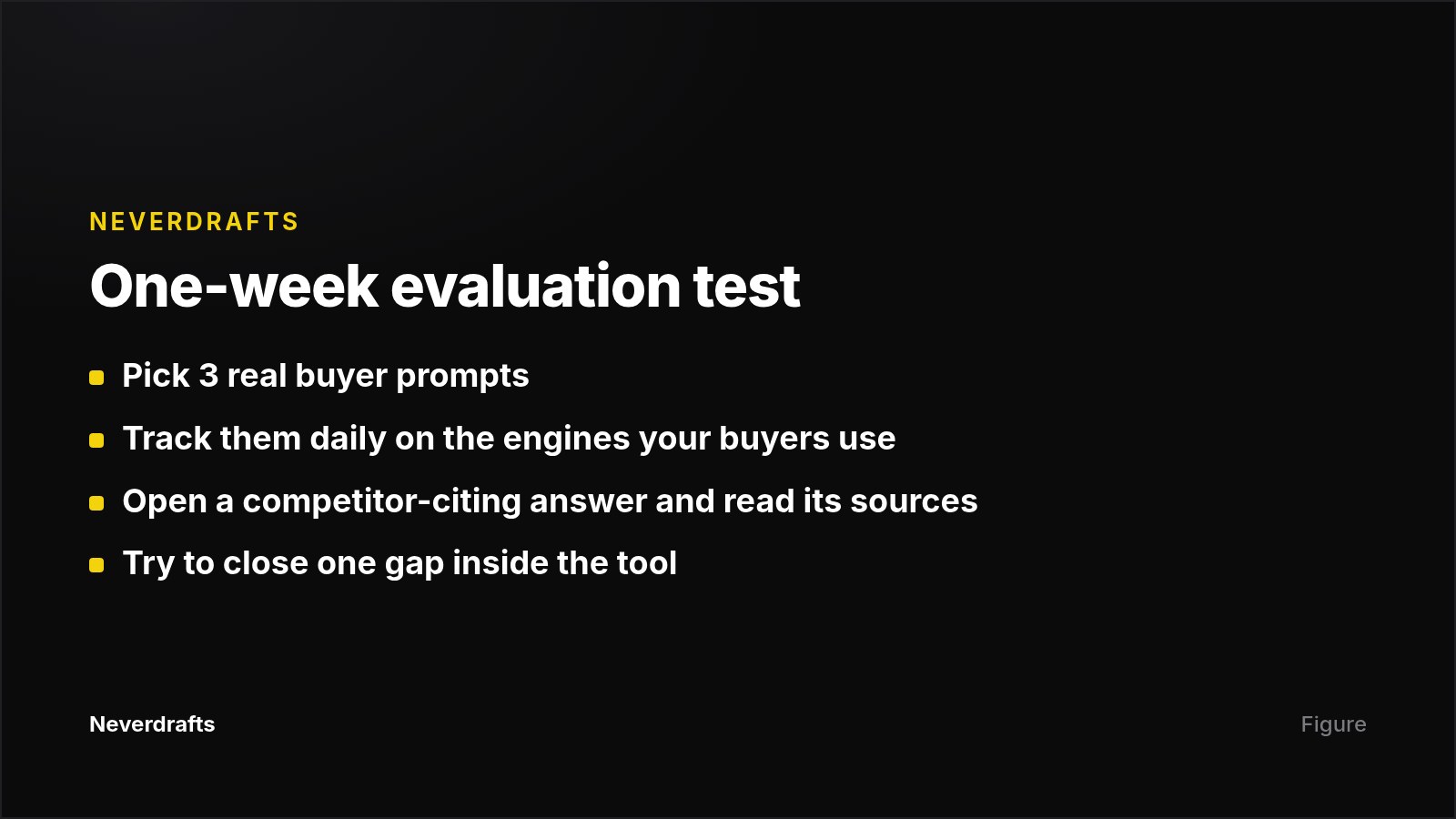
Industry-Lens suggests running a real buying question on the engines you plan to monitor, opening an answer that mentions a competitor, and reading the cited source pages. Frase's version of this test is to track three prompts for a week and try to close one gap without leaving the tool. If budget is the deciding question, our piece on when AI search visibility is worth the investment for small SaaS offers a framework.
Next step
To see where you stand before comparing vendors, run a free Neverdrafts audit on your brand. It needs no card and shows which ChatGPT, Claude, Google AI Mode, and Perplexity prompts you're losing to competitors. If Profound is also on your shortlist, our Neverdrafts vs. Profound comparison sets out the differences.
Frequently asked questions
Does Semrush's AI Toolkit track ChatGPT and Claude?
According to AIRankAudit, the Toolkit focuses primarily on Google AI Overviews and does less with ChatGPT, Perplexity, and Claude citation tracking. Some sources report ChatGPT and AI Mode coverage but no Claude or Perplexity. Semrush's packaging changes often, so check its live pricing page. If Claude coverage is essential, Profound, Peec AI, AthenaHQ, Frase, and Nightwatch all list it.
What is the cheapest alternative to Semrush's AI Toolkit?
Otterly.ai's Lite plan costs $29/month for 15 prompts, and Rankscale starts at $20/month on annual billing. AthenaHQ's free Essential plan covers five platforms at no cost. Check prompt caps and per-engine add-ons, because the cheapest sticker price can become expensive once you add the engines and prompts you actually need.
Which Semrush AI Toolkit alternative is best for agencies?
In Rankability's October 2026 test, Ahrefs and SE Ranking tied as the most-named agency alternatives, each cited by 8 of 11 AI platforms. Profound followed at 6 of 11. For agencies, the useful comparison points are client-seat limits, white-label reporting, API access, and whether pricing scales per domain, which is a common complaint about Semrush.
Are AI visibility tool results accurate?
Partly, and it's hard to say by how much. LLMs are non-deterministic, so the same prompt on the same engine can return different answers minutes apart. Zapier notes that tools mimicking real user sessions may reflect what users see more closely than API-only tools. None of the sources reviewed for this article include an independent audit of vendor accuracy, so validate a few prompts by hand during your trial.
Should I keep Semrush and add a dedicated tool?
That makes sense if your team relies on Semrush for keyword research and audits and only needs deeper multi-engine AI coverage. You would pay for both, but you'd keep your existing workflows. If AI visibility pricing is the main pain point, SE Ranking's AI features are reportedly included in its base plan rather than billed as a separate add-on, which may cost less overall depending on your existing subscriptions.