
AI search visibility is worth a targeted investment for most small SaaS companies whose buyers research software before they buy. It works best as an extension of the SEO and content work you already do, not as a separate program costing several thousand dollars a month. The return comes from being named on the shortlist at the moment a buyer compares options, not from traffic volume. The work also differs by engine: ChatGPT leans on your own site, while Perplexity and Gemini lean on review sites and community threads.
Key takeaways
- In one 2026 study, 53 of 100 B2B SaaS companies received zero citations across ChatGPT and Perplexity. In that sample, most companies were invisible, so the bar in many categories may be low.
- Engines reward different work. On Perplexity and Gemini, 76% and 72% of B2B SaaS product citations route through third-party domains respectively (OneMetrik's headline figure for the pair is roughly 79%), while ChatGPT links to the vendor's own site about three-quarters of the time.
- Google says AI Overviews and AI Mode have no technical requirements beyond standard Search indexing, so solid SEO fundamentals already cover part of the job.
- Agency retainers for generative engine optimization (GEO) start around $4,000–$5,000 per month. That is more than most small SaaS teams need to spend at the start.
- Sensible first moves for a lean team are clear product, pricing, and comparison pages, plus a steady flow of genuine reviews on review platforms.
- Measure citations on your actual buyer prompts before scaling spend. None of the studies reviewed here measure how long content changes take to show up as citations.
What does "AI search visibility" mean for a SaaS company?
AI search visibility is how often AI assistants name, recommend, or cite your product when a buyer asks a question your software answers. OneMetrik defines it as the share of AI answers that cite or mention your brand when buyers research in ChatGPT, Perplexity, Gemini, and Google AI Overviews.
For a SaaS company, the prompts that matter are commercial ones. Examples include "best HR software for mid-size companies," "top payroll platforms for startups," and "[tool] alternatives." AnswerManiac's study used queries like these and excluded informational queries such as "what is endpoint security." Those informational questions rarely decide a purchase.
Visibility is also more than a single yes-or-no outcome. OneMetrik breaks it into several measures that behave differently on every AI surface:
- Direct citations: your page is linked as a source.
- Unlinked brand mentions: your product is named but not linked.
- First-party source share: how often the engine cites your own domain.
- Third-party source share: how often it cites review sites, comparison blogs, and forums that mention you.
- Source density: how many sources appear in each answer.
This matters for budgeting. A company can be mentioned often on ChatGPT and be absent on Perplexity, and a single "AI visibility score" would hide that gap.
Why should a small SaaS company care about this now?
Buyers are moving their early research into AI chatbots quickly. According to a survey cited by SERPdojo, the share of B2B software buyers who start research in an AI chatbot rose from 29% in April 2025 to 51% by March 2026.
That research stage is when shortlists form. If a buyer asks an assistant for "the best onboarding tools for a 50-person company" and gets five names, the vendors left off may never get a demo request, however good their Google rankings are.
The shift also changes what a "win" looks like. On high-consideration queries, a mention puts your brand in front of a buyer who is actively comparing vendors. Google also reports that clicks from results pages with AI Overviews are higher quality, with users more likely to spend more time on the site.
For a small SaaS company, the practical conclusion is to treat AI visibility as demand capture, not a traffic channel. You are trying to be on the list when it counts, not to replace organic sessions one for one.
How visible are B2B SaaS companies in AI answers today?
Most are not visible at all, which is both the risk and the opening. AnswerManiac tested 42 buyer-intent queries across ChatGPT (GPT-4o) and Perplexity (Sonar Pro) for 100 B2B SaaS companies between April 28 and May 12, 2026. The results:
- 53 companies received zero citations across both engines.
- 47 companies were cited at least once.
- The highest total for any single company was just 3 citations.
- 22 companies appeared on both engines, while 25 appeared on only one.
- Perplexity cited more companies per query on average than ChatGPT.
The top names were not household brands. Trainual and Unit led with 3 citations each, followed by 15Five, Assembly, and Avoma with 2. The study also found that several well-funded SaaS companies with large marketing budgets received zero AI citations. In other words, marketing spend alone did not buy visibility.
What did the cited companies have in common?
Cited companies with Wikipedia pages, G2 profiles, and analyst coverage were overrepresented. In HR Tech, the most competitive sub-vertical, companies with strong G2 and analyst coverage appeared most often. The authors say plainly that this correlation does not establish causation.
One detail from the methodology is useful here. Every company was selected because it already had at least 10 reviews on G2 or Capterra — that was a selection criterion, not a finding. More than half of these companies still went uncited, so a basic review presence alone is not enough to guarantee a mention.
Why this is good news for a small company
When citations are spread this thin, a small vendor with clear positioning and good third-party coverage can realistically show up next to much larger competitors. In AI answers, the field is still unsettled.
Does each AI engine reward the same kind of work?
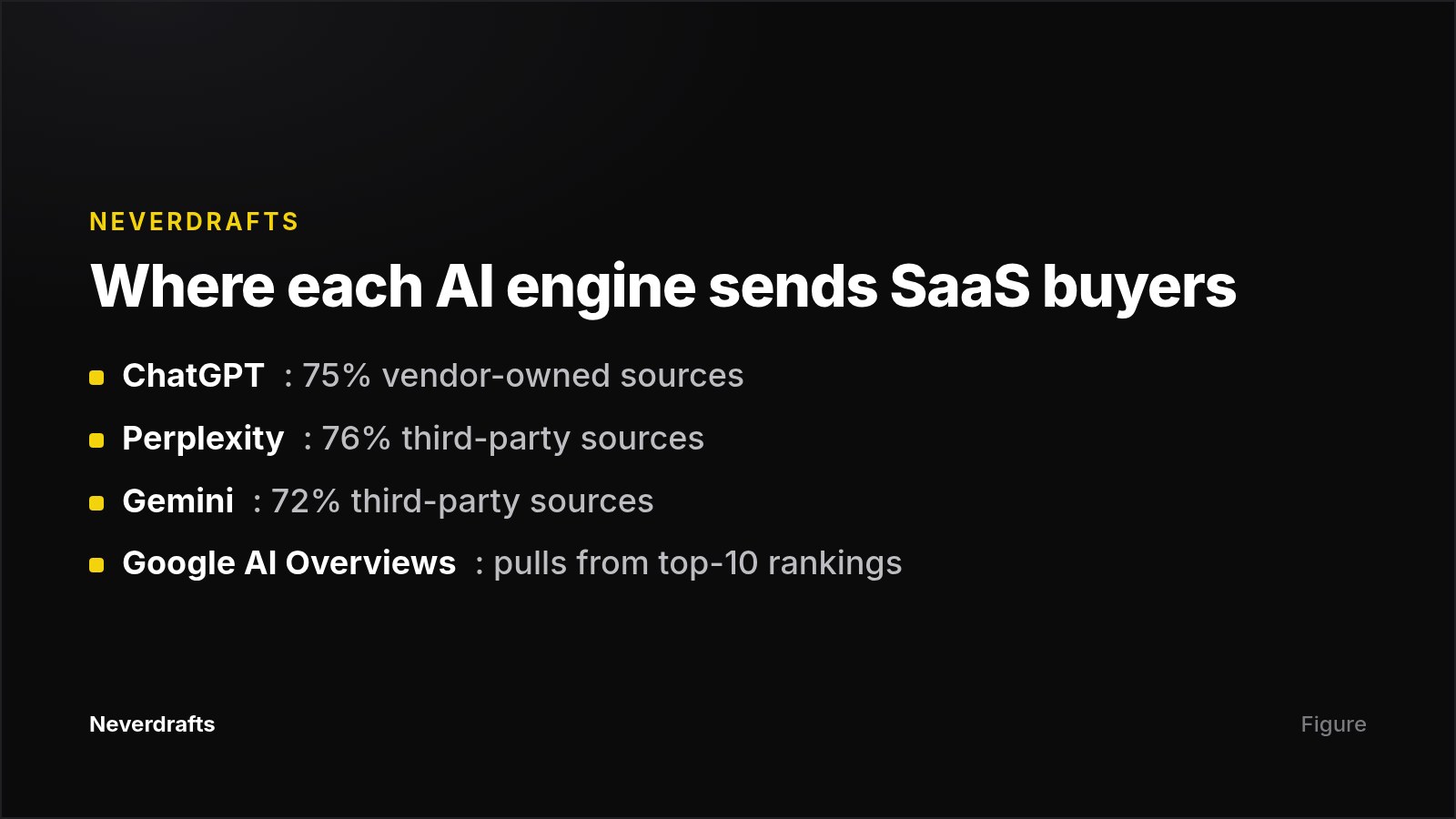
No. The engines draw on different source ecosystems, so work that helps on one may do little on another. OneMetrik audited 500 high-intent B2B SaaS queries across four engines, three runs per query, and found only an 11% shared-domain overlap between ChatGPT and Perplexity.
| Engine | Owned vs. third-party citations | What tends to win | Where a small team should focus |
|---|---|---|---|
| ChatGPT | 75% vendor-owned, 25% third-party | Strong product, pricing, and comparison pages | Your own site architecture and page clarity |
| Perplexity | 24% owned, 76% third-party | Review platforms, comparison blogs, Reddit, fresh content | Reviews, community presence, content refresh cadence |
| Gemini | 28% owned, 72% third-party | Review and comparison sources | Third-party coverage, like Perplexity |
| Google AI Overviews | Mixed profile | Pages already ranking in the top 10 | Traditional SEO on commercial pages |
Figures from OneMetrik's 2026 report, rounded from a 500-query, three-run average. The report calls them directional.
What this means for a lean budget
The split suggests a simple allocation. OneMetrik's own summary is to build owned product and comparison pages for ChatGPT, build credible third-party coverage for Perplexity and Gemini, and keep commercial pages ranking for Google AI Overviews.
For a small team, these are not three separate programs. Your product and comparison pages already serve SEO. Reviews already support sales. Community participation already supports brand. The AI-visibility lens mostly changes priorities and page formats.
Does Google require anything special?
No. Google's documentation says that to appear as a supporting link in AI Overviews or AI Mode, a page must be indexed and eligible to appear in Google Search with a snippet, and there are no additional technical requirements. Its recommended practices are standard SEO:
- Allow crawling in robots.txt and in any hosting or CDN configuration.
- Make content findable through internal links.
- Keep important content available in text form.
- Make sure structured data matches the visible text on the page.
Be wary of any vendor selling a special "AI markup" package as a requirement for Google's AI features.
How much does investing in AI visibility cost?
The cost ranges from a few hours of your own time to more than $15,000 a month. The right level depends on how much of the work your team can do itself. Here are the main options.
| Approach | Typical cost | What you get | Best fit |
|---|---|---|---|
| DIY with existing tools | Staff time; Google Search Console is free | Page improvements, review requests, manual prompt checks | Pre-revenue or very early teams |
| Monitoring and content software | Varies by tool; e.g., Neverdrafts (our product) starts at $99/month | Automated prompt tracking, competitor share of voice, drafted content | Small teams with one marketer |
| Boutique GEO agency | $4,000–$5,000+/month | Strategy, semantic and entity work, content, outreach | Funded teams lacking in-house capacity |
| Mid-market or enterprise agency | $8,000+ to $15,000+/month | Technical GEO, retrieval modeling, measurement | Larger companies with complex portfolios |
SERPdojo notes that agency starting prices are not directly comparable. Some quote advisory work, while others quote content production, digital PR, software access, or broader retainers. Before signing, confirm the scope, contract length, deliverables, and whether measurement is included.
At $4,000 a month, an agency costs about $48,000 a year. For a company with a few hundred thousand dollars in annual revenue, that is hard to justify before you have evidence your buyers use AI assistants at all. If you are weighing that route, our breakdown of alternatives to hiring a GEO agency covers lighter-weight options.
When is AI visibility worth it for a small SaaS company, and when is it not?
It is worth it when your buyers compare vendors before purchasing and your category has names an assistant can list. It is not yet worth significant spend when your product sells mostly through channels where AI research plays little part. No source has published a minimum company size or revenue level at which the investment turns net-positive, so treat the checklist below as reasoning, not a formula.
Signs it is worth investing now
- Buyers ask for recommendations before they buy. Your prospects search phrases like "best [category] for [use case]" or "[competitor] alternatives."
- Your category has shortlists. Assistants already return a list of vendors for your core queries, and you can check whether you are on it.
- Competitors are showing up and you are not. If a rival is named on prompts where you are the better fit, you are losing consideration you could win.
- You already have some third-party footprint — reviews, comparison-blog mentions, community threads — to build on.
- Your deal size justifies the effort. Higher-consideration purchases are where a shortlist mention carries the most weight.
Signs to wait or keep it minimal
- You sell mostly through partners, marketplaces, or direct outbound, and buyers rarely search before engaging.
- You are still changing your positioning. AI systems need a consistent picture of what you do, so fix that first.
- Your site has basic SEO problems. Crawling or indexing issues block Google AI features before anything else matters.
- You cannot yet describe your category in a phrase buyers would type.
Even in the "wait" case, the foundational work still pays off through normal SEO and sales enablement. Clear product pages and honest reviews are rarely wasted effort.
What should a small team do first?
Start with the work that serves several engines and other channels at once, then add monitoring so you know what is working. The sources list many possible actions but do not rank them by effort and impact. The order below is a practical sequence for a team with one marketer, based on the engine patterns above.
- Tighten your owned commercial pages. ChatGPT links to vendor sites about three-quarters of the time on product queries, so a thin site is a direct liability. Make sure product, pricing, use-case, integration, and comparison pages each answer one clear question.
- Format pages for extraction. Cited pages consistently used clear H1/H2 hierarchies, direct question-and-answer framing, and scannable lists. Pages built around specific, sourced figures were more likely to be surfaced.
- Make your positioning consistent everywhere. SERPdojo stresses connecting product, use-case, comparison, integration, and supporting evidence across the whole site so AI systems form a coherent picture. If your homepage says "HR platform," your G2 listing says "payroll tool," and your docs say "people ops suite," you are giving the models three different answers.
- Build a steady flow of genuine reviews. Perplexity and Gemini send roughly 76% and 72% of citations to third-party sources. Among cited companies in AnswerManiac's study, those with Wikipedia pages, G2 profiles, and analyst coverage were overrepresented, though the authors note this is correlation, not causation.
- Take part honestly in communities. Perplexity weights community discussion, with Reddit prominent among them, as a trust signal. Answer real questions in your category. Do not seed promotional threads.
- Refresh key pages on a schedule. Perplexity favours recently updated content, so a quarterly review of your commercial pages is worth the time.
- Keep ranking in Google. Pages already in the top 10 are materially more likely to be pulled into an AI Overview. Ranking is a precondition, though not a guarantee.
For a longer version of this sequence focused on brand authority, see our 10-step guide to improving AI visibility.
How do you measure whether it is working without an enterprise budget?
Track a fixed set of buyer-intent prompts over time, and compare your appearances with a few named competitors. That is the core of every serious approach, from spreadsheets to paid tools.
Free and manual measurement
- Google Search Console. Traffic from AI Overviews and AI Mode is included in the Performance report under the "Web" search type. It is not broken out separately, but you can watch overall trends for your commercial pages.
- Google Analytics. Google suggests also tracking conversions and time on site. It reports that AI Overview clicks tend to be higher quality.
- A manual prompt log. List 20–40 prompts a buyer would actually type. Run them in each engine, and record whether you appear, where, and alongside whom.
Manual checks have a real limitation: AI responses are non-deterministic. AnswerManiac notes that running the same query again may produce different results, which is why OneMetrik ran every query three times. A single manual check is a snapshot. Repeated checks over weeks are a trend.
Paid monitoring
If manual logging becomes a recurring time sink, monitoring software can take it over. At Neverdrafts, we built our platform for this loop. It monitors real ChatGPT, Claude, Google AI Mode, and Perplexity answers daily on tracked prompts. It scores visibility by position (first recommendation versus passing mention), compares share of voice against named competitors, and drafts content for the prompts where you are absent. Plans start at $99 per month. For other options at a similar price point, see our list of affordable Profound alternatives for small businesses.
Whatever you use, tie visibility to engagement and pipeline, not just mention counts. Our guide to proving GEO ROI in three layers covers how to connect citations to revenue.
What are the risks and limits of the current evidence?
The data is young, partly commercially motivated, and silent on some questions a small company most needs answered. That argues for small, measured bets rather than big retainers.
The studies are snapshots
AnswerManiac ran each query once per engine and describes its results as "a structured snapshot of AI engine behavior during the testing window, not as a stable measurement." OneMetrik calls its figures directional and notes that API access does not perfectly mirror the consumer product, especially for Google AI Overviews.
The studies also measured different things. AnswerManiac tested ChatGPT with web browsing disabled to isolate the model's trained knowledge. OneMetrik measured live citations. The numbers answer related but different questions, so do not combine them into one estimate.
The researchers have commercial interests
AnswerManiac discloses that it offers AI visibility optimization services, which creates a commercial interest in the topic, and it publishes its raw data for independent checking. OneMetrik is a marketing agency, and SERPdojo ranks itself first in its own agency guide. Neverdrafts sells monitoring software. Read every source in this space, including this one, with that in mind.
Key questions remain unanswered
- Time to citation. None of the studies reviewed here measure how long content changes take to produce AI citations, or how that compares with SEO rankings. Google notes only that recrawling can take from several days to several months.
- Vertical differences. HR Tech was the most competitive sub-vertical in one study. Nobody has published data on whether DevTools, Fintech, or Martech need more or less effort.
- Accuracy. The studies count whether you appear, not whether you are described correctly. Being grouped with the wrong competitors, or recommended for a use case you do not serve, can cost more than being absent. SERPdojo lists being "included but described inaccurately" as a distinct problem to solve.
Given these gaps, a sensible approach is a 90-day trial. Fix your core pages, grow reviews, track a fixed prompt set, and decide whether to scale based on what you observe for your own company, not industry averages.
Next step
Before spending on an agency, find out where you stand on the prompts your buyers actually use. You can try Neverdrafts for $1 for three days with full access: add your brand, track your core buyer prompts across ChatGPT, Claude, Google AI Mode, and Perplexity, and see which competitors are recommended in your place. If the results show you are already visible, you have your answer at almost no cost.
Frequently asked questions
Is AI search visibility just SEO with a new name?
Partly. Google says AI Overviews and AI Mode have no requirements beyond standard Search eligibility, and top-10 rankings make AI Overview inclusion materially more likely. Perplexity and Gemini behave differently, though. They send roughly three-quarters of product citations to third-party sites such as review platforms and forums. SEO covers the foundation, but reviews, community presence, and page formatting for extraction add work that traditional SEO often skips.
How much should a small SaaS company budget for AI visibility?
Start with staff time and possibly a low-cost monitoring tool, not a retainer. GEO agencies publicly start around $4,000–$5,000 per month, and enterprise services reach $15,000 or more. Most small teams can handle page improvements, review requests, and prompt tracking in-house for the first few months. Scale spending only after you can see which prompts you are winning or losing.
Can a small company realistically compete with larger brands in AI answers?
Yes. Citations are currently spread thinly: in one 2026 study of 100 B2B SaaS companies, 53 received no citations, and the most-cited company appeared only three times. Several well-funded companies were absent entirely. Clear positioning and credible third-party coverage can put a small vendor on the same shortlist as far bigger competitors.
Which AI engine should a small SaaS company prioritize?
Prioritize the engine your buyers use, and start where your existing strengths lie. If your website is strong, ChatGPT, which cites vendor sites about 75% of the time, is the natural starting point. If you have good reviews and community presence, Perplexity and Gemini favor that third-party evidence. Google AI Overviews follows your existing search rankings. The overlap between engines is low, so check each one separately.
How long does it take to start getting cited by AI assistants?
None of the studies reviewed here measure this directly. Google notes that recrawling a changed page can take anywhere from several days to several months. A practical approach is to track the same prompts weekly for about 90 days before judging results.