
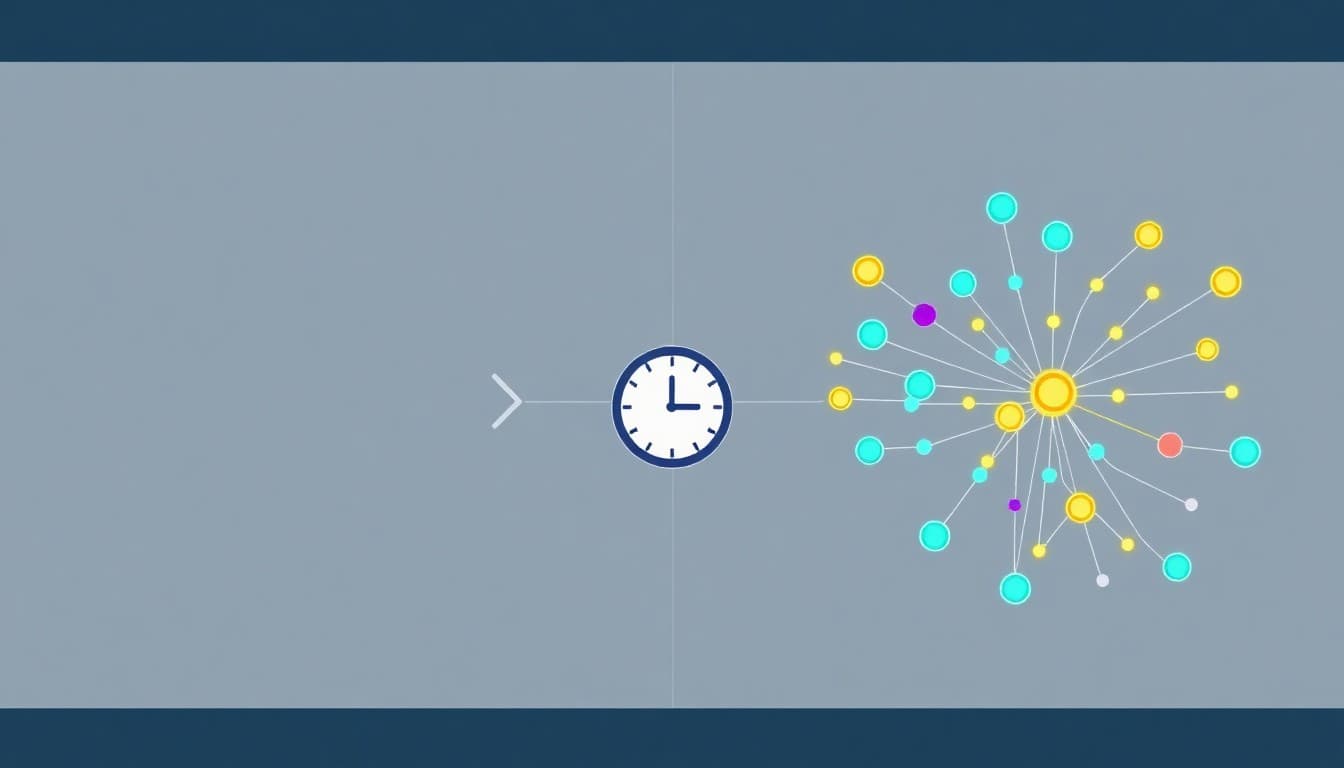
AI marketing automation is software that uses machine learning, natural language processing and generative AI to run marketing tasks such as segmentation, lead scoring, send-time choice and content variants. Instead of following fixed if/then rules, it learns from your data and adjusts as results come in. Traditional automation sends the email you scheduled. AI automation decides who gets which message, on which channel, and when.
Key takeaways
- Rules vs. learning: Traditional automation follows rules a human set up. AI-driven automation updates segments, triggers and decisions continuously as customer behavior changes.
- Time saved: AI users save an average of 12 hours per week, according to ZoomInfo's research.
- Common features: Predictive lead scoring, dynamic content and send-time optimization now appear across most modern platforms. "AI decisioning" is the newer capability.
- Underuse is the real cost: Teams use only 42% of their martech stack's capabilities, mostly because of gaps in strategy, integration and training.
- Prices vary widely: Plans range from free tiers and $10.70/month, billed annually to $60,000+/year enterprise contracts.
What is AI marketing automation, exactly?
AI marketing automation is marketing software that predicts and adapts rather than only executing instructions. ZoomInfo describes it as platforms that "learn from your data, predicting which prospects are most likely to buy, adjusting messaging in real time" without anyone rebuilding workflows by hand. Before adopting these tools, teams spend an estimated 60–70% of their time on manual segmentation, email variants, lead scoring and workflow management.
Three technologies do most of the work:
- Machine learning finds patterns in behavior data. It powers behavioral segmentation and real-time budget allocation, the same approach behind Amazon's "Frequently Bought Together" and Netflix recommendations.
- Natural language processing reads and writes human language. It runs chatbots, sentiment analysis and AI writing assistants.
- Generative AI produces new content: subject lines, ad creative, email copy and video, via tools such as Jasper, Synthesia and Sora.
The core problem it solves is scale. As ZoomInfo puts it, "a team of five marketers cannot manually optimize outreach for 10,000 target accounts. AI can."
How is it different from traditional marketing automation?
The main difference is who makes the decisions. In traditional automation, a person writes the rules. In AI automation, the system makes decisions within limits a person sets. ZoomInfo's comparison covers six dimensions:
| Dimension | Traditional automation | AI-driven automation |
|---|---|---|
| Triggers | Predefined rules (form fill, page visit, time delay) | Real-time predictive signals from behavior, intent and engagement |
| Segmentation | Static lists, refreshed periodically | Dynamic segments that update continuously |
| Optimization | Manual A/B tests, one variable at a time | Multivariate optimization across message, timing and channel |
| Decision-making | If/then logic configured by a human | AI decisioning across multiple variables at once |
| Learning | Same rules until someone changes them | Continuous improvement from outcomes |
| Account targeting | Manual ICP lists from static data | Intent-driven prioritization updated in real time |
Source: ZoomInfo
For illustration: a traditional workflow sends "email B three days after a whitepaper download." An AI workflow might wait, switch to a retargeting ad, or send a different case study, because that pattern has worked better for similar contacts.
What can AI marketing automation actually do?
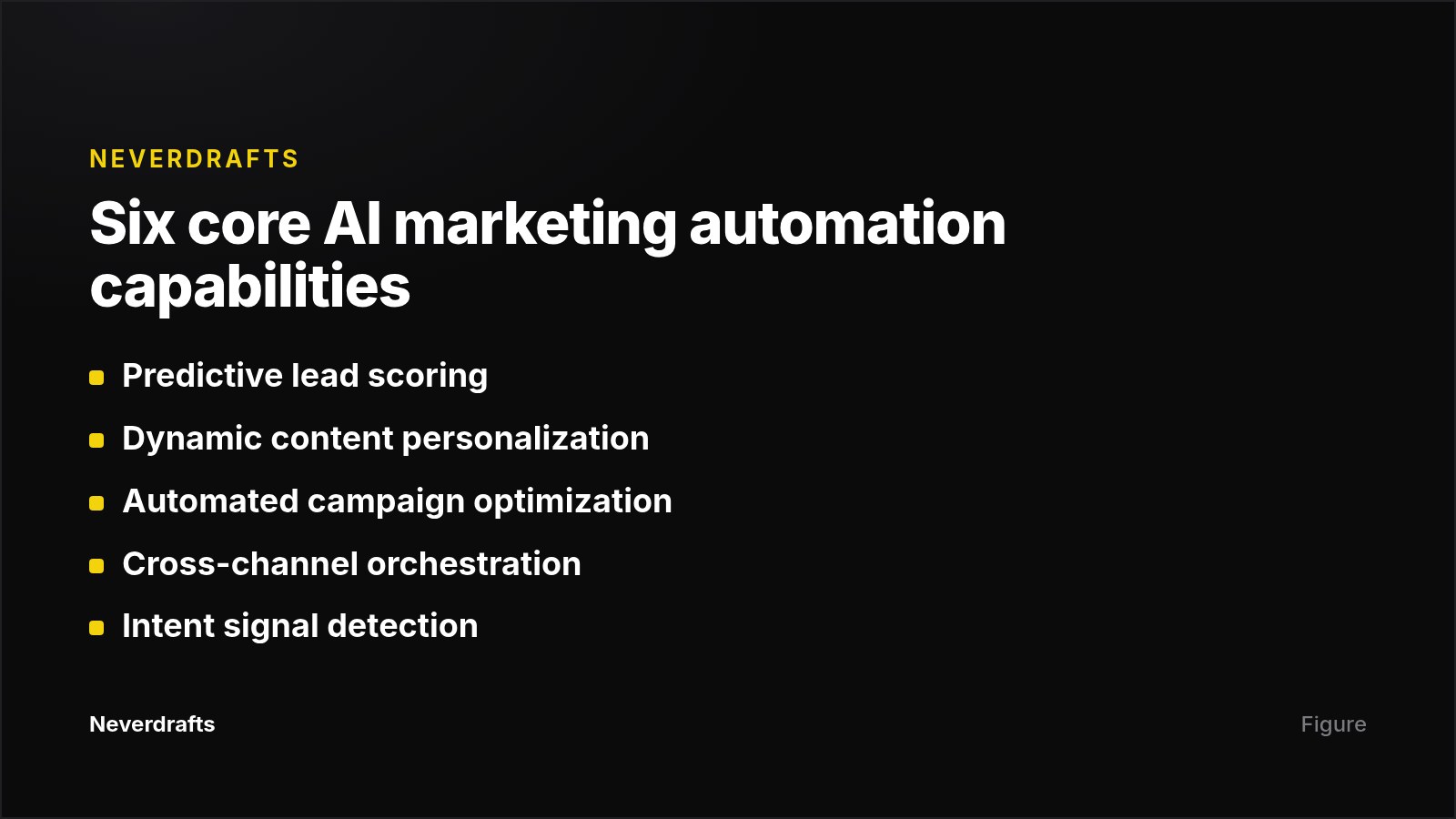
ZoomInfo lists five core AI capabilities to evaluate, plus an emerging sixth. Predictive lead scoring, dynamic content personalization and send-time optimization are the ones that show up across most modern platforms. The others — cross-channel orchestration and intent signal detection — are more differentiated, particularly for B2B accounts.
- Predictive lead scoring. The system scores new prospects against the traits of past closed deals.
- Dynamic content personalization. Case studies, proof points or offers change by industry, company size or buying stage.
- Automated campaign optimization. Subject lines, send times and calls to action are tested, and the winners are applied automatically.
- Cross-channel orchestration. The system picks between email, ads and web experiences based on how each prospect engages.
- Intent signal detection. Outreach is triggered when prospects research solutions like yours, not on an arbitrary cadence.
The sixth is AI decisioning: reinforcement learning that evaluates message, timing, channel and offer together for each individual rather than for a whole segment. Hightouch's version plugs into a data warehouse or CDP and shows which decision was made for each customer and why. OfferFit works as a decision layer between data systems and ESPs like Braze, Salesforce and Iterable.
What results do companies report?
The reported numbers are large. Most come from vendor or analyst reports, so treat them as directional rather than guaranteed:
- 78% of high-performing marketing teams use automation to manage campaigns (HubSpot State of Marketing 2025).
- Integrating automation with a CRM is linked to 54% higher lead conversion rates.
- AI-enhanced automation delivers 3.1x faster campaign deployment and 2.7x greater ROI than manual processes (Salesforce benchmark).
- Fully integrated ecosystems show 38% higher lead-to-close rates and 29% shorter sales cycles (Forrester).
- Latenode's guide cites a 400% lead-generation boost for HubSpot AI users and 30% higher open rates for ActiveCampaign users.
One caveat applies to all of these. They measure immediate metrics such as opens, clicks and conversions. None of the sources reviewed shows whether automation creates incremental revenue or simply captures demand that already existed.
Which tools are used for AI marketing automation?
ZoomInfo splits the market into two groups. Revenue engine tools tie activity to pipeline through intent data, scoring and CRM sync. Velocity tools use generative AI to speed up content, design, SEO and email. Most teams use some of each.
| Tool | Best known for | Starting price |
|---|---|---|
| HubSpot Marketing Hub | All-in-one inbound, AI lead scoring, Smart Content | Free tier with basic automation |
| Mailchimp | Customer Journey Builder, predictive segments | From $10.70/month, billed annually |
| Klaviyo | Real-time data activation | From $20/month |
| Jasper | AI copywriting | From $59/month, billed annually |
| Customer.io | Event-triggered workflows | From $100/month |
| Braze | Personalized messaging AI | Pricing on request |
| Bloomreach | Targeted enterprise campaigns | From $60,000/year |
| Latenode | Visual + code workflow orchestration across 300+ apps | Free; paid from $19/month |
Other names that come up often include Marketo (Predictive Audiences), Salesforce Account Engagement (Einstein) and ActiveCampaign. Specialist tools also appear, such as Seventh Sense for send-time optimization and Movable Ink for content that updates after an email is sent.
Pricing models make comparisons hard. Some vendors charge monthly subscriptions, others use annual licenses, and others bill by consumption. Latenode, for instance, charges by execution time and says this can cut costs by up to 90% compared with task-based pricing. That figure is the company's own claim.
Why do so many implementations underdeliver?
When implementations fall short, the cause is usually organizational, not technical. Gartner's finding that organizations use only 42% of available martech capabilities traces back to missing strategy, weak integration and too little training.
Several gaps show up across the reviewed sources:
- Integration overhead. Sources say CRM and CDP connections drive ROI. They rarely document what happens when APIs break or data syncs lag across 5–10 tools.
- Content quality. None of the sources tests whether AI-written subject lines or offers outperform human-written ones, or how to keep output consistent with your brand.
- Compliance. None covers GDPR or SOC 2 in depth. Latenode's self-hosting option is one of the few data-control features mentioned.
- Fit for small teams. None of the sources contrasts enterprise complexity with simpler options for teams under 10; a lighter tool like Mailchimp's journeys may be enough.
How should a small team get started?
Begin with one workflow that already costs you hours each week, then add tools only when that workflow is working. This checklist follows the selection criteria in the sources:
- Pick a single workflow to automate first. Lead scoring, welcome journeys or content production are common starting points.
- Audit your data. Predictive features depend on clean history, such as past deals and engagement events.
- Confirm native integrations with your CRM, analytics and ad platforms before you sign.
- Set guardrails for AI-generated copy: tone, claims and approval steps.
- Define the metric you'll judge it on, ideally pipeline or revenue rather than open rate alone.
- Budget for training. Gartner found organizations use only 42% of their martech capabilities, largely because of missing strategy, integration and training.
Choosing tools workflow by workflow avoids overbuying. We cover that approach in buying AI marketing tools by workflow, not by feature list.
Next step
If your automation stack covers email and ads but not AI search, check where competitors appear in AI answers instead of you. At Neverdrafts, we monitor ChatGPT, Claude, Perplexity and Google AI Mode answers daily on the prompts you track, show which sources AI cites instead of you, generate content aimed at the prompts you're losing, and track AI crawler visits after publishing. We offer a free audit with no credit card required, and paid plans start at $99/month for one brand and up to 50 tracked prompts.
Frequently asked questions
Is AI marketing automation the same as marketing automation?
No. Traditional marketing automation runs rules a person defines, such as "send this email three days after a download." AI marketing automation uses machine learning to choose segments, timing, channel and content. It keeps adjusting those choices based on outcomes, so performance can improve without anyone rewriting the workflow. Many established platforms, including HubSpot and Mailchimp, now combine both approaches.
How much does AI marketing automation software cost?
Costs range from free to $60,000+ per year. HubSpot has a free tier with basic automation, and Mailchimp starts at $10.70 per month billed annually. Klaviyo starts at $20 per month and Customer.io at $100 per month. Enterprise platforms like Bloomreach start at $60,000 per year, while Braze and several others quote pricing only on request.
Will AI marketing automation replace marketers?
The sources reviewed say no. Automation takes over repetitive work like list segmentation, variant building and lead scoring, which can consume 60–70% of a team's time. That time goes back to strategy, creative work and relationships. People still define goals, content, channels and brand guardrails, and the AI optimizes within those limits.
What is AI decisioning?
AI decisioning uses reinforcement learning to choose the best combination of message, timing, channel and offer for each individual customer. It replaces sequential A/B tests run on whole segments. Hightouch reports which decision was made for each customer and why; OfferFit provides campaign and personalization reports as a decision layer between your data and ESPs like Braze and Salesforce.
What's the biggest mistake when adopting these tools?
The most common pitfall sources point to is buying capability you won't use. Organizations use only about 42% of their martech stack's features on average, mainly because of weak strategy, poor integration and too little training. Start with one high-cost workflow, connect it properly to your CRM, and measure it against revenue before expanding.
Sources
- 25 Best AI Marketing Tools You Need in 2025 — indigitall
- 22 AI Marketing Tools You Need to Win in 2025 — Hightouch
- AI Marketing Automation Software: 10 Best Tools for 2026 — ZoomInfo
- Best Marketing Automation Platforms 2025 — Webolutions
- 10 Best AI Marketing Automation Tools Reviewed in 2026 — TheCMO
- 15 Best AI Marketing Automation Platforms in 2025 — Latenode