
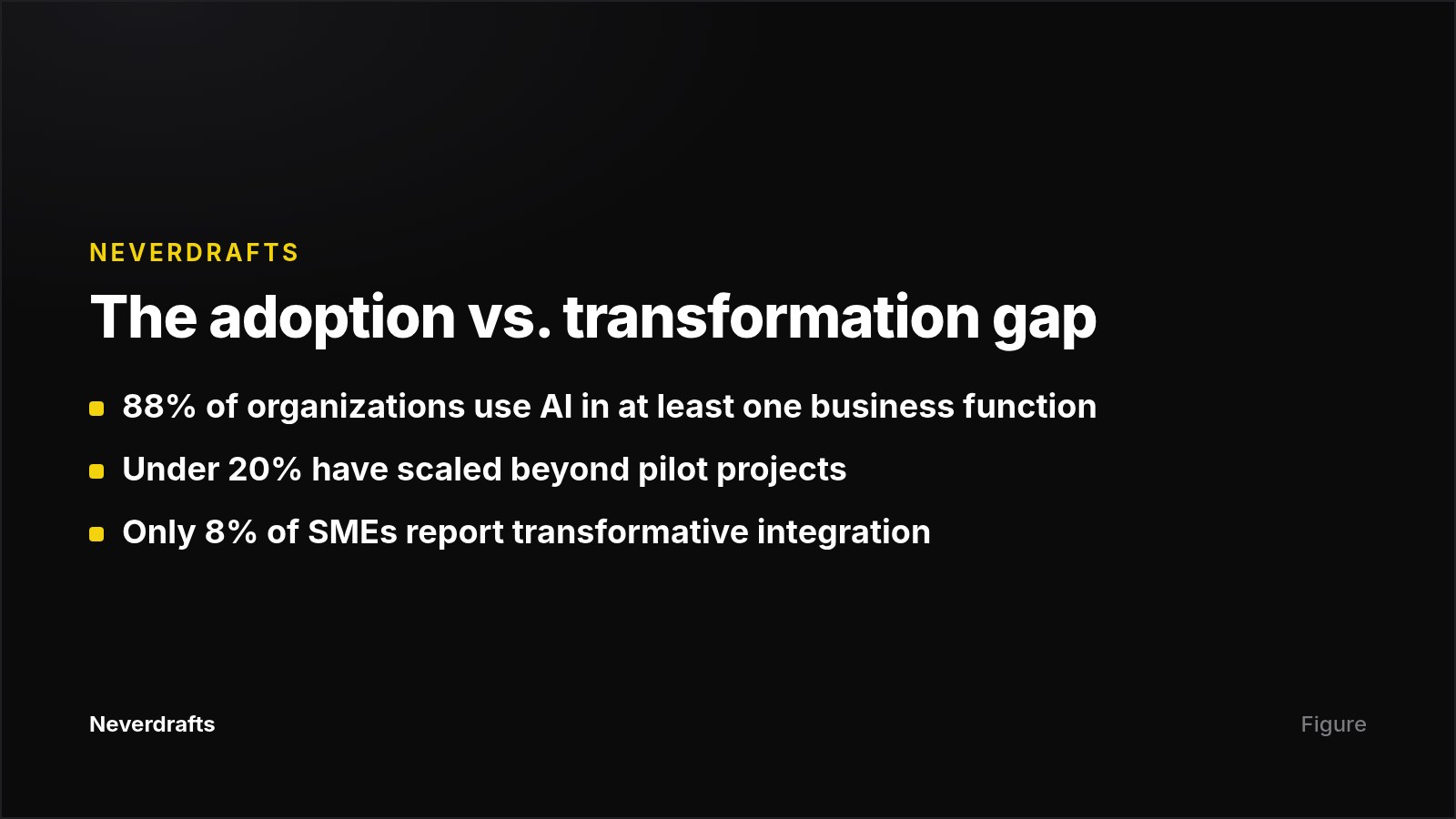
AI transformation is the strategic integration of AI across operations, products, and services to drive innovation and competitive advantage — not a few AI tools bolted onto existing processes. Nearly nine in ten organizations now regularly use AI, yet fewer than 20% have scaled beyond pilot projects, which means the hard part is redesigning how work gets done, not choosing software. The organizations that succeed align three things at once: process, people, and platform.
Key takeaways
- Gen AI usage jumped from 55% in 2023 to 75% in 2024, and an estimated 88% of organizations use AI in at least one business function — adoption is no longer the differentiator.
- 39% of SMEs used AI applications in 2025, up from 26% in 2024, but only 8% reached truly transformative integration (OECD research cited by Electe).
- IDC research shows an average ROI of 3.7x per dollar invested in generative AI, with top performers reaching 10.3x.
- Transformations fail for organizational reasons: weak strategy alignment, poor data governance, cultural resistance, and spreading effort across too many use cases.
- Start narrow. Pick two or three use cases tied to margin, speed, or decision quality and define the success criterion before the project starts.
- Newer firms build AI in from day one: 6.5% of businesses starting in 2025 paid for an AI tool in their first month, versus 1.6% of the 2023 cohort.
What is AI transformation, and how is it different from using AI tools?
AI transformation changes the operating model; tool adoption changes the toolbar. Organizations using AI successfully don't add capabilities to existing processes — they rethink operating models entirely, evolving from automating routine tasks toward AI agents that handle complex workflows with more autonomy.
The practical test: if you removed the tool tomorrow and the only loss was faster email drafting, that's adoption; if your quoting process, staffing model, and service hours would all revert, that's transformation. This distinction explains the gap between the 88% of organizations using AI somewhere and the 8% of SMEs at transformative integration. Most companies sit in between: real usage, no structural change.
What kind of return should you expect?
IDC research puts average generative AI returns at 3.7x per dollar invested, with leaders at 10.3x — but those averages hide enormous variance and are not a forecast for your business. A more useful benchmark is what AI high performers have in common: bold ambitions, redesigned workflows, faster scaling, and significantly higher investment in AI capabilities than peers. These are organizations attributing 5% or more of EBIT impact to AI.
At the small business end, reported gains are narrower and more operational. Idea Financial reports examples such as a florist in Atlanta that saw a 35% increase in online bookings within three months of adding an AI chatbot, a boutique retailer in Chicago that cut excess stock by 28% while decreasing stockouts by 15% with AI inventory forecasting, and an accounting firm that reduced paperwork handling time by 62% with AI document processing. Treat those as illustrations of the shape of returns — time saved, errors reduced, capacity freed — rather than targets to copy.
Why do most AI transformations stall after the pilot?
They stall for organizational reasons, not technical ones. Companies treating gen AI as technology deployment rather than business transformation leave pilots stranded, unable to deliver the measurable impact leadership demands.
| Failure pattern | What it looks like in practice | Fix |
|---|---|---|
| Strategy misalignment | Projects with no clear tie to a business outcome (S1) | Define a North Star tied to revenue, cost, or customer outcomes before selecting tools |
| Weak data governance | Bad data in, bad data out; unclear access and quality (S1) | Audit where critical data lives and which systems don't talk to each other (S6) |
| Cultural resistance | AI perceived as imposed from above or as a threat (S6) | Name a visible business sponsor, not just a technical owner |
| Too many use cases | Tools spread thin across hundreds of experiments, none reaching scale (S1) | Pick two or three high-impact workflows (S6) |
| Starting on the wrong problem | Pilot launched on a use case with incomplete data (S6) | Start from the process that consumes the most time or generates the most errors |
One more trap: treating transformation as a one-time effort rather than continuous evolution. A pilot that ends with a presentation has not transformed anything.
What does a practical AI transformation roadmap look like?
Four phases, in order. Skipping the first two is the most common reason the later two never happen.
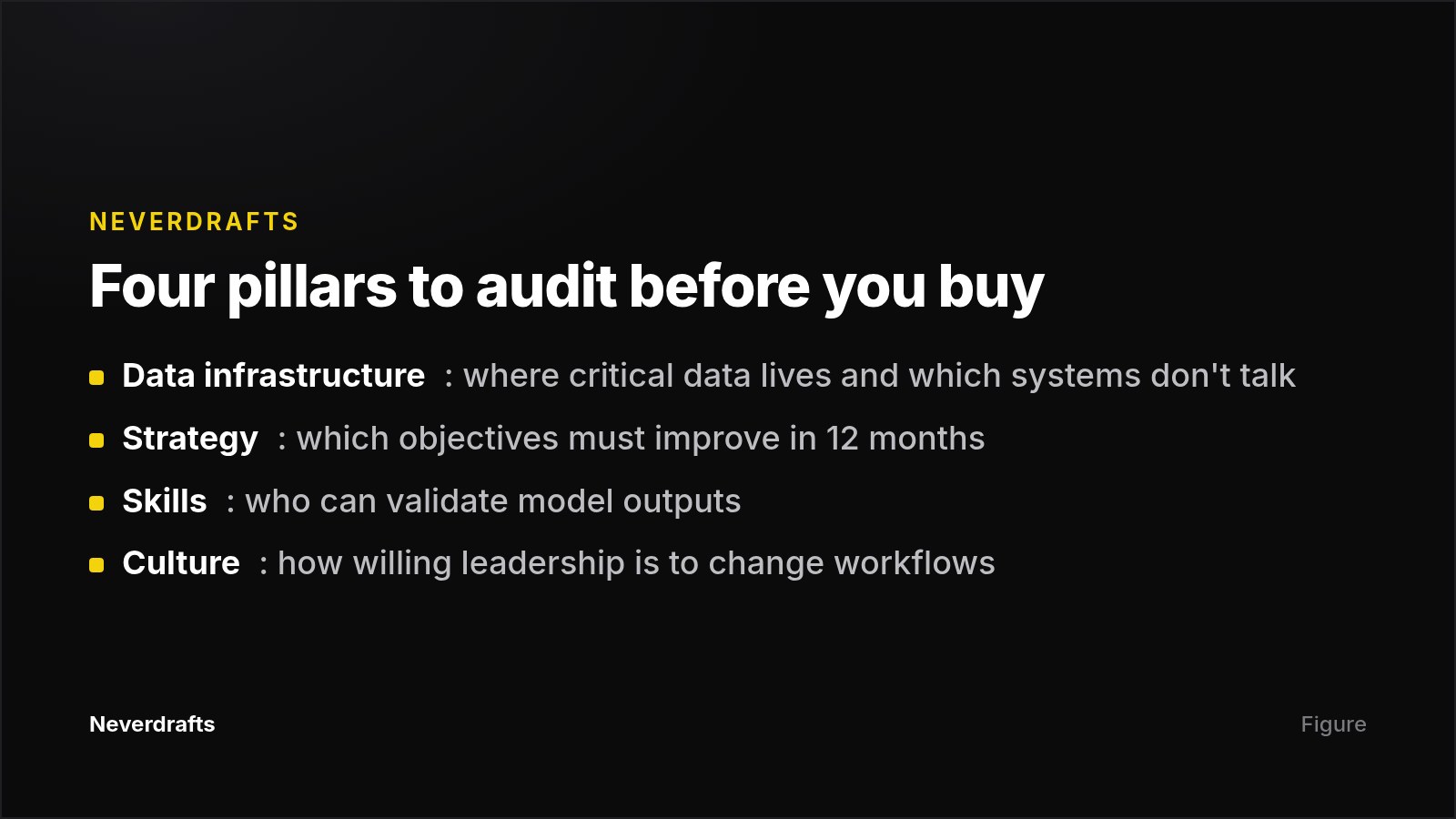
1. Self-assessment across four pillars
Before buying any solution, audit technology infrastructure, strategy, company culture, and skills development: where critical data lives and how accessible it is, which business objectives must improve in the next twelve months, who can interpret forecasts and validate model outputs, and how willing management is to change habits and decision-making workflows.
2. Set a North Star and governance baseline
Develop a plan for driving measurable business results against corporate priorities, then settle governance before the first pilot. For businesses operating in Europe, GDPR obligations and the AI Act set a minimum compliance baseline from the outset.
3. Pilot with crawl-walk-run
Begin with lower-risk opportunities offering near-term productivity gains, then expand to complex use cases that transform core functions. Many companies start with AI-powered content or customer service before moving to applications like predictive maintenance.
Marketing and content are a common first pilot because output is measurable and the feedback loop is short. Neverdrafts covers one slice of that: tracking which AI assistants recommend competitors instead of you, then auto-drafting and publishing content targeted at the prompts where you're absent, with crawler-visit tracking to verify the pages are being read.
4. Decide build vs. buy, then scale
Build only what creates genuine competitive advantage, and buy everything else (see the FAQ below). Scaling then depends on repeating the pattern that worked, not launching a second unrelated experiment.
Which functions should you transform first?
Marketing, sales, and customer service lead adoption rates across industries, according to survey data on where AI is deployed. For a small or mid-sized business, the sensible sequence follows data readiness and measurability.
| Function | Typical AI application | Why it's a good starting point |
|---|---|---|
| Customer service | Chatbots handling product questions, returns, and lead qualification (S2) | 24/7 coverage without added headcount; easy to measure |
| Marketing | Content generation, predictive prospect scoring, email personalization (S2) | Short feedback loop; open and conversion rates already tracked |
| Operations | Invoice processing, scheduling, meeting transcription (S2) | Hours saved convert directly to cost |
| Finance | Cash flow prediction, expense pattern analysis (S2) | Early warning on shortfalls |
| Document-heavy work | Contract, report, and research summarization (S3) | High volume, clear before/after comparison |
For accuracy-sensitive applications, retrieval-augmented generation (RAG) has become important to reduce hallucinations by grounding responses in company-specific data.
How do you measure whether it worked?
Define the success criterion before go-live — time saved, accuracy, error reduction, or decision speed — and track adoption alongside outcomes. Adoption metrics include the percentage of employees using AI tools and the number of business functions with deployed solutions.
A short baseline checklist:
- Record the current cost, cycle time, and error rate of the target process before the pilot starts.
- Name the one number that must move, and by how much, for the pilot to continue.
- Set a review date within months, not years.
- Decide in advance what happens if the number doesn't move.
Budget honestly, too. Adopting AI represents a significant investment of time, resources, and effort, and underestimating that scope is itself a documented failure mode.
Next step
If marketing content is your first transformation candidate, start by measuring where you currently stand in AI answers. Neverdrafts tracks ChatGPT, Claude, Google AI Mode, and Perplexity responses daily against your buyer prompts, drafts content aimed at the prompts you're missing from, and shows AI crawler visits as proof — we close the monitor, diagnose, fix, and prove loop in one tool. Plans start at $99/month with a $1 three-day full-access trial; you can see how it compares to other AI visibility tools first.
Frequently asked questions
How long does AI transformation take?
There's no fixed timeline, but the useful frame is a visible return within a few months per use case, not per program. SME guidance recommends choosing applications that measurably cut time, errors, or costs with a visible return in months, then scaling. Transformation itself is continuous — treating it as a one-time effort is a common failure.
Is AI transformation only for large enterprises?
No. 39% of SMEs already use AI applications, up from 26% the prior year, and cloud-based AI has reduced both cost and complexity so tools are available without a dedicated IT department. Limited budgets are a real constraint, but Electe finds fragmented data and low AI literacy at management level are what most often stop SMEs getting past the pilot stage.
What's the difference between AI transformation and digital transformation?
Digital transformation focuses on modernizing infrastructure. AI transformation means evolving from automating routine tasks to deploying AI agents that handle complex workflows with autonomy. In practice the two overlap: fragmented data, legacy systems, and unintegrated ERP are exactly what stall SME AI pilots.
Why does data quality matter so much?
Because model sophistication cannot compensate for it. Bad data in means bad data out, and dirty data blocks pilots before they begin. Confirm you have the correct data for the use case, that it's high quality and timely, and that the right people can access it under automatic controls for compliance, security, and quality.
Should we build or buy AI capabilities?
Build only where it creates genuine competitive advantage. If building something doesn't make it harder for competitors, spend resources elsewhere. Software projects typically take longer, require specialized talent, and cost more than planned, so most companies buy foundational platforms and build only the differentiating layer on top.
Sources
- AI Transformation: A Complete Strategy Guide for 2025 — Databricks Blog
- 5 Ways AI Can Transform Your Small Business in 2025 — Idea Financial
- How Artificial Intelligence Will Transform Businesses — Business News Daily
- Understanding the use of AI among small businesses — JPMorgan Chase Institute
- AI for Small Business — SBDCNet
- Winning Strategy: AI-Driven Digital Transformation Roadmap for SMEs — Electe
- Automated Content Creation: Which Tool Fits Your Workflow — Neverdrafts
- Neverdrafts vs. Profound