
Jasper, ChatGPT, and Gemini are the strongest general picks for 2026: Jasper if you need brand-voice control and marketing templates, ChatGPT if you want one flexible assistant for everything, and Gemini if your team already works in Google Docs and needs live search data. If budget is the constraint, Rytr starts at $7.50/month with a free tier; if you need published SEO articles rather than raw drafts, an automated publishing platform fits better than a chat window.
Key takeaways
- Text generation is no longer a differentiator — creating effective, human-like text is now table stakes. Brand voice, knowledge bases, and integrations are what separate tools.
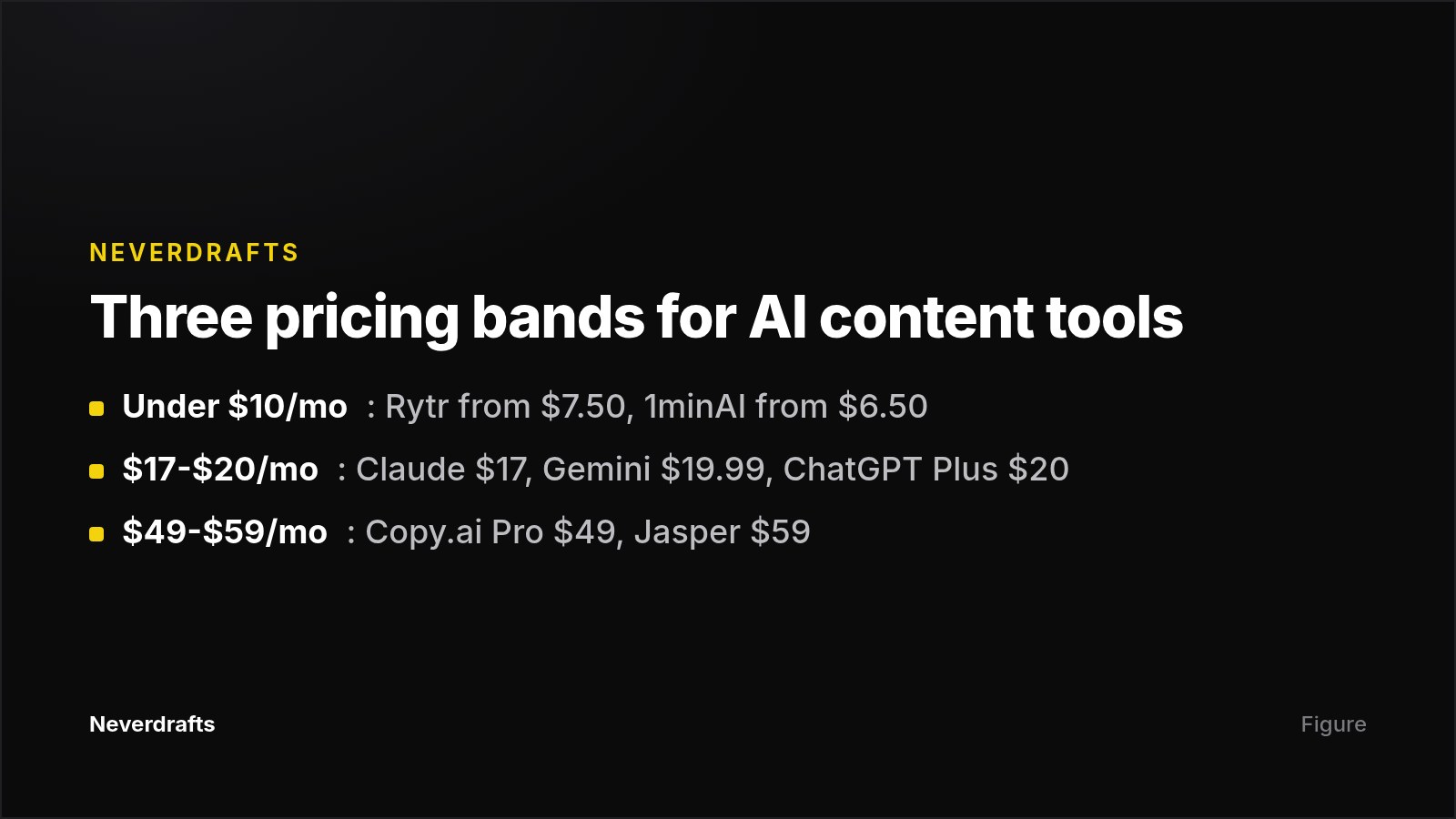
- Pricing clusters into three bands: free/under $10 (Rytr, 1minAI), $17–$20 for premium chat assistants (ChatGPT Plus, Claude, Gemini), and $49–$59 for marketing platforms (Copy.ai Pro, Jasper).
- Over 60% of marketers have already put AI content tools into their workflow, and 83.2% of content marketers planned to use them in 2024.
- Every option on this list hallucinates. Human oversight is a must, regardless of price.
- No single tool wins outright. Match the tool to the job: drafting, optimizing, or publishing.
Summary table: best AI content generators in 2026
| Tool | Best for | Standout feature | Pricing |
|---|---|---|---|
| ChatGPT | General-purpose drafting and brainstorming | Deep research, file/image input, voice mode | Free plan; from $20/month |
| Gemini | Teams inside Google Workspace | "Gems" — reusable custom AI agents | Free version; from $19.99/month |
| Jasper | Marketing and content teams | Brand voice plus pre-built templates | $59/month, 7-day trial, no free plan |
| Writesonic | Long-form content marketing | Sonic Editor, a Docs-style writing surface | GPT-4 for premium users |
| Neverdrafts | Publishing SEO articles on autopilot | Auto-generates and publishes to your CMS | From $99/month; $1 three-day trial |
| Copy.ai | Short-form ads and social copy | "Infobase" for brand details | Free: 2,000 words/month; Pro from $49/month |
| Rytr | Affordable short-form writing | PAS and AIDA copywriting frameworks | Free plan; from $7.50/month |
| Claude | Long-form writing with complex reasoning | Google Workspace integration, sentiment analysis | Free plan; from $17/month |
Disclosure: Neverdrafts is our product.
ChatGPT: the default general-purpose choice
OpenAI's ChatGPT is the tool most people reach for first, and it handles blog posts, captions, product descriptions, summaries, and draft feedback in a conversational format that makes follow-up edits easy. Free access is available, with ChatGPT Plus at $20/month for better output and faster responses.
Two limitations matter. The release of GPT-5 introduced tight rate limits on free plans, and free users can't override automatic model routing. It also has no built-in SEO scoring or publishing workflow — it produces text, and the rest is on you.
Gemini: best if you live in Google Docs
Gemini's advantage is location. It runs inside Google Workspace, so you can draft in the Docs sidebar and insert output directly into the document. It also has real-time access to Google Search, which helps when writing about current events or time-sensitive stats.
The most useful feature is Gems — custom AI agents you configure once with your own instructions, tone, and goals, so you stop re-prompting. Gemini has no built-in keyword analysis or content scoring, and like ChatGPT it can state incorrect answers confidently.
Jasper: best for marketing teams with a brand voice to protect
Jasper is built for businesses and content teams rather than individuals. You pick a template — blog intro, Facebook ad — add details, and it writes. Its differentiator is brand voice settings plus a memory of facts about your business and products.
It also integrates with Surfer SEO, Grammarly, and Copyscape, covering optimization, grammar, and plagiarism in one workflow. The cost is the catch: $59/month with a 7-day trial and no free plan. Zapier names it the best pick for businesses, which is the right frame — solo bloggers will find cheaper options that do enough.
Writesonic: best for volume long-form content
Writesonic is tuned for scale: long-form blog content, landing pages, and product descriptions. It uses GPT-4 for premium users and includes Sonic Editor, a Google Docs-style interface where you draft and polish in one place, plus a Chatsonic assistant that pulls live data.
Zapier lists it as the best option for content marketing. Published pricing details are thin across the sources reviewed here, so check current tiers before committing.
Neverdrafts: best when you need published pages, not drafts
Disclosure: Neverdrafts is our product. Every other tool on this list hands you text and stops. Neverdrafts monitors what ChatGPT, Claude, Google AI Mode, and Perplexity actually answer for your tracked prompts, auto-generates articles targeting the prompts you're losing, and publishes them one-click to WordPress, Webflow, Shopify, Framer, or via API.
It suits B2B SaaS teams and agencies who care about being cited in AI answers, not just word count. Plans start at $99/month (1 brand, 50 tracked prompts daily, 30 articles/month), with a $1 three-day trial. Limitations are real: it is not a freeform chat assistant, it will not write your ad copy or fiction, and pricing starts well above the $7–$20 consumer tools.
Copy.ai: best for short-form ads and social
Copy.ai leans toward quick, punchy output. It ships with over 90 templates and an "Infobase" that stores brand details so output stays consistent, plus support for 25+ languages and a team dashboard.
Its Free Forever plan allows up to 2,000 words per month, with Pro from $49/month. Quality is strongest on social posts and ad copy; blog content is more variable.
Rytr: best cheap option that still does the job
Rytr starts at $7.50/month with a free plan and includes tone-of-voice templates plus PAS and AIDA copywriting generators — useful structure for people who don't write ads professionally. Zapier names it the affordable pick. It is built for fast short-form writing, so don't expect it to carry a 4,000-word pillar page.
Claude: best for long, reasoning-heavy drafts
Claude starts at $17/month with a free plan and is positioned for long-form writing with complex reasoning, with Google Workspace integration and sentiment analysis. If your content involves technical explanation or nuanced argument rather than ad variants, it earns a trial alongside ChatGPT.
How to choose an AI content generator
Five criteria decide this, in roughly this order:
- Workflow stage. Drafting, optimizing, and publishing are different jobs. Buying a drafting tool when your bottleneck is publishing wastes money — see choosing tools by workflow stage rather than feature list.
- Control over output. The best tools let you set a default brand voice and build a knowledge base the AI treats as a source of truth. Without that, you edit every draft from scratch.
- Integrations. WordPress plugins, Google Docs add-ons, and browser extensions matter more than raw model quality because they remove copy-paste steps.
- Free tier or trial. Most tools offer one. Gemini, ChatGPT, Claude, Rytr, and Copy.ai all have free plans; Jasper does not.
- Accuracy tolerance. All generative models produce probabilistic output. Fact-check anything with a number, a name, or a date in it.
One honest caveat about every round-up including this one: no source reviewed here publishes a side-by-side output-quality comparison. Assume the major tools are close on writing quality and choose on interface, control, and integration instead.
Next step
If your bottleneck is getting SEO content live and cited rather than getting words on a page, start with a $1 three-day trial of Neverdrafts. Track the 50 prompts your buyers actually ask, see which competitors AI recommends instead of you, and publish the first remediation articles to your CMS in the same session. Agencies managing multiple brands should look at the Agency plan at $399/month for 10 brands and 500 prompts.
Frequently asked questions
Is there a genuinely free AI content generator?
Yes. Gemini's free version works with any Google account, ChatGPT offers free access with rate limits, Claude and Rytr both have free plans, and Copy.ai's Free Forever plan covers up to 2,000 words per month. Free tiers are fine for testing; they typically cap usage, restrict model selection, or limit collaboration features.
Which AI content generator is best for SEO blogging?
Jasper is the strongest single choice because it integrates with Surfer SEO, Grammarly, and Copyscape, covering optimization and plagiarism checks in one place. Gemini produces well-structured, research-backed drafts but has no built-in keyword analysis or content scoring, so you would pair it with a separate SEO tool.
Do AI content generators produce plagiarised content?
They generate new text rather than copying, but overlap with existing content can happen. Jasper integrates Copyscape for plagiarism checks. Most other tools reviewed here do not advertise built-in plagiarism detection, so run outputs through a separate checker if originality is a compliance requirement.
How big is the AI content market?
The digital content creation market was valued at $77.95 billion in 2025 and is projected to reach $258.37 billion by 2034. Adoption on the buyer side is already mainstream: over 60% of marketers use AI content tools, and 83.2% of content marketers planned to in 2024.
Can AI replace my content writer?
No. Left unsupervised, these tools tend to produce fairly generic and frequently incorrect content, even when it reads as human-written. The practical model is AI for first drafts, outlines, and repetitive formats, with a human handling strategy, accuracy, and the specificity that makes content worth citing.
Sources
- Best AI content generators in 2026: Top 8 tested picks — Hostinger
- 12 best AI content generation tools in 2026 — Netlify
- Best AI Content Generators for 2025 — Type.ai
- The 7 Best AI Content Generators You Need This Year — Copy.ai
- Best AI Content Creation Tools 2025 (Free & Paid Picks) — CKEditor
- The 6 Best AI Writing Generators in 2026 — Zapier