
Yes, traditional SEO helps you show up in ChatGPT answers, but only as a foundation. It does not guarantee a citation. Crawlability, indexing in Bing and Google, and solid on-page content make your pages eligible to be retrieved. ChatGPT then chooses which passages to cite based on how directly they answer the prompt, how current they look, and how well other sites corroborate your brand.
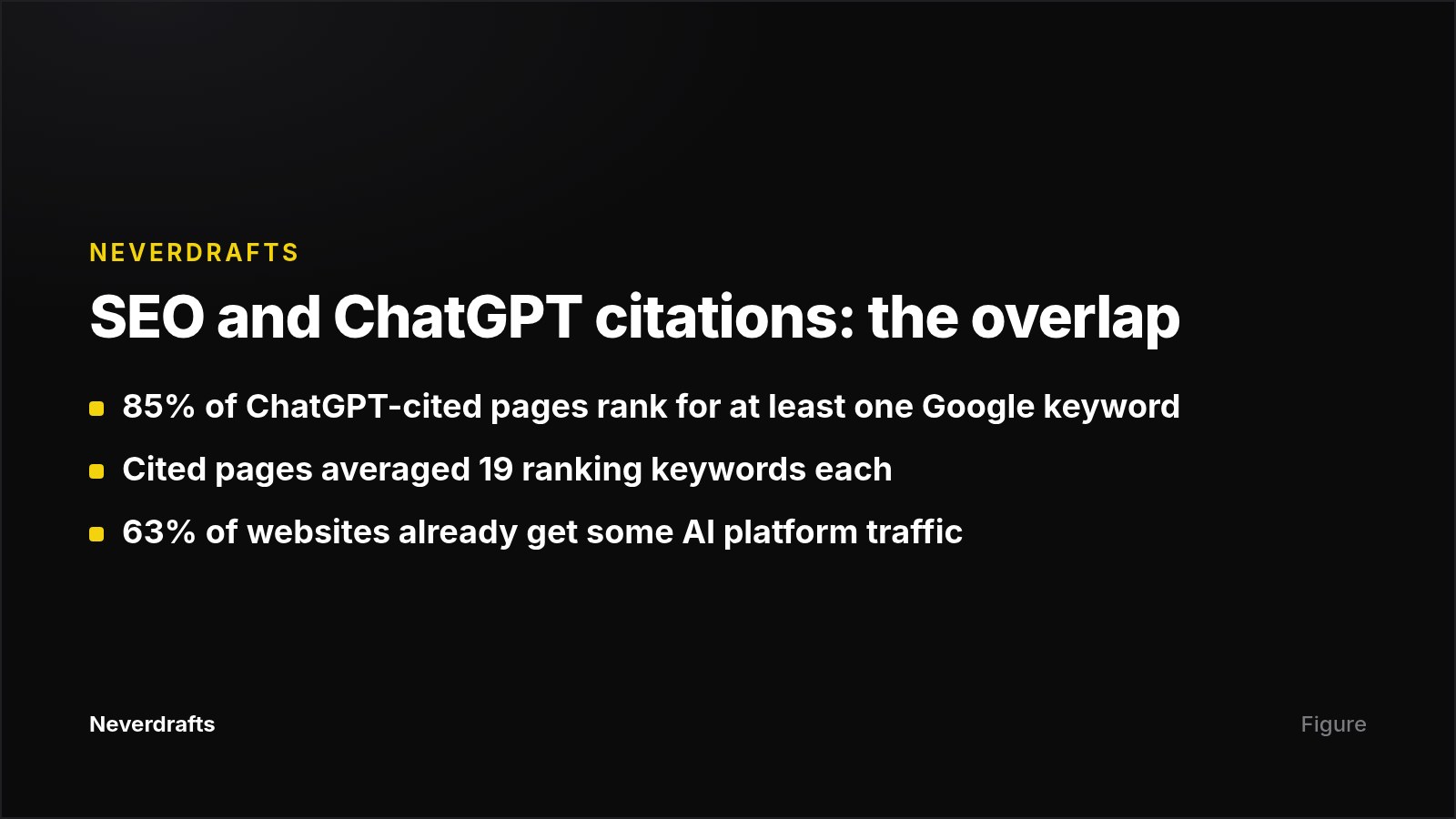
In a Semrush case study, 85% of ChatGPT-cited pages also ranked for at least one keyword in Google. Ranking is close to a prerequisite. It is not enough on its own.
Key takeaways
- SEO is the entry ticket. ChatGPT runs live web searches against Bing primarily, with Google secondary. If your pages aren't indexed, they can't be cited.
- Indexed and cited are separate steps. Retrieval makes a page eligible. Citation depends on whether ChatGPT finds a clean, quotable passage from a credible source.
- One robots.txt rule matters a lot. If you block OAI-SearchBot, your site will not be shown in ChatGPT search answers. Blocking GPTBot only affects training.
- Specificity and freshness carry extra weight. An Authority Tech study of Perplexity citations, which RankAI says applies equally to ChatGPT, found pages with specific data points are cited at roughly 2-3× the rate of vague-prose pages, and 65% of AI bot hits target content less than a year old.
- Off-site mentions count heavily. Reddit, review platforms like G2 and Capterra, and consistent brand details across the web influence whether ChatGPT trusts you enough to cite you.
- Measure citation rate across many prompts, not one fixed ranking. Track how often you're cited and where you appear, since the same prompt can return different sources on different runs.
Does traditional SEO actually help you show up in ChatGPT?
Yes. Semrush's Petlibro case study found that AI-cited pages averaged 19 ranking keywords each, and 85% of ChatGPT-cited pages also ranked for at least one keyword in Google. Pages ChatGPT cites are usually pages search engines already find relevant.
The same source draws the obvious conclusion: traditional SEO is necessary but no longer sufficient. ChatGPT retrieves content through web search, then writes an answer that may cite you, mention you, or skip you entirely. Your rankings get you into the candidate pool. Something else decides whether you get quoted.
Evergreen Media gives practical advice on sequencing: if your SEO foundation is weak, keep focusing on it, because it's the foundation. If you're already well positioned, run a baseline check of how visible you are in chatbots and AI search engines.
This matters because ChatGPT is no longer a small channel. chatgpt.com has 3.8 billion monthly visits, ChatGPT receives over 1 billion daily queries with 300 million weekly active users, and 63% of websites already see traffic from AI platforms, although it averages under 1% of total traffic for now. Evergreen Media adds that chatgpt.com is sending increasingly more clicks to the open web, which is one reason this channel is worth a baseline audit now rather than later.
How does ChatGPT find the pages it cites?
ChatGPT Search retrieves pages from a web index, pulls out the passages that answer the prompt most directly, and attaches linked citations to the answer it writes. Evergreen Media describes generative engines as a collection of generative models plus a search engine that finds relevant documents, producing an answer in several steps and citing sources directly. That two-part design explains why SEO helps but isn't the whole story.
Step 1: Retrieval runs on a search index
ChatGPT Search uses Bing as the underlying search engine, and RankAI notes that Google serves as a secondary source. Evergreen Media cites Seer Interactive research showing that good Bing rankings often correlate with mentions in ChatGPT, though the two are not identical. Traditional SEO does its work at this step: indexability, relevance and authority decide whether your page enters the pool ChatGPT reads from.
Step 2: Selection happens at the passage level
After retrieval, ChatGPT still has to pick which passages to use. The BGR Review guide states the distinction plainly: being indexed somewhere and being selected as a cited source are different steps. The page needs a passage that answers the query cleanly, looks current, and comes from a source credible enough to justify a citation.
This is where big, well-known brands can lose to smaller ones. BGR Review observes that ChatGPT Search will skip a strong brand when the page is hard to parse or lacks a clean, quotable answer. A homepage that leads with slogans and vague claims gives the model nothing to quote. A sentence that states a specific price, the payment terms, and what's included is easy to cite because it is explicit, narrow and verifiable — even from a lesser-known site.
Step 3: The answer changes from run to run
Ask Google the same question twice and you get roughly the same results. ChatGPT works differently. Evergreen Media notes that you might enter the same question twice and receive a completely different answer, so the goal is to raise the probability of appearing, not to hold a fixed position.
Which parts of traditional SEO carry over to ChatGPT, and which don't?
Most technical and content fundamentals carry over. Keyword-centric tactics and link-building on their own carry over less. The table maps common SEO practices to their value for ChatGPT visibility.
| SEO practice | Helps in ChatGPT? | What changes for ChatGPT |
|---|---|---|
| Crawlability and indexing | Yes, essential | Bing indexing matters as much as Google. OAI-SearchBot must be allowed in robots.txt. |
| Ranking for target keywords | Partly | 85% of cited pages rank for at least one keyword, but a ranking doesn't guarantee a citation. |
| Title tags and internal links | Limited | These help discoverability but do little if the model cannot connect your brand into one consistent entity. |
| Backlinks | Partly | Brand mentions on Reddit, review sites and major publishers carry disproportionate weight. |
| Featured-snippet formatting | Yes, amplified | Evergreen Media calls generative engine optimization similar to Featured Snippet optimization, just on steroids. |
| Content freshness | Yes, amplified | ChatGPT's retrieval layer treats stale dateModified timestamps as a negative signal. |
| JavaScript-heavy pages | Bigger risk | ChatGPT's retrieval layer struggles with JS-rendered pages. |
| Structured data | Yes | Schema that ties together organization, author, service and local business helps models confirm who you are. |
Anything that makes your content easy to retrieve, parse and verify carries over or matters more. Anything aimed mainly at pushing a page up a ranked list of ten blue links matters less.
Why isn't ranking well in Google enough on its own?
Ranking well in Google isn't enough because ChatGPT chooses passages, not pages, and weighs credibility signals that sit outside your website.
People ask ChatGPT longer, more specific questions than they type into Google. Evergreen Media gives an example: instead of "best laptops 2025," a ChatGPT user asks which laptops under $1,500 suit video editing and gaming and have long battery life. ChatGPT can assemble the answer from several sources, so a page optimized for a short head term may not contain a passage that fits a question that specific.
Your own site also isn't the only source about you. Evergreen Media lists aggregators, comparison portals and trade media as strategically important when someone asks for a recommendation. If your site says less about you than your review profiles or a press mention do, the model has little reason to cite your site first.
What do ChatGPT's crawlers need from your site?
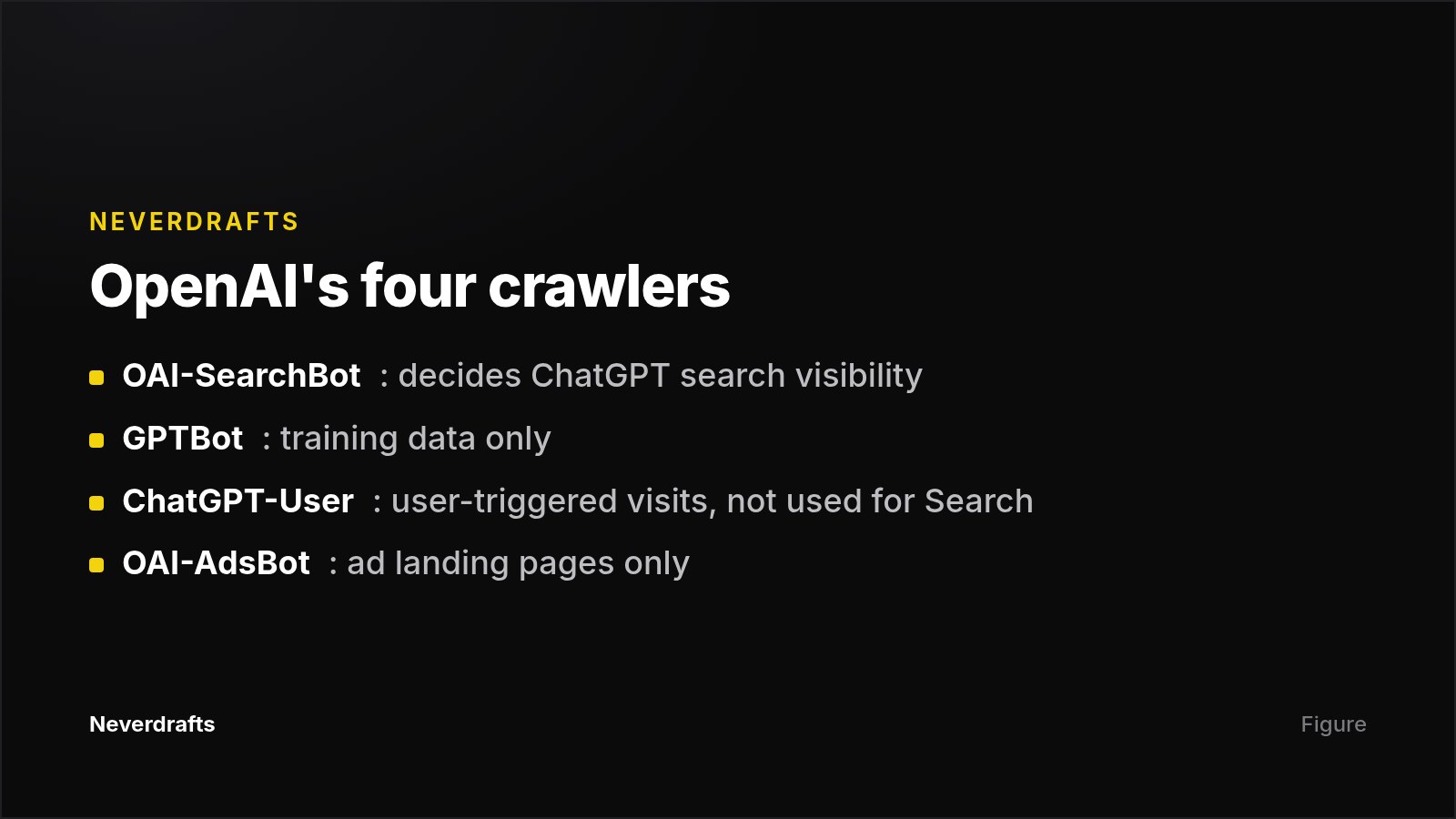
ChatGPT needs to be allowed to crawl you, and the crawler that matters for search is OAI-SearchBot. OpenAI runs four separate user agents, and each setting is independent of the others:
- OAI-SearchBot: surfaces websites in search results in ChatGPT's search features. Sites that opt out won't appear in ChatGPT search answers, though they can still appear as navigational links.
- GPTBot: crawls content that may be used to train OpenAI's generative AI foundation models. Blocking it opts you out of training, not search.
- ChatGPT-User: visits pages when users ask ChatGPT or a Custom GPT a question. It doesn't crawl automatically and isn't used to decide what appears in Search.
- OAI-AdsBot: validates the safety of pages submitted as ads on ChatGPT and only visits those pages.
This split means you can stay visible in ChatGPT answers while declining to contribute training data: allow OAI-SearchBot and disallow GPTBot.
RankAI, citing Forge & Smith, calls allowing OpenAI's crawler the single most-overlooked baseline fix. Add this to robots.txt:
User-agent: OAI-SearchBot Allow: / OpenAI also recommends allowing requests from its published IP ranges, which matters if a firewall or CDN blocks unfamiliar bots. After you change robots.txt, it can take about 24 hours for OpenAI's systems to adjust.
Because ChatGPT relies mainly on Bing, Bing Webmaster Tools deserves as much attention as Google Search Console. RankAI recommends that you:
- Set up Bing Webmaster Tools and submit XML sitemaps.
- Run Site Explorer to find 404s, robots.txt blocks and accidental noindex tags.
- Use IndexNow to push new content quickly.
- In Google Search Console, review the "Why pages aren't indexed" report and validate fixes.
- Keep critical content out of JavaScript-only rendering.
The BGR Review team starts AI-search audits by checking that key URLs are visible in the Bing index and readable as plain text without scripts, pop-ups or blocked sections.
How should you structure content so ChatGPT can extract it?
Write in passage-sized blocks, where each heading asks a question and the first sentence under it answers that question. Semrush's analysis, as summarized by RankAI, found that ChatGPT extracts cleanly from content with descriptive headings that match user questions, short single-idea paragraphs, and direct answers in the opening sentence under each heading. AI-cited pages also used bullet lists and numbered steps far more often than uncited pages.
Formatting rules that consistently help:
- Question-first H2s and H3s. Phrase headings as "What is X?" or "How do I do Y?" because ChatGPT pattern-matches user prompts to question-shaped headings.
- Definition-led opening sentences. Answer the heading in one or two lines, like a glossary entry.
- One claim per section. A precise answer page with strong headings, dated wording and one claim per section gives the model cleaner attribution than a page that tries to answer everything.
- Specific numbers instead of adjectives. The Authority Tech study of Perplexity citations found that pages with specific data points and verifiable facts are cited at roughly 2-3× the rate of vague-prose pages, and RankAI treats this as applying to ChatGPT as well.
- Visible source citations. In Princeton's GEO study, "Statistics Addition" and "Cite Sources" were the top-performing tactics, boosting AI visibility by up to 40%.
Evergreen Media's "class leader" advice goes further than formatting: provide unique information or data not found in existing training data or on other websites. Proprietary numbers, original benchmarks and first-hand pricing give ChatGPT a reason to cite you rather than one of the many pages repeating the same general advice. Before you rewrite a page, study what ChatGPT currently returns for your target question, for format, relevance and length, along with which sources and competitors are already cited.
Why do third-party mentions matter more than backlinks alone?
Third-party mentions matter because ChatGPT Search rewards brands it can identify and corroborate across the web, and it draws heavily on a small group of platforms. RankAI puts it plainly: on-page work has a ceiling, and the compounding gains come from external signals.
ALM Corp identified Reddit, Wikipedia, Amazon and Forbes as four of ChatGPT's most-cited domains. Comparable data from other AI engines points the same way: Reddit accounted for 6.6% of all Perplexity citations and 21% of all Google AI Overview citations, with similar over-indexing documented for ChatGPT.
Practical moves from the same playbook:
- Reddit: take part genuinely in category subreddits, since brand-led promotion gets flagged.
- Review platforms: get listed on G2, Capterra and TrustRadius, which ChatGPT pulls from heavily for "best X" commercial queries.
- YouTube: video transcripts are indexed and surface as citations on tutorial-style queries.
Entity consistency is an old local-SEO habit that matters more now. The BGR Review guide warns that if your footer shows one phone number, your directory listings show another, and your review profiles are half-filled, you look harder to trust than a competitor with fewer pages. RankAI gives the same advice at the brand level: your homepage, LinkedIn, G2 listing and third-party mentions should agree on one positioning line, because ChatGPT aggregates inconsistent entities into ambiguous descriptions.
OpenAI also works with selected media partners, and Evergreen Media notes that content from these partners may be preferentially treated, which makes mentions on those outlets especially valuable. None of the sources reviewed here quantify the size of this effect, so treat it as a reason to include partner publications in PR targeting, not as a guaranteed boost.
How much does content freshness matter for ChatGPT?
Freshness is a strong citation signal in ChatGPT, and the available data favors recently updated pages. 65% of AI bot hits target content less than one year old (Semrush data cited by ConvertMate), and e-commerce content updated within 30 days earns 3.2× more citations across AI platforms (ConvertMate's 2026 benchmark).
RankAI recommends a quarterly refresh of your top commercial pages, with the date visibly updated. Make the update substantive: correct outdated prices, terms and figures, because a stale claim gives ChatGPT a reason to distrust the passage. The BGR Review guide gives an example where a page still references an old guarantee window that conflicts with current terms elsewhere, and ChatGPT Search has a reason to avoid or mistrust that passage.
Which content formats win commercial ChatGPT prompts?
For buyer-intent prompts, comparison and alternatives pages win most often. RankAI reports that two formats dominate commercial-intent ChatGPT citations: comparison tables for "X vs Y" queries and alternatives lists for "X alternatives" queries.
This fits traditional SEO well, since comparison pages already target high-intent keywords. The adjustment is to make them extractable: a clear table, a one-line verdict per option, and honest limitations a model can quote. For categories with hundreds of long-tail buyer questions, one-off articles won't cover every variant, which is why some teams generate these pages programmatically.
How do you know whether your SEO is helping in ChatGPT?
You test prompts, not keywords. Google Search Console shows nothing about ChatGPT citations, so you need a separate measurement routine.
Nathan Gotch's method, summarized by RankAI, is to build a list of 50-100 buyer prompts in your category, run each in ChatGPT monthly, and record whether your brand is mentioned and at what position. Two metrics come out of it: mention rate (the percentage of prompts where you're cited) and mention position (when you are cited, whether you appear first or fifth). Because answers vary between runs, a single check proves little; running the same prompt set on a fixed schedule turns a noisy signal into a trend you can act on.
Manual tracking takes time. RankAI estimates the full six-stage process at roughly 40-80 hours of monthly work for a category team doing it by hand. Our comparison of ChatGPT brand mention tracking tools covers automated options. At Neverdrafts, we monitor real ChatGPT, Claude, Google AI Mode and Perplexity answers daily on buyer-intent prompts, score visibility from 0 to 100 per response, draft content aimed at the prompts you're losing, and track AI crawler visits to show whether a fix was picked up.
Which SEO habits should you avoid?
A few practices that are harmless in classic SEO work against you here:
- Blocking OAI-SearchBot, often by accident from a blanket "block all AI bots" rule. It removes you from ChatGPT search answers.
- Hiding key facts in JavaScript, tabs or pop-ups. Content that isn't readable as plain text is hard for the retrieval layer to extract.
- Slogan-first pages. Vague claims like "trusted solutions" give the model nothing neat to quote.
- Publishing volume before trust. The BGR Review guide recommends fixing entity clarity and review signals first, then building citation-ready pages, rather than adding more keyword pages while the About page stays thin.
- Letting pages go stale. RankAI says stale dateModified timestamps count as a negative signal, so refresh content and update the visible date together.
A checklist: traditional SEO plus the ChatGPT layer
Traditional SEO foundation
- Pages indexed in Google, with indexing issues cleared in Search Console.
- Pages indexed in Bing, with sitemaps submitted through Bing Webmaster Tools.
- Critical content rendered as plain HTML, not JavaScript only.
- Ranking for at least some relevant keywords on the pages you want cited.
- Structured data covering organization, author and service details.
ChatGPT-specific layer
- OAI-SearchBot allowed in robots.txt, and OpenAI's IP ranges not blocked.
- Question-shaped headings with a direct answer in the first sentence.
- Specific, dated facts and visible source citations instead of general claims.
- Consistent business details across your site, review profiles and directories.
- Active presence on Reddit, relevant review platforms and YouTube where your buyers look.
- Comparison and alternatives pages for your main buyer queries.
- Quarterly refresh of top commercial pages, with visible update dates.
- A monthly prompt-testing routine that tracks mention rate and position.
What don't we know yet about ChatGPT citations?
- How ChatGPT breaks ties. Sources explain what makes a page more citable, but not how ChatGPT weighs freshness, clarity and authority when several pages answer equally well.
- Ideal page length. Every source favors compact, extractable passages. None measures whether longer, deeper pages help or hurt.
- Query-type differences. Most evidence covers "best X" and "X vs Y" prompts. Informational, navigational and troubleshooting queries may follow different citation patterns.
- How fast citations decay. Quarterly refresh is the standard advice, but there's no published data on how quickly citations drop when content ages or a competitor updates first.
- The size of the partner effect. OpenAI's media partnerships may favor certain publishers, but by how much is unknown.
Treat these as reasons to test on your own prompts rather than copying a fixed recipe.
Next step
Find out where you currently stand before changing anything. Write down 50 buyer prompts in your category, check whether OAI-SearchBot is allowed on your site, and compare which competitors ChatGPT cites against your Google rankings. To automate the monitoring and the content fixes, Neverdrafts offers a $1, three-day trial with full access to any plan, so you can see your visibility score across ChatGPT, Claude, Google AI Mode and Perplexity on real prompts.
Frequently asked questions
Does ranking #1 on Google mean ChatGPT will cite me?
No. Strong Google rankings make you more likely to be retrieved, and 85% of ChatGPT-cited pages rank for at least one Google keyword. But retrieval and citation are separate steps: ChatGPT picks passages that answer the prompt directly, look current and come from corroborated sources. A lower-ranked page with a cleaner, more specific answer can still win the citation.
Should I block GPTBot if I want to appear in ChatGPT?
No, blocking GPTBot does not affect ChatGPT search visibility. GPTBot collects content for model training, while OAI-SearchBot controls whether your pages appear in ChatGPT search answers. OpenAI treats the two settings independently, so you can allow OAI-SearchBot and disallow GPTBot. Robots.txt changes can take about 24 hours to take effect.
Is Bing more important than Google for ChatGPT visibility?
For ChatGPT, yes: ChatGPT Search uses Bing as its primary retrieval index, with Google as a secondary source, and Seer Interactive found Bing rankings correlate with ChatGPT mentions. Submit sitemaps in Bing Webmaster Tools, fix any indexing errors, and use IndexNow to get new content picked up quickly.
Do backlinks still matter for ChatGPT?
Backlinks still support the search rankings that make retrieval possible. For citations, though, brand mentions on specific platforms carry more weight. Reddit, Wikipedia, Amazon and Forbes are among ChatGPT's most-cited domains, and review sites like G2 and Capterra feed many "best X" answers. Consistent descriptions of your brand across those places help ChatGPT trust and cite you.
How long does it take to start appearing in ChatGPT answers?
There is no published benchmark. The technical fixes are fast: robots.txt changes register in about a day. Citation gains depend on indexing, content changes and off-site mentions building up, which takes longer, so track your mention rate across a fixed set of prompts each month instead of judging from a single result.