
To find which prompts your competitors appear in across AI search, run a consistent set of buyer-intent questions through ChatGPT, Perplexity, Claude, Gemini, and Google AI Overviews on a schedule. Record every brand each answer names and every source it cites, then filter for "competitor-only prompts," where rivals are recommended and you are not. You can do this by hand for a small prompt set, but dedicated AI visibility trackers are faster and more reliable because they rerun prompts daily, store raw answers, and flag gaps automatically.
Key takeaways
- A competitor prompt gap is a buyer-intent prompt where one or more competitors are mentioned, cited, ranked, or recommended while your brand is absent (MaxAEO).
- Keyword gap tools are not enough. AI answers draw on a different blend of sources, summaries, and entity associations than blue-link rankings (MaxAEO).
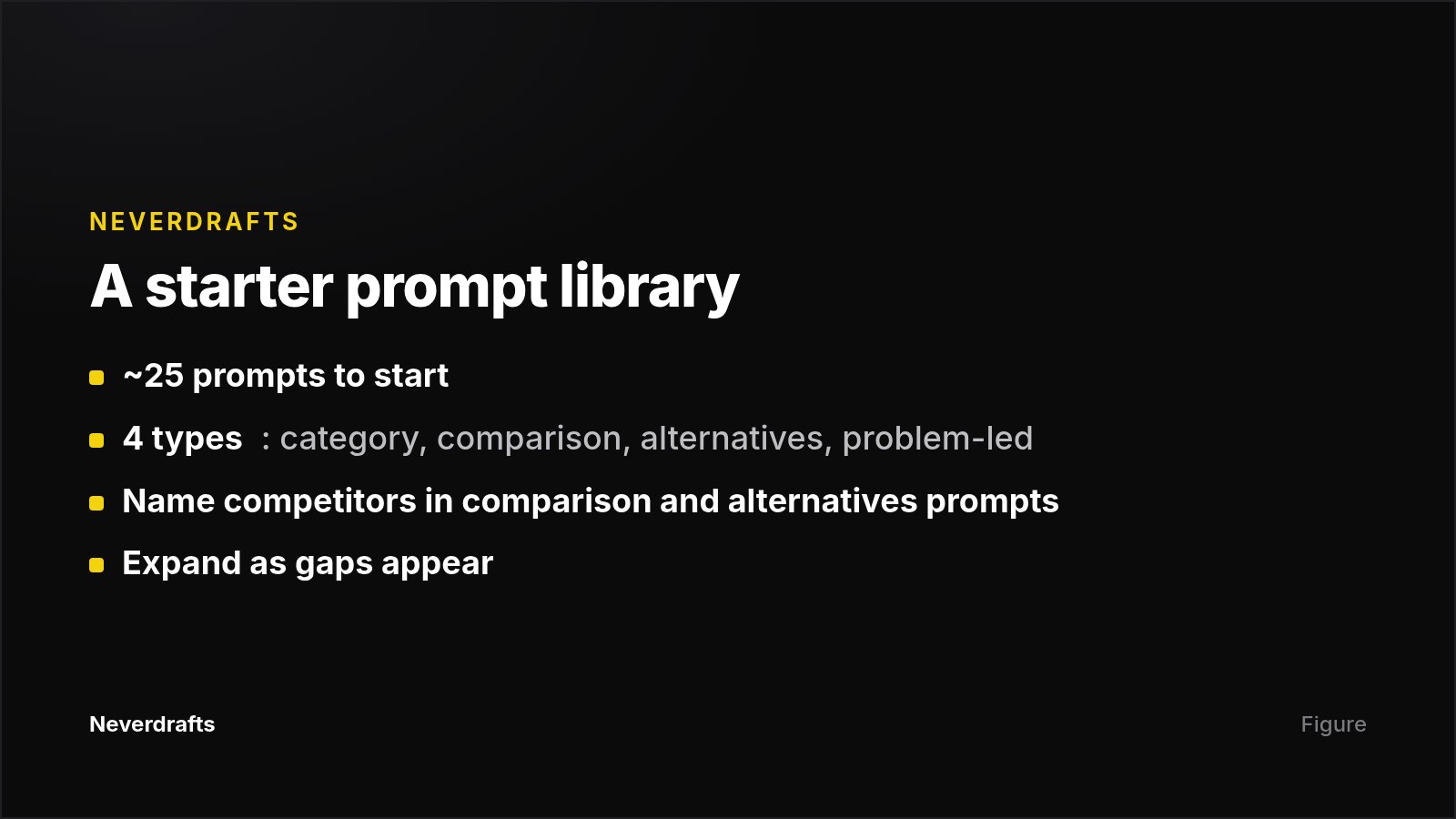
- Start with around 25 prompts covering your core category, main competitors, and the problems you solve, then expand as gaps appear.
- Track citations separately from mentions. Being named in an answer and having your website cited are different outcomes.
- Classify gaps as Absent, Outranked, or Mispositioned, and score them on a 1–5 scale across five dimensions. Prompts scoring 18–25 out of 25 are usually the highest priority.
What do you need before you start?
You need four things before running a single prompt:
- A named competitor list. Semrush's Keyword Gap tool compares you against up to four competitors at once, which is a reasonable size for a first list. Step 1 explains how to pick them.
- A spreadsheet or tracking tool. Each row should hold one prompt, with columns for each engine, each brand mentioned, its position, and the cited URLs.
- Access to the engines your buyers use. At minimum that means ChatGPT, Perplexity, Claude, Gemini, and Google AI Overviews. Google AI Mode, Copilot, and Grok are worth adding if your market uses them.
- Real buyer language. Sales call notes, support tickets, and forum threads tell you how customers phrase questions. Your marketing copy usually does not.
Plan for this to be ongoing work rather than a one-time audit. AI answers change as models update and new sources appear. PromptRush notes that daily tracking shows those shifts when they happen rather than months later.
Step 1: Define which competitors you're actually competing with in AI answers
Start by separating two kinds of competitors. Semrush draws the line this way:
- Business competitors sell similar products to the same audience.
- SEO competitors appear in search or AI results for the queries you target, even if they sell something different.
Semrush's example: for a prompt like "running shoes for flat feet," Nike's business competitors are brands such as On and Brooks, but its SEO competitor is Runner's World, a publisher. In AI search the same split matters. A review site or comparison blog can shape the answer as much as a rival product does.
Concrete actions:
- List the companies your sales team loses deals to most often. These are your business competitors.
- Search five or six of your core category questions in Google and in an AI assistant. Note which publishers, review sites, and forums keep appearing. These are your content competitors.
- If you use Semrush, check the Competitive Positioning Map in Domain Overview to see which domains rank for similar terms.
What good looks like: a short list of business competitors you will track as brand mentions, plus a separate list of influential publishers you will watch as cited sources.
Common mistake: tracking only the brands you consider rivals. Many trackers, including PromptRush, detect every brand named in your answers automatically. Pay attention when an unfamiliar name keeps appearing. AI assistants may group you with companies you never thought of as competitors.
Step 2: Build a prompt library that mirrors how buyers ask
A prompt is not a keyword. Buyers ask full questions such as "What is the best project management tool for a 10-person team?" (Surva.ai). Your prompt list should read like those questions.
Which prompt types should you include?
PromptRush recommends mixing four types:
| Prompt type | Example | What it reveals |
|---|---|---|
| Category | "best email security tool for small businesses" | Whether AI puts you on the shortlist |
| Comparison | "[your brand] vs [competitor]" | How AI weighs you head to head |
| Alternatives | "alternatives to [competitor]" | Buyers who are ready to switch |
| Problem-led | "how do I stop emails going to spam" | Whether AI connects your brand to the problem you solve |
For competitor research, the alternatives and comparison types are the most direct. An "alternatives to [competitor]" prompt shows which brands AI considers substitutes for that rival, and whether you are one of them.
Where do good prompts come from?
Use several sources so you don't build a list that only reflects your own assumptions:
- Competitor websites. Page titles, headings, and navigation show which topics rivals prioritize (Semrush).
- Your existing keywords. Convert SEO terms into natural-language questions. Surva.ai and PromptRush both describe keyword-to-prompt expansion as a bridge between SEO and AI visibility. If you are unsure how the two relate, see our explainer on whether traditional SEO helps you show up in ChatGPT answers.
- Sales calls and support tickets. The questions prospects ask your team are often the questions they ask AI first.
- Reddit and niche forums. Look for threads where people ask for recommendations in your category.
- Competitor-sourced discovery. Some tools find prompts where rivals are already winning. Surva.ai does this through DataForSEO's LLM Mentions API. Ahrefs' Brand Radar lets you explore a pre-indexed dataset of 380+ million prompts per month instead of starting from a blank list.
What good looks like: about 25 prompts, worded conversationally, covering all four types and naming your main competitors in the comparison and alternatives prompts.
Common mistake: writing prompts in keyword shorthand ("CRM small business best"). PromptRush advises keeping the wording close to how real buyers ask, including longer, conversational questions.
Step 3: Choose how you'll run and record the prompts
You can run prompts by hand or use a tracker. The right choice depends on how many prompts you need to monitor and how often.
When is manual tracking enough?
Manual checks work for a first look. Open each engine, paste each prompt, and record the brands named, their order, and any cited links. For 25 prompts across five engines that is 125 answers per pass.
The weakness is noise. AI answers vary between runs, and MaxAEO points out that one-time checks are unreliable. A competitor appearing once in one engine does not mean much. You need repeated runs before patterns become clear.
What should a tracking tool do?
MaxAEO argues the software must do four things together: run repeatable prompts, compare your brand with competitors, identify prompts where competitors appear and you do not, and trace the cited sources. Without all four, the gap list will be incomplete. Two more features are worth checking for: storage of raw answer text, so you can audit what was said later, and recommendation position, because being listed first is different from being mentioned at the bottom.
How do the main tools compare for this job?
| Tool | Approach | Engines / scope | Competitor-gap features | Notable limits |
|---|---|---|---|---|
| Ahrefs Brand Radar | Large pre-indexed dataset plus custom monitoring | 380M+ prompts/month; also YouTube, TikTok, Reddit | Explore which brands appear across a whole category | Built around exploration more than tightly defined prompt sets |
| Profound | Structured prompt monitoring | Wider range of AI platforms than Ahrefs | Visibility, sentiment, citation share, prompt demand estimates | Non-enterprise plans capped at 50–100 prompts |
| Surva.ai | Prompt tracking with discovery | 5 platforms | Competitor prompt discovery, visibility gap alerts, CPC and trend data per prompt | Five-engine scope |
| PromptRush | Daily prompt scans | ChatGPT, Gemini, Perplexity, AI Overviews, AI Mode; Claude via add-on | Competitor benchmarking, source tracking | Claude requires an add-on |
| MaxAEO | Monitoring and competitor intelligence | 8 AI engines | Prompt-level gaps, recommendation position, raw answers | Engine list and plan limits vary — confirm with vendor |
| Neverdrafts | Monitoring plus auto-remediation | ChatGPT, Claude, Google AI Mode, Perplexity | Competitor citation analysis, position-weighted scoring | Four engines; Starter covers 50 prompts |
Ahrefs Brand Radar and Profound represent the two main approaches: Brand Radar behaves more like a research engine you can point at an unfamiliar category, while Profound is organized around monitoring prompts you've already chosen. Surva.ai, PromptRush, and MaxAEO are built specifically for prompt-level competitor comparison. Surva.ai stands out for discovery, combining AI-generated research, competitor-sourced prompts, and keyword expansion, and it shows search volume, CPC, and ad count next to each prompt to help judge commercial value. MaxAEO covers the widest engine list of the group and offers a free AI visibility diagnosis report.
Common mistake: choosing a tool on engine count alone. Check whether it can filter to "competitor present, we're absent," and whether it shows cited URLs. Those two features are what turn tracking into competitor research.
Step 4: Run every prompt across engines, repeatedly
Different engines give different answers. Surva.ai notes that ChatGPT, Claude, Perplexity, Gemini, and Google AI Overviews use different training data, retrieval methods, and content preferences. A brand that dominates in Perplexity may be absent from Claude entirely.
Concrete actions:
- Run each prompt in every engine on your list. If your market is location-specific, set the country. PromptRush asks for the country you sell in during setup.
- Record the full answer text, not just a yes or no for each brand.
- Repeat on a schedule. Dedicated tools typically rerun prompts daily. If daily isn't feasible by hand, aim for at least weekly checks on your top prompts.
- Note each brand's position in the answer: first recommendation, part of a list, or a passing mention.
What good looks like: after a couple of weeks, each prompt shows a mention rate per brand per engine. For example, a competitor named in four of five platforms while you appear in one, like the example in Surva.ai's prompt results view.
Common mistake: treating a single run as the truth. A gap that shows up once is a hint. A gap that repeats across days and engines is a finding.
Step 5: Filter for competitor-only prompts and classify each gap
Now sort the data. The core view is every prompt where at least one tracked competitor appears and you do not. Most trackers have this filter. Surva.ai, for example, sends visibility gap alerts when competitors appear in prompts where you don't.
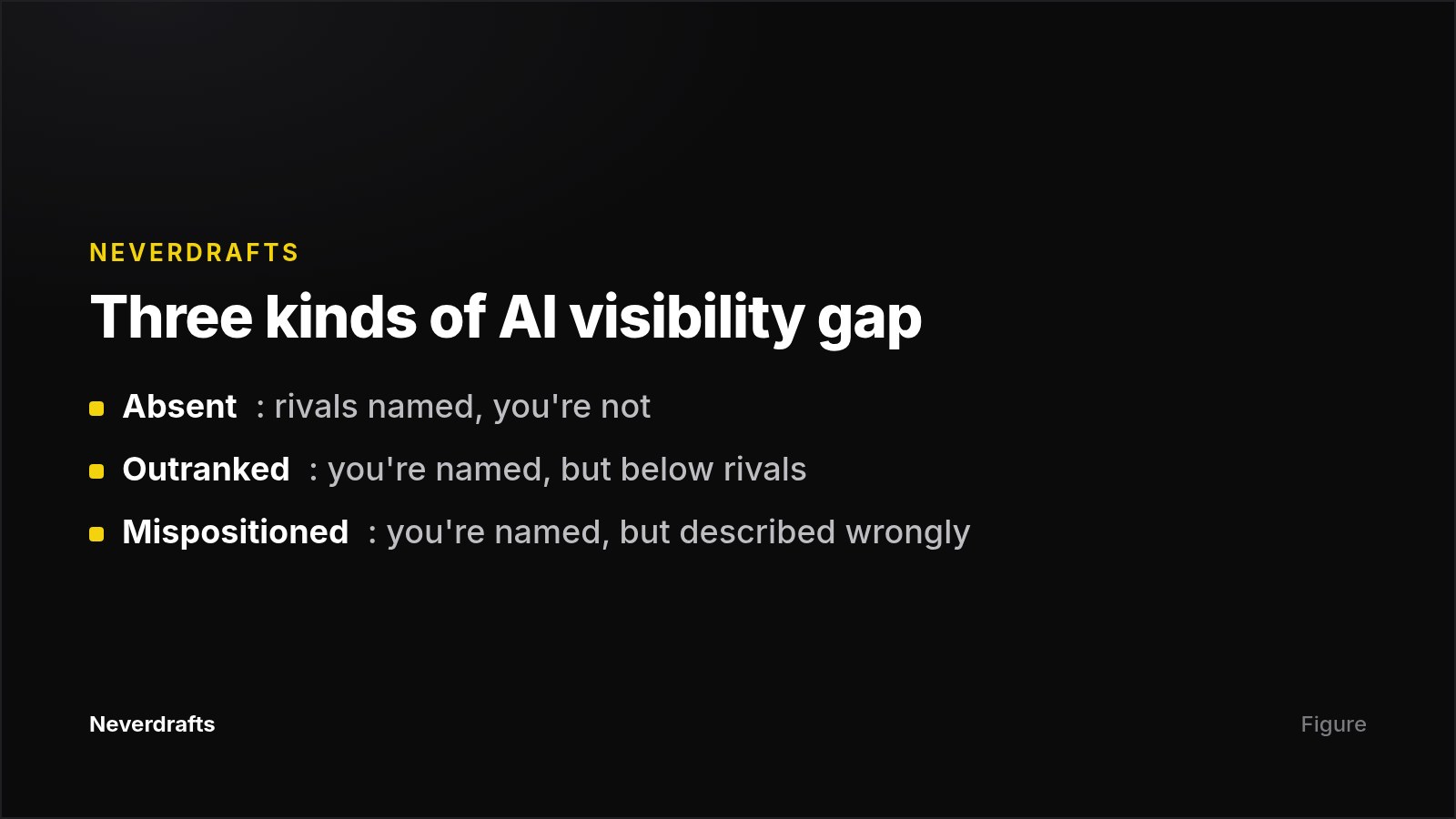
Stopping at present-or-absent misses useful detail. MaxAEO's Absent, Outranked, Mispositioned model separates three failure modes:
- Absent: competitors appear and you don't. Likely causes include weak entity association, missing comparison content, few third-party citations, or thin topical coverage.
- Outranked: you appear, but competitors are recommended above you. This often points to weaker proof points, vaguer positioning, or fewer cited sources supporting your relevance.
- Mispositioned: you appear, but the answer describes you incorrectly, too narrowly, or with outdated information.
Add a column to your spreadsheet for this classification. Each type calls for a different fix. Absent prompts usually need new category content and more third-party sources. Outranked prompts need stronger comparison assets. Mispositioned prompts need clearer documentation, updated messaging, and corrections to stale third-party descriptions.
Common mistake: ignoring sentiment. MaxAEO notes that a negative or cautious mention can be worse than no mention. Read the actual sentences, not just the brand count.
Step 6: Trace the sources behind each competitor mention
Trace each competitor mention by listing the URLs the engine cited, because AI engines lean on review sites, comparison articles, forums, and publications rather than inventing recommendations (PromptRush).
Concrete actions:
- For each competitor-only prompt, list the URLs the engine cited. Perplexity attaches numbered citations to every answer, which makes it a good place to start.
- Group the citations by domain across all your prompts. Look for publishers or review sites that appear again and again next to competitor mentions.
- Mark which of those sources you could realistically influence: a listicle you could pitch, a review platform where you could collect reviews, or a forum thread you could take part in honestly.
- Check which of your own pages are cited, if any. Those pages are working, so build on them.
What good looks like: a short list of third-party domains driving competitor visibility in your category, each labeled with whether and how you could earn a presence there.
Common mistake: confusing mentions with citations. A brand can appear in an answer without any of its pages being referenced. If competitors are named because a popular comparison article lists them, rewriting your homepage won't change much. Earning a place in that article might.
Step 7: Score and prioritize the gaps
You will likely find more gaps than you can fix at once. Not every competitor-only prompt deserves the same urgency. A rival appearing once in one engine matters less than three rivals recommended across six engines.
Score each gap from 1 to 5 on five dimensions:
- Intent strength. Is the prompt informational, comparison-based, or purchase-ready?
- Competitor coverage. How many competitors appear?
- Engine breadth. Does the gap repeat across multiple engines?
- Citation fixability. Can you reach the cited sources through content, PR, documentation, review sites, or comparison pages?
- Business value. Does the prompt map to a high-value segment or product line?
Add the scores for a total out of 25. (MaxAEO's 18–25 priority threshold assumes you sum the five 1–5 scores, rather than multiply them.) MaxAEO suggests prioritizing prompts scoring 18–25. These are typically bottom-funnel questions where AI assistants are building a shortlist without you.
One optional input helps break ties. Surva.ai shows a 12-week trend score per prompt, which helps separate prompts with growing interest from prompts nobody asks anymore.
Common mistake: chasing the prompt with the most competitors rather than the one with the highest business value. A crowded informational prompt can matter less than an "alternatives to [your biggest rival]" prompt where only one competitor appears.
Step 8: Act on the gaps and re-measure the same prompts
Competitor research only pays off if it changes what you publish and pitch. Match each fix to the gap type from Step 5 and the sources from Step 6:
- Absent: publish category and comparison content that clearly links your brand to the prompt's topic, and go after the third-party sources that name competitors.
- Outranked: strengthen proof points with specific use cases, integrations, and comparison pages that make your positioning concrete.
- Mispositioned: update product documentation and messaging, and correct outdated descriptions on review sites and directories.
Keep tracking the same prompts after you act. Historical data shows whether new content, reviews, and PR actually move your visibility. Without a before-and-after comparison on identical prompts, you can't tell whether a change worked or whether the model shifted on its own.
What good looks like: a monthly review showing each high-priority prompt's mention rate and position before and after the fix, by engine.
Common mistake: changing prompt wording partway through. If you rewrite a prompt, you lose the baseline. Add new variants as new rows instead.
What mistakes should you avoid when tracking competitor prompts?
Most failed competitor-prompt audits come down to a handful of repeat problems:
- Relying on keyword gap tools alone. They show where rivals rank, not where AI recommends them. Semrush itself frames keyword gaps as only the first of three layers, alongside AI visibility and conversation visibility.
- Tracking one engine. Results differ by platform, so a single-engine audit can hide your biggest gaps.
- Starting too big. Hundreds of untested prompts produce a noisy dashboard. Start around 25 and expand where gaps cluster.
- Ignoring answer position. Being mentioned last after three competitors is not the same win as being recommended first.
- Skipping the raw text. Counts hide mispositioning. Read what the AI actually says about you and your rivals.
- Hitting plan limits. Check prompt caps before you commit to a tool. Profound's non-enterprise plans, for example, cap monitoring at 50–100 prompts.
- Treating it as a one-off. Model updates shift recommendations week to week. A gap list from three months ago may be out of date.
Troubleshooting tip: if a competitor appears everywhere but you can't find a pattern in its citations, check whether the engine cites any sources for that prompt at all. An answer with no visible citations may be drawing more on training data than live retrieval, which can make third-party coverage and consistent entity descriptions a more productive focus than editing any single page.
Next step
To see where you stand before building a full prompt library, run the free Neverdrafts audit. It takes about 30 seconds, needs no card, and shows your current AI visibility for your domain. If competitors are already winning your priority prompts, our comparisons with Profound and Searchable explain how monitoring-plus-remediation differs from monitoring alone.
Frequently asked questions
Can I find competitor prompts for free?
Yes, for a small set. Run around 25 buyer questions by hand in ChatGPT, Perplexity, Claude, Gemini, and Google AI Overviews, and log every brand named and every source cited in a spreadsheet. Several vendors, including MaxAEO and PromptRush, also offer free visibility reports. Manual checks are noisy, though, because answers vary between runs. Repeat each prompt over several days before drawing conclusions.
How many prompts should I track to find competitor gaps?
Start with around 25 prompts covering your core category, your main competitors, and the problems you solve, then add more where gaps cluster. That size is enough to reveal patterns without burying you in data. Mix category, comparison, alternatives, and problem-led prompts, and name your competitors directly in the comparison and alternatives questions.
Why does a competitor show up in AI answers when I outrank them on Google?
AI answers rely on a different blend of sources, summaries, and entity associations than traditional rankings. A competitor may be listed in widely cited comparison articles, review sites, or forum threads that AI engines draw on, even if its own pages rank lower. Tracing the cited sources for each prompt usually explains the gap.
What's the difference between being mentioned and being cited?
A mention means the AI names your brand in its answer. A citation means it links to or references one of your pages as a source. You can be mentioned without being cited when the AI learned about you from third-party sites. Track both, because they point to different fixes: content on your site versus presence on external sources.
How often should I recheck competitor prompts?
Dedicated tools typically rerun prompts daily, because model updates and new sources can change recommendations from week to week. If daily isn't feasible by hand, aim for at least weekly checks on your highest-priority prompts. Keep prompt wording identical between checks so you can compare results over time and tell real shifts from random variation.
Which AI engines matter most for competitor research?
Track at least ChatGPT, Perplexity, Claude, Gemini, and Google AI Overviews, and add Google AI Mode, Copilot, or Grok if your buyers use them. Each engine uses different data and retrieval methods, so a competitor can dominate one and be absent from another. Per-engine reporting shows where rivals are strongest and where you should focus.
Sources
- Semrush: How to find competitor keywords and close visibility gaps
- MaxAEO: Which AI search optimization software identifies prompts where competitors appear and my company does not?
- Surva.ai: Search Prompt Tracking
- PromptRush: AI Prompt Tracking and AI Visibility Tracker
- Style Factory: Ahrefs vs Profound