
The main alternatives to a done-for-you GEO agency like The Prompting Company fall into four groups:
- Monitoring platforms, from self-serve (OtterlyAI, Peec AI) to enterprise (Profound, AthenaHQ).
- Platforms that also produce content, such as Neverdrafts (our product) and Hoverboard AI.
- Your existing SEO suite, such as Semrush.
- Narrow-scope help, such as a fractional consultant, a technical SEO specialist or a digital PR firm.
Choose software if you already have people who can write and publish. Choose a content-generating platform or a part-time specialist if you don't.
Key takeaways
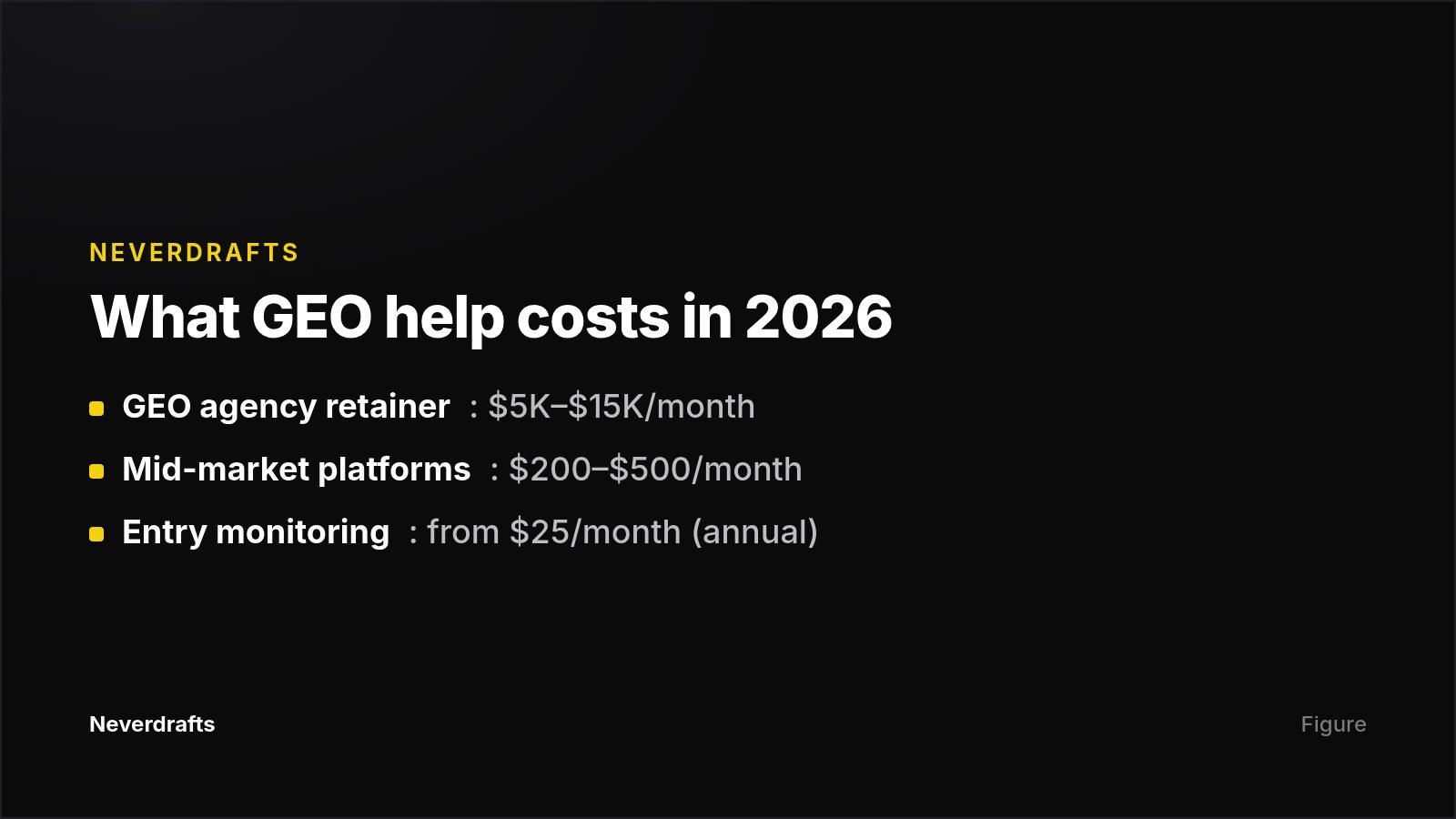
- GEO agency retainers typically run $5K–$15K per month. Most self-serve platforms cost in the low hundreds per month.
- Monitoring platforms tell you where you're missing from AI answers. They do not write content for you, so someone still has to execute.
- OtterlyAI is the cheapest entry point in this list, at $25/month billed annually for 15 prompts. Profound and AthenaHQ are the enterprise options.
- Content-generating platforms close part of the execution gap that agencies usually fill.
- The deciding question is not "agency or software." It is who turns findings into published work, as Gigawatt Group's partner comparison frames it.
What exactly are you replacing when you skip a GEO agency?
You're replacing three bundled jobs — measurement, diagnosis and execution — which The Prompting Company sells as a done-for-you service. The company was founded in 2025 and has raised $7M across two seed rounds: $500K from Y Combinator in January 2025 and $6.5M led by Peak XV Partners in October 2025. There is a base plan and an enterprise tier that adds white-glove support and SAML integration. Reported customers include Rippling, Rho, Motion and Vapi.
Its method is a useful benchmark for any alternative. Co-founder Michelle Marcelline describes running around 100 long-tail buyer prompts across ChatGPT, Perplexity, Google AI and Claude every day. The team then writes content modeled on the URLs that got competitors cited.
That breaks down into:
- Measurement: prompt tracking, share of voice and citation analysis.
- Diagnosis: finding which prompts you lose and which sources win them.
- Execution: writing, publishing and earning third-party mentions.
Every alternative below covers some of these jobs, not all. Match the gap to the tool.
How do the main alternatives compare?
Most alternatives are monitoring platforms priced in the low hundreds per month; only content-generating platforms and human specialists cover execution.
| Alternative | Type | Best for | Standout feature | Pricing (from sources) |
|---|---|---|---|---|
| OtterlyAI | Monitoring platform | Small teams, solo marketers, consultants | Low entry price, API and MCP access on Standard tier | $25–$422/mo annual; $29–$489/mo monthly |
| Peec AI | Monitoring platform | Marketing teams wanting dashboards | Polished mid-market dashboard, competitor tracking | $200–$400/mo mid-tier |
| Neverdrafts | Monitoring + content generation | Teams without writers | Drafts and publishes content for losing prompts | $99–$399/mo |
| Profound | Enterprise platform | Brands with brand-intelligence teams | Deep AI Overview reporting, procurement readiness | Enterprise tier |
| Brandlight / AthenaHQ | Mid-market and enterprise platforms | Competitor-led or segmented enterprise reporting | Clean competitor tracking / audience-segmented reports | $200–$400/mo; enterprise tier |
| FirstAnswer.ai | Specialist tool | Reputation and answer accuracy | Answer-quality analysis | Plan-dependent |
| Semrush | SEO suite add-on | Teams already on Semrush | AI visibility next to existing SEO data | Per-domain/per-user costs |
| Hoverboard AI | Agency workflow platform | Agencies and consultants running GEO | Measurement-to-task-to-content workflow | Not stated |
| Fractional consultant or audit | Human help | Teams needing strategy, not a retainer | Flexible scope | Not stated |
| Technical SEO or digital PR specialist | Narrow-scope partner | Specific crawl or authority gaps | Deep expertise in one lever | Not stated |
1. OtterlyAI: the lowest-cost way to start measuring
OtterlyAI is a self-serve monitoring platform. It tracks ChatGPT, Google AI Overviews, Perplexity and Microsoft Copilot, with Claude, Google AI Mode and Gemini available as add-ons. Cloro's four-week test positioned it as analyst-leaning with a citation-rate focus, placing its mid-tier at $250–$500/month in that comparison.
Who it's for: solo marketers, small teams and consultants who will act on the data themselves. 1Point21 Interactive rates it best for small agencies and consultants.
Strengths: every plan includes daily tracking, unlimited team members, link citation analysis and a GEO audit. The Standard tier adds API access, MCP access and agent analytics.
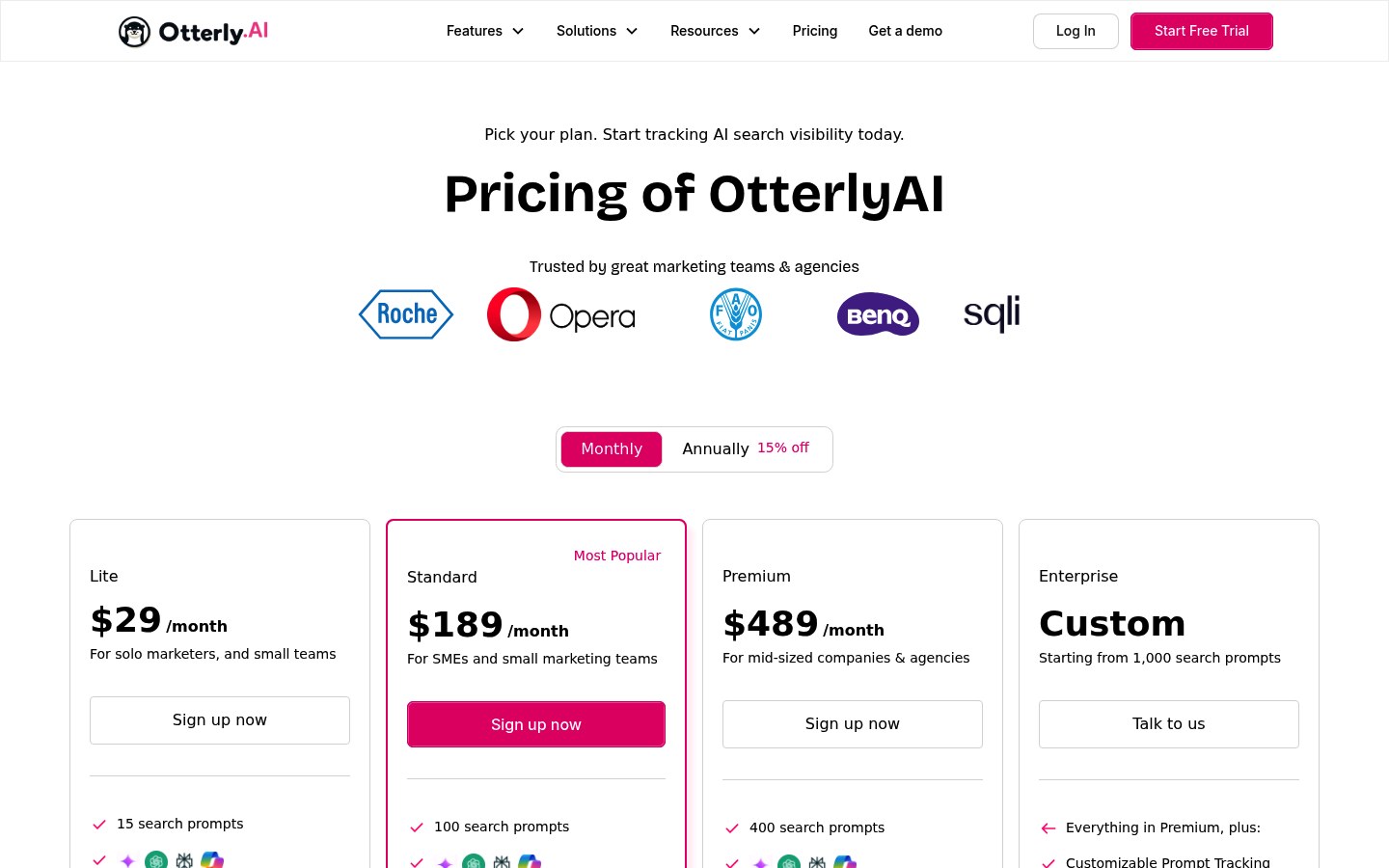
Pricing: billed annually, Lite is $25/month for 15 prompts, Standard is $160/month for 100 prompts and Premium is $422/month for 400 prompts. Monthly billing is $29, $189 and $489. On Standard and Premium, extra prompts cost $99 per 100.
Limitations: it offers less depth than a full agency operations platform. The Lite tier caps recommendations at three per week. Like every monitoring tool, it tells you what to fix but does not write the fix.
2. Peec AI: a dashboard-first platform for marketing teams
Peec AI is a mid-market measurement platform. Cloro's four-week test found it had the most polished mid-market dashboard of the group, with strong competitor tracking and a recurring stakeholder report that works out of the box.
Who it's for: marketing teams that own the GEO program and want a clean view of mention rate and share of voice.
Strengths: accessible dashboards, daily tracking, and flexible reporting connections to existing data stacks.
Pricing: Cloro places its mid-tier at $200–$400/month.
Limitations: 1Point21 notes it is more focused on measurement than campaign execution. You still need writers.
3. Neverdrafts: monitoring plus content generation and publishing
Disclosure: Neverdrafts is our product.
Neverdrafts monitors real answers from ChatGPT, Claude, Google AI Mode and Perplexity daily on tracked buyer prompts. It scores visibility from 0 to 100 per response, weighted by where you appear in the answer. For prompts where you rank absent or low, it generates content and publishes it with one click to WordPress, Webflow, Shopify or Framer, or through an API. It then tracks AI bot traffic to your site so you can see whether citations lift.
Who it's for: small businesses and lean marketing teams that want the agency workflow — measure, write, publish — without a retainer or in-house writers.
Strengths: competitor citation analysis showing which domains AI names instead of you; sentiment scoring; content generation in 150+ languages; white-label dashboards for agencies.
Pricing (see full pricing):
- Starter: $99/month (1 brand, 50 prompts, 30 articles).
- Growth: $199/month (3 brands, 150 prompts, 100 articles).
- Agency: $399/month (10 brands, 500 prompts, 300 articles).
A $1, three-day trial gives full access to any plan.
Limitations: it does not do digital PR or earn third-party mentions on sites like Reddit or industry publications. Engine coverage is four systems; it does not track Copilot, Gemini or Grok. It has no named enterprise customers or third-party validation yet.
4. Profound: the enterprise platform
Profound is what Cloro calls the polish standard: strong AI Overview reporting, deep competitive-intelligence workflows and a mature SOC 2 and procurement story. It had the most complete AI Overview coverage in Cloro's test.
Who it's for: enterprises with a dedicated brand-intelligence function where polished stakeholder reporting matters.
Strengths: broad engine coverage, advanced agency environments, and the calmest procurement path for a large buyer.
Pricing: it starts north of where mid-market budgets land.
Limitations: the price excludes mid-market buyers, and data-model lock-in limits custom segmentation. If cost is the reason you're avoiding an agency, see our guide to affordable Profound alternatives for small business teams.
5. Brandlight and AthenaHQ: competitor focus vs. segmented enterprise reporting
Brandlight is a mid-market measurement platform that Cloro rated as having the cleanest competitor-tracking workflow, priced around $200–$400/month. It suits competitor-led programs where share of voice — are you visible, or are you winning — is the headline metric.
AthenaHQ sits at the other end: an enterprise-tier platform built for audience-segmented reporting, for large organizations that need visibility broken down by audience or business unit. No public price appears in the sources.
Limitations: both are measurement tools. Execution stays with your team either way.
6. FirstAnswer.ai: answer-quality specialist
FirstAnswer.ai solves a narrow problem: how AI describes you once you appear. It analyzes whether the framing is positive, negative, complete or partial, rather than counting raw mentions.
Who it's for: brands where sentiment or answer accuracy is the dominant concern, such as a company that AI engines describe with outdated pricing or features.
Pricing: plan-dependent.
Limitations: it is a specialist, so you'll likely pair it with a broader monitoring tool.
7. Semrush: extend the SEO program you already pay for
If your team already runs Semrush, its AI visibility features put AI visibility alongside an established SEO toolset. This is the "expand your existing SEO program" route. Google itself states that foundational SEO practices remain relevant to generative AI search.
Who it's for: teams centered on Semrush whose priority is Google's AI Overviews.
Limitations: per-domain and per-user costs can become expensive across a large portfolio, and strong Google performance doesn't show how Claude, Perplexity or Copilot choose sources.
8. Hoverboard AI: for agencies and consultants doing GEO in-house
Hoverboard AI is an agency workflow platform that 1Point21 Interactive calls the best agency GEO tool on the market — a practitioner's view, since 1Point21 uses it daily, not an independent ranking.
Who it's for: SEO or content agencies and consultants who want to offer GEO themselves instead of referring clients to a specialist agency.
Strengths: prospect audits; citation analysis at the prompt, model, domain and URL level; task assignment, content ideation, article generation, and white-label PDF reporting; source data aggregated across clients in the same vertical.
Limitations: it is more platform than a business needs for occasional, single-brand checks. No pricing appears in the sources.
9. Fractional consultant or one-time audit
A part-time GEO specialist or a one-off audit gives you strategy without a retainer. There is no published pricing benchmark for fractional GEO help in the sources, so vet candidates on method rather than price.
Who it's for: teams that have writers but lack someone to build the prompt set, read citation data and prioritize work.
How to vet one: borrow Gigawatt Group's scorecard. Ask for a sample audit, their prompt framework, and a measurement plan with a baseline and a controlled prompt set. Weight diagnostic method and measurement design highly, since execution stays with you.
Limitations: quality varies widely, and you still need a monitoring tool to track progress between engagements.
10. Narrow-scope partners: technical SEO or digital PR
Gigawatt Group splits GEO partners into five types. Two are narrower than an agency:
- Technical SEO specialists suit sites with crawl, rendering, indexation, schema or architecture problems.
- Digital PR and authority firms suit brands with weak external validation.
PR work matters because AI answers cite third-party sources. Marcelline notes the mix of cited URLs, including company blogs, Reddit, Hacker News and dev.to, tells a brand where to publish.
Limitations: each covers one lever only. Technical specialists rarely produce content, and PR firms rarely fix on-site clarity.
How should you choose an alternative to a GEO agency?
Choose based on who will execute, then check engine coverage, citation-level measurement, measurement design, and what you can fund for 6–12 months. We grouped the options above using the three-bucket model from Cloro's test — measurement platforms, specialist tools and managed services — because most buyer confusion comes from comparing products that aren't the same kind of thing.
Who will do the execution?
This is the first question. If you have writers, a monitoring platform like OtterlyAI or Peec AI is enough. If you don't, you need a tool that generates content or a person who writes. Otherwise you'll have a dashboard full of gaps and no one to close them.
Which engines do your buyers use?
Coverage varies. OtterlyAI's base plans track four engines, with Claude, Gemini and AI Mode as add-ons. 1Point21 lists up to nine engines worth considering, including Grok and DeepSeek. More engines aren't automatically better; track only the ones where your buyers ask questions.
Does it measure citations, not just mentions?
Mention rate is the easiest metric to move. Citation rate, meaning how often AI links to your own pages, is the metric that most closely tracks referral traffic. Prefer tools that break citations down by domain and URL.
Is the measurement design sound?
AI answers are probabilistic. A useful setup runs a fixed, long-tail prompt set across multiple engines repeatedly and averages the results. A single screenshot can't establish a baseline.
What can you afford for 6–12 months?
GEO is a running program, not a one-off task. Compare a $5K–$15K monthly retainer against software plus internal hours, not against software alone. For more cost-led comparisons, see our page on alternatives to The Prompting Company.
Next step
If you lack writers and want the measure-write-publish loop an agency would run, try Neverdrafts' $1, three-day trial on any plan. Load 20–50 real buyer prompts, note your baseline visibility score, publish content for the prompts where you're absent, and re-measure the same prompts afterward — Cloro's own comparison used a four-week window as a reference point.
Frequently asked questions
Is a GEO platform a real replacement for a GEO agency?
It replaces measurement and diagnosis, not necessarily execution. Most monitoring platforms track mentions, citations and share of voice but don't write content. They tell you what to write about. A platform replaces an agency only if your team can produce and publish content, or if the platform itself generates content you're willing to review and approve.
How much cheaper is software than a GEO agency?
Agencies typically charge $5K–$15K per month. Mid-market platforms like Peec AI and Brandlight run about $200–$400 per month. OtterlyAI starts at $25 per month billed annually. Enterprise platforms such as Profound and AthenaHQ sit higher. Factor in the internal hours needed to act on the data before comparing totals.
How many prompts should I track?
The Prompting Company's approach starts from your top five topics and builds about 100 long-tail prompts tied to features, use cases and personas. Smaller teams can begin with 15–50 and expand. Prompts should be specific enough to reflect real buyer questions, not generic category terms.
Will traditional SEO alone get me into AI answers?
It helps, especially for Google AI Overviews, since Google says foundational SEO still applies to generative search. But strong Google rankings don't show how ChatGPT, Claude or Perplexity choose sources. AI answers also cite third-party sources such as company blogs, Reddit, Hacker News and dev.to, so separate AI tracking is worth running.
What should I ask a fractional GEO consultant before hiring?
Ask for a sample audit, their prompt-building method and how they set a measurement baseline. Also ask how they separate observation from real progress and which content they've published. Gigawatt Group's scorecard weights content execution highest at 20%, followed by diagnostic method, technical competence and measurement design at 15% each.
Sources
- [S1] How Generative Engine Optimization Works: Michelle Marcelline of The Prompting Company
- [S2] Gigawatt Group: Best Generative Engine Optimization Company for AI Visibility in 2026
- [S3] Neuron Feed: The Prompting Company startup profile
- [S4] OtterlyAI pricing
- [S5] 1Point21 Interactive: Best GEO tools for agencies
- [S6] Cloro: GEO services compared