
Small businesses that find Profound too expensive have several strong options, grouped by budget. Otterly.ai costs $29/month and gives basic multi-engine tracking. Peec AI or Promptwatch cost around $95/month for monitoring plus action recommendations. Semrush's AI Visibility Toolkit costs $99/month per domain and suits teams already working in Semrush. If you also want a tool that writes and publishes fixes, look at execution-focused platforms like Promptwatch, Frase, and Neverdrafts (our product).
The deciding question is what you are trying to escape. For most small teams, it is Profound's ChatGPT-only $99 Starter plan, with multi-engine tracking not arriving until the $399 Growth plan.
Key takeaways
- Profound's Starter plan costs $99/month for ChatGPT only, 50 prompts and one seat. Three engines require the $399/month Growth plan.
- Below $100/month, Otterly.ai, friction AI and Promptwatch each track four or more engines; Peec AI tracks three of six on its entry tier.
- Cheapest paid baseline: Otterly.ai at $29/month. AthenaHQ's free Essential tier is cheaper but credit-based, not a plain tracking dashboard.
- Best for whole-team access: Peec AI, with unlimited seats on every tier.
- Best for monitoring plus content that ships: Promptwatch, Frase, Writesonic GEO and Neverdrafts (our product).
- Most comparison articles in this category are written by vendors who rank themselves first, including several cited here. Verify pricing on each vendor's page before you buy.
What does Profound's entry plan actually give a small business?
Profound is a serious, well-funded product. It raised $96M in February 2026 at a $1B valuation, bringing total funding to $155M, and more than 10% of the Fortune 500 use it. That funding shows in the product. It also shows in who the product is priced for.
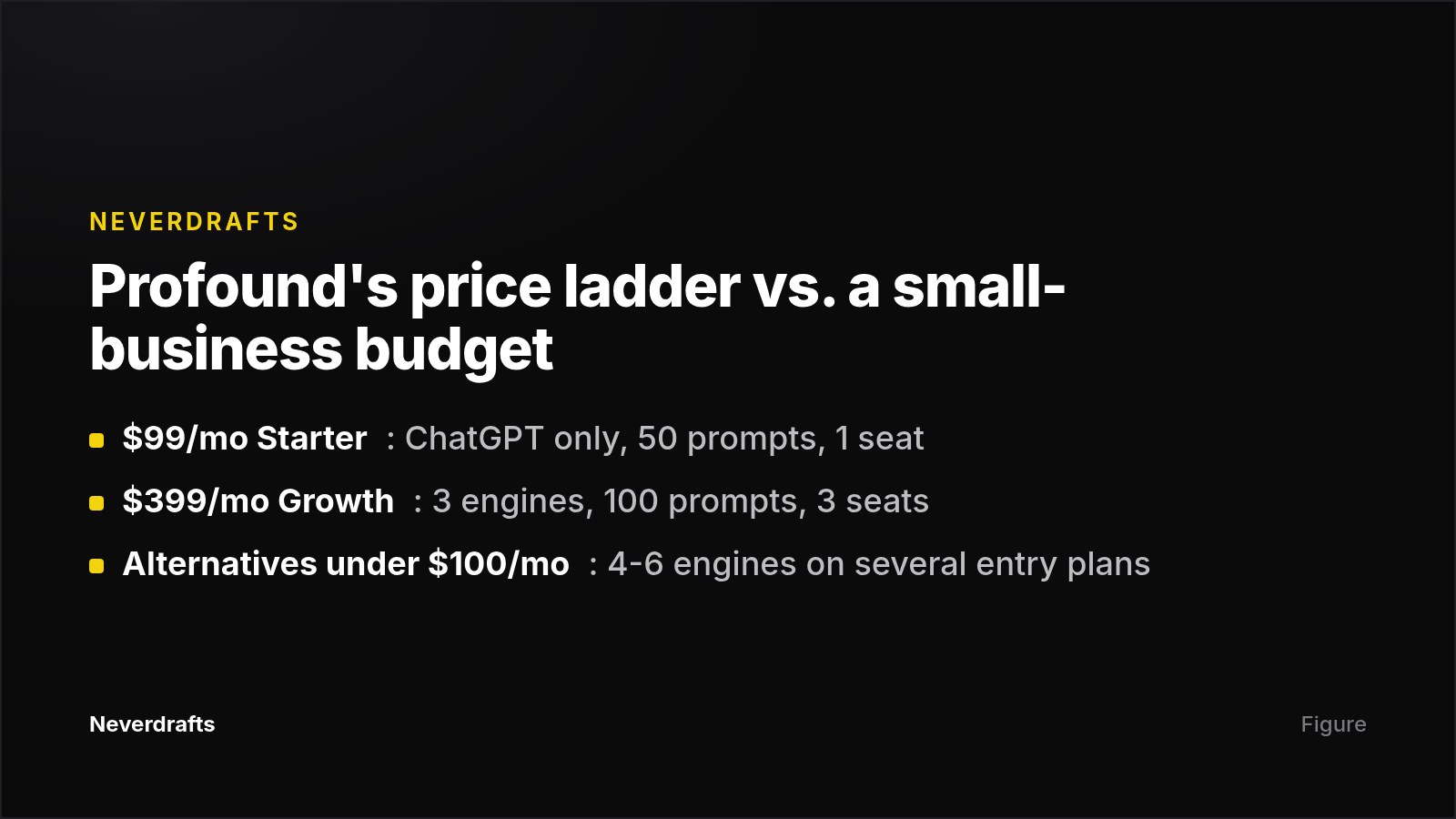
Here is the plan ladder as reported from Profound's rendered pricing page in September 2026:
| Profound plan | Price | Engines | Prompts | Agent credits | Seats |
|---|---|---|---|---|---|
| Starter | $99/month | ChatGPT only | 50 | 100 | 1 |
| Growth | $399/month (about $332.50 billed annually) | 3 | 100 | 400 | 3 |
| Enterprise | Custom quote | Up to 9 | Custom | Custom | Custom, with API and SSO |
Sources don't fully agree on the Enterprise ceiling: Frase reports up to nine engines from the rendered pricing page, while friction AI reports up to ten. Confirm the current number before an Enterprise conversation.
A small business on Starter sees one engine. That means it cannot track Perplexity or Google AI Overviews, which only arrive on Growth.
Buyers raise other issues on G2 and in public discussion:
- bugs and tracking issues
- billing errors and slow exports
- slow support responses
- a learning curve
- no white-label reporting for agencies
Yotpo's review describes Profound as built for a different kind of marketing team, with a client base that skews B2B and fintech (Plaid, Stripe, Ramp, MongoDB, DocuSign). friction AI describes it as sales-gated and designed for analytics teams with dedicated capacity.
None of this makes Profound weak. It just means a two-person marketing team is paying for a product shaped around someone else.
Which affordable Profound alternatives are worth comparing?
This round-up is built around budget ceilings. For each tool it answers two questions: what do you get at the entry price, and what do you give up compared with Profound?
Tools are listed roughly from lowest to highest entry price. Prices come from the cited sources and change often.
| Tool | Best for | Standout feature | Entry price (per sources) |
|---|---|---|---|
| Otterly.ai | Solo operators testing AI visibility | Lowest paid entry; daily alerts | $29/month |
| LLMPulse | Establishing a tracking baseline | 14-day free trial | $53/month |
| friction AI | Checking whether AI recommends you over a competitor | 3–5x prompt repetition to reduce noise | $69/month |
| Writesonic GEO | Content teams already on Writesonic | Prioritized to-do list with CMS edits | $79/month annual |
| Peec AI | Small teams that want everyone in the dashboard | Unlimited seats; action roadmap | ~$95/month |
| Promptwatch | Teams that want to act, not just monitor | Free tier; crawler log analysis | Free; $95/month |
| Neverdrafts | Small teams that want monitoring and auto-published fixes | Remediation articles included in every plan | $99/month |
| Semrush AI Visibility Toolkit | Teams already paying for Semrush | AI visibility inside an SEO suite | $99/month per domain |
| Frase | Content-led teams tying AI visibility to SEO | Tracking, drafting and publishing in one workflow | Seven-day free trial; check vendor page |
| AthenaHQ | Teams wanting a free start and broad coverage later | Free Essential tier; 9 models on Starter | Free; $295/month |
For a wider view beyond Profound substitutes, see our breakdown of AI search optimization tools that fit small business budgets.
Otterly.ai: the cheapest way to see where you stand
What it is: a lightweight tracker for brand mentions and citations across major AI engines. It reports through a simple daily-alert dashboard and is also sold through the Semrush App Center.
Who it is for: a founder or solo marketer who wants to know whether ChatGPT mentions the brand at all before committing more budget.
Strengths:
- The Lite tier costs $29/month and covers ChatGPT, Perplexity, Google AI Overviews and Microsoft Copilot.
- Promptwatch's table lists six engines, adding Google AI Mode and Gemini. The difference likely reflects tier and add-ons.
- There is a 14-day free trial.
Limitations:
- Otterly shows what is happening but does not act on it. Fixing a gap is your job.
- It has no prompt-volume data, no commerce features and no enterprise integrations.
- Advanced features sit behind upgrade prompts.
Verdict: the right first purchase if your real question is "are we visible at all?"
LLMPulse: a low-cost baseline tracker
What it is: a tracking-first tool. Demand-Genius rates it Strong on tracking and Limited on execution and impact.
Who it is for: teams that want to establish baselines before deciding whether AI visibility deserves a bigger budget.
Strengths:
- Starts at $53/month, placing it in the low-cost tier.
- Offers a 14-day free trial, enough to collect two weeks of answer data before paying.
Limitations:
- It is a measurement tool. You will need a separate process to turn findings into content.
- The cited sources give little detail on engine coverage. Confirm which engines the entry plan includes before you buy.
Verdict: a reasonable middle ground between Otterly's price and the $95 tier, if tracking is all you need.
friction AI: focused on whether AI recommends you over competitors
What it is: a self-serve platform that measures recommendation accuracy, meaning whether AI surfaces you instead of a competitor, rather than mention volume alone.
Note that friction AI publishes one of the comparisons cited here. Weigh its self-description with that in mind.
Who it is for: SMB-to-mid-market teams that want transparent pricing and care about competitive positioning.
Strengths:
- Starts at $69/month and covers ChatGPT, Claude, Gemini and Perplexity.
- Runs each prompt 3–5 times to reduce statistical noise, which addresses a real problem with single-sample answer tracking.
- Reports per-prompt failure modes, such as entity confusion, comparison bias and outdated negatives, instead of one visibility score.
Limitations:
- By its own account, it lacks Profound Enterprise's breadth: Prompt Volumes, Agent Analytics and Shopping.
- Commerce teams will not find it a complete replacement.
Verdict: a good fit for a service business or SaaS that loses deals to one or two named competitors.
Writesonic GEO: GEO features inside a content platform
What it is: a content platform with GEO (generative engine optimization) features. Frase ranks it second in its list because it sorts tracking results into a prioritized to-do list, then pushes on-page edits into a CMS.
Who it is for: content teams already on Writesonic that want visibility data next to their writing tool.
Strengths:
- Starts at $79/month on annual billing.
- Turns tracking findings into concrete edits, which moves it past pure monitoring.
Limitations:
- The Starter plan covers 3 engines. Wider coverage (10 engines) is reserved for Enterprise.
- The $79 figure assumes annual billing, so the month-to-month cost may be higher.
Verdict: worth a look mainly if Writesonic already handles your content.
Peec AI: unlimited seats and an action roadmap
What it is: a monitoring platform that generates a prioritized list of content, PR and schema actions each cycle. Frase notes it reports each prompt individually, with citation analysis across several markets.
Who it is for: small marketing teams where several people need dashboard access.
Strengths:
- Unlimited seats on every tier, which friction AI calls rare in this category.
- Setup is faster than Profound's enterprise onboarding.
- Offers a 7-day free trial.
Limitations:
- Pricing varies by source: about $95/month from Promptwatch, and $103/month from Demand-Genius after currency conversion. Demand-Genius converted its figure from local currency, so the dollar price may vary.
- The base plan covers 3 of 6 engines per tier, and Claude and DeepSeek are Enterprise-only.
- The recommendations are opinionated. Teams that want raw data for their own analysis may find it too prescriptive.
Verdict: the best value if seat count is what makes other tools expensive for you.
Promptwatch: a free tier, then execution at $95
What it is: an AI visibility platform that, like Profound, scrapes real AI interfaces rather than querying APIs. It adds crawler logs and content publishing on top. Promptwatch ranks itself first in its own comparison, so read its claims with that context.
Who it is for: teams that want to act on visibility data and need more than ChatGPT from the start.
Strengths:
- The free Explore plan is ChatGPT-only. The $95 plan lets you choose 4 of 11 platforms per project, including Claude and Grok, with prompt tracking refreshed daily.
- AI crawler log analysis connects to Cloudflare, Vercel, Netlify, AWS CloudFront and other CDNs. This shows which pages AI bots actually fetched.
- Content Agents publish directly to Webflow or Framer, with approval gates and budget caps.
- Multi-market tracking at country, state and city level is included on every plan.
Limitations:
- Only four engines are tracked per project at once, even though 11 are available to choose from.
- Direct publishing is limited to Webflow and Framer. Other CMSs need a manual export.
Verdict: a strong pick for a small team that wants both measurement and execution without paying Profound Growth prices.
Neverdrafts: monitoring plus auto-published fixes
Disclosure: Neverdrafts is our product.
What it is: Neverdrafts monitors real ChatGPT, Claude, Google AI Mode and Perplexity answers daily on the prompts you track. When competitors are recommended instead of you, it generates content aimed at winning those prompts back and publishes it.
Who it is for: small businesses and agencies that want the monitor, fix and prove loop in one tool, rather than a dashboard that leaves the writing to them.
Strengths:
- Starter costs $99/month for 1 brand, 50 tracked prompts and 30 remediation articles per month. That is the same price as Profound's Starter, but with four engines instead of one.
- One-click publishing to WordPress, Webflow, Shopify and Framer, plus an API.
- Position-weighted visibility scoring (0–100 per response), sentiment scoring, share of voice and competitor citation analysis.
- AI crawler traffic tracking, so you can see whether bots reach the pages you publish.
- White-label dashboards for agencies.
- A $1 three-day trial with full access and no contract.
Limitations:
- Engine coverage is four platforms. Gemini, Google AI Overviews, Copilot, Grok and DeepSeek are not listed.
- Starter's 50-prompt cap matches Profound Starter. Tracking more requires Growth ($199/month, 150 prompts, 3 brands) or Agency ($399/month).
- At $99 it is not the cheapest option here. If you only need tracking, Otterly or LLMPulse cost less.
Verdict: a fit if your bottleneck is producing and publishing the content that closes visibility gaps, not just seeing them. We compare it directly in Neverdrafts vs Profound.
Semrush AI Visibility Toolkit: the add-on for existing Semrush users
What it is: AI answer visibility reporting inside the wider SEO suite many teams already pay for.
Who it is for: small businesses whose SEO workflow already runs in Semrush.
Strengths:
- Costs $99/month per domain.
- Combines traditional SEO with AI visibility, so you avoid adding another login.
- Offers a 7-day free trial.
Limitations:
- Coverage is listed as ChatGPT, Google AI Mode and Gemini, and Promptwatch notes that broader engine claims are contested.
- Pricing is per domain, which Promptwatch calls the most commonly missed cost for agencies. Teams running more than one site should budget for each domain separately.
- Demand-Genius rates its Impact capability as Limited.
Verdict: sensible if you are already a customer with one domain. Less compelling as a standalone purchase.
Frase: AI visibility joined to SEO content work
What it is: a content platform that tracks ChatGPT, Perplexity, Claude, Gemini and Google AI daily, then researches, drafts, scores and publishes the page that needs fixing. Frase ranks itself first in its own list.
Who it is for: content-led small businesses where the same person owns SEO and AI visibility.
Strengths:
- Prompt-level share of voice, with each prompt sorted into awareness, consideration or decision stage.
- An AI crawler log and per-prompt targeting across 40+ countries.
- Content Guard watches published pages through Search Console for ranking decay and drafts corrections.
- Frase Answers collects the questions visitors type on your site.
- A seven-day free trial with no card required.
Limitations:
- The cited excerpt does not state Frase's paid plan prices. Check the vendor page.
- It is a broader content platform, so it may include more than a team that only wants AI tracking needs.
Verdict: a strong option if you want one tool for both Google rankings and AI answers.
AthenaHQ: free to start, broad coverage at $295
What it is: a credit-based tracking platform with action workflows. Frase notes it returns recommendations through an action center, with a content agent and a Shopify publishing path.
Who it is for: teams that want a free starting point and may later need broad model coverage or analytics integration.
Strengths:
- The Essential tier is free and covers 5 engines. Starter covers 9 models.
- Native GA4 integration connects visibility to analytics.
Limitations:
- The Starter tier costs $295/month, which is more than most budgets in this round-up allow.
- Credit-based usage makes monthly costs harder to predict.
- The sources do not explain what a small business can realistically learn from the free tier alone.
Verdict: start free. Upgrade only once the free data shows a gap worth paying to close.
Which tools did we leave out, and why?
- Ahrefs Brand Radar is priced at $398–$699/month as an add-on. Demand-Genius lists a $29 Brand Radar-only price, so pricing is disputed. Either way, it mainly makes sense for existing Ahrefs customers.
- Scrunch starts around $250/month and targets enterprise brands.
- Brandlight is built for Fortune 500 brand teams.
- Yotpo Discover targets ecommerce brands, using their own review and order data. The excerpt states no price.
- Rankscale and AI Sightline appear in some AI-generated answers, but none of our sources verify their pricing, so they are not ranked here.
How to choose an affordable Profound alternative
We used Promptwatch's four evaluation criteria and added a fifth for small teams.
- Engine coverage on the base plan. Count what you get without add-ons. Several tools advertise five to seven engines and gate some of them.
- Real monthly cost. Include add-ons, per-domain pricing and annual billing requirements. Writesonic's $79 is an annual figure, and Semrush's $99 is per domain.
- Monitor or act. Decide whether you need a dashboard or something that produces fixes. Yotpo frames this as whether a tool acts or only reports.
- Data collection method. Real-UI scraping shows what users see. API queries show something adjacent.
- Solo-operator effort. Some tools need a dedicated technical team; others are built for one marketer. If you are that one marketer, favor self-serve tools with trials.
A simple budget decision path
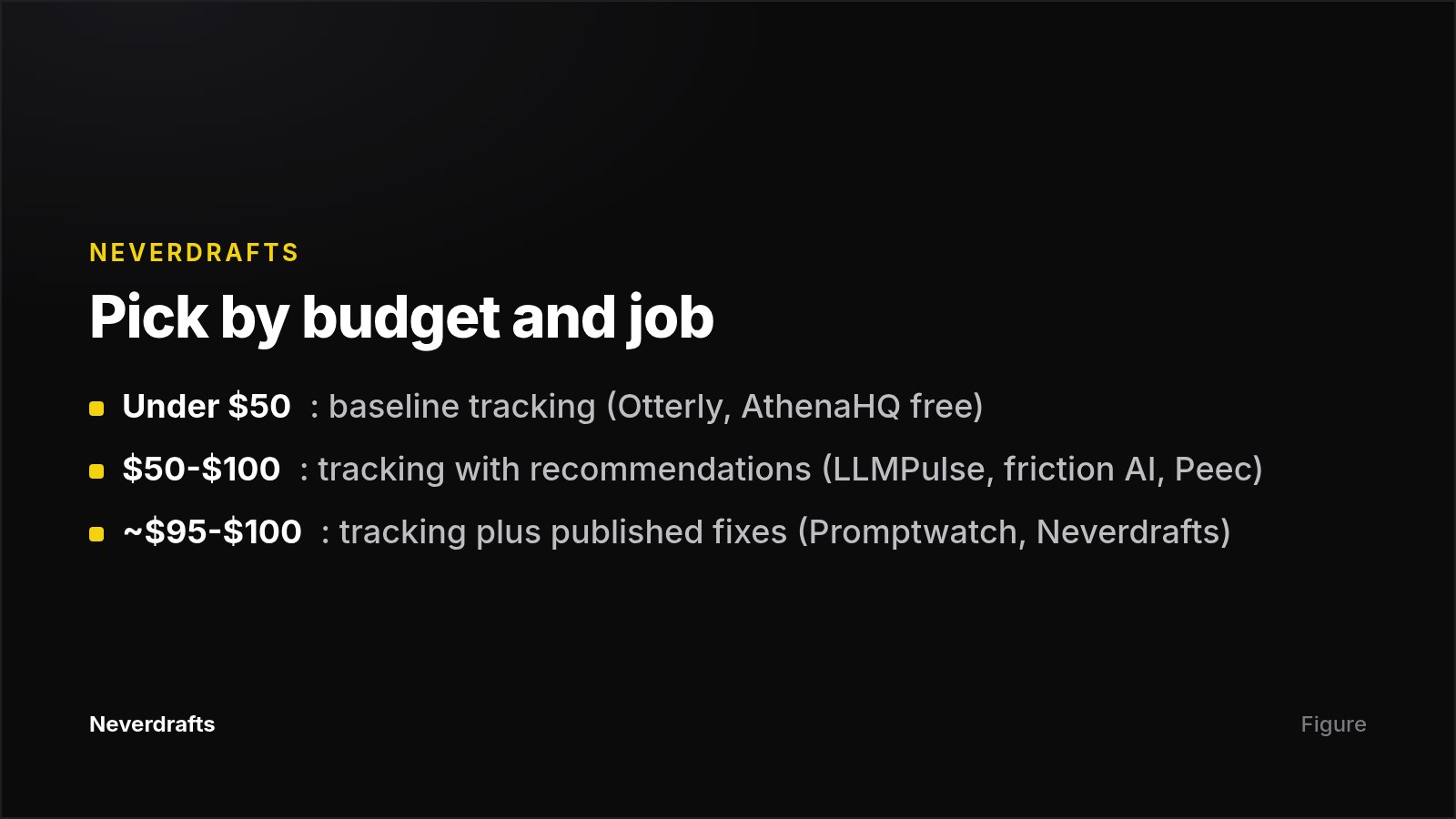
- Under $50/month: Otterly.ai, or AthenaHQ's free Essential tier. Expect tracking-focused features; confirm what AthenaHQ's free tier actually includes before assuming it covers execution too.
- $50–$100/month, tracking focus: LLMPulse, friction AI or Peec AI. Choose Peec if seats matter and friction AI if competitive positioning matters.
- Around $95–$100/month, execution focus: Promptwatch or Neverdrafts. Compare which CMS each one publishes to directly.
- Content-led, price unconfirmed: Frase. Run the seven-day free trial and check vendor pricing before committing a budget line to it.
- Already on an SEO suite: Semrush's toolkit before anything new.
Measure the right thing
Citation rate is not the only metric. Demand-Genius reports that just 16% of AI responses across complex journeys cite a brand directly. For B2B, that makes citation counts a partial signal.
If you sell into long buying cycles, track how AI describes your category and your strengths, not only whether it links to you. If you would rather hand the work off entirely, our guide to alternatives to hiring a GEO agency covers managed options.
Next step
Before you pay for anything, list 20–50 prompts your customers actually ask. Then run them through one or two free trials to see which tool shows the gaps you care about. If you want to test monitoring and auto-published fixes together, Neverdrafts offers a $1 three-day trial with full access, no credit card required, no contract.
Frequently asked questions
Is there a free alternative to Profound?
Yes, with limits. Promptwatch has a free Explore plan, but it tracks ChatGPT only. AthenaHQ's free Essential tier covers five engines. Frase offers a seven-day free trial, and Otterly.ai and LLMPulse offer 14-day trials. Free tiers are useful for a baseline but rarely include content execution or enough prompts for ongoing tracking.
What is the cheapest Profound alternative that tracks multiple AI engines?
If "cheapest" means "free," AthenaHQ's Essential tier covers five engines at no cost, though it's credit-based and the sources don't fully explain what the free tier includes in practice. Among paid plans, Otterly.ai is the cheapest at $29/month, covering ChatGPT, Perplexity, Google AI Overviews and Microsoft Copilot. That's four engines for less than a third of Profound Starter's price, which covers ChatGPT alone. Otterly reports visibility but does not create fixes.
What do you get on each Profound plan?
Profound prices by the number of answer engines tracked. Starter ($99/month) includes ChatGPT, 50 prompts and one seat. Growth ($399/month) adds Perplexity and Google AI Overviews for three engines total, 100 prompts and three seats. Enterprise is a custom quote covering up to nine engines by one source or up to ten by another, plus API access and SSO. If your main complaint about Profound is engine coverage, the jump from Starter to Growth is where that gets resolved, at four times the price.
Do I need an execution tool or just a tracker?
If you have time and writers to act on findings, a tracker like Otterly, LLMPulse or Peec is enough. If nobody on your team has time to rewrite pages after a visibility drop, an execution tool saves more than it costs. Promptwatch, Frase, Writesonic GEO and Neverdrafts draft or publish content directly.
Are Peec AI prices in euros or dollars?
Sources report Peec AI at about $95/month, but Demand-Genius lists $103/month after converting to US dollars in April 2026. The gap likely comes from currency conversion timing rather than a confirmed difference in what's billed. Check Peec's pricing page in your own currency before you buy.
Sources
- 8 Best Profound Alternatives In 2026 – Yotpo
- Best Profound Alternatives in 2026 – Promptwatch
- Profound Alternatives: AI Visibility Tools That Do More Than Measure – Frase
- 10 Best Profound Alternatives for B2B AI Search in 2026 – Demand-Genius
- Profound Alternatives: 5 Platforms to Evaluate (2026) – friction AI
- Neverdrafts
- Neverdrafts pricing
- Neverdrafts vs Profound