
The best LLM SEO tools in 2026 are Otterly.ai for budget monitoring (from $29/month), Profound for enterprise-grade engine coverage (up to 9 AI engines at Enterprise), Semrush's AI Visibility Toolkit or Ahrefs Brand Radar if you already pay for those suites, Neverdrafts or RankAI if you want the tool to draft and publish the content that wins AI answers back, and ZipTie for technical crawlability audits. There is no single "best overall." The right tool depends on which job you need done: tracking citations, fixing content, or making your site readable to AI crawlers.
Disclosure: Neverdrafts is our product. It appears below as one entry among 13, with its limitations listed like every other tool.
Key takeaways
- Pick the job before the tool. LLM SEO tools fall into pure-play trackers, SEO-suite add-ons, content platforms with AI tracking, and technical auditors, according to Mission Growth's category breakdown. Monitor-plus-execution platforms form a fifth group.
- Entry prices range from about $20 to $495 per month. Several vendors, including Peec AI and Profound at the enterprise tier, gate pricing behind a sales call.
- Engine coverage varies widely. Some entry tiers track only ChatGPT. Other tools cover 9 to 11 engines, including Claude, Gemini, Grok, Copilot, Meta AI, and DeepSeek.
- Data method matters as much as coverage. Some platforms observe real prompts. Others build "prompts" from SEO keyword lists. Profound calls this the most important split in the category.
- Most tools only report. Only a few, including RankAI and Neverdrafts, generate and publish content aimed at the prompts you are losing.
- Several popular roundups are written by vendors that rank themselves first. Read them, including this one, with that in mind.
Which LLM SEO tool fits which job? (Summary table)
Pricing below is taken from the cited sources. Where sources disagree, the table notes it. Prices were checked by the source publishers between May and September 2026, so confirm them on the vendor's page before you buy.
| Tool | Category | Best for | Standout feature | Entry pricing (per sources) |
|---|---|---|---|---|
| Otterly.ai | Pure-play tracker | Solo founders, small teams | GEO content audit in every tier | $29/mo Lite; $25/mo billed annually |
| Profound | Pure-play tracker (enterprise) | Enterprise AEO programs | Up to 9 engines, Agent Analytics | Free trial (ChatGPT, 10 prompts); paid tiers disputed across sources |
| Peec AI | Pure-play tracker | Mid-market and agency teams | Clean dashboard, 6–7 engines | Not published by vendor; third-party figures from $95/mo |
| AthenaHQ | Pure-play tracker | Teams testing before committing | Free tier, hallucination detection | Free Essential; paid from $95/mo (sources vary) |
| AIclicks | Pure-play tracker | Solo creators and bloggers | Prompt-level view, pick 3 engines | $59/mo monthly |
| LLMrefs | Pure-play tracker | Agencies, multi-site managers | Flat rate for 10+ platforms | $79/mo flat |
| Scrunch AI | Tracker plus AI-served pages | Mid-market and enterprise brands | Agent Experience Platform | $250/mo annual; $300/mo monthly |
| Neverdrafts | Monitor plus execution | Small businesses and agencies that want monitoring and fixes in one tool | Drafts and publishes content for losing prompts | $99/mo Starter; $1 three-day trial |
| RankAI | Execution-first platform | B2B, SaaS, ecommerce teams | Programmatic pages with auto-rewrites | From $49/mo |
| Semrush AI Visibility Toolkit | SEO-suite add-on | Existing Semrush customers | AI benchmarks next to SEO data | $99/mo add-on (requires paid Semrush) |
| Ahrefs Brand Radar | SEO-suite add-on | Existing Ahrefs users | 7 AI engines plus YouTube, TikTok, Reddit | From $50/mo; $199/mo Visibility Index |
| Surfer SEO | Content platform with AI tracking | Content teams on Surfer | AI tracking inside content workflow | $82/mo AI Search Analytics |
| ZipTie | Technical GEO audit | Developer-heavy teams | AI crawlability audits | $42.75/mo Starter |
What does an LLM SEO tool actually measure?
An LLM SEO tool measures how often, and how favorably, your brand appears inside AI-generated answers. A classic rank tracker tells you your position on a search results page. An LLM SEO tool tells you whether ChatGPT, Perplexity, Claude, Gemini, or Google AI Overviews mention you when a buyer asks a relevant question.
RankAI's guide sums up the shift: "The unit of value is a citation, not a click." That changes what you track. Rankings and impressions give way to:
- Prompt coverage: which buyer questions trigger a mention of your brand.
- Citation sources: which of your pages, or third-party pages, the AI engine pulls from.
- Share of voice: how often you appear compared with competitors on the same prompts.
- Sentiment and accuracy: whether the AI describes you correctly and positively.
- AI crawler activity: whether AI bots are reading your pages at all.
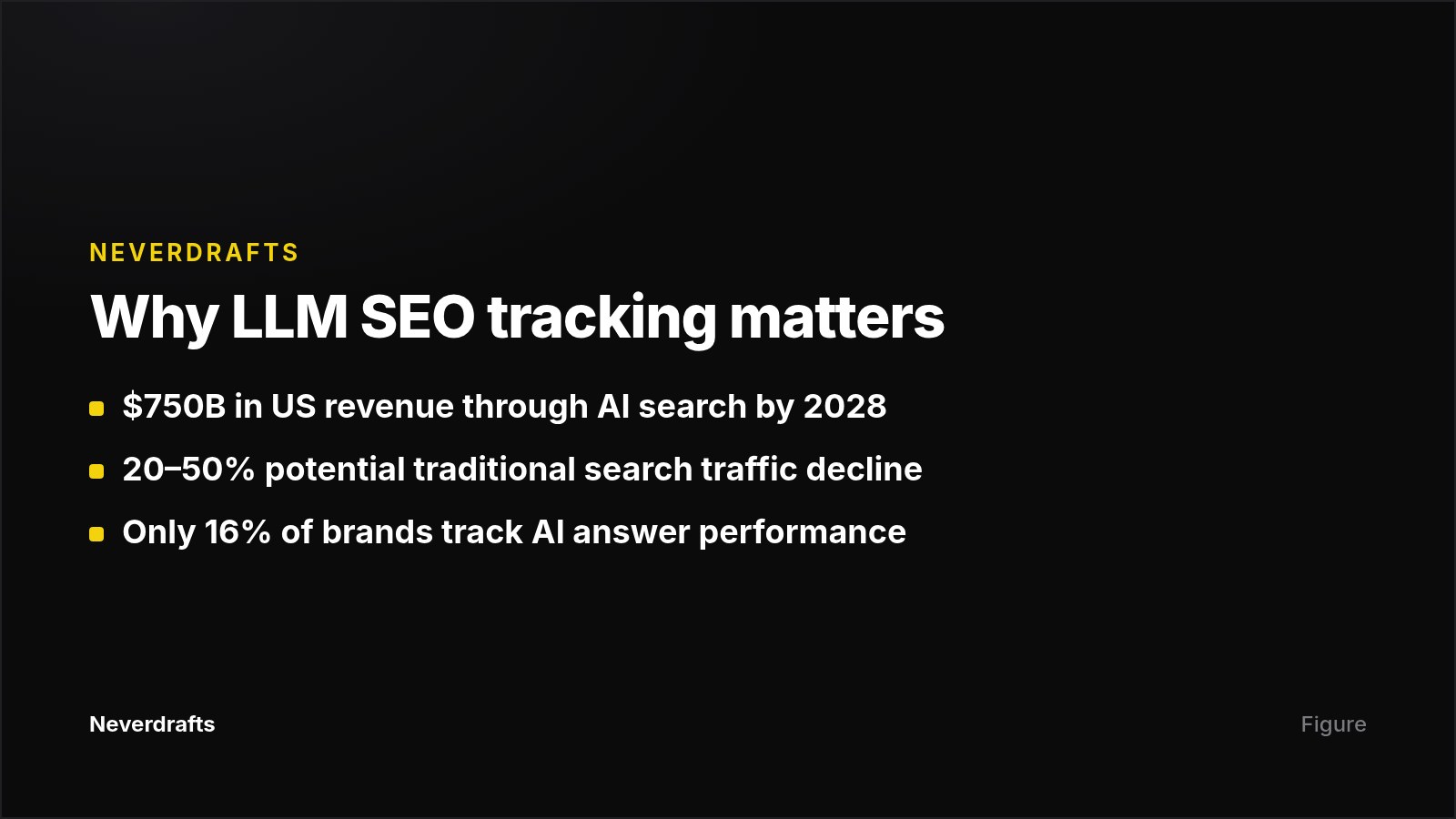
The commercial stakes explain why the category grew so quickly. McKinsey projects that by 2028, $750 billion in US revenue will flow through AI-powered search. The same projection warns that unprepared brands could see traditional search traffic fall 20 to 50%. Yet only 16% of brands systematically track their performance in AI answers.
Are all LLM SEO tools doing the same job?
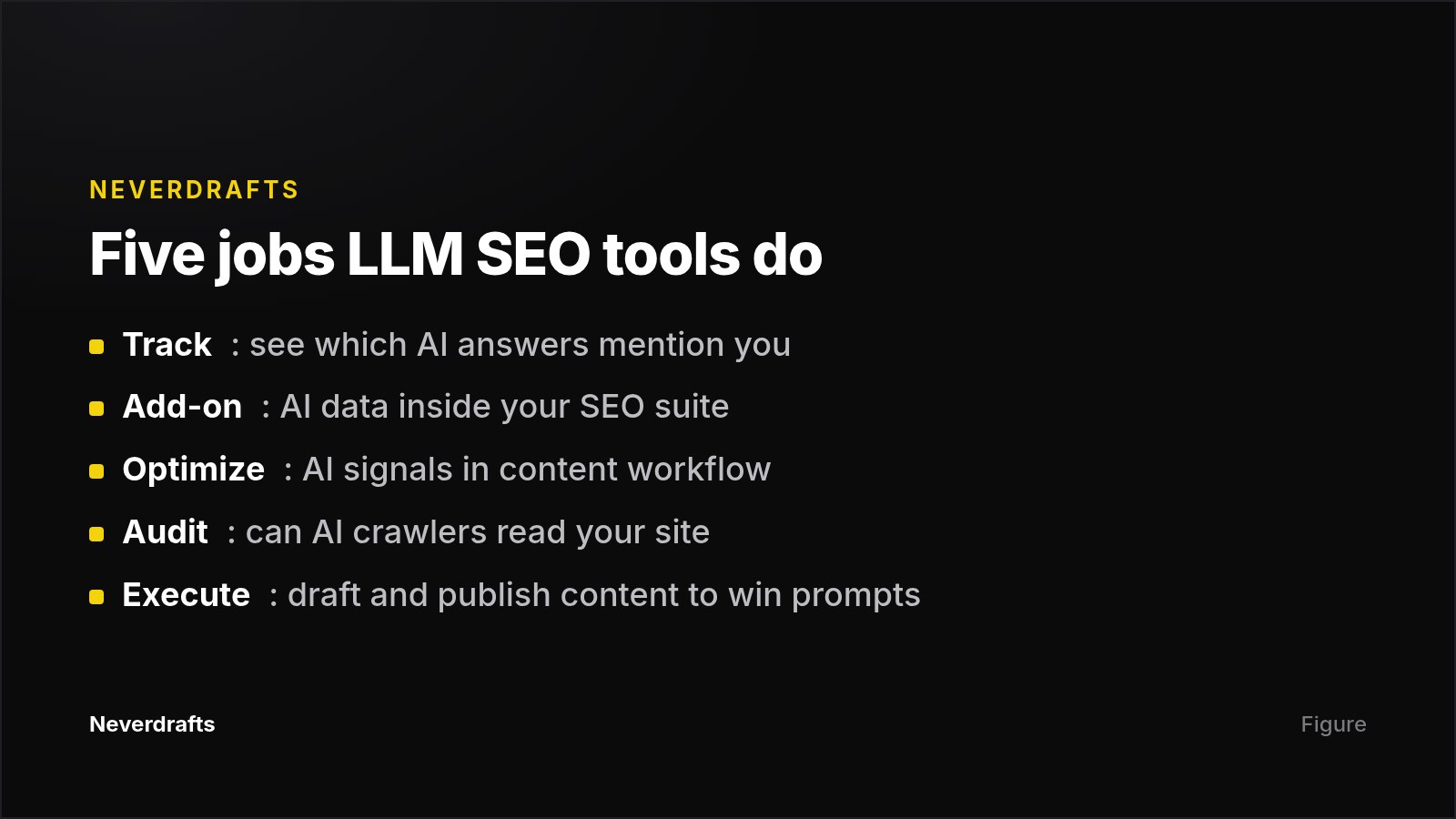
No. This is the biggest source of confusion in the category. Mission Growth argues that "'best overall' is the wrong question until you know which of the four boxes you're shopping in." Its four categories, plus a fifth that other sources identify, look like this:
- Pure-play AI-visibility trackers watch brand mentions and citations and do little else. Examples: Profound, Peec AI, Otterly.ai, AthenaHQ, LLMrefs, AIclicks.
- SEO-suite add-ons bolt AI tracking onto tools you may already pay for. Examples: Semrush's AI Visibility Toolkit, Ahrefs Brand Radar.
- Content-optimization platforms with AI tracking treat AI visibility as one workflow feature. Example: Surfer SEO.
- Technical GEO audit tools check whether AI crawlers can reach and read your content. Example: ZipTie.
- Execution platforms generate, publish, or rewrite content aimed at the prompts where you are losing. RankAI describes three layers: citation tracking, content optimization, and execution. Examples: RankAI, Neverdrafts.
The distinction matters because a tracker tells you where you are losing. It does not fix the problem. If your team has writers and a clear editorial process, a tracker may be all you need. If you have no one to act on the data, a dashboard alone will not change your citations.
How we built this list
This roundup draws on five published comparisons from 2025 and 2026, plus pricing and feature details those sources report from vendor pages. The sources were WooNinjas, Mission Growth, RankAI, RightBlogger, and Profound. Prices and engine counts below come from the sources linked in each entry.
A few ground rules:
- Where sources disagree, we say so. Peec AI and Profound pricing differ materially between sources. We list both views rather than picking one.
- Vendor-written sources are flagged. RankAI ranks itself first in its own roundup. Profound's guide leads with Profound. Mission Growth includes its own service in its table. We use their factual claims, such as engine lists and prices, but treat their rankings as marketing.
- Our own product is treated like the others. Neverdrafts gets the same "best for," strengths, and limitations structure, and its facts come only from our published product information.
The tools are grouped by job, not ranked from one to thirteen. A $29 tracker and an enterprise platform are not competing for the same buyer.
Otterly.ai: best budget tracker for small teams
Otterly.ai is an AI visibility platform that tracks prompts, brand mentions, citations, competitors, and share of voice. It also provides GEO audits and reports to identify visibility gaps, per WooNinjas. It is one of the cheapest entry points in the category, per Mission Growth.
Best for: Solo founders and small teams whose priority engines fall within the base four.
Strengths:
- Lite tier covers four engines for 15 tracked prompts: ChatGPT, Google AI Overviews, Perplexity, and Microsoft Copilot.
- GEO content audit included in every tier.
- Client dashboards, data exports, and Looker Studio reporting, which suits agencies producing monthly reports.
- A logger plugin connects a website to Otterly's Agent Analytics feature for crawler tracking.
Limitations:
- Claude, Google AI Mode, and Gemini sit behind paid add-ons on top of the base plan.
- No real prompt-volume data, so prioritizing which prompts to track leans on intuition.
- It provides recommendations but does not create or publish content, and has no direct WordPress publishing integration.
Pricing: Lite $29/month, Standard $189/month, Premium $489/month, Enterprise custom from $1,000/month. Standard includes 100 prompts. Annual billing brings Lite to $25/month.
Profound: best for enterprise-wide engine coverage
Profound is an enterprise-focused platform that tracks prompts, mentions, citations, sentiment, competitors, and AI crawler activity. It has one of the widest engine ceilings among dedicated trackers, reported as 9 engines at Enterprise. RankAI's review lists them: ChatGPT, Perplexity, Claude, Gemini, Grok, Copilot, Meta AI, DeepSeek, and AI Overviews.
Best for: Enterprise marketing teams building a full answer-engine optimization program with rigorous reporting.
Strengths:
- Scales to 9 platforms at Enterprise, among the broadest in the category.
- According to Profound's own guide, it tracks engines daily on real front-end data across 50+ countries, with Agents and Agent Analytics connecting content to attribution.
- Autonomous agents for AEO, content, and PR work. RankAI names Ramp among its customers.
- AI content briefs and bot traffic tracking.
Limitations:
- Pricing is unclear and sources contradict each other. Mission Growth reports that the free trial covers ChatGPT only with 10 one-time prompts, and the only paid step up is custom Enterprise. WooNinjas lists Starter at $99/month and Growth at $399/month. RankAI reports no public pricing.
- Profound itself acknowledges it can be overkill for teams that only want a lightweight visibility score.
- Execution happens through the agent layer rather than direct page generation.
Pricing: Free trial available. Paid tiers vary by source, so confirm directly with the vendor.
If Profound's price or scope is more than you need, our comparison of Neverdrafts vs. Profound sets out the trade-offs.
Peec AI: best clean monitoring dashboard for mid-market teams
Peec AI is a GEO tool built for marketing teams. It monitors custom prompts, brand visibility, ranking positions, AI sentiment, citation sources, and competitor benchmarks. RankAI lists 7 engines: ChatGPT, AI Mode, AI Overviews, Copilot, Perplexity, Gemini, and Grok. Mission Growth counts six across its named plans.
Best for: Mid-market marketing teams and agencies that want broad engine coverage in a well-designed dashboard, without an execution layer.
Strengths:
- A clean interface with daily tracking and screenshot audit trails that make reports easier to trust.
- Strong prompt benchmarking and sentiment analysis, plus Looker Studio integration and API access on higher tiers.
- A dedicated WordPress plugin that reads server logs and tracks AI bot activity.
- 14-day free trial without commitment.
Limitations:
- Pricing transparency is poor. Mission Growth states the vendor's pricing page "never states a number" and that any third-party figure does not come from Peec AI's page.
- Volume data is clickstream-based rather than real conversations.
- No content creation or publishing.
Pricing: Starter, Pro, Advanced, and Enterprise tiers exist. WooNinjas reports Starter $95/month, Pro $245/month, Advanced $495/month, but Mission Growth could not verify those figures on the vendor's page.
AthenaHQ: best for testing free before committing
AthenaHQ is an AI search visibility platform with an "Ask Athena" agentic copilot, hallucination detection, and multi-region tracking across 60+ countries. It is one of the few tools with a genuinely usable free tier.
Best for: Mid-market marketing and PR teams that want to test AI visibility tracking before paying, and care about brand accuracy.
Strengths:
- A free Essential tier with 300 credits covering five platforms.
- Paid tiers step up to as many as 11 platforms, including Mistral, DeepSeek, and Meta AI alongside the major engines.
- Hallucination detection, which matters if AI engines misstate your pricing or features.
- Automated schema and entity tagging at scale, with an Action Center that turns data into next steps.
- Named clients include SoFi, Coinbase, R/GA, Nextiva, and PagerDuty.
Limitations:
- Prompt volume relies on an undisclosed estimation model, and recommendations often need real editing.
- No content publishing layer.
- Engine counts vary by source: 8 engines per RankAI, 11 per Mission Growth.
Pricing: Free Essential tier. RankAI reports a Self-Serve plan at $95/month, while Mission Growth lists Starter at $295/month. Enterprise is custom.
AIclicks: best tracker for solo bloggers and creators
AIclicks is a pure-play tracker that RightBlogger names its best overall pick for bloggers and content creators. Its appeal is simplicity: a prompt-level view that answers whether you appear inside AI answers.
Best for: Solo creators and small blogs that want concrete prompt-level visibility data at a modest price.
Strengths:
- Prompt tracking shows which questions lead to mentions and citations across ChatGPT, Perplexity, Gemini, Claude, Grok, and Google AI Overviews.
- Geo auditing and competitor tracking, useful if you are growing in one country first.
- A flexible Starter tier where you pick 3 engines instead of paying for all of them.
Limitations:
- The Starter tier covers only 3 LLMs. Wider coverage requires higher plans.
- The trial is short at 3 days.
- It is a tracker, so acting on the data is up to you.
Pricing: $59/month on monthly billing. Annual billing is cheaper, and RightBlogger's summary cites $49/month.
LLMrefs: best flat-rate tracker for agencies
LLMrefs builds keyword-focused prompt sets and tracks share of voice and keyword rankings across AI search engines. The flat price makes budgeting simple for agencies handling several clients.
Best for: Agencies and multi-site managers who want predictable cost and cleaner reporting.
Strengths:
- A flat $79/month covering 10+ platforms, with no per-engine add-ons.
- Includes llms.txt support alongside tracking in one price.
- Keyword-based prompt generation reduces guesswork compared with writing prompts by hand.
- 7-day trial.
Limitations:
- Prompts are keyword-derived. That is convenient, but it is exactly the "reverse-engineered" approach Profound flags as an assumption rather than observed behavior.
- RightBlogger notes it is probably more than a solo blogger needs.
- No content creation.
Pricing: $79/month flat, with a 7-day trial.
Scrunch AI: best for audit-first diagnostics plus AI-served pages
Scrunch AI positions itself as an AI customer experience platform. It pairs LLM diagnostics with an Agent Experience Platform (AXP) that serves AI-optimized pages to crawlers without changing the human-facing site.
Best for: Mid-market and enterprise brands or agencies that want diagnostics and a delivery layer aimed specifically at AI crawlers.
Strengths:
- 6 engines tracked: ChatGPT, Claude, Gemini, Perplexity, AI Mode plus AI Overviews, and Meta. Enterprise coverage extends up to 9.
- Real-time LLM bot crawl monitoring and citation source mapping.
- The AXP is a distinctive approach: optimizing what AI agents receive rather than rewriting your site.
- 7-day free trial of Starter, no credit card required.
Limitations:
- The highest entry price among the tools RankAI reviewed.
- Content generation isn't shipped yet, and monitored prompts are configured rather than sourced from real conversations.
Pricing: Starter at $250/month billed annually or $300/month monthly.
Neverdrafts: best for monitoring and fixing losing prompts in one tool
Disclosure: Neverdrafts is our product. Neverdrafts monitors where AI systems recommend your competitors instead of you, then drafts and publishes content to win those answers back. It belongs in the monitor-plus-execution group with RankAI, not with the pure trackers.
Best for: Small businesses, lean marketing teams, and agencies that want one tool to cover the full loop: monitor, diagnose, fix, and confirm AI crawlers picked up the fix. It suits teams without a dedicated writer on standby for every visibility gap.
Strengths:
- Daily monitoring on real web interfaces of ChatGPT, Claude, Google AI Mode, and Perplexity, rather than APIs or extrapolated scores, on buyer prompts you define.
- A 0–100 visibility score per answer that separates "absent," "mentioned in passing," and "recommended." That distinction is more useful than a simple yes or no on mentions.
- One-click content drafting targeted at each prompt you are losing.
- One-click publishing to WordPress, Webflow, Shopify, Framer, and API-first stacks, with no copy-paste step.
- AI crawler tracking that shows when AI bots visit the pages you published, so you can confirm the fix was seen.
- Share of voice, sentiment analysis, content in 150+ languages, and white-label dashboards for agency client reporting.
Limitations:
- Narrower engine coverage than the top trackers. Neverdrafts monitors four engines. Profound, AthenaHQ, and LLMrefs cover 9 or more, including Gemini as a standalone app, Copilot, Grok, Meta AI, and DeepSeek. If your buyers use those engines heavily, a wider tracker is the better fit.
- Prompts are ones you define, not sourced from a real-user demand panel. The quality of your tracking depends on how well you choose buyer prompts.
- No free tier. Access starts with a paid trial.
- No dedicated technical crawlability audit of the kind ZipTie specializes in.
- As with any generated content, plan for editorial review before publishing drafts under your brand.
Pricing: Starter $99/month (1 brand, 50 tracked prompts, 30 remediation articles/month). Growth $199/month (3 brands, 150 prompts, 100 articles/month). Agency $399/month (10 brands, 500 prompts, 300 articles/month). A $1 three-day full-access trial is available, with no contract.
RankAI: best execution-first platform for programmatic pages
RankAI pairs human strategists with AI agents that publish, test, and rewrite pages until they earn LLM citations. Its primary deliverable is execution, not reporting. Note that RankAI ranks itself first in its own roundup, which is one of this article's sources.
Best for: B2B, SaaS, ecommerce, and agency teams that want programmatic page generation and continuous rewrites at scale.
Strengths:
- Programmatic page generation tuned for LLM extractability.
- An auto-rewrite engine that triggers on a 3-week performance threshold.
- Multi-CMS publishing: WordPress, Shopify, Webflow, Wix, Sanity, Framer, and custom stacks.
- Senior strategist support on higher tiers, plus a free audit with no credit card required.
- The company states it is backed by Y Combinator, Microsoft, a16z, and OpenAI.
Limitations:
- By its own account, its monitoring engine list is smaller than Profound's (9) or Rankscale's (8+).
- No permanent free tier, only the free audit.
- The programmatic approach suits sites that need many pages. Smaller sites may not need that scale.
Pricing: Self-serve from $49/month, per RankAI's pricing page as of May 2026.
Semrush AI Visibility Toolkit: best for existing Semrush customers
Semrush's AI Visibility Toolkit adds cross-LLM benchmarking to the SEO suite many teams already use daily. It is an add-on, not a standalone product.
Best for: Teams already paying for Semrush who want AI visibility data next to their keyword and backlink data.
Strengths:
- AI benchmarks sit right beside the SEO tools teams already use, so there is no new login or workflow.
- Keeps keyword research, backlinks, and AI tracking in one bill.
- RightBlogger recommends using the AI features of a suite you already pay for instead of rushing into a second subscription.
Limitations:
- The base add-on is small: 1 domain and 25 prompts.
- Brand Performance covers only four to five engines and updates weekly, with no Claude, Copilot, Grok, Meta AI, or DeepSeek.
- The cost stacks on top of a paid Semrush plan, which RightBlogger lists from $139/month.
Pricing: $99/month add-on, requires a paid Semrush subscription.
Ahrefs Brand Radar: best for Ahrefs users tracking beyond chatbots
Ahrefs Brand Radar brings AI visibility into the Ahrefs environment. It is unusual in covering video and community platforms alongside AI engines.
Best for: Existing Ahrefs users, especially those tracking large prompt sets or brand presence on YouTube, TikTok, and Reddit.
Strengths:
- 7 AI engines plus YouTube, TikTok, and Reddit.
- Data is collected through the same front-end method Profound uses, according to Profound's own review.
- A low entry price for the Custom Prompts tier.
Limitations:
- Prompts are keyword-derived, not real AI conversations, and most chatbot platforms refresh only monthly.
- RightBlogger notes the AI tracking feels more like an add-on than the main event.
- Requires an Ahrefs plan. RightBlogger lists Ahrefs Lite at $129/month.
Pricing: From $50/month (Custom Prompts); $199/month (Visibility Index).
Surfer SEO: best for content teams already optimizing in Surfer
Surfer SEO is primarily an on-page content optimization platform that has added AI Search Analytics. It treats AI visibility as one feature within a writing workflow.
Best for: Content teams already on Surfer who want AI visibility signals while they write and edit.
Strengths:
- Tracks ChatGPT, Perplexity, Google AI Mode, AI Overviews, and Gemini.
- Keeps optimization and tracking in the same place where writers already work.
- Strong on-page guidance, which matters because tracking cannot rescue thin or poorly structured content.
Limitations:
- RightBlogger says Surfer helps with content optimization, yet it's not a full AI visibility tool, and describes its citation tracking as basic.
Pricing: $82/month for AI Search Analytics. RightBlogger lists a $49/month starting price for Surfer's base plan.
If you are deciding between content tools rather than trackers, our guide to picking SEO content writing tools by workflow stage covers that decision in more depth.
ZipTie: best for technical AI crawlability audits
ZipTie is the technical auditor in this list. It checks whether AI crawlers can reach and read your content at all, a prerequisite that visibility trackers assume rather than verify.
Best for: Developer-heavy teams that suspect AI crawlers cannot reach or read their content.
Strengths:
- Focuses on crawlability, which no amount of content work can fix if AI bots cannot read the page.
- Covers 7 AI engines on a usage-based model.
- 7-day trial.
Limitations:
- Technical auditing is a narrow job. You will likely still need a tracker or content tool alongside it.
- Coverage in the published roundups is thin, so feature depth beyond crawlability is less documented than for the major trackers.
Pricing: $42.75/month Starter.
What other LLM SEO tools are worth knowing?
Several platforms appear in only one or two of the source roundups, or serve narrower needs:
- Rankscale: Credit-based LLM citation analytics across 8+ engines from $20/month, with an interface familiar to rank-tracker users. It has the lowest published entry price the sources report for this category.
- AirOps: A content workflow platform with a genuine free Insights tier and customers including Webflow, Notion, and HubSpot. Profound notes a steep learning curve and around five engines.
- Rankability: An all-in-one SEO and AI visibility platform. WooNinjas calls it the best overall choice for combining SEO, GEO, AEO, and content optimization. Profound notes up to nine platforms on the Agency plan but keyword-configured visibility.
- Evertune: Brand-accuracy monitoring built on a 25-million-person consumer panel, aimed at reputation-focused teams.
- Conductor: Enterprise SEO infrastructure extended to AI, with 160+ countries and city-level tracking.
- BrightEdge and Adobe LLM Optimizer: Enterprise options for teams already inside those ecosystems, covered in Profound's review.
- Miniloop: Not a visibility tracker. RightBlogger describes it as SEO content automation from keyword discovery to CMS publishing, with rank tracking rather than LLM citation tracking.
For a narrower look at pure monitoring tools only, see our AI brand monitoring tools engine coverage and price comparison.
How much does LLM SEO tracking cost per prompt?
Monthly price alone makes tools hard to compare, because prompt allowances differ so much. Dividing the published price by included prompts gives a rough cost per tracked prompt. These figures are our own arithmetic on the sourced prices, not vendor claims. Neverdrafts is our product, and its per-prompt figures include remediation articles and, on the Agency tier, a multi-brand allowance, so they are not like-for-like with single-domain tracking plans:
| Plan | Monthly price | Tracked prompts | Approx. cost per prompt | Notes |
|---|---|---|---|---|
| Otterly.ai Lite | $29 | 15 | ~$1.93 | 4 engines; others are add-ons |
| Otterly.ai Standard | $189 | 100 | ~$1.89 | Same engine limits |
| Semrush AI Visibility Toolkit | $99 | 25 | ~$3.96 | Plus a paid Semrush plan |
| Neverdrafts Starter | $99 | 50 | ~$1.98 | Includes 30 remediation articles, 1 brand |
| Neverdrafts Growth | $199 | 150 | ~$1.33 | Includes 100 remediation articles, 3 brands |
Cost per prompt ignores important differences in engine count, refresh frequency, and whether the price includes content. A cheaper prompt refreshed monthly on keyword-derived data is not equivalent to a pricier prompt checked daily on real interfaces. Use the table to flag outliers, not to pick a winner.
How to choose an LLM SEO tool
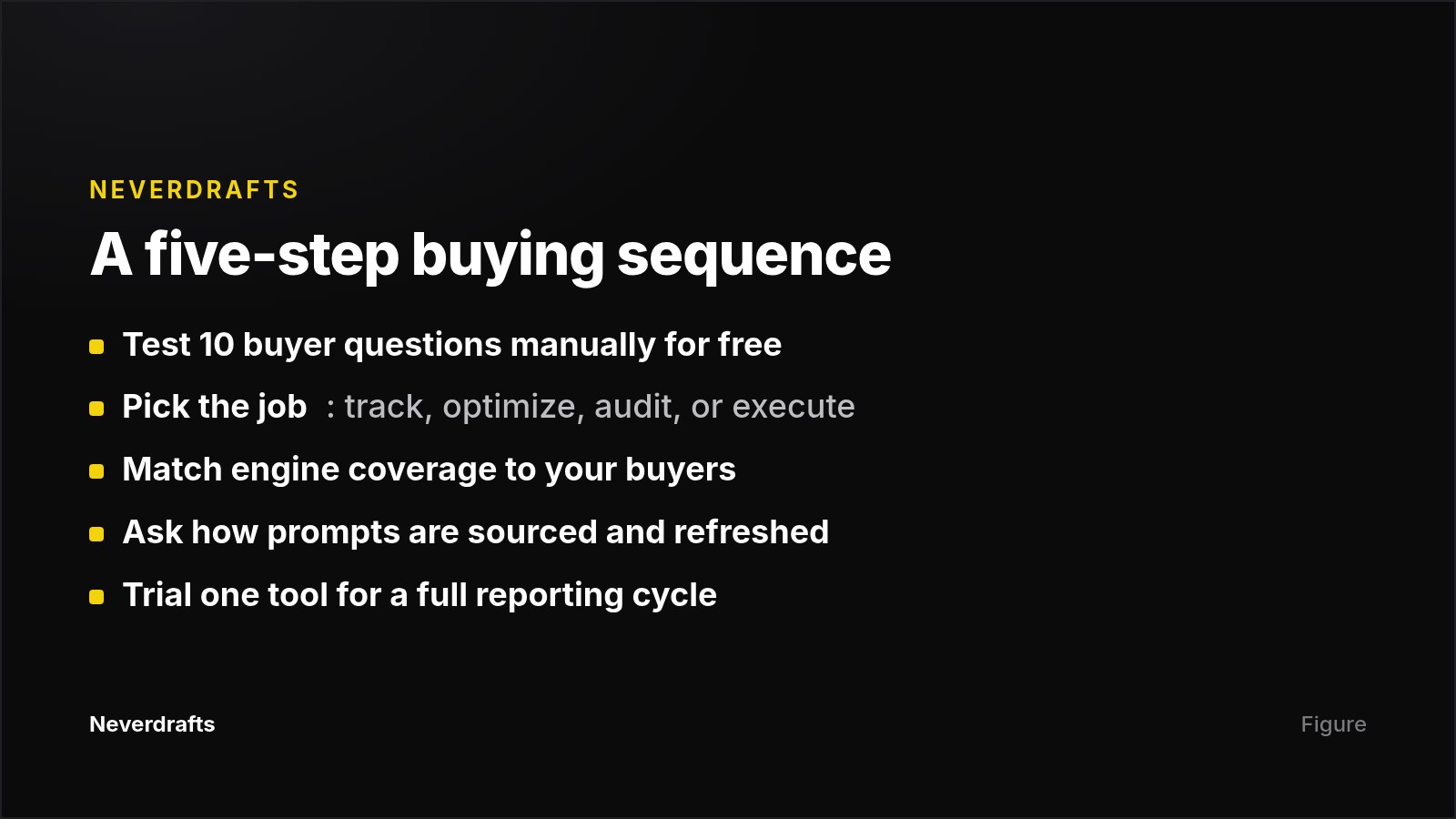
Use these criteria to narrow the list above. Work through them in order, because each one narrows the field for the next.
1. Which job do you need done?
Decide whether you need tracking, content optimization, technical auditing, or execution. If you have writers ready to act on data, a tracker like Otterly.ai or Peec AI is enough. If no one on your team will turn a visibility gap into a published page, choose a tool that closes that loop, such as RankAI or Neverdrafts. If you suspect AI bots cannot read your site, start with ZipTie.
2. Which AI engines do your buyers actually use?
Profound's guide notes that ChatGPT, Perplexity, and Google AI Overviews "get you in the door," but Claude, Gemini, Copilot, Grok, Meta AI, and DeepSeek all shape purchase decisions for some audiences. Check what entry tiers include. Profound's trial covers ChatGPT only, and Otterly.ai charges extra for Claude and Gemini. Pay for the engines your buyers use, not for the longest list.
3. Where does the prompt data come from?
This is the criterion most roundups skip. Some platforms observe real prompts. Others generate "prompts" from SEO keyword lists, including Ahrefs, Conductor, BrightEdge, and Rankability per Profound's review. Keyword-derived prompts are convenient but are an assumption about what people ask. Ask every vendor directly how prompts and volumes are sourced.
4. How often does the data refresh?
AI answers change frequently. Semrush's Brand Performance updates weekly, and most Ahrefs chatbot data refreshes monthly. Peec AI and Profound track daily. Weekly data works for quarterly strategy. Daily data matters if you are testing content changes and want to see the effect quickly.
5. Does it collect data the way users see it?
Tools differ in whether they query engines through APIs or through the real front-end interface users see. Front-end collection better reflects actual user experience. Profound and Neverdrafts both state they use real front-end interfaces, and Profound's review says Ahrefs collects data through the same front-end method. Ask any vendor that does not say how it collects data.
6. Does it fit your stack?
CMS support matters if the tool publishes content. RankAI supports WordPress, Shopify, Webflow, Wix, Sanity, and Framer. Neverdrafts supports WordPress, Webflow, Shopify, Framer, and API-first stacks. Peec AI offers a WordPress plugin for crawler tracking. For reporting, Otterly.ai and Peec AI both connect to Looker Studio.
7. Do you need geographic or accuracy tracking?
If you sell across markets, check country coverage. AthenaHQ tracks 60+ countries, and Conductor offers 160+ countries plus city-level data. If AI engines misstate your pricing or features, prioritize accuracy monitoring. AthenaHQ offers hallucination detection, and Evertune focuses on brand accuracy.
8. Can you test before you pay?
Most tools offer some trial. AthenaHQ has a free tier, Peec AI offers 14 days, LLMrefs, ZipTie, and Scrunch offer 7 days, AIclicks offers 3, and Neverdrafts offers a $1 three-day trial. Before any trial, run your top 10 buyer questions manually in ChatGPT, Perplexity, and Google. That free baseline shows whether you have a visibility problem at all, and tells you which engines to prioritize.
Which tool matches which buyer?
- Solo blogger or creator on a budget: AIclicks or Otterly.ai Lite.
- Small business with no in-house writer: a monitor-plus-execution tool such as Neverdrafts or RankAI.
- Agency managing many clients: LLMrefs for flat-rate tracking, Otterly.ai for reporting, or Neverdrafts Agency for tracking plus white-label dashboards and content.
- Mid-market marketing team: Peec AI or AthenaHQ.
- Enterprise with a dedicated AEO program: Profound, or Conductor or BrightEdge if you already run on them.
- Team already paying for Semrush or Ahrefs: start with their add-on before buying anything new.
- Developer-led team with suspected crawl issues: ZipTie first, then a tracker.
If you are still deciding whether AI visibility deserves budget at all, our breakdown of when AI search visibility is worth the investment for small SaaS covers the thresholds.
Next step
Write down the five to ten buyer questions you most want AI assistants to answer with your brand, and run them manually in ChatGPT, Claude, Perplexity, and Google AI Mode. If you want that check automated daily, with drafts generated for the prompts you are losing, start the $1 three-day Neverdrafts trial and track those same prompts. Compare the results against at least one pure-play tracker from this list before committing.
Frequently asked questions
What is the difference between LLM SEO, GEO, and AEO?
They describe the same goal: getting your brand surfaced and cited inside AI-generated answers. LLM SEO emphasizes large language models like ChatGPT and Claude. GEO (generative engine optimization) is the term Profound and several other vendors use. AEO (answer engine optimization) emphasizes answer-style results such as Google AI Overviews. RightBlogger notes they all describe the same goal. Tools marketed under any of these labels generally do the same job.
Are there free LLM SEO tools?
A few have usable free options. AthenaHQ offers a free Essential tier with 300 credits across five platforms. AirOps has a free Insights tier. Profound's free trial covers ChatGPT only, with 10 one-time prompts. The cheapest paid options the sources report are Rankscale from $20/month and Otterly.ai from $25–29/month. Manually testing prompts in ChatGPT, Perplexity, and Google also costs nothing (see Step 8 above).
Do I still need Semrush or Ahrefs if I buy an LLM SEO tool?
Usually yes, if you rely on them for keyword research, backlinks, and classic rankings. RightBlogger notes that Semrush and Ahrefs "still do important work for keyword research, backlinks, and content opportunities," even as their AI tracking features remain add-ons rather than the main event. The common recommendation is a hybrid stack: keep your existing SEO suite and add a dedicated AI visibility tool. If you already pay for one of these suites, test its AI add-on before buying a separate tracker.
How many prompts should I track?
Start small and specific. Entry plans typically include 15 to 50 prompts. Otterly.ai Lite includes 15, and Semrush's toolkit includes 25. A focused set of buyer-intent questions, such as "best [category] for [audience]" and comparison queries, is more useful than hundreds of loosely related prompts. Expand once you know which prompts drive decisions, and add competitors' branded comparisons as you go.
Can an LLM SEO tool guarantee my brand gets cited?
No. AI engines decide what to cite based on the sources they retrieve and trust, and their answers vary between sessions. Tracking tools show where you appear. Execution tools help you publish content targeted at specific prompts. Neither controls the model's output. Content quality, structure, crawlability, and third-party mentions all influence citations, so treat any tool as a way to measure and improve your odds, not a guarantee.
How often do LLM SEO tools refresh their data?
It varies by vendor. Peec AI, Profound, and Neverdrafts track daily. Semrush's Brand Performance updates weekly, and Ahrefs refreshes most chatbot platforms monthly. Daily tracking helps when you are testing content changes and want fast feedback. Weekly or monthly data is fine for trend reporting. Always check refresh frequency on your specific plan tier, because it can differ from the vendor's headline claims.
Sources
- [S1] WooNinjas, "5 LLM SEO Tools Worth Trying for Your WordPress Site in 2026": https://wooninjas.com/llm-seo-tools-2026/
- [S2] Mission Growth, "Best LLM SEO Tools": https://missiongrowth.io/blog/best-llm-seo-tools
- [S3] RankAI, "Best LLM SEO Tools to Rank in AI Answers in 2026": https://rankai.ai/articles/best-llm-seo-tools
- [S4] RightBlogger, "Best LLM SEO Analysis Tools That Are Worth Paying For": https://rightblogger.com/blog/best-llm-seo-tools
- [S5] Profound, "Best generative engine optimization (GEO) tools for AI search in 2026": https://www.tryprofound.com/blog/best-generative-engine-optimization-tools
- Neverdrafts product and pricing information: https://neverdrafts.com
- Neverdrafts vs. Profound: https://www.neverdrafts.com/vs/profound