
For most small businesses, the best AI search optimization setup combines two tools. The first is the Semrush AI Visibility Toolkit ($99/month per domain), which shows whether ChatGPT, Gemini, Google AI and Perplexity mention your brand. The second is Surfer or Frase (both from $49/month), which help you optimize the pages that rank.
If nobody on your team has time to write the fixes, Neverdrafts (from $99/month) tracks AI answers and also generates and publishes the content. Disclosure: Neverdrafts is our product. If your budget is close to zero, start with Otterly.ai ($29/month), RabbitSEO's free plan, or the self-hosted OpenSEO.
Key takeaways
- SEO now has two surfaces. Traditional rankings and AI answers need different tools, and the best tool for one is rarely the best for the other.
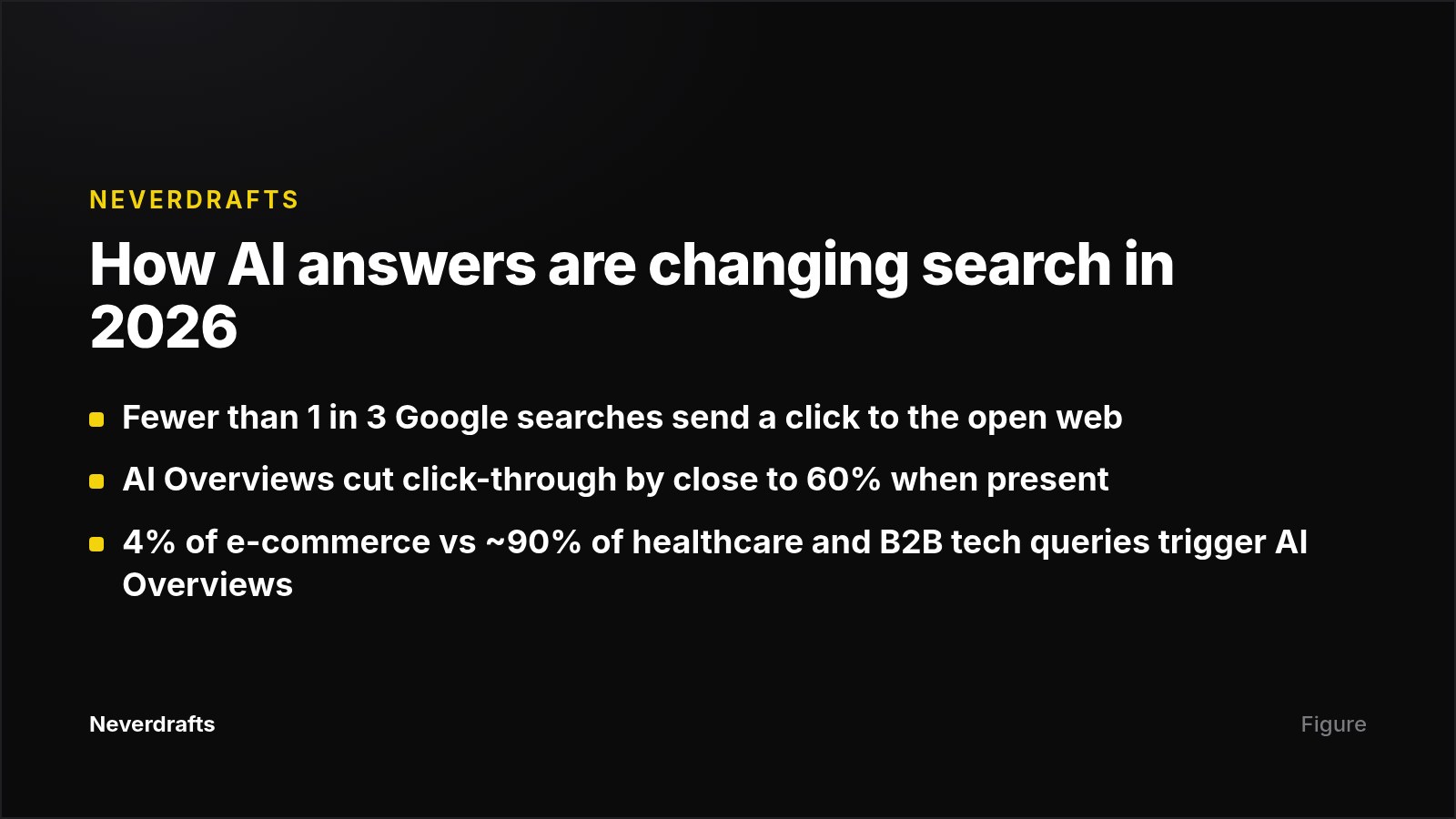
- Your sector decides how much AI visibility matters. Only 4% of e-commerce searches trigger an AI Overview, while healthcare and B2B technology queries approach 90% coverage.
- Good tools cost less than $100/month each. Small businesses can now get enterprise-grade data and optimization often for under $100/month, compared with $2,000–5,000+ for an agency.
- The reliable stack has three parts: a content optimizer, an AI-visibility tracker and a general LLM, with an all-in-one suite underneath for keyword and backlink data. Most small businesses only need two of these to start.
- Treat AI visibility scores as directional. No two trackers agree on a brand's "share of voice", so pick one tool and watch the trend rather than the absolute number.
Which AI search optimization tools are best for small businesses?
Semrush AI Visibility for tracking, Surfer or Frase for content, and Neverdrafts if you need fixes written are the best fits for most small businesses; the table below covers all ten tools we recommend, grouped by the job each one does. Prices are entry tiers as stated by the vendor or by independent reviews. Most tools bill roughly 20% cheaper annually.
| Tool | Best for | Standout feature | Entry price (from sources) |
|---|---|---|---|
| Semrush AI Visibility Toolkit | Tracking brand mentions in AI answers on a budget | 25 daily-tracked prompts across ChatGPT, Google AI, Gemini, Perplexity | $99/mo per domain, billed annually |
| Surfer | Owners who write their own content | On-page optimization plus AI search tracking in one workflow | $49/mo annual; $99 with AI-prompt tracking |
| Neverdrafts | Small teams that need fixes written and published, not just reports | Monitoring, auto-generated articles and one-click CMS publishing | $99/mo Starter; $1 three-day trial |
| Frase | Solo writers and small teams | GEO tracking folded into every plan | $49/mo |
| SE Ranking | Small businesses wanting one mid-priced suite | MCP connector on every plan, white-label reports | $129/mo base; AI add-on +$89 |
| Ahrefs | Link-building and competitive research | Backlink database depth; Brand Radar AI | $129/mo Lite; Brand Radar AI from $199/mo |
| RabbitSEO | Wix and Shopify site owners | AI visibility checker with approve-before-publish fixes | Free plan available |
| Otterly.ai | Cheapest paid, dedicated AI-visibility monitoring | Low-cost GEO monitoring | $29/mo |
| OpenSEO | Technical owners with near-zero budget | Free, open-source, agent-native suite | Free (self-host) |
| NeuronWriter | Cheapest serious on-page optimizer | On-page content scoring at a low price | $23/mo |
Do small businesses need AI visibility tracking or classic SEO tools?
Most small businesses need both. How much weight to give each depends on what you sell.
Clicks from search are shrinking. According to SparkToro's 2026 analysis, fewer than one in three Google searches now sends a click to the open web, and other trackers estimate zero-click searches at roughly 68% in early 2026. AI Overviews appear on 20%+ of Google searches and cut click-through rates by close to 60% when present. In Google's AI Mode, Semrush measured 93% of searches ending without a click.
Organic search still matters a great deal. BrightEdge research cited by MEGA puts it at 53% of all trackable website traffic. What has changed is where that attention goes. Across sectors, the effect is uneven:
- E-commerce and product sellers. Only 4% of e-commerce searches trigger an AI Overview in 2026, down from 29% at rollout. Classic ranking and on-page work should get most of your budget.
- Healthcare, B2B technology and informational publishers. Coverage is approaching 90%. If your customers research before buying, you need to know whether AI assistants recommend you.
- Local service businesses. Google's local pack drives phone calls, directions requests, and store visits. None of the sources we reviewed measures how often AI answers replace local pack clicks. A sensible approach is to get local SEO right first, then add a cheap AI tracker to check whether assistants name you for "best [service] in [city]" prompts.
If you run a small software company and are weighing the cost, our breakdown of when AI search visibility is worth the investment for small SaaS covers the thresholds in more detail.
1. Semrush AI Visibility Toolkit: best-value AI answer tracking
What it is. Semrush's AI Visibility plan is sold as its own plan on Semrush's pricing page (The AI Rankings lists it as a $99/month add-on) for tracking how your brand appears in AI search. The Base plan includes AI visibility reports for any domain and daily rankings for 25 custom prompts. It also includes Brand Performance analysis for one domain and mention tracking across ChatGPT, Google AI, Gemini and Perplexity.
Who it is for. Small businesses that want to know whether AI assistants mention them and their competitors, and that already have someone who can act on the findings.
Strengths:
- Broad engine coverage for the price. The Base plan covers four major AI platforms. The AI Rankings calls it the best-value way to track ChatGPT, Gemini, Google AI and Perplexity mentions.
- Competitive context. The plan includes AI competitor analysis, prompt research, and a site audit for AI readiness, with up to 300 reports per day.
- Flexible terms. Semrush says you can cancel, downgrade, or upgrade at any time unless you have signed custom terms.
- A familiar ecosystem. OneLittleWeb, which tested 40+ tools, calls Semrush One the most comprehensive AI SEO platform and uses it daily.
Limitations:
- It diagnoses but does not fix. You get reports, not content. Closing the gaps it finds is still your job.
- 25 prompts goes quickly. Tracking a handful of services across a few phrasings will use most of your quota.
- Extra seats and reporting cost more. Additional users start at $45/month. The Base Report add-on, which includes Google Analytics and Search Console integrations, is $10/month.
Pricing. $99/month per domain, billed annually. OneLittleWeb also advertises a 7-day free trial of Semrush One. That trial is for the Semrush One platform, not necessarily the standalone AI Visibility plan; check Semrush's pricing page for current AI Visibility trial terms.
2. Surfer: best all-round content optimizer
What it is. Surfer is a content optimization platform. OneLittleWeb rates it best for on-page optimization and tracking AI mentions. The AI Rankings names it the strongest all-round pick for doing the SEO work: keyword research, briefs and on-page optimization.
Who it is for. Owners and small marketing teams who write their own content and want each page to have the best possible chance of ranking and being cited.
Strengths:
- Speed. OneLittleWeb reports that the Content Editor saves hours per article.
- Both surfaces in one place. The AI Rankings describes it as combining on-page and AI search in one workflow.
- A clear upgrade path. You can start on the content tier and add AI-prompt tracking later.
Limitations:
- No free access. OneLittleWeb lists Surfer as paid only.
- It optimizes, it does not write for you. You still need someone to produce the drafts.
- It is not a full suite. For backlink data or site-wide technical audits you will need another tool.
Pricing. $49/month on annual billing, or $99/month with AI-prompt tracking.
3. Neverdrafts: best for owners who need the fixes written and published
Disclosure: Neverdrafts is our product. We include it because it fits this category, and we describe its limits as plainly as we do for every other tool.
What it is. Neverdrafts is an AI visibility optimization (GEO) platform. It checks real ChatGPT, Claude, Google AI Mode and Perplexity answers every day to see which prompts recommend your competitors instead of you. It then generates remediation articles aimed at those prompts and publishes them to WordPress, Webflow, Shopify or Framer. For custom stacks, it offers an API.
Who it is for. Small businesses that already know AI assistants are skipping them but have no writer or agency to act on a tracking report. It is also built for agencies, with white-label dashboards and client reporting.
Strengths:
- Monitoring and fixes in one tool. It covers tracking, diagnosis, content generation and publishing, so you don't need a separate content workflow after reading the report.
- Explains why you are missing. It shows which domains and sources AI assistants cite instead of you.
- Evidence that content worked. It logs AI crawler visits to your site so you can connect new content to citation changes. It also reports position-weighted visibility scores (0–100 per response), sentiment and share of voice against named competitors.
- More prompts at the entry tier. The Starter plan tracks 50 prompts, compared with 25 on Semrush's Base plan.
Limitations:
- It is not a keyword research or backlink suite. If you need classic rank tracking, keyword volumes or link data, you will still need something like Semrush, Ahrefs or SE Ranking.
- Engine coverage differs from some rivals. It monitors ChatGPT, Claude, Google AI Mode and Perplexity. Gemini is not on its list, while Semrush tracks Gemini.
- Generated content still needs review. Auto-published articles carry your brand's name. Plan time to check facts and tone, especially in regulated sectors like healthcare.
- The measurement caveat still applies. As with every tracker in this young category, treat visibility scores as a trend line rather than an absolute truth.
Pricing. Starter is $99/month for 1 brand, 50 prompts and 30 articles per month. Growth is $199/month for 3 brands, 150 prompts and 100 articles. Agency is $399/month for 10 brands, 500 prompts and 300 articles. A $1 three-day full-access trial is available, with no contract.
4. Frase: best value for solo writers
What it is. Frase is a content research, brief and optimization tool built around generative engine optimization. MEGA describes it as helping you research, write, and optimize content specifically to get cited by AI.
Who it is for. Solo business owners, freelance writers and very small teams who want briefs and optimization guidance without paying for a suite.
Strengths:
- GEO tracking on every plan. In 2026 Frase folded GEO tracking into every plan instead of charging for it as an add-on, so you don't pay extra for AI visibility monitoring.
- Easy to learn. OneLittleWeb calls its research and brief generation excellent and its interface intuitive.
- Free trial. You can test it before paying.
Limitations:
- Its tracking is lighter than dedicated trackers'. Bundled GEO features give you a signal, but a dedicated tracker offers more prompt control and competitor depth.
- It has no backlink or deep technical audit data. It is a content tool, not a suite.
Pricing. $49/month. The AI Rankings calls it the best value for solo writers.
5. SE Ranking: mid-priced suite with an AI add-on
What it is. SE Ranking is an all-in-one SEO suite covering keyword research, rank tracking and audits, with an optional AI visibility add-on.
Who it is for. Small businesses, and the freelancers or small agencies serving them, who want one dashboard for classic SEO plus AI tracking at a lower price than Ahrefs.
Strengths:
- A mid-range price for a full suite. The AI Rankings positions it as a mid-priced suite with an MCP connector on every plan. MCP is the protocol AI assistants use to connect to external tools and data.
- Client-ready reporting. OneLittleWeb notes that its white label reports work well for client deliverables.
- Free trial. You can try it before committing.
Limitations:
- AI tracking costs extra. Adding the AI toolkit pushes the monthly bill above $200.
- It is built for teams more than solo owners. OneLittleWeb lists it as best for small to mid-sized agencies and SEO teams, so a solo shopkeeper may not use all of it.
Pricing. $129/month base, with the AI add-on at $89/month.
6. Ahrefs: deepest backlink data, pricier AI tracking
What it is. Ahrefs is an all-in-one SEO platform known for its backlink index. It now sells AI tracking through Brand Radar and custom prompt packages. Ahrefs says it is powered by the world's second-most active crawler and 10+ years of web-scale data.
Who it is for. Small businesses whose growth depends on links and competitive research, such as niche e-commerce stores, publishers and B2B firms in crowded markets.
Strengths:
- Backlink depth. OneLittleWeb calls it the industry-leading backlink database.
- Some AI prompt tracking is included. The Lite plan includes 5 tracked AI prompts, 750 tracked keywords, 5 projects, and 6 months of historical data.
- Cheap entry points. Ahrefs Free gives you Ahrefs data on your own site, and Starter costs $29/month for keyword and competitor research.
- Metered prompt packages. If you only want your own prompts tracked, the Basic package costs $50/month for 2,500 checks, with overage at $0.020 per check.
Limitations:
- Full AI tracking is expensive. Brand Radar AI starts at $199/month on top of your plan.
- Rank tracking updates weekly. Tracked keywords update weekly on every plan, including Enterprise. That is slower than the daily prompt tracking offered by AI-focused tools.
- No free trial. OneLittleWeb notes no free trial, although free Webmaster Tools are available for your own site.
- Lite has one user. Lite includes 1 user, with up to 2 more at $40/month each, and caps you at 1,000 credits per user.
Pricing. Lite is $129/month, Standard $249/month and Advanced $449/month. Annual billing saves up to 17%.
7. RabbitSEO: budget AI visibility for Wix and Shopify sites
What it is. RabbitSEO combines an AI visibility checker with a fixer that proposes changes you approve before they go live.
Who it is for. OneLittleWeb lists it as best for small businesses, Wix and Shopify site owners who need AI visibility on a budget.
Strengths:
- A free plan. You can start without paying.
- You stay in control of changes. Approve-before-publish means nothing changes on your site without your sign-off.
- Suited to small sites. OneLittleWeb calls it a strong fit for small sites.
Limitations:
- It does not scale to many sites. OneLittleWeb says it is not built for large agency portfolios.
- Paid plan pricing is not in our sources. Check current paid tiers on the vendor's site before relying on it.
8. Otterly.ai: cheapest paid, dedicated AI-visibility monitor
What it is. Otterly.ai is a dedicated AI visibility (GEO) monitoring tool. The AI Rankings lists it for affordable GEO monitoring.
Who it is for. Small businesses that want to test whether AI visibility matters in their market before spending $99 or more per month.
Strengths:
- Lowest paid entry price among the dedicated GEO trackers The AI Rankings lists. At $29/month, it costs less than a third of Semrush's or Profound's entry tier.
- A focused product. It monitors AI answers and does not try to be a suite.
Limitations:
- Monitoring only. You will need a content tool or writer to act on what it finds.
- Measurement differs between tools. The AI Rankings notes that methodologies vary: some tools query models with synthetic prompts, others sample real user queries. Ask any tracker how it generates prompts.
Pricing. $29/month.
9. OpenSEO: free, self-hosted alternative to the big suites
What it is. OpenSEO is an open-source, self-hostable SEO suite. The AI Rankings describes it as a free alternative to Semrush and Ahrefs that is agent-native, meaning your AI assistant can run keyword research and audits directly.
Who it is for. Technically comfortable owners or developer-led startups who would rather spend time than money.
Strengths:
- Free software. Free to self-host.
- Works with AI assistants. It is designed so an assistant can run the keyword research and audits, which fits how SEO work is shifting toward general-purpose models.
Limitations:
- You host and maintain it. "Free" excludes server costs and your own time.
- Little independent testing. None of our sources tested it head-to-head against paid suites, so data quality compared with Semrush or Ahrefs is unverified.
Pricing. Free (self-host).
10. NeuronWriter: cheapest serious on-page optimizer
What it is. NeuronWriter is a content optimization tool. The AI Rankings calls it the cheapest serious on-page optimiser.
Who it is for. Owners who publish regularly and want optimization guidance at the lowest possible cost, possibly paired with a cheap AI tracker.
Strengths:
- Lowest entry price in the content category. It starts at $23/month.
- Easy to combine with other tools. Pairing it with Otterly.ai costs $52/month combined.
Limitations:
- No AI tracking listed. The sources list it only as a content optimizer.
- Less independent detail. Our sources give less feature detail than for Surfer or Frase, so use a trial to check the interface.
Pricing. $23/month.
What about Profound, Clearscope and other tools you'll see recommended?
Several other tools appear often in AI answers and roundups. They are either aimed at larger teams or cover narrower jobs:
- Profound leads at the enterprise end, covering up to nine AI engines from $99/month on annual billing. It is built for enterprises, which is why it is not in our main list. If Profound is on your shortlist, see our guide to affordable Profound alternatives for small businesses.
- Clearscope costs $129/month with unlimited seats. It is best for polishing human-written content, which suits teams with several writers.
- Search Atlas is described by OneLittleWeb as new but powerful, with an Ahrefs-like interface and lower prices than competitors.
- Seobility is another budget suite worth checking, combining audits and keyword tools with AI-visibility tracking; we did not find independent pricing for it in our sources.
- Koala AI is OneLittleWeb's pick for best value for AI content generation for solo bloggers.
- Scalenut offers budget AI drafting plus optimization from $59/month ($24 annual).
- ChatGPT and Perplexity are general tools, but OneLittleWeb uses ChatGPT daily for meta descriptions, outlines, and FAQs. It rates Perplexity as better for research because it always cites sources.
Whatever you buy, set up Google Search Console first. It is free, and it is your ground truth for how Google sees your site. Several paid tools, including Semrush's Base Report add-on, connect to it.
What does a realistic small-business AI SEO stack cost?
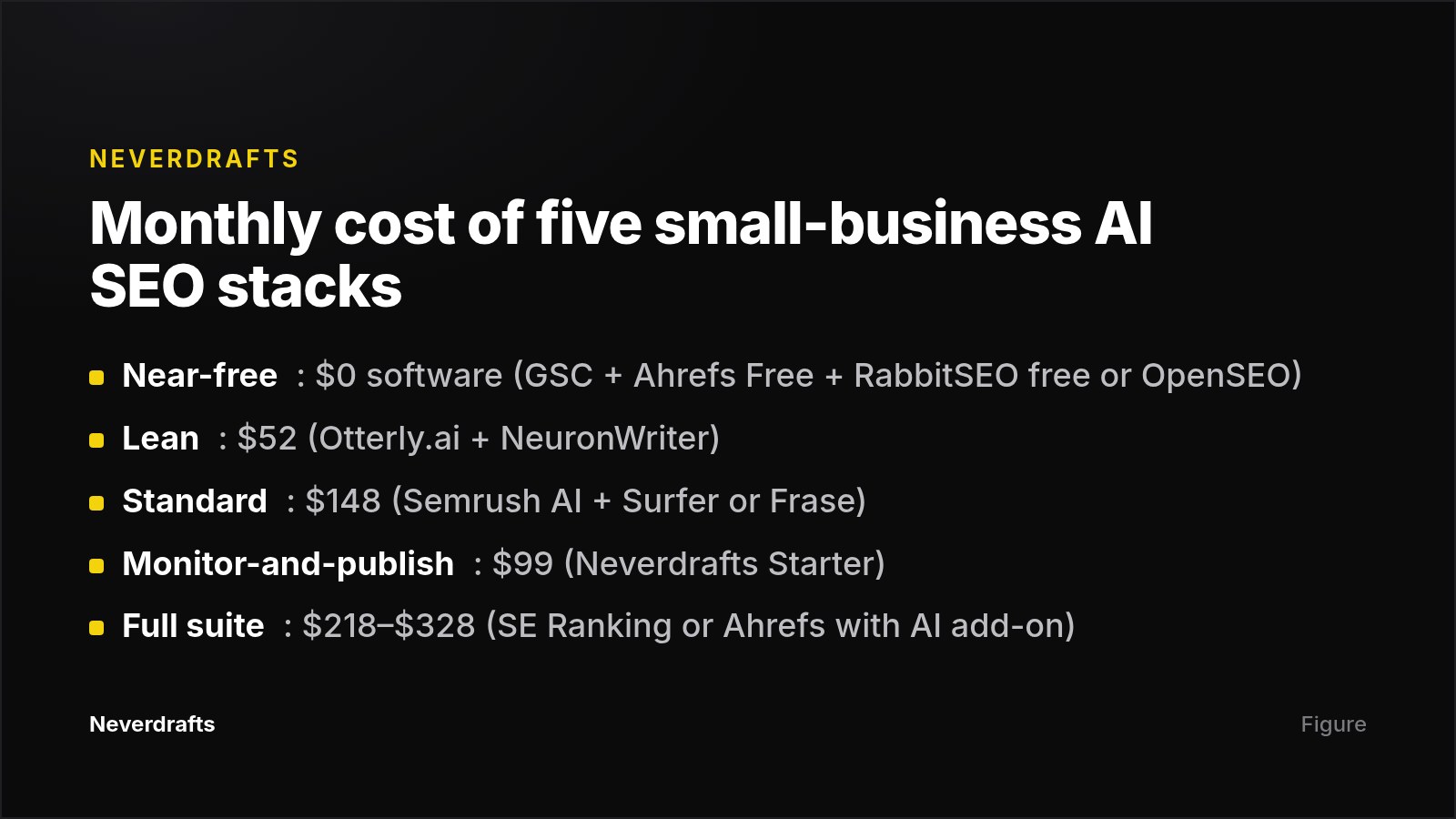
You don't need every category on day one. Here are five realistic stacks, costed from the published entry prices above:
- Near-free starter ($0 software): Google Search Console, Ahrefs Free and either RabbitSEO's free plan or self-hosted OpenSEO. Suits owners who can spend a few hours a week and want to learn before paying.
- Lean ($52/month): Otterly.ai at $29 plus NeuronWriter at $23. Basic AI monitoring and on-page optimization.
- Standard ($148/month): Semrush AI Visibility at $99 plus Surfer or Frase at $49. Broad AI tracking and strong content optimization, but you write the content.
- Monitor-and-publish ($99/month): Neverdrafts Starter plus Google Search Console. Suits businesses whose bottleneck is producing content rather than analysing data.
- Full suite ($218–$328/month): SE Ranking plus its AI add-on ($129 + $89) or Ahrefs Lite plus Brand Radar AI ($129 + $199). Best if link-building and competitive research drive your growth.
For comparison, MEGA puts agency retainers at $2,000–5,000+ per month and doing SEO yourself without tools at 15–25 hours a week. AI-assisted SEO can bring that down to 1–3 hours per week, depending on the tool.
How to choose AI search optimization software for a small business
Use these criteria, in order, to narrow the list above.
Which surface is costing you customers?
Start with your sector data. If you sell physical products, the 4% AI Overview rate for e-commerce means classic SEO tools such as Surfer, NeuronWriter or a suite should get most of your budget. If you are in healthcare, B2B technology or information-heavy services, where coverage approaches 90%, put an AI-visibility tracker near the top of your list.
Do you have someone to act on the data?
This is the question most buyers skip. A tracker that finds 20 lost prompts is only useful if someone writes 20 pieces of content. If nobody on your team has that time, choose either a content optimizer that speeds up your own writing or a tool that generates and publishes the content.
Which AI engines matter for your customers?
Coverage varies by tool:
- Semrush tracks ChatGPT, Google AI, Gemini, and Perplexity.
- Profound covers up to nine engines.
- Neverdrafts covers ChatGPT, Claude, Google AI Mode and Perplexity.
Before you buy, check that the engines your customers use are on the tool's list.
How transparent is the tool's measurement?
The AI Rankings advises users to prefer tools that disclose how they generate prompts, because the category is barely a year old and methods differ. A tool that tracks real answers daily for prompts you define is easier to trust than one that gives you an opaque score.
What does it really cost at your usage level?
Look beyond the headline price:
- Prompt limits. Semrush Base tracks 25 prompts and Ahrefs Lite 5 AI prompts. Check how quickly your list of products, locations and phrasings would use these up.
- Extra users. Semrush charges $45/month per additional user, and Ahrefs $40/month on Lite.
- Annual discounts. Billing annually typically saves about 20%, and Ahrefs advertises savings up to 17%.
- Overage. Metered plans such as Ahrefs' prompt packages bill extra checks at the end of the month.
Can you try it first?
Many tools offer a trial. Use it to run your ten most important prompts and see whether the output leads to something you would act on this week. OneLittleWeb evaluated tools on accuracy, pricing, integrations, ease of use, and reliability, and those five criteria make a good checklist during a trial.
Next step
List ten questions your customers would type into ChatGPT or Perplexity before buying from you, such as "best [your service] for [your customer type]." Then check which AI answers name you and which name competitors. You can do this manually, or run the same prompts through Neverdrafts' $1 three-day trial to see daily visibility scores, the sources AI assistants cite instead of you, and draft articles aimed at the gaps. If you are comparing us with an enterprise tracker, our Neverdrafts vs Profound page sets out the differences.
Frequently asked questions
What is the best AI SEO tool for a small business on a tight budget?
For under $60 a month, pair Otterly.ai ($29/month) for AI-answer monitoring with NeuronWriter ($23/month) for on-page optimization. If you can spend nothing, use Google Search Console and Ahrefs Free, then add RabbitSEO's free plan or self-host OpenSEO. Once you confirm AI answers matter in your market, upgrading to Semrush's $99/month AI Visibility plan or Surfer or Frase makes sense.
What is the difference between SEO and GEO?
SEO aims to get your pages ranking in traditional search results. GEO (generative engine optimization), also called answer engine optimization, aims to get your brand cited inside AI-generated answers from ChatGPT, Gemini, Perplexity and Google's AI features. The two overlap, since clear and authoritative content helps both. However, they are measured differently and usually tracked with different tools.
Do local businesses need AI visibility tracking?
Not as a first priority. Google's local pack still drives calls, directions and visits, so fix your local listings and on-page basics first. None of the sources we reviewed measures how often AI answers replace local pack clicks. Once your local SEO is in order, a low-cost tracker can check whether assistants name you for "best [service] near me" style prompts.
How much time does AI SEO software save?
MEGA estimates DIY SEO at 15–25 hours per week, compared with 1–3 hours per week using AI tools, depending on the tool. OneLittleWeb reports that Surfer's Content Editor saves hours per article. The savings depend on whether the tool only analyses or also produces content. Analysis-only tools still leave you the writing.
Are AI visibility scores accurate?
They are directional, not absolute. The category is roughly a year old, and tools use different methods: some query models with synthetic prompts, while others sample real user queries. As a result, no two trackers agree on a brand's share of voice. Pick one tool, track the same prompts consistently, and focus on whether your position improves over time.
Should I pay monthly or annually?
Pay monthly for the first one to three months while you test whether a tool fits your workflow. Semrush, for example, lets you cancel or change plans at any time on standard terms. Once you are sure, annual billing typically saves around 20%, and Ahrefs advertises savings of up to 17%.