

Otterly.AI is the cheapest credible Profound alternative for most small businesses, at $29 a month for 15 prompts across four AI engines. Peec AI, at about $95 a month, suits teams that need more room. If you already pay for Semrush or SE Ranking, their AI add-ons are usually the least disruptive option. If you want a tool that also produces content to close visibility gaps, compare Eclincher, CrowdReply and Neverdrafts (our product), which pair tracking with action.
Key takeaways
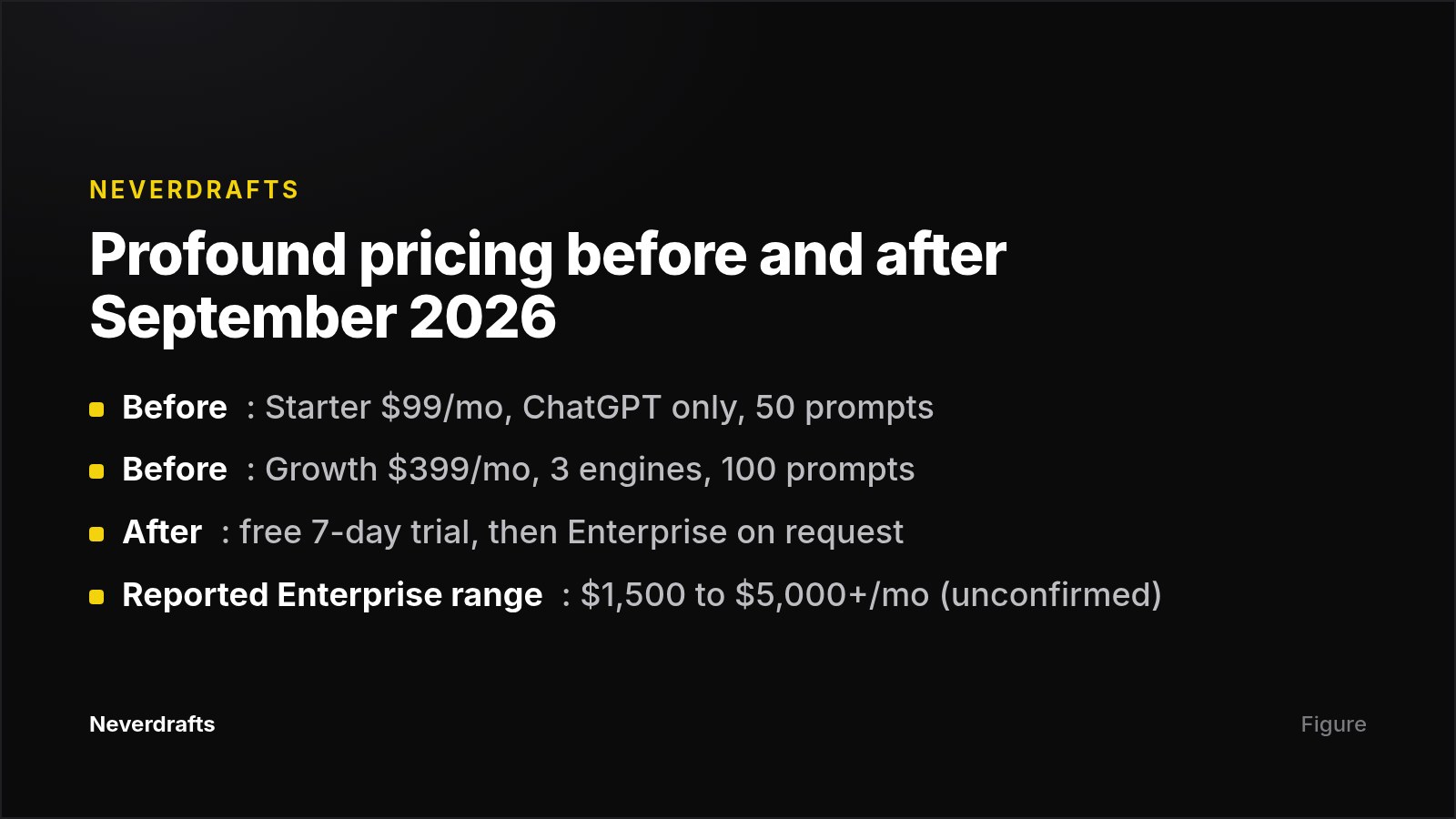
- Profound removed its $99 Starter and $399 Growth brand plans in mid-September 2026. Brands now get a free trial and then a sales-led Enterprise plan.
- Third-party reviewers report Profound Enterprise contracts at roughly $1,500 to $5,000 or more per month. These figures are unconfirmed.
- Under $100 a month, the realistic options are Otterly.AI, DemandSphere, SE Ranking's add-on, Peec AI, Neverdrafts, CrowdReply, HubSpot AEO, and the Semrush add-on.
- No single tool replaces everything Profound does. It bundles results tracking, prompt-volume data and crawler analytics, so pick a tool for the job you actually need.
- Many review sites still quote Profound's old $99 plan. Check the publication date on anything you read.
What changed at Profound, and why are small businesses looking elsewhere?
Until mid-September 2026, a small business could buy Profound without speaking to sales. Starter cost $99 a month for ChatGPT only and 50 prompts. Growth cost $399 a month for ChatGPT, Perplexity and Google AI Overviews with 100 prompts, and both plans were billed annually.
Both plans are gone. Profound's pricing page now offers a free trial of 50 prompts a day for 7 days on ChatGPT, Gemini and Google AI Overviews, followed by custom Enterprise pricing. The change came around the time the company raised $180 million at a $1.8 billion valuation. Agencies still have a self-serve path, reported at $399 a month per client workspace, with Geotoolbox listing a $99 monthly base fee on top of that per-workspace charge.
If you run a small business, this turns a credit-card purchase into a sales conversation and an enterprise budget line. The underlying need has not gone away. Ahrefs' 2026 study found AI Overviews linked to a 58% lower click-through rate for the top organic result. Pew Research found people click a result on 8% of searches with an AI summary, compared with 15% without one.
If you are on a legacy Starter or Growth plan, ask Profound directly about renewal terms. No public terms for existing customers have been published.
How do the affordable Profound alternatives compare?
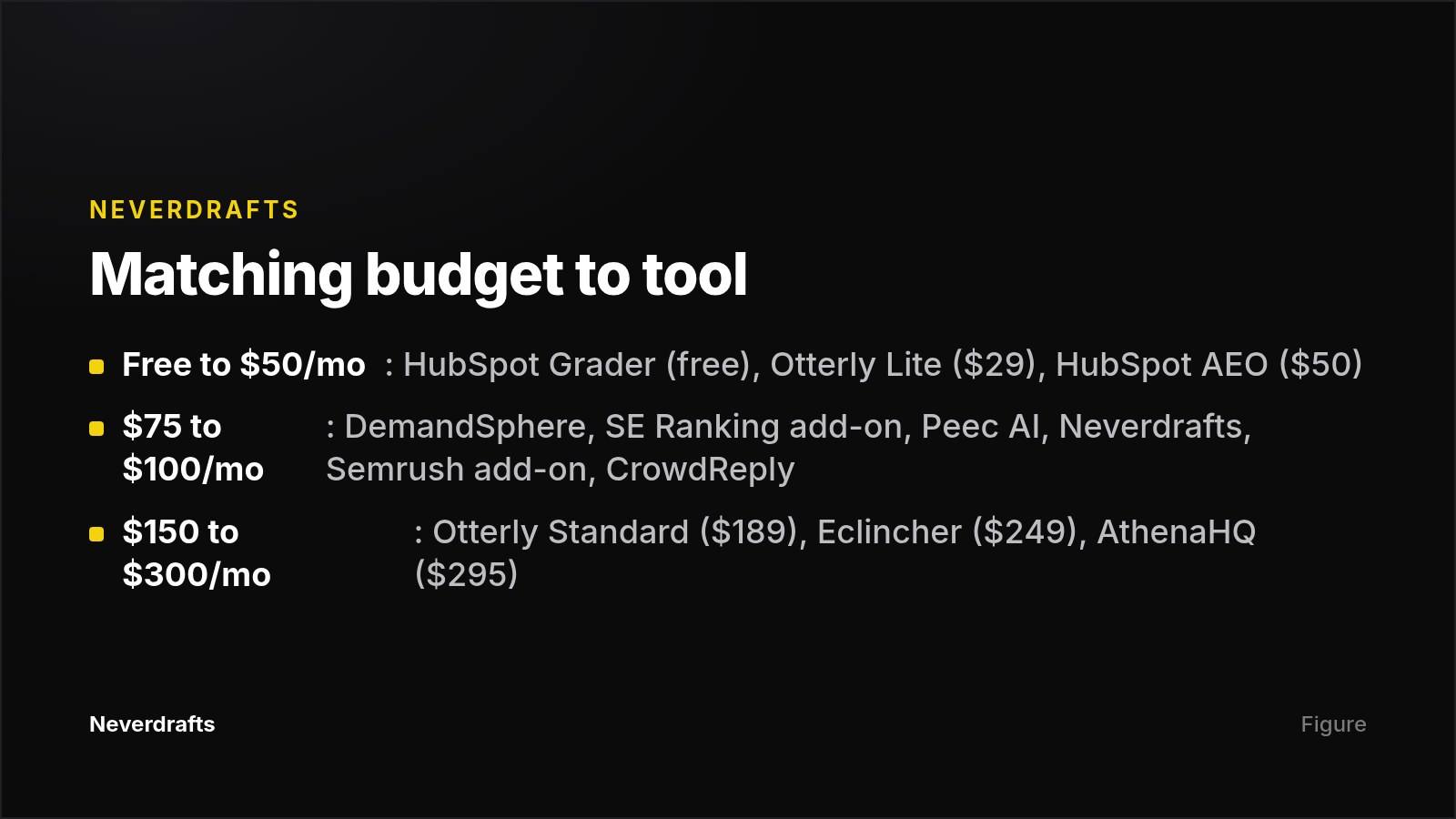
Entry prices run from free (HubSpot's Grader) and $29 a month (Otterly Lite) to $295 a month (AthenaHQ), with most credible trackers clustered between $79 and $99 a month. The table below lists entry prices as published by vendors or verified by third-party reviewers in 2026. Prices in this category change often, so confirm on each vendor's site before you buy.
| Tool | Best for | Standout feature | Entry price |
|---|---|---|---|
| Otterly.AI | Solo marketers testing AI visibility | Four engines and unlimited seats at the lowest price | $29/mo ($25/mo annual) |
| HubSpot Grader & AEO | A free first check, then light ongoing tracking | Free score, then CRM-grounded tracking | Free, then $50/mo |
| DemandSphere | Teams wanting SERP and AI tracking together | Unlimited users and domains on every plan | $79/mo |
| SE Ranking | Existing SE Ranking users | AI Search add-on inside the SEO suite | €79/mo add-on (~$85) |
| Peec AI | Small SEO teams and agencies | Unlimited seats, three tracked models | €89/mo (about $95) |
| Neverdrafts | Teams that want tracking plus drafted fixes | Auto-generated remediation articles and bot-traffic proof | $99/mo |
| Semrush AI Visibility Toolkit | Existing Semrush users | AI data next to rankings and backlinks | $99/mo per domain, billed annually |
| CrowdReply | Brands that want citation outreach | Backlinks marketplace for fixing citation gaps | $99/mo |
| Eclincher AI Visibility | Teams replacing Profound Growth | Prompt Gaps view, monthly billing | $249/mo |
| AthenaHQ | Teams wanting broad engine coverage | Free credit sampler, 11 engines on Starter | Free, then $295/mo |
The sections below follow the same order, cheapest entry price first, so you can stop reading once you hit your budget ceiling.
For a wider view of tools beyond Profound replacements, see our guide to the best AI search optimization software for small businesses.
1. Otterly.AI: the cheapest real entry point
Otterly.AI is a prompt-based tracker that its pricing page positions for solo marketers and small teams. It was named a Gartner Cool Vendor for 2025.
Who it is for: small businesses that want to see how AI engines describe them this month without signing a contract.
Strengths:
- The Lite plan costs $29 a month, or $25 a month billed annually. It tracks 15 prompts daily across ChatGPT, Google AI Overviews, Perplexity and Microsoft Copilot.
- Every tier includes unlimited team members, sentiment analysis, citation source tracking and a crawlability audit.
- The upgrade path is clear. Standard costs $189 a month for 100 prompts and adds API access, MCP access and agent analytics. Extra prompts cost $99 per 100.
Limitations: Claude, Google AI Mode and Gemini are paid add-ons. Lite also includes only one workspace and three recommendations per week. Fifteen prompts is enough to test a handful of buying questions, but it will not cover a full product line. The jump from $29 to $189 is steep.
2. HubSpot AI Search Grader and AEO: free and low-cost starting points
HubSpot's AI Search Grader gives a free one-time visibility score. It is a sensible first test before you spend anything. For ongoing tracking, HubSpot AEO starts at $50 a month and covers ChatGPT, Gemini and Perplexity.
Who it is for: HubSpot customers, and anyone who wants a baseline score before choosing a paid tool.
Strengths:
- The Grader requires no signup commitment and no payment to see a first score.
- AEO ties AI visibility data to CRM records already in HubSpot, which removes a second login for existing customers.
Limitations: The Grader offers no ongoing monitoring, so you cannot see trends or the effect of changes. HubSpot AEO's deeper execution depends on other Marketing Hub tools, and its engine coverage is narrower than most dedicated trackers.
3. DemandSphere: SERP and AI tracking under one login
DemandSphere tracks SERP rankings, AI Overviews and AI Mode alongside brand mentions in ChatGPT, Perplexity, Gemini and Copilot.
Who it is for: small businesses that still depend heavily on Google organic traffic and do not want two separate tools.
Strengths:
- Plans start at $79 a month and scale with tracked prompts, which keeps budgeting predictable.
- Every plan, including Starter, includes unlimited users and unlimited domains.
- Classic rank tracking and AI citation tracking sit in one dashboard.
Limitations: Log analytics, which help with the crawler-access question, are reserved for the Enterprise tier. Prompt allowances at the entry price are not detailed in our sources, so ask before buying.
4. SE Ranking: two ways in, both affordable
SE Ranking sells AI tracking two ways. The AI Search add-on costs €79 a month, or €63.20 on annual billing (roughly $85 USD), layered onto an existing SE Ranking SEO subscription. A standalone product, SE Visible, starts at $99 a month with a 10-day trial.
Who it is for: teams already using SE Ranking, or buyers who want AI tracking inside a full SEO platform.
Strengths:
- Unlimited users are included, which helps agencies and in-house teams with several contributors.
- Writesonic's separate $129-a-month SE Ranking listing covers ChatGPT, Gemini, AI Overviews, AI Mode and Perplexity; confirm with SE Ranking which engines the €79 add-on or $99 SE Visible plan specifically include, since our sources price those two differently from the $129 tier.
Limitations: Writesonic's review flags a weekly refresh and CSV-only exports as the main drawbacks on its listed plan. Otterly.AI and the Semrush toolkit both refresh daily, so if you need daily movement data, compare those first.
5. Peec AI: unlimited seats for growing teams
Peec AI is a European platform with a strong research reputation among SEO teams.
Who it is for: small teams and agencies that analyze visibility trends rather than just checking a score.
Strengths:
- Entry pricing starts around €89 a month, roughly $95 a month, with unlimited seats on every paid plan.
- Self-serve plans track three models. Writesonic describes these as three selected models you choose, while Debutify lists the defaults as ChatGPT, Perplexity and Google AI Overviews. Confirm which applies when you sign up.
- Writesonic's comparison names it the best pick for agencies because of the seat model. By contrast, Profound's old Growth plan included three seats.
Limitations: Gemini, Claude and several other engines cost extra. Price the add-ons before signing if you need every engine from day one. Like most pure trackers, it reports gaps but leaves the content work to you.
6. Neverdrafts: monitoring plus drafted fixes in one loop
Disclosure: Neverdrafts is our product.
Neverdrafts monitors which AI systems recommend your competitors instead of you. It then auto-drafts content aimed at those prompts and tracks whether citations move. It runs the full Monitor → Diagnose → Fix → Prove loop in one dashboard.
Who it is for: small businesses without a dedicated analyst or content writer. Its main audience is teams for whom the bottleneck is producing the fix, not reading the report.
Strengths:
- Daily monitoring of real ChatGPT, Claude, Google AI Mode and Perplexity answers. Each response gets a position-weighted visibility score from 0 to 100.
- Competitor citation diagnosis shows which domains AI engines cite instead of you.
- Auto-generated remediation articles target prompts where you are absent, with one-click publishing to WordPress, Webflow, Shopify and Framer, or via API.
- AI bot traffic tracking on published pages serves as evidence that citations moved.
- Monthly billing with no contracts, plus a free audit that needs no credit card.
Pricing: Starter costs $99 a month for one brand, 50 prompts and 30 remediation articles. Growth costs $199 a month for three brands, 150 prompts and 100 articles. Agency costs $399 a month for 10 brands and 500 prompts. See the pricing details.
Limitations: Google AI Overviews and Microsoft Copilot are not among its tracked engines. If those matter most to you, Otterly.AI (AI Overviews and Copilot included) or Eclincher (Gemini included) may fit better. At $99, the entry price is more than three times Otterly's Lite plan. If you only want monitoring, you pay for content capacity you may not use. Drafted articles should still be reviewed before publishing.
7. Semrush AI Visibility Toolkit: the add-on for existing subscribers
Semrush folded AI tracking into its SEO suite through the AI Visibility Toolkit, priced at $99 a month per domain when billed annually.
Who it is for: small businesses already paying for Semrush.
Strengths:
- It tracks 25 custom prompts daily across ChatGPT, Google AI, Gemini and Perplexity.
- AI mentions sit next to the keyword and backlink data your team already uses, with no extra login.
Limitations: It makes much less sense as a standalone purchase, and per-domain pricing adds up across multiple sites. AI shopping analysis requires an enterprise product. Annual billing is also a commitment many small teams wanted to avoid when they left Profound.
8. CrowdReply: tracking with citation outreach
CrowdReply tracks how often your brand appears in AI answers and which pages those answers cite. It covers ChatGPT, Perplexity, Gemini, Google AI Overviews, Google AI Mode, Grok and Microsoft Copilot.
Who it is for: brands that know their gap is off-site, meaning the publisher pages and discussions AI engines cite.
Strengths:
- Plans run $99 for Starter, $299 for Growth and from $499 for Enterprise, with a 7-day free trial and a 30-day money-back guarantee.
- A backlinks marketplace and citation outreach let you act on gaps instead of only reporting them.
- This matters because a May 2026 Muck Rack study attributed 84% of AI citations to earned media.
Limitations: Lower tiers cap brands, prompts and engines, so busier teams tend to end up on Growth or higher.
9. Eclincher AI Visibility: the closest replacement for Profound Growth
Eclincher positions its AI Visibility product as the closest like-for-like replacement for Profound's old Growth plan.
Who it is for: teams that were about to buy Profound Growth and want similar capacity without annual billing.
Strengths:
- Standard costs $249 a month, billed monthly, for ChatGPT, Perplexity and Gemini. It includes 100 unique prompts and 3,000 responses a month across 10 topics.
- A Prompt Gaps view highlights questions where competitors appear and you don't.
- Optional AI Blog Writer and AI Local SEO tools sit alongside it, which is useful for local businesses.
- A free AEO check tests nine prompts about your brand.
Limitations: Google AI Overviews is not included on Standard. At $249 it sits at the top of a typical small-business budget.
10. AthenaHQ: broad engine coverage with a free sampler
AthenaHQ is a Y Combinator-backed platform founded by engineers who previously worked on Google Search and DeepMind.
Who it is for: teams that want to sample several engines before paying, then need wide coverage.
Strengths:
- A free credit sampler lets you test several engines on your own brand.
- The Starter plan covers 11 engines, the broadest coverage on this list at a published price.
Limitations: Paid access jumps to $295 a month. That is a large step from free, with nothing in between, so the free allocation is best used to decide whether you need that breadth.
How should a small business choose an affordable Profound alternative?
Use the criteria below, in order. The first two usually narrow the list to two or three options.
1. Decide which of Profound's three jobs you actually need
Geotoolbox splits Profound into results tracking, real prompt-volume data and crawler analytics. Most small businesses only need the first, which is also the most commoditized. Even Profound's own head of growth, Nick Lafferty, has written that matching all three usually means stitching together three to five tools.
2. Match engines to where your customers ask
Check which engines are included at the entry price, not just which are available. Otterly includes Copilot and AI Overviews but charges extra for Gemini. Eclincher's Standard plan includes Gemini but not AI Overviews. Paying add-on fees for engines your customers rarely use wastes budget.
3. Count your prompts honestly
List the 10 to 30 questions a buyer would actually ask an AI assistant before choosing a business like yours. If the list exceeds 15, Otterly Lite is too small. Semrush's 25 prompts or a 50-prompt plan will fit better.
4. Ask what happens after the dashboard
G2 reviewers criticized Profound for showing where you stand, not what to do about it. If no one on your team will turn reports into content or outreach, favor tools that include action, such as drafted content, prompt-gap views or citation outreach.
5. Check whether AI crawlers can reach your pages
Crawler access is the dimension almost nobody tracks, yet it decides whether your visibility can rise above zero. Otterly's plans include a crawlability audit, and Neverdrafts tracks AI bot traffic to published pages. Elsewhere, log analytics tend to sit on enterprise tiers.
6. Prefer monthly billing while you learn
This category changes quickly. Monthly plans let you switch tools as your needs become clear, while annual billing locks in a guess. For more budget-focused comparisons, see which AI search optimization tools fit small business budgets.
Next step
Run a free Neverdrafts audit, which needs no credit card. It shows which of your prompts AI engines answer with competitors instead of you. If the gaps are mostly about producing content, compare our Starter plan on the pricing page. If you are weighing us against your old Profound setup, our Neverdrafts vs Profound comparison sets out the differences.
Frequently asked questions
What is the cheapest Profound alternative?
The cheapest paid option is Otterly.AI's Lite plan at $29 a month, or $25 a month billed annually. It covers 15 prompts across ChatGPT, Google AI Overviews, Perplexity and Microsoft Copilot, with unlimited team members. For a single free check, HubSpot's AI Search Grader gives a one-time visibility score but no ongoing tracking.
Does Profound still have a $99 plan?
Not for brands. Profound removed its $99 Starter and $399 Growth brand plans in mid-September 2026. Brands now get a free 7-day trial, then custom Enterprise pricing through a sales demo. Agencies can still self-serve, reportedly at a $99 monthly base plus $399 a month per client workspace. Many review sites still quote the old brand plans, so check publication dates.
Is there a free Profound alternative?
There are free options with limits. HubSpot's AI Search Grader gives a free one-time score. AthenaHQ offers a free credit sampler across several engines before paid plans start at $295 a month. Profound's own free trial gives 50 prompts a day for 7 days. None of these replace ongoing daily monitoring.
Is Peec AI or Otterly.AI better for a small team?
Otterly.AI is better if your budget is tight and 15 prompts covers your key questions, since it costs $29 a month. Peec AI, at around €89 a month (roughly $95), suits teams that need more capacity and analysis depth. It includes unlimited seats and tracks three models on self-serve plans; sources differ on whether you choose those three or get a fixed default of ChatGPT, Perplexity and AI Overviews. Gemini, Claude and other engines are paid add-ons on Peec.
Should I use my SEO suite's add-on instead of a dedicated tool?
If you already pay for Semrush or SE Ranking, the add-on is often the most practical choice. Semrush's toolkit costs $99 a month per domain, billed annually, for 25 prompts. SE Ranking's AI Search add-on costs €79 a month, or €63.20 billed annually. Add-ons rarely match dedicated platforms on depth, but they keep AI data next to your existing rankings.