
For most small businesses, the best AI search optimization software is OtterlyAI at $29/month, which tracks ChatGPT, Google AI Overviews, Perplexity and Microsoft Copilot daily. Pair it with HubSpot's free AEO Grader for a one-time baseline before you spend anything. If you also need a traditional SEO suite, SE Ranking is the budget all-in-one pick. If you want software that writes and publishes content to close the gaps it finds, our own tool, Neverdrafts (from $99/month), covers both monitoring and fixing.
The right choice depends on which half of the job you need help with. Some tools only tell you whether AI assistants mention your business. Others help you change the answer. This guide sorts the options by that split, by budget, and by how exposed your sector is to AI answers.
Key takeaways
- Cheapest useful starting point: OtterlyAI Lite costs $29/month for 15 prompts across 4 AI engines, with citation analysis and a GEO audit included. HubSpot's AEO Grader gives a free one-time benchmark across ChatGPT, Perplexity and Gemini.
- Monitoring and optimization are different purchases. Most trackers report visibility and leave the content work to you. Few tools tell you what to publish next, and fewer publish it for you.
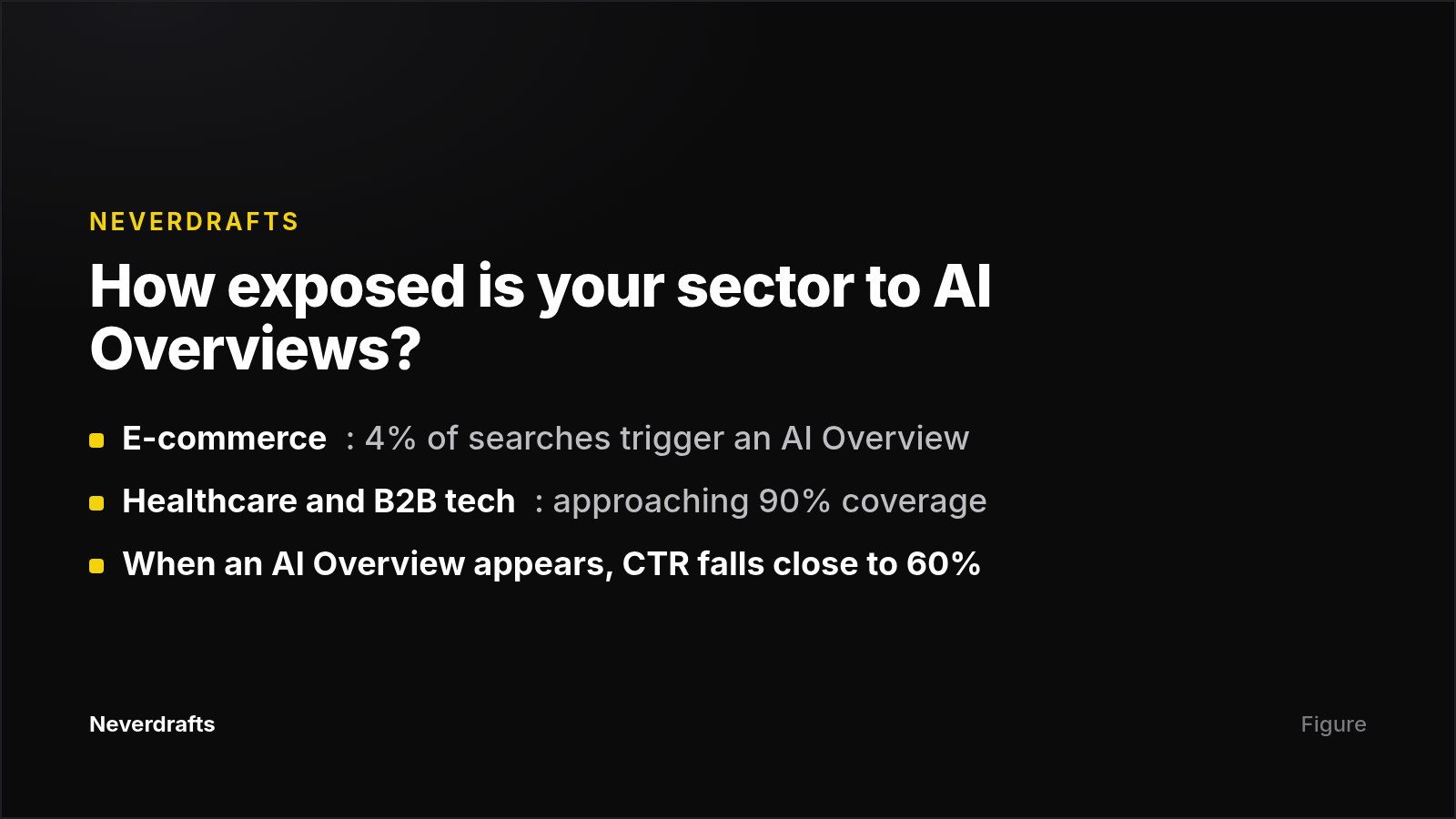
- Your sector decides your urgency. Only 4% of e-commerce searches trigger an AI Overview, while healthcare and B2B technology queries approach 90% coverage.
- All-in-one suites charge extra for AI tracking. Semrush's AI Visibility Toolkit is a $99/month add-on. SE Ranking adds AI visibility for $89 on top of a $129 base.
- Treat every visibility score as directional. LLM answers vary from run to run, and no two trackers agree on a brand's share of voice.
Why "AI search optimization" now means two separate jobs
Search used to have one surface: the ranked list of blue links. In 2026 it has two. The AI Rankings describes it this way: SEO is now two surfaces, traditional rankings and AI answers, and the best tool for one is rarely the best for the other.
The shift shows up in click data. By SparkToro's 2026 analysis, fewer than one in three Google searches now sends a click to the open web. AI Overviews appear on 20%+ of searches and cut click-through by close to 60% when present, with position-one results seeing CTR drops of around 34.5%.
Estimates of AI Overview frequency vary by source and method. Zapier's 2026 review says Google's AI answers appear in nearly half of all searches. Either way, a real share of your potential customers now get an answer before they see your link.
For a small business, that creates two distinct needs:
- Monitoring: finding out whether ChatGPT, Perplexity, Google's AI features and Copilot mention you when buyers ask questions in your category, and which competitors they name instead.
- Optimization: changing the content, structure and citations that AI systems draw on, so the answer shifts in your favor.
Goodie's market overview puts the gap plainly: most tools tell you what's happening; fewer tell you what to publish next, and even fewer execute the fix for you. Keep that in mind as you read the entries below. A $29 tracker and a $129 suite are not competing for the same job.
Does your business actually need this yet?
The exposure is uneven. According to Stackmatix data cited by The AI Rankings, only 4% of e-commerce searches trigger an AI Overview in 2026, down from 29% at rollout. Healthcare and B2B technology queries are approaching 90% coverage. The same source summarizes it: if you sell products, classic SEO is largely intact. If you publish informational content, AI answers are taking your clicks.
A small online shop can start with a free baseline and revisit in a quarter. A small B2B software company, clinic or professional services firm should probably be tracking now. We cover that decision in more depth in when AI search visibility is worth the investment for small SaaS.
The best AI search optimization software for small businesses at a glance
Prices below are entry tiers stated in the cited sources. Most vendors offer annual discounts, and some list different prices in different places, which we note where it applies.
| Tool | Best for | Standout feature | Entry pricing (per sources) |
|---|---|---|---|
| OtterlyAI | Budget ongoing monitoring | Daily tracking across 4 engines with link citation analysis | $29/mo, or $25/mo annually |
| HubSpot AEO Grader | Free first diagnostic | One-time visibility snapshot across ChatGPT, Perplexity, Gemini | Free; paid from $45/mo with annual commitment |
| Neverdrafts | Monitoring plus content that fixes the gaps | Auto-generated remediation content with one-click CMS publishing | $99/mo; $1 for a 3-day trial |
| SE Ranking | All-in-one SEO plus AI tracking on a budget | MCP connector on every plan | $129/mo base + $89 AI add-on |
| Peec AI | Smart suggestions, multi-market brands | Prompt, competitor and citation tracking | ~$80/mo |
| Rankscale | Broad engine coverage without upsells | 17+ engines on one plan, credit-based | $99/mo |
| Semrush AI Visibility Toolkit | Businesses already on Semrush | Keyword data plus AI mention tracking | $99/mo add-on |
| Frase | Solo writers and small content teams | GEO tracking folded into every plan | $49/mo |
| Writesonic | Content production plus visibility tracking | AI Traffic Analytics and Action Center | $79/mo annual / $99/mo |
| Surfer | All-round on-page optimization with AI tracking | On-page and AI search in one workflow | $49/mo annual; $99 with AI-prompt tracking |
If you want a budget-first ranking instead of a job-first one, we published a separate breakdown of AI search optimization tools that fit small business budgets.
OtterlyAI: the default low-cost tracker for small businesses
OtterlyAI is a dedicated AI visibility monitoring tool. It runs the prompts you choose against AI search engines every day and reports whether your brand appears, where it ranks, and which links the engines cite. Independent reviewers reach the same conclusion about it. Zapier picks it for affordability, Goodie lists it for budget-friendly ongoing monitoring, and The AI Rankings calls it affordable GEO monitoring.
Who it's for: solo marketers, owner-operators and small teams who want to know where they stand without committing to a suite.
What you get on the $29 Lite plan
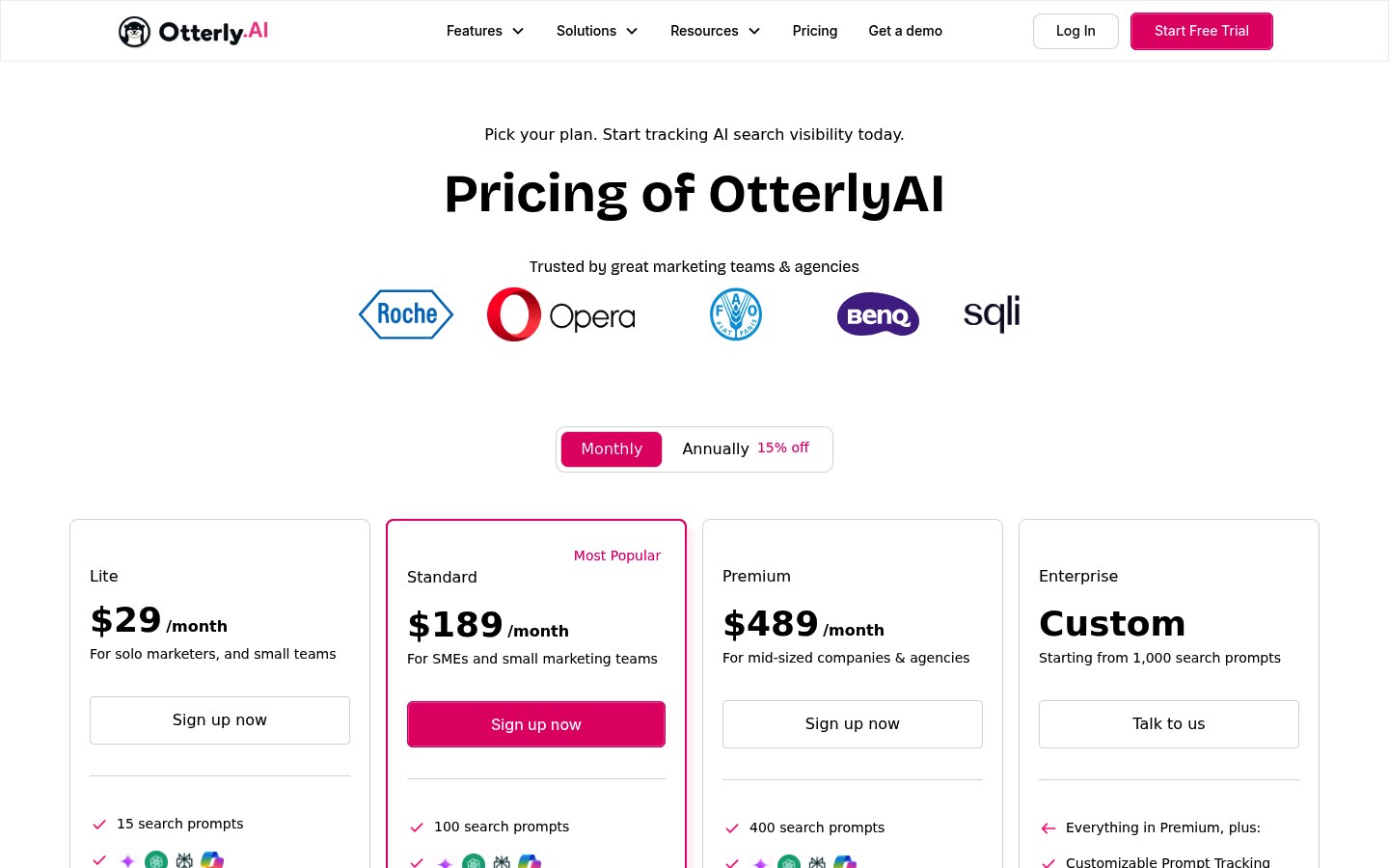
According to OtterlyAI's pricing page, the Lite plan includes:
- 15 search prompts, tracked daily
- 4 AI search engines: ChatGPT, Google AI Overviews, Perplexity and Microsoft Copilot
- Claude, Google AI Mode and Gemini as paid add-ons
- Unlimited team members and unlimited brand reports
- 1 workspace and 3 recommendations per week
- Link Citations Analysis, Brand Visibility Index and Domain Ranking
- A Generative Engine Optimization Audit, with 1,000 GEO URL audits per month
- Multi-country support across 50+ countries
- ChatGPT Ads tracking and an AI prompt research tool
Annual billing takes 15% off, which brings Lite to $25/month.
Strengths
- The lowest serious entry price in this list for ongoing daily monitoring.
- Citation analysis at the entry tier. Seeing which domains AI engines cite in your category is often more useful than the visibility score itself, because it tells you where to get mentioned.
- Covers Google AI Overviews and Copilot by default. HubSpot's free grader omits both, and Peec AI caps plans at 3 engines.
- Unlimited seats on every tier, so a part-time contractor or agency partner can log in at no extra cost.
Limitations
- 15 prompts goes fast. If you sell three services in two cities, you can use up your allowance on a single product line.
- The jump from Lite to Standard is steep. Standard costs $189/month ($160 annually) for 100 prompts, and Premium is $489/month for 400 prompts. Extra prompts cost $99 per 100 on Standard and above.
- API and MCP access start at Standard. The same applies to Agent Analytics and the Looker Studio connector.
- Monitoring, not production. OtterlyAI includes recommendations (3 per week on Lite) and an audit, but writing and publishing content is still your job.
HubSpot AEO Grader: the free first diagnostic
HubSpot's AEO product starts with a free grader that benchmarks how AI engines describe your brand. Goodie lists it as a free one-time benchmark covering 3 engines: ChatGPT, Perplexity and Gemini. NoGood ranks HubSpot AEO fifth of its top 10 GEO tools, with a score of 70.8. It describes the ideal user as marketers and small teams that want a free, instant baseline of their AI visibility before committing to a paid tool.
Who it's for: any small business that has never checked its AI visibility. Run it before you buy anything else.
Strengths
- Free. It costs nothing to learn whether the problem exists.
- More than a yes/no check. NoGood lists share of voice and sentiment scoring, competitor benchmarking and narrative mapping among its features.
- Backed by an established platform. HubSpot acquired XFunnel in late 2025 and folded that technology into its own AEO product line. If you see XFunnel listed as an independent tool, that listing is out of date.
- Fits naturally if you already run HubSpot for CRM or email.
Limitations
- The free grader is a snapshot, not a tracker. You get one reading, not a daily trend line.
- Only three engines. Google AI Overviews and Copilot are not in the free benchmark's engine list.
- Ongoing tracking costs money. The paid standalone tool starts at $45/month with an annual commitment, which makes it more expensive than OtterlyAI Lite on a monthly basis.
Neverdrafts: monitoring plus content that targets the prompts you're losing
Disclosure: Neverdrafts is our product.
Neverdrafts tracks which AI systems recommend your competitors instead of you. It then generates and publishes content aimed at the specific prompts where you're losing. It sits in the "optimization-driven" bucket Goodie describes, where most of the market is still thin. The aim is to close the loop from monitoring to diagnosis to fix to proof inside one tool.
Who it's for: small B2B SaaS companies, product teams and agencies that know they have a visibility gap and lack the writing capacity to fix it prompt by prompt.
What it does
- Tracks real answers daily from ChatGPT, Claude, Google AI Mode and Perplexity on buyer-intent prompts you define.
- Scores visibility by position, from 0 to 100 per response, so a mention in the first line counts for more than a mention at the bottom.
- Diagnoses competitor citations, showing which domains the AI names instead of you and why.
- Generates remediation content targeted at the exact prompts you're losing, in 150+ languages.
- Publishes in one click to WordPress, Webflow, Shopify, Framer or a custom API endpoint.
- Tracks AI bot traffic, showing which AI crawlers actually visit the pages you published.
- Tracks sentiment, splitting mentions into positive, neutral and negative, with share of voice against competitors.
Pricing
- Starter: $99/month for 1 brand, 50 prompts and 30 remediation articles per month
- Growth: $199/month for 3 brands, 150 prompts and 100 articles per month
- Agency: $399/month for 10 brands, 500 prompts and 300 articles per month
- Trial: $1 for 3 days with full access, no credit card required, no contracts
Strengths
- One tool for tracking and fixing. You don't need to pair a tracker with a separate writing tool and copy findings between them.
- Content is mapped to lost prompts, not generic keywords, so each article has a specific job.
- Bot-traffic tracking gives you evidence that AI crawlers found the new pages, which helps you see whether a fix is working before citations move.
- No annual lock-in, and the trial is cheap enough to test against your own prompts.
Limitations
- Higher entry price than pure monitors. At $99, Starter costs more than three times OtterlyAI Lite. If you only want to watch, that's money spent on features you won't use.
- Engine coverage differs from some trackers. Neverdrafts tracks ChatGPT, Claude, Google AI Mode and Perplexity. If Microsoft Copilot or Google AI Overviews matter most to your buyers, compare that list carefully against OtterlyAI's default four.
- Built with B2B SaaS and agencies in mind. A single-location local business may get more from Google Business Profile work and a local-focused tool (see the local section below).
- Generated content still needs a human pass. Any automated article should be checked for accuracy and brand voice before you rely on it.
SE Ranking: the budget all-in-one for SEO plus AI visibility
SE Ranking is a traditional SEO suite that covers keyword tracking, audits and backlinks, with AI visibility available as an add-on. The AI Rankings lists it at $129/month base, with AI visibility for an extra $89, and describes it as a mid-priced suite with an MCP connector on every plan. In current AI answers it is often called the budget pick for all-in-one SEO plus AI tracking.
Who it's for: small businesses that don't yet own an SEO suite and want one subscription covering both classic rankings and AI answers.
Strengths
- One login for both surfaces. For a business where e-commerce or local search still drives most traffic, keeping classic rank tracking next to AI visibility makes sense.
- MCP connector on every plan. That lets AI assistants that support MCP pull SE Ranking data directly. OtterlyAI, by comparison, reserves MCP for its Standard tier and above.
- Cheaper than the big two suites. Ahrefs' equivalent setup is $129 base plus $199 for AI visibility.
Limitations
- $218/month combined for base plus AI add-on is real money for a small business, more than seven times OtterlyAI Lite.
- Monitoring-led. Like most suites, it reports AI visibility rather than writing the content that changes it.
- Overkill if you already pay for SEO tooling. If you have Semrush or Ahrefs, adding their AI module is usually simpler than switching suites.
Peec AI: smart suggestions for multi-market brands
Peec AI is a dedicated LLM visibility tracker covering prompts, competitors and citations. Zapier singles it out for smart suggestions, which points to its focus on telling you what to do next rather than only charting a score. Goodie positions it for agencies and multi-market brands at roughly $80/month.
The company has grown fast. The AI Rankings reports that Peec AI raised $29M and passed $4M+ ARR within ten months, which offers some reassurance that it will be around next year in a category still consolidating.
Who it's for: small businesses selling in more than one country or language, and small agencies running visibility for a handful of clients.
Strengths
- Singled out for smart suggestions in Zapier's testing, rather than passive charts alone.
- Prompt, competitor and citation tracking in one tracker.
- Strong funding and traction for a tool this young.
Limitations
- Engine count is capped per plan. Goodie lists 3 engines per plan (capped), compared with OtterlyAI's 4 base engines at a lower price.
- Annual commitment. The roughly $80 figure assumes annual billing, which is a bigger upfront outlay for a cash-conscious business.
- Still monitoring-first. Suggestions help, but production stays with you.
Rankscale: broad engine coverage without per-engine upsells
Rankscale is a credit-based AI visibility tracker that The AI Rankings lists at $99/month covering 17+ engines without per-engine upsells. Many trackers charge more for each extra engine (OtterlyAI sells Claude, Gemini and Google AI Mode as add-ons). Rankscale bundles coverage instead.
Who it's for: businesses whose buyers spread across many AI assistants, or teams that want to see the long tail of engines before deciding where to focus.
Strengths
- Widest engine coverage at this price point in our sources.
- No surprise add-ons for engines.
- Bundled, credit-based pricing instead of per-engine fees.
Limitations
- Credit-based pricing means you should confirm how many checks your plan's credits cover before committing. Usage models like this complicate budgeting compared with a flat per-prompt plan.
- May be more than a small business needs. Current AI answers note that granular multi-LLM monitors like Rankscale and Scrunch can be priced beyond small budgets.
- Monitoring only. It tells you where you stand across many engines, not what to publish.
Semrush AI Visibility Toolkit: best for existing Semrush users
Semrush's AI Visibility Toolkit adds AI answer tracking to the Semrush suite. The AI Rankings calls it the best-value way to track ChatGPT, Gemini, Google AI and Perplexity mentions at $99/month. Zapier picks it specifically for existing Semrush users. Goodie lists a $99–$199/month range.
Semrush also changed hands this year. Adobe completed its $1.9 billion acquisition of Semrush on April 28, 2026, folding the AI visibility toolkit into Adobe's Digital Experience business. Adobe cited AI-driven traffic to U.S. retail sites growing 269% year over year as its rationale.
Who it's for: small businesses already paying for Semrush.
Strengths
- Keyword data and AI tracking side by side, which helps you connect classic search demand with AI prompts.
- Familiar interface if your team already works in Semrush.
- Corporate backing from Adobe, for those worried about tool longevity.
Limitations
- It's an add-on. It is priced on top of an existing Semrush subscription, per domain. For a new buyer, the total cost is far above a standalone tracker.
- Not aimed at new small-business buyers. It suits existing users, not businesses shopping for their first AI visibility tool.
- Ownership changes can bring pricing and packaging changes. Check current terms before you sign an annual contract.
Frase: best value content optimizer with GEO tracking built in
Frase is a content optimization tool for briefs, on-page scoring and drafting. The AI Rankings names it the best value for solo writers and small teams at $49/month. In 2026, Frase folded GEO tracking into every plan instead of selling it as an add-on, the reverse of what Semrush and Ahrefs did.
Who it's for: small businesses where one person writes the content and needs both an optimizer and basic AI visibility data.
Strengths
- Content tooling and AI tracking for $49, cheaper than most pure trackers plus a separate writing tool.
- Works on the optimization side of the split, where most monitors stop.
- Good fit for in-house writers who want guidance rather than finished articles.
Limitations
- GEO tracking is a feature, not the core product. Expect less depth than a dedicated tracker on citation analysis or engine breadth.
- You still write. Frase guides and drafts, but publishing and editing remain manual.
Writesonic: content production paired with visibility tracking
Writesonic combines AI writing tools with AI visibility tracking. NoGood ranks it fourth with a score of 73.5 and highlights citation tracking across leading LLMs, AI Traffic Analytics that show which pages attract AI crawlers, an Action Center for missed visibility opportunities, and sentiment analysis. Pricing differs between sources: The AI Rankings lists $79/month on annual billing, while Goodie lists $99/month.
Who it's for: content-heavy small businesses and small agencies that want to see a visibility gap and draft a fix in the same tool.
Strengths
- Monitoring and creation together. NoGood notes you can create or optimize content to close gaps without switching tools.
- Crawler analytics show whether AI bots are reaching your pages.
- Action Center turns visibility data into a task list.
Limitations
- NoGood frames its best fit as agencies and enterprises, so some features may exceed what a very small business uses.
- Price varies by source and billing cycle. Confirm the current plan before you budget.
Surfer: all-round on-page optimization with optional AI tracking
Surfer is The AI Rankings' best all-round pick for doing the SEO work: keyword research, briefs and on-page optimization. It costs $49/month on annual billing, or $99 with AI-prompt tracking.
Who it's for: small businesses whose classic organic traffic still matters most (online retailers, for example) and who want light AI tracking alongside.
Strengths
- The AI Rankings' best all-round pick for on-page work plus AI search.
- AI tracking available without buying a second product.
- Sensible for e-commerce, where only 4% of searches trigger an AI Overview and classic rankings still carry most of the weight.
Limitations
- AI tracking doubles the price, from $49 to $99.
- Optimization-led, not a deep tracker. If AI answers are your main concern, a dedicated monitor will report in more depth.
Other tools worth knowing about (and when to skip them)
These tools came up repeatedly in our sources. Each suits a narrower situation than the main picks above.
NeuronWriter: the cheapest serious on-page optimizer
At $23/month, NeuronWriter is the lowest-cost on-page optimizer in The AI Rankings' table. It's a reasonable pairing with a low-cost tracker like OtterlyAI if you write in-house and want both for around $50 a month.
OpenSEO: free and self-hosted
OpenSEO is a free, self-hostable, open-source alternative to Semrush and Ahrefs. It is agent-native, so an AI assistant can run keyword research and audits directly. It suits technically confident owners who will run their own hosting. It is not a turnkey AI visibility tracker.
Yext Scout: for local tracking
Zapier picks Yext Scout for local tracking. Local businesses are underserved in most AI visibility coverage. A restaurant, dental practice or plumber should check whether a local-focused tool fits better than a national tracker built for SaaS brands.
Ahrefs Brand Radar: for existing Ahrefs users
Ahrefs Brand Radar layers citation tracking onto Ahrefs' backlink and keyword data. NoGood ranks it third with a score of 78.3. The AI Rankings lists Ahrefs at $129 base plus $199 for AI visibility, and Goodie notes Ahrefs restructured Brand Radar pricing around per-platform indexes at $199/month per index. Full engine coverage therefore costs more than the headline price. It's worth it if you already use Ahrefs, and hard to justify as a first purchase.
Profound, Scrunch AI and Goodie: enterprise tools most small businesses can skip
- Profound leads at the enterprise end, tracking up to nine engines, with an entry price of $99/month on annual billing. If its entry tier tempts you, our guide to affordable Profound alternatives for small business teams compares the options.
- Scrunch AI starts at $250/month and focuses on enterprise brand safety and hallucination detection. Sitecore acquired it for a reported $225 million on June 3, 2026.
- Goodie offers custom pricing and tracks 11+ engines, from ChatGPT and AI Mode to DeepSeek and Alexa for Shopping. Goodie publishes one of the comparison guides cited here and ranks itself first, so weigh that guide's verdict accordingly.
For a wider comparison that includes these enterprise platforms, see best GEO tools in 2026: 15 platforms compared.
How much does AI visibility tracking cost per prompt?
None of the sources compare cost per prompt directly, even though Zapier advises buyers to determine the cost per prompt, how it grows with frequency, how many engines you track and which regions you target. Here is that math for the two tools in this list that publish prompt allowances, using monthly list prices.
| Plan | Monthly price | Prompts | Cost per prompt per month | Engines included |
|---|---|---|---|---|
| OtterlyAI Lite | $29 | 15 | ~$1.93 | 4 (ChatGPT, AI Overviews, Perplexity, Copilot) |
| OtterlyAI Standard | $189 | 100 | ~$1.89 | 4 |
| OtterlyAI Premium | $489 | 400 | ~$1.22 | 4 |
| OtterlyAI extra prompts | $99 | +100 | ~$0.99 | 4 |
| Neverdrafts Starter | $99 | 50 | ~$1.98 | 4 (ChatGPT, Claude, AI Mode, Perplexity) |
| Neverdrafts Growth | $199 | 150 | ~$1.33 | 4 |
| Neverdrafts Agency | $399 | 500 | ~$0.80 | 4 |
OtterlyAI figures come from its pricing page. Neverdrafts figures come from its published plans, which also include remediation articles that the per-prompt number doesn't capture.
Three things stand out:
- Per-prompt cost barely drops between OtterlyAI Lite and Standard. You pay for API, MCP and unlimited workspaces, not cheaper prompts. It only drops meaningfully at Premium, where $489/month works out to roughly $1.22 per prompt.
- Engine add-ons raise the effective rate. Adding Claude, Gemini or AI Mode on OtterlyAI pushes the real cost per prompt above the table figures, since those engines are billed separately from the base plan.
- Comparing per-prompt cost across tool types is misleading. A tracker and a tracker-plus-content tool sell different things. The table above is included for reference, not as a recommendation to pick whichever row is cheapest; compare the full monthly cost of reaching the same outcome, including whether articles, API access or extra engines are part of the deal.
How to choose AI search optimization software for a small business
These are the criteria we used to build this list, in the order a small business should weigh them.
1. Decide whether you need monitoring, optimization or both
This is the biggest fork. If you have a writer, an agency or time to act on findings yourself, a monitor such as OtterlyAI, Peec AI or Rankscale is enough. If you know the gap exists and can't produce content to close it, you need an optimization-capable tool like Frase, Writesonic, Surfer or Neverdrafts. NoGood weighted this "optimization vs. monitoring balance" at 25% of its scoring, equal to engine coverage, because pure monitors don't move the number on their own.
2. Check engine coverage against where your buyers search
LLM outputs vary by platform, so a tool that skips your customers' preferred assistant leaves you blind. Before buying:
- Ask a few customers which assistants they use, or check which engines your analytics show referring traffic.
- Check whether those engines are included or sold as add-ons.
- Don't pay for 17 engines if two of them drive almost all relevant queries.
3. Estimate how many prompts you actually need
Start with buyer-intent questions, not every keyword you rank for. A typical small business might track:
- "Best [service] in [city]" or "best [product type] for [use case]"
- Comparison prompts naming you and your top two competitors
- Problem-led prompts ("how do I fix [problem your product solves]")
- Pricing and alternatives prompts ("[competitor] alternatives")
Multiply by product lines and locations. If the total is under 15, OtterlyAI Lite fits. If it's 40 to 150, you're in Standard, Neverdrafts Starter or Growth, or a suite's AI add-on. OtterlyAI also offers a prompt calculator to help with the estimate.
4. Prioritize citation data over vanity scores
Zapier lists citation source detection among the most important features, because it shows which pages AI engines trust. That is your outreach and content target list. A visibility score tells you whether you're winning. Citation data tells you how to start.
5. Expect measurement variance and choose transparent tools
Zapier warns that LLMs are non-deterministic: the same prompt on the same engine at the same time can produce different responses. The AI Rankings adds that methodologies differ, with some tools using synthetic prompts and others sampling real queries, and no two trackers agree on a brand's share of voice. Its advice: treat scores as directional and prefer tools that disclose how they generate prompts. Zapier notes some tools, such as ZipTie, mimic real user behavior rather than relying solely on APIs, which may better reflect what users actually see.
In practice, pick one tool and judge the trend over weeks, not the absolute number on any single day.
6. Match the tool to your sector's exposure
Use the sector data from earlier as a budget guide:
- E-commerce: low AI Overview exposure. A free baseline plus classic SEO tooling (Surfer, SE Ranking) is usually enough for now.
- Healthcare, B2B tech, professional services: high exposure. Daily monitoring and active optimization are justified.
- Local services: check local-focused options like Yext Scout and your Google Business Profile before buying a national tracker.
7. Check integrations and the cost of growing
Zapier awarded bonus points for tools that connect to workflow tools. For small businesses, the questions that matter are practical:
- Does it publish to your CMS, or will you copy and paste?
- Is API or MCP access on your tier, or only higher up?
- What happens to cost when you add a second location or product line?
Sample small-business stacks by budget
The AI Rankings suggests the reliable 2026 pattern is a content optimizer, an AI-visibility tracker and a general LLM, with a suite underneath for keyword and backlink data. Small businesses can scale that down. Here are stacks built only from tools and prices in this article.
Under $50 a month: find out where you stand
- HubSpot AEO Grader (free) for a one-time baseline
- OtterlyAI Lite ($29, or $25 annually) for daily tracking on your 15 most important prompts
- Optional: NeuronWriter ($23) if you write in-house
Best for owner-operators and e-commerce shops with modest AI exposure.
Around $100 a month: track and act
Choose one of these:
- Frase ($49) if you write yourself and want optimization guidance with built-in GEO tracking
- Surfer with AI-prompt tracking ($99) if classic organic traffic is still your priority
- Neverdrafts Starter ($99) if you want gaps found and remediation content produced and published for 50 prompts
- Rankscale ($99) if you need broad engine coverage and will handle content separately
$200 and up: suite plus AI visibility
- SE Ranking base plus AI add-on ($218 combined) for a single subscription covering classic SEO and AI tracking
- Or OtterlyAI Standard ($189) for 100 prompts with API, MCP and Looker Studio access
- Or Neverdrafts Growth ($199) for 3 brands, 150 prompts and 100 articles per month
What to do in your first 30 days
Whatever you buy, a simple sequence keeps the spend useful:
- Week 1: Run the free HubSpot AEO Grader. Write down every competitor it benchmarks you against.
- Week 1: Draft 15 to 50 buyer-intent prompts using the categories above.
- Week 2: Start tracking on one tool. Don't change prompts for at least two weeks, or the trend data becomes meaningless.
- Week 3: Study citation data. List the domains AI engines cite for your prompts, and whether your site appears.
- Week 4: Publish or update content for the 3 to 5 prompts where you're closest to appearing, then watch for movement over the following month.
Next step
If your baseline shows competitors winning prompts you should own, the quickest way to test the monitor-and-fix approach is Neverdrafts' $1, 3-day trial. Add 10 to 20 of your buyer-intent prompts, check which domains are cited instead of you, and review one generated remediation article before deciding whether to publish it. If you only need monitoring, start with OtterlyAI Lite instead.
Frequently asked questions
Is there free AI search optimization software for small businesses?
Yes, with limits. HubSpot's AEO Grader gives a free one-time benchmark of how ChatGPT, Perplexity and Gemini describe your brand. OpenSEO is a free, self-hostable open-source SEO suite, though it isn't a dedicated AI visibility tracker. For ongoing daily monitoring, the cheapest paid option in current reviews is OtterlyAI Lite at $29 per month, or $25 with annual billing.
How much should a small business spend on AI visibility tracking?
Most small businesses can start under $50 a month: a free baseline plus a low-cost tracker covering 15 or so prompts. Spending $100 to $200 makes sense when your sector has heavy AI Overview exposure, such as healthcare or B2B technology, or when you need content produced as well. Suite add-ons push combined costs above $200 per month.
Do I still need traditional SEO tools if I buy an AI visibility tracker?
Usually, yes. AI visibility trackers report whether AI assistants mention you, but they don't replace keyword research, technical audits or rank tracking. E-commerce sites especially still depend on classic rankings, since only about 4% of e-commerce searches trigger an AI Overview. Many businesses pair a content optimizer or suite with a dedicated tracker rather than choosing one.
How many prompts should a small business track?
Start with the questions buyers actually ask before purchasing: "best" queries for your category and location, comparisons with your top competitors, alternatives queries, and problem-led questions your product solves. For a single-product local business, 15 prompts may be enough. Businesses with several products, locations or languages often need 50 to 150 to cover the questions that drive revenue.
What is the difference between GEO and AEO?
Goodie defines AEO (answer engine optimization) as winning short, direct answers like featured snippets or one-line AI summaries. GEO (generative engine optimization) targets citations inside longer, contextual AI responses from tools like ChatGPT and Perplexity. AI SEO is the umbrella covering both. In practice, vendors use the terms interchangeably, so check what a tool tracks rather than what it calls itself.
Why do different AI visibility tools give me different scores?
LLMs are non-deterministic: the same prompt can produce different answers even seconds apart. Tools also generate prompts differently. Some use synthetic queries, others sample real user queries, and some mimic real user sessions instead of calling APIs. As a result, no two trackers agree on share of voice. Use one tool consistently and watch the trend over weeks rather than comparing absolute numbers.