
Most small businesses now use AI in some form: survey estimates range from 75% of SMBs investing in AI to 88% reporting they use AI tools. The most common uses are marketing, content creation, customer support and administrative work, and the average small business worker reports saving 5.6 hours per week. Adoption is far from even, though — sole proprietors trail firms with employees by a wide margin, and payments data suggests real committed spending lags self-reported usage.
Key takeaways
- Self-reported AI use among small businesses sits between 75% and 88% depending on the survey, while 57% say they are actively investing in AI technology — up from 36% in 2023.
- Firm size is the strongest predictor of adoption: 47% of sole proprietors use AI versus 83% of small businesses with employees.
- Marketing (53%), sales (49%) and customer support (46%) are the most common implementation areas.
- Benefits are widely reported but unevenly distributed: managers save 7.2 hours a week versus 3.4 hours for individual contributors.
- Job-loss fear outpaces stated employer intent — only 12% of SMBs are very likely to cut staff because of AI in the next 12 months.
- The biggest barrier among holdouts is not cost but comprehension: 62% cite a lack of understanding of AI's benefits.
How many small businesses actually use AI?
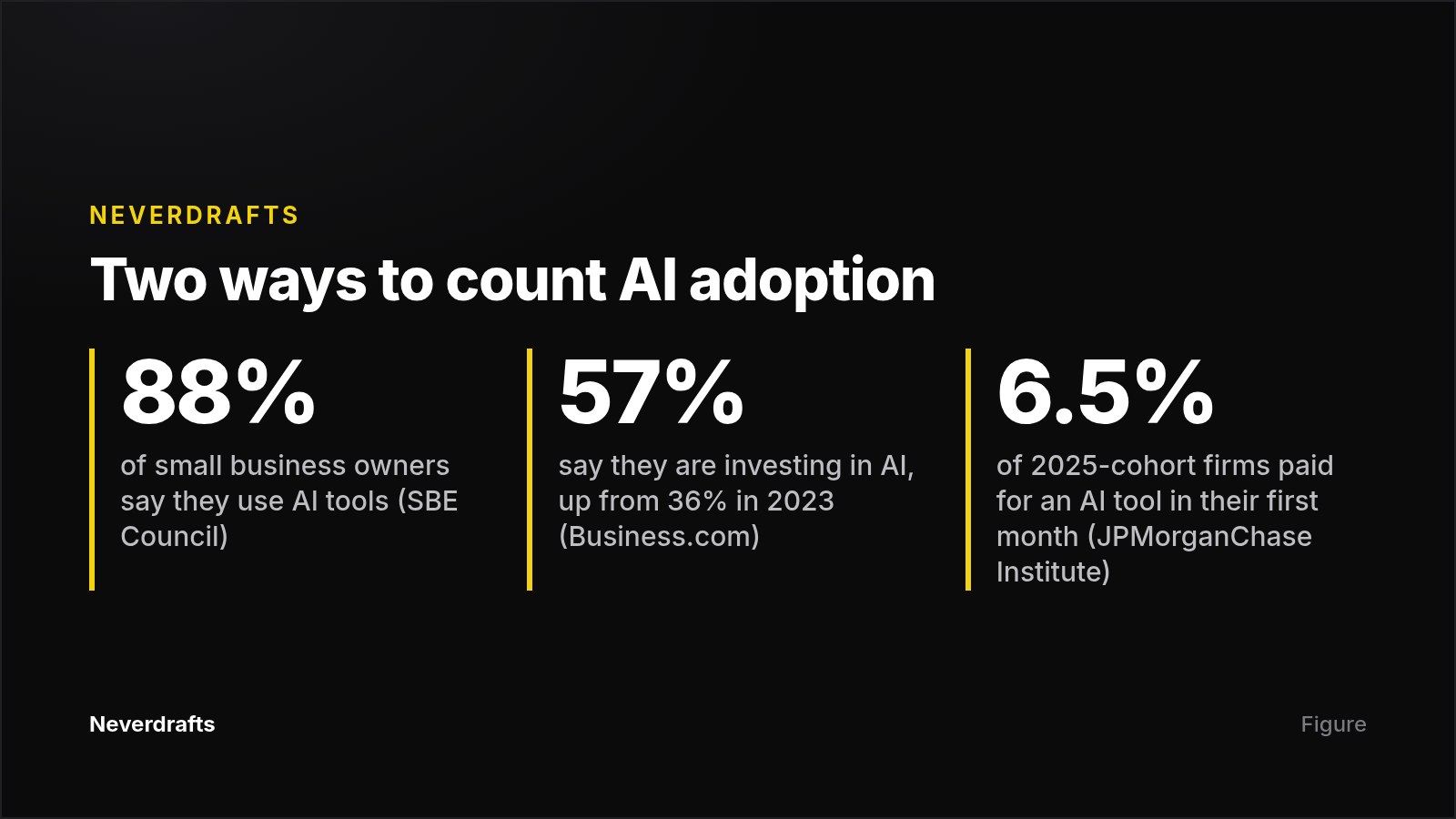
It depends entirely on how you define "use." Four surveys and one set of payments data give five different answers, and the gap between them is the most useful thing in the data.
| Source | Headline figure | What it measures |
|---|---|---|
| SBE Council / TechnoMetrica | 88% | Owners reporting they use AI tools |
| Salesforce SMB Trends | 75% | SMBs putting money into AI |
| Service Direct | 77% | Small businesses that adopted AI in some capacity |
| Business.com / Dialog | 57% | SMBs investing in AI technology |
| JPMorganChase Institute | 6.5% | 2025-cohort firms that paid for an AI tool in month one |
All five datasets reflect 2025 fieldwork or 2025 firm cohorts, so the differences below are about definition, not timing.
The first four are survey self-reports across the general small-business population. The last one is payments data from JPMorganChase Institute, and it measures something much narrower: only firms founded in 2025, and only whether they paid for an AI tool within their first month of operation. That figure rose from 1.2% for the 2019 cohort to 6.5% for the 2025 cohort — a sharp jump in relative terms, but it is a floor on committed spending among brand-new firms, not a population-wide adoption rate, so it should not be read as a direct contradiction of the 88% figure above.
Both pictures can be true at once. The likely explanation is that self-reports capture any contact with AI, while committed-spend data captures only firms that have put money behind a tool early on. If you are benchmarking yourself, decide which question you're answering before you panic about falling behind.
What are small businesses actually using AI for?
Marketing and customer-facing work, overwhelmingly. Service Direct found the most common implementation areas were marketing (53%), sales (49%) and customer support (46%) — and, counterintuitively, employee productivity ranked lowest, despite being how most AI vendors pitch the technology.
Salesforce's report lists the same pattern in more detail. The top use cases are running marketing campaigns, creating content faster, recommending products, natural-language search, and answering customer questions around the clock. The SBE Council survey adds business research, image and video development, AI-powered email marketing and financial management to the list, with users running an average of 4.8 tools across their operations.
Usage deepens with tool count. Companies running 1–3 AI products cluster around marketing (45%) and sales (37%); those running four or more expand into customer support (50%), finance management (44%) and product engineering (35%). Forty-three percent of businesses use four to six AI tools weekly.
A newer marketing use case sits alongside all of this: getting found inside AI assistants themselves. As buyers ask ChatGPT and Perplexity for recommendations instead of scrolling search results, visibility in those answers becomes a distribution channel. That is the job we do at Neverdrafts — we monitor whether AI engines mention your business on the prompts your buyers actually type, and generate content aimed at the prompts where you're absent. If you're evaluating writing tools more broadly, our ranked comparison of AI content generators covers the alternatives.
Pricing is the quiet growth area
Just over one in four small businesses — 28% — use algorithmic, dynamic or personalized pricing. Among those that do, 52% report improved profit margins, 48% increased revenue, 41% better inventory management and 40% improved cash flow. Among non-users, 43% think it could help them compete against larger companies.
Does AI actually save small businesses time and money?
Reported gains are consistent across every survey, but the size of the gain depends heavily on your role.
The average small business worker saves 5.6 hours per week using AI. Split by seniority, managers save 7.2 hours and individual contributors save 3.4 hours — more than a two-to-one difference. Managers do more of the work AI is currently good at: drafting, summarizing, research, first-pass analysis.
On business outcomes, Service Direct's headline findings report AI users citing increased productivity (87%), effectiveness (86%) and improved growth (86%). Salesforce found nine in ten AI-using small businesses say operations are more efficient, and 85% expect a return on their AI investment.
The SBE Council data explains the mechanism better than the outcome percentages do. The primary motivation for adoption is efficiency and productivity (60%), followed by customer service (42%). Forty-one percent say AI lets them spend more strategic time growing the business, 35% redirect resources to higher-value projects, and 33% say it helped them improve customer engagement and retention.
One caveat worth stating plainly: these are self-reported perceptions, not audited results. None of the available surveys publish time-to-ROI benchmarks, typical tool spend by business size, or training cost estimates. Treat "87% report increased productivity" as evidence of satisfaction, not as a measured productivity figure.
Why are the smallest businesses furthest behind?
Because AI adoption scales with headcount, and the gap is large. Business.com's survey breaks investment down by firm size:
| Firm size | Investing in AI | Workers whose AI use rose year over year |
|---|---|---|
| 1–9 employees | 24% | 45% |
| 10–49 employees | 45% | 58% |
| Largest band surveyed* | 75% | 67% |
Source: Business.com 2026 Small Business AI Outlook Report
*Business.com reports this band as firms of roughly 50–250 employees; the published label for this row is ambiguous, so treat it as directional rather than precise.
Service Direct found the same split from a different angle: 47% of sole proprietors have adopted AI versus 83% of small businesses with employees.
The reasons are not primarily financial. Among non-adopters, Service Direct found lack of understanding (62%) was the top barrier, ahead of in-house resource and culture limits (60%), with 25% specifically citing a lack of knowledge about which tools exist. The SBE Council survey is blunter: 77% of non-adopters simply see no reason to use AI in their business, with 16% citing knowledge barriers and 15% limited resources.
There is also a perception gap. Salesforce found that SMBs already using AI assume their peers use it too, while only one in three non-adopters believe AI is common in their industry — meaning some owners are underestimating how far competitors have moved.
What's holding adopters back once they start?
Integration and data handling, not the technology itself. Among businesses already using AI, the most reported challenges are AI integration and usage (72%) and data and privacy concerns (70%).
Salesforce names security as the single biggest worry, with industry-specific complications layered on top: financial services teams struggle with legacy systems that don't integrate cleanly, and retailers navigate the line between personalization and making customers feel profiled.
Small businesses are responding with governance rather than retreat. SBE Council respondents report training staff, reviewing AI outputs for accuracy and compliance, or hiring outside experts to do so. Employee response has been positive or neutral for 94% of those firms, with 58% reporting strong employee engagement.
Will AI cost small business jobs?
Employer intent and employee fear do not line up. Only 12% of SMBs say they are very likely to reduce staff because of AI in the next 12 months.
Worker sentiment is more complicated. In the same survey, 45% of small business workers worry that adopting "too much AI" could damage their company's reputation, and 30% act more enthusiastic about AI in front of colleagues than they actually feel. Fifty-three percent favor keeping operations "mostly human-led," and managers are notably more open to integration than their teams — 37% of managers prefer an equal human-AI balance versus 27% of individual contributors.
That gap matters operationally. If a third of your team is performing enthusiasm they don't feel, your adoption metrics are measuring compliance, not capability.

How should a small business start with AI?
Start with one repetitive task you already do weekly, not with a platform decision. The evidence points toward low-cost, narrow applications: AI-driven invoicing, automated scheduling, and content-generation tools for social media all lower the barrier to entry for the smallest firms.
A practical sequence:
- Pick one task, not one tool. Choose something you do at least weekly that involves writing, summarizing, classifying or answering repeat questions.
- Test in a low-risk area first. Salesforce notes that hesitant SMBs succeed by testing AI in low-risk areas and leaning on trusted platforms while they learn.
- Set a review rule before you publish anything. Decide who checks AI output for accuracy and compliance, and what gets checked every time.
- Measure the hours, not the vibe. Track time spent on the task before and after. Reported savings across roles range from about 3.4 to 7.2 hours a week, so use your own baseline rather than assuming either end applies to you.
- Expand only after the first use case sticks. Firms using four or more tools reach further into support and finance, but they got there sequentially.
- Revisit quarterly. Among current AI users, 30% still report pain points they wish AI could solve — the tooling is moving fast enough that last quarter's gap may now be closed.
If you're past the single-task stage and trying to make AI part of how the business actually runs, the harder problem is operating-model change rather than tool selection — we cover that shift in moving AI from pilot to operating model.
Momentum is clear in the intent data: 71% of small businesses plan to increase AI investment over the next year and 90% of current users plan to add more tools to their stack.
Next step
If marketing is your first or next AI use case, the measurable version of it is knowing whether AI assistants recommend your business when a buyer asks. Neverdrafts monitors real ChatGPT, Claude, Google AI Mode and Perplexity answers on prompts you choose, shows which competitors get named instead, and drafts content targeted at the prompts you're losing. Plans start at $99/month for 50 tracked prompts, with a $1 three-day full-access trial if you want to see your current visibility before committing.
Frequently asked questions
What percentage of small businesses use AI?
Between 75% and 88%, depending on the survey and definition. SBE Council found 88% report using AI tools; Salesforce found 75% investing in AI; Service Direct found 77% adoption. Business.com's narrower measure of active investment is 57%, up from 36% in 2023. Payments data shows far lower committed-spend adoption, at 6.5% of 2025-cohort firms in their first month.
What is the most common AI use case for small businesses?
Marketing, at 53% of adopters, followed by sales at 49% and customer support at 46%. Within marketing, the frequent applications are campaign management, content creation, email marketing, and image or video development. Employee productivity ranks lowest among reported use cases, despite being how most vendors position AI.
How much time does AI save a small business?
The average small business worker reports saving 5.6 hours per week. The figure varies sharply by role: managers save 7.2 hours weekly, while individual contributors save 3.4 hours. These are self-reported figures from survey respondents rather than independently measured productivity data, so treat them as directional.
Why do sole proprietors adopt AI less than other small businesses?
Adoption rises with headcount — 47% of sole proprietors use AI versus 83% of small businesses with employees. Among firms with 1–9 employees, only 24% are investing in AI. The primary barrier is not budget but understanding: 62% of non-adopters cite unclear benefits, and 77% say they see no reason to use AI in their business.
Are small businesses cutting jobs because of AI?
Not at scale, according to employer intent. Only 12% of SMBs say they are very likely to reduce staff due to AI in the next 12 months. Worker anxiety runs higher than that: 45% worry that adopting too much AI could harm their company's reputation, and 30% overstate their enthusiasm for AI to colleagues.
What's the biggest risk when a small business adopts AI?
Data security and integration. Among current AI users, 72% report integration and usage challenges and 70% report data and privacy concerns. Salesforce identifies security as the leading hesitation, with legacy-system friction in financial services and customer-trust concerns in retail as industry-specific complications.
Sources
- 2026 Small Business AI Outlook Report — Business.com
- Small Business "Check Up" Survey — Small Business & Entrepreneurship Council
- Understanding the use of AI among small businesses — JPMorganChase Institute
- AI and the Future of Small Business (A Trends Report Recap) — Salesforce
- 2025 Small Business AI Report — Service Direct