
Nearly every self-serve AI visibility tool is cheaper than Profound. Since mid-September 2026, Profound has not published a price for brands. It offers only a 7-day free trial and a custom-quoted Enterprise plan.
The best options by budget:
- Cheapest entry: Rankscale ($17–$20/month) and Otterly.AI ($29/month).
- Closest like-for-like volume under $100: Peec AI and Rankshift.
- Widest engine coverage at a published price: AthenaHQ (11 engines) and Rankshift (9) (Okara).
- Largest prompt allocation: Scrunch AI, 350 custom prompts at $250/month on annual billing.
Cheaper plans track fewer prompts or engines. Compare how many AI answers each plan checks per month, not the headline price.
Key takeaways
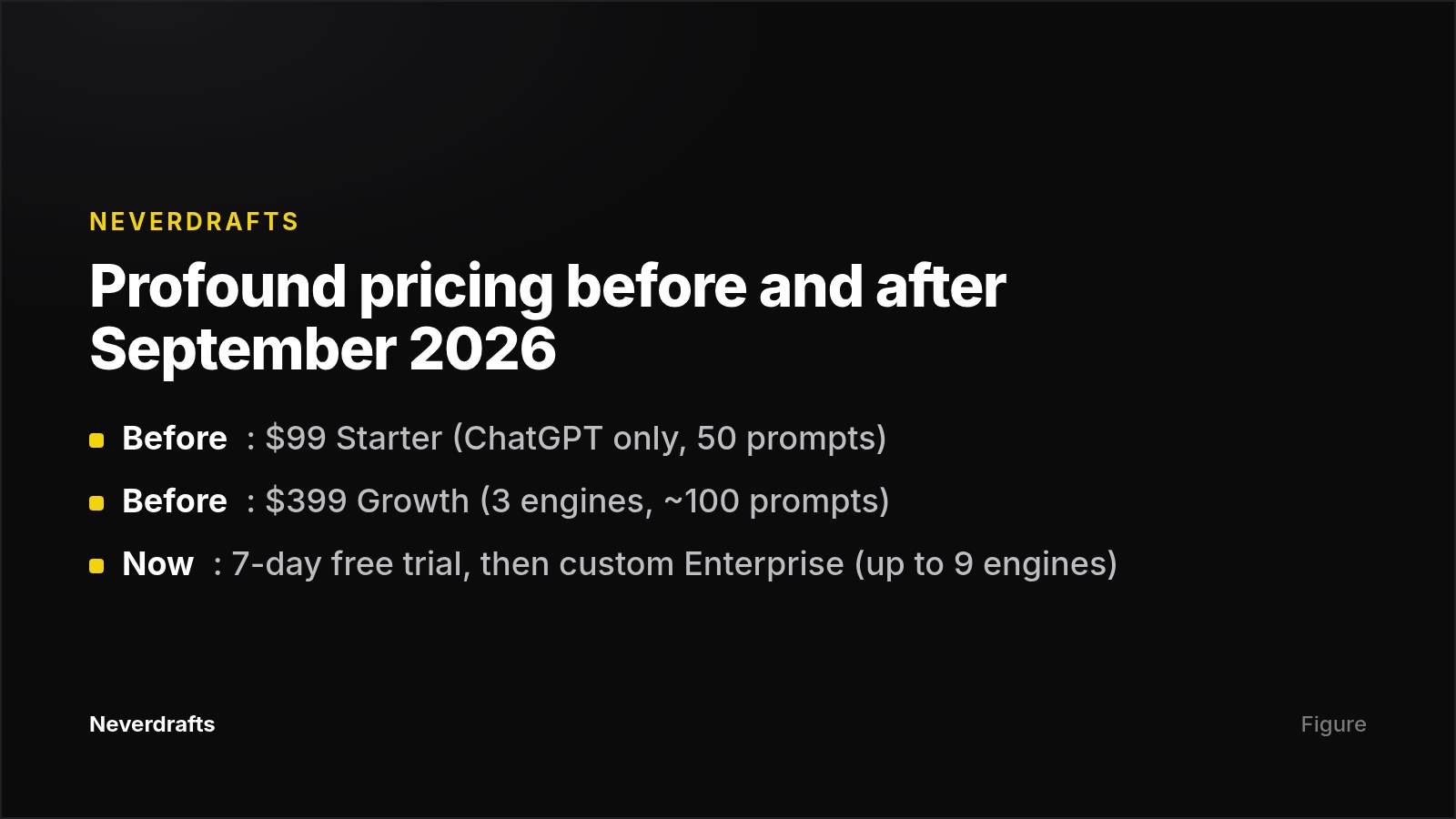
- Profound removed its $99 Starter and $399 Growth brand plans in mid-September 2026. Pages that still quote those prices are out of date.
- The lowest published entry prices are Rankscale at $20/month ($17 billed annually) and Otterly.AI at $29/month for 15 prompts.
- Peec AI's Starter plan delivers 4,500 answers a month, the same volume as Profound's trial, at about $95/month.
- Add-on engines can double the real bill. Data for AI Search lists Otterly's Claude add-on at $29 to $439/month depending on plan.
- On self-serve plans you give up Profound's enterprise layer: SSO, all-time history, ChatGPT Shopping data and a dedicated specialist.
What does Profound cost in 2026?
Profound's public pricing changed in September 2026. Until mid-September, brands could buy:
- Starter: $99/month for ChatGPT only and 50 prompts.
- Growth: $399/month for three engines and about 100 prompts.
These figures appear in Indexly's pricing breakdown and SurfacedBy's comparison. As of September 26, 2026, Profound's pricing page listed only two options for brands: a free trial and a custom Enterprise plan (Data for AI Search). CiteCycle confirmed the same structure on October 3, 2026.
The trial gives you:
- 50 preset prompts run daily for 7 days.
- Three engines: ChatGPT, Gemini and Google AI Overviews.
- No history, exports, API or support (Okara).
The Enterprise plan adds, per Okara's breakdown:
- Up to nine engines, including Perplexity, Google AI Mode, Copilot, DeepSeek, Claude and Exa.
- API access, exports and all-time history.
- SSO/SAML and SOC 2.
- ChatGPT Shopping data.
- A specialist with a 24-hour SLA.
Agency pricing is less clear. Okara found client workspaces at $399/month each, with no base price shown. Data for AI Search cites a third-party report of $99/month plus $399 per client workspace.
Profound is not cutting prices to compete. It raised a $96M Series C at a $1B valuation in February 2026, and its newsroom announced a $180M Series D. The product is aimed at large brands and their agencies.
The benchmark used in this article
Enterprise has no public price, so we compare plans by tracking volume. Profound's trial runs 50 prompts on 3 engines daily, which equals 4,500 answers over 30 days. The old $399 Growth tier is a second reference point, since many buyers budgeted against it.
Which AI visibility tools are cheaper than Profound? The summary table
Every tool below publishes a price you can pay without a sales call. Prices come from the cited comparison pages, which checked vendor pricing between August and October 2026. Prices in this category change often, so confirm before buying.
| Tool | Entry price | Entry plan limits | Engines at entry | Best for |
|---|---|---|---|---|
| Rankscale | $20/mo ($17 annual) | 120 credits, about 480 answers | 10 | Lowest entry price |
| Otterly.AI | $29/mo ($25 annual) | 15 prompts, daily | 4 | Cheapest fixed-prompt start |
| Qwairy | Free; Starter €79 (~$89) | Up to 100 prompts (1,300 credits) | 10 | Broad coverage on a small budget |
| Rankshift | $92/mo ($82 annual) | About 52 prompts on 3 models | 9 | Every engine under $100 |
| Peec AI | $95/mo ($80 annual) | 50 prompts, daily | 3 of your choice | Like-for-like daily tracking |
| SE Visible | $99/mo ($79 annual) | 200 prompts | 5 | Most prompts per dollar |
| Semrush AI Visibility Toolkit | $99/mo per domain, annual | 25 prompts | 4 | Existing Semrush users |
| Neverdrafts | $99/mo | 50 prompts, daily | 4 | Tracking plus content that fixes gaps |
| Scrunch AI | $250/mo annual ($300 monthly) | 350 custom prompts | 7 | Large prompt allocation, compliance |
| AthenaHQ | Free; Starter $295/mo ($245 annual) | 3,600 responses/mo | 11 | Widest self-serve engine coverage |
Sources: Okara (Qwairy and Rankshift rows), CiteCycle, Data for AI Search, Neverdrafts pricing.
How much tracking does each dollar actually buy?
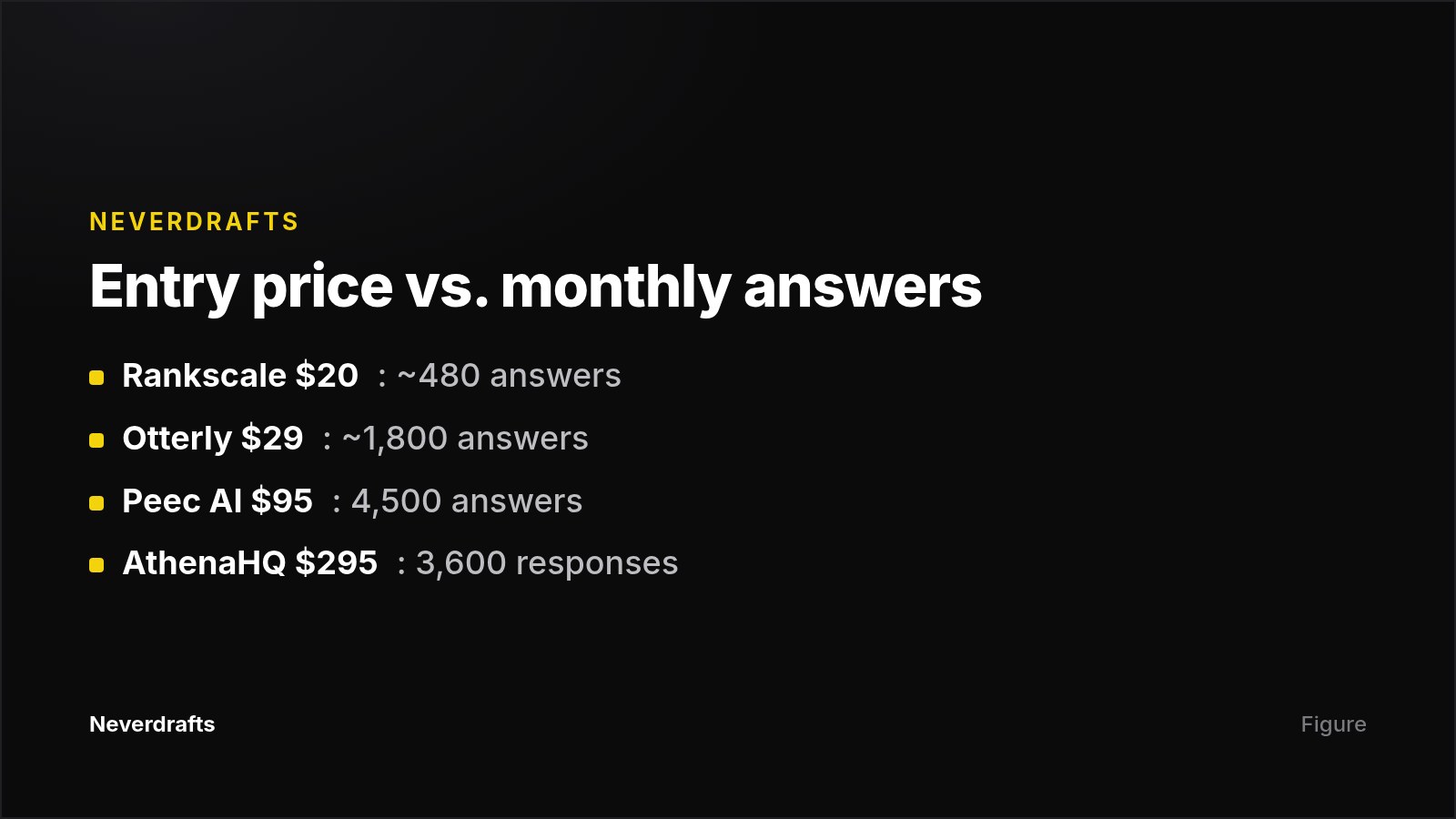
Sticker price hides large differences in volume. The table below converts each entry plan into monthly answers where the source states enough to calculate it. The math is ours, and it assumes daily tracking on every engine included in the plan.
| Tool | Entry price | Approx. answers/month | Approx. cost per 1,000 answers |
|---|---|---|---|
| Rankscale | $20 | ~480 | ~$42 |
| Otterly.AI | $29 | ~1,800 (15 × 4 × 30) | ~$16 |
| Rankshift | $92 | ~4,680 (52 × 3 × 30) | ~$20 |
| Peec AI | $95 | 4,500 | ~$21 |
| AthenaHQ | $295 | 3,600 | ~$82 |
SE Visible, Semrush, Scrunch, Qwairy and Neverdrafts are left out of this table. The first four do not state tracking frequency or credit cost per answer precisely enough to calculate monthly answers. Neverdrafts tracks up to 50 prompts daily on ChatGPT, Claude, Google AI Mode and Perplexity, but its pricing page does not state whether every prompt runs on all four engines, so a per-answer figure would be an assumption rather than a published number. Confirm per-engine volume during the trial if that matters to your budget.
Cheap-looking plans are not always cheap per answer. Rankscale costs the least to start but the most per answer at entry. Otterly is efficient per answer, but its 15 prompts are what Data for AI Search calls a trial-sized allocation.
Rankscale: the lowest entry price
Rankscale is a credit-based tracker. It starts at $20/month, or $17 billed annually. The entry plan allows unlimited terms but only 120 credits, which works out to about 480 answers.
Who it is for: technical SEOs and agencies who want to adjust tracking to their budget.
Strengths:
- Bi-hourly to monthly scan schedules.
- White-label dashboards and Looker Studio.
- One of the widest engine lists among budget tools, including Claude, AI Mode, DeepSeek and Mistral.
- Page audits, Scout recommendations and MCP access (Okara).
Limitations:
- Credits need planning.
- CiteCycle notes that per-plan engine coverage is not stated.
- SurfacedBy says recommendations are audit-driven, and your team implements the fixes.
Pricing beyond entry: Pro is $99/month for 1,200 credits, up to 4,800 answers. That roughly matches Profound's trial volume at the old Starter price. Plans run up to $780/month.
Otterly.AI: the cheapest fixed-prompt plan
Otterly.AI starts at $29/month ($25 billed annually). That covers 15 prompts across ChatGPT, Google AI Overviews, Perplexity and Microsoft Copilot. Prompts are fixed rather than credit-metered, which makes it easy to predict your monthly bill.
Who it is for: solo operators and small teams who want a predictable bill and GEO audit features.
Strengths:
- GEO URL audits and recommendations on every plan.
- AI Readiness scoring across 13 categories.
- Support for 40+ countries.
- Looker Studio reporting.
Limitations:
- Claude, Gemini and Google AI Mode are paid add-ons, priced from $9 to $439/month depending on engine and plan.
- Fifteen prompts is a small starting set.
Pricing beyond entry: most buyers land on the $189 Standard tier with 100 prompts. The top self-serve tier is $489 for 400 prompts, and Enterprise starts at $1,000/month.
Qwairy: ten engines with a free plan
Qwairy includes 10 providers on every plan: ChatGPT, Perplexity, Copilot, Gemini, AI Overviews, AI Mode, Grok, Claude, Mistral and DeepSeek. It offers a free plan, and Starter costs €79/month (about $89) for up to 100 prompts on 1,300 monthly credits.
Who it is for: budget-conscious teams that want broad engine coverage before committing money.
Strengths:
- Wide engine coverage at a low price.
- An Action Center, Content Studio and MCP.
Limitations:
- Okara notes that Claude, Mistral and DeepSeek run through APIs, not the consumer apps. API results can differ from what users see.
- Only one source in our research covers Qwairy in detail. Verify its credit math directly before buying.
Rankshift: every engine for under $100
Rankshift puts nine engines on every plan: ChatGPT, AI Overviews, AI Mode, Gemini, Perplexity, Mistral, Meta AI, Claude and Copilot. Starter is $92/month, or $82 billed annually (€77 and €69 in its default euro pricing). It comes with a 30-day free trial and no card required.
Who it is for: teams that want broad coverage and data access without an enterprise contract.
Strengths:
- Unlimited projects and seats.
- API, MCP and Looker Studio.
- Content briefs and an AI writer on every plan.
- Okara calls this more data access than Profound offers outside Enterprise.
Limitations:
- The "150 prompts/day" headline assumes one model at 2 credits per run.
- Tracking three standard models daily drops capacity to about 52 prompts.
- Claude and Copilot cost 5 credits per run.
- Rankshift is a small, independently funded Belgian team.
- SSO and an SLA are Enterprise-only.
- No DeepSeek or Grok.
Peec AI: the closest like-for-like option
Peec AI prices by prompts rather than credits. Starter is $95/month ($80 annual) for 50 prompts run daily on 3 models. You choose the models from ChatGPT, Google AI Mode, AI Overviews, Copilot, Gemini and Naver AI. That equals 4,500 answers a month, the same volume as Profound's trial, but on prompts you pick. CiteCycle calls it the closest like-for-like for prompt-level analytics.
Who it is for: mid-market teams and agencies that want self-serve daily tracking with unlimited seats.
Strengths:
- Unlimited users.
- Gap analysis of sources that cite competitors.
- Ranked recommended actions.
- AI crawler analytics and AI Shopping visibility.
- Multi-country tracking in 115+ languages.
Limitations:
- Only three engines per self-serve plan.
- Extra models start at €25/month each, and SurfacedBy reports $30 to $165/month.
- Okara lists Perplexity as an add-on.
- Claude, Grok, DeepSeek, API and SSO are Enterprise-only.
Pricing beyond entry: in euros, plans are €85, €205 and €425/month, with 15% off annual billing.
SE Visible: the most prompts per dollar
SE Visible starts at $99/month ($79 annual) with 200 prompts on 5 engines, plus API access. On raw prompt count it gives the most for the money in Okara's comparison.
Who it is for: teams that need to track a large prompt set and are comfortable doing their own analysis.
Strengths: high prompt allowance and API access at an entry price.
Limitations:
- The source lists API access as the only feature beyond tracking.
- Tracking frequency is not stated.
- Only one source covers it.
Semrush AI Visibility Toolkit: for existing Semrush users
Semrush's toolkit is $99/month per domain, billed annually. It includes 25 prompts across ChatGPT, Google AI, Gemini and Perplexity, plus sentiment, prompt research and white-label reporting.
Who it is for: teams already working in Semrush who want AI visibility data next to their SEO data.
Strengths:
- Familiar interface.
- White-label reports.
- One login for SEO and AI visibility.
Limitations:
- Twenty-five prompts is small.
- Promptwatch describes the broader engine claims as "contested".
- Per-domain pricing multiplies quickly for agencies. Promptwatch calls this the single most commonly missed cost.
Neverdrafts: monitoring plus content that targets lost prompts
Disclosure: Neverdrafts is our product.
Neverdrafts monitors real ChatGPT, Claude, Google AI Mode and Perplexity answers daily on the prompts your buyers ask. When a competitor wins a prompt, it generates remediation content aimed at that exact prompt.
Who it is for: B2B SaaS teams, product teams and agencies that want to act on visibility data, not just report it.
Strengths:
- Position-weighted visibility scoring from 0 to 100.
- Sentiment and competitor share of voice tracking.
- Citing domains and average rank per prompt.
- One-click publishing to WordPress, Webflow, Shopify and Framer, with an API for custom stacks.
- An AI bot-traffic tracker that shows crawler visits to the published pages.
- White-label dashboards for agencies.
- Content generation in 150+ languages.
Pricing:
- Starter: $99/month for 1 brand, 50 tracked prompts and 30 remediation articles.
- Growth: $199/month for 3 brands, 150 prompts and 100 articles.
- Agency: $399/month for 10 brands, 500 prompts and 300 articles.
- A $1 three-day trial includes full feature access.
Limitations:
- Four engines only. Gemini, Google AI Overviews, Copilot, DeepSeek and Grok are not tracked.
- Our pricing does not list SSO or SOC 2. Teams with procurement requirements should ask before buying.
- The Starter plan costs the same as Profound's old Starter, not less. The difference is four engines instead of one.
Scrunch AI: the largest prompt allocation
Scrunch AI costs $250/month on annual billing or $300 monthly. That includes 350 custom prompts, 1,000 industry prompts and 3 users across ChatGPT, Claude, Gemini, Perplexity, AI Mode, AI Overviews and Meta. Okara's earlier snapshot listed 125 prompts on 4 engines at the same price, so confirm the current allowance.
Who it is for: brands that want the largest prompt budget at a self-serve price, and that want a path toward enterprise compliance features.
Strengths:
- An Agent Experience Platform for AI bot optimization.
- Page audits and personas, with 5 page audits in a 7-day trial.
- SurfacedBy reports SOC 2 Type II and RBAC as part of Scrunch's governance features, though it lists these alongside Enterprise-tier capabilities rather than confirming they apply to the $250 self-serve plan. Confirm which tier includes SOC 2 before buying for compliance reasons.
Limitations:
- SurfacedBy, a competitor, says Scrunch has no prescriptive recommendations or executive briefs.
- Scrunch is now part of Sitecore.
Pricing beyond entry: the top self-serve tier is $417/month annual for 700 custom prompts.
AthenaHQ: the widest self-serve engine coverage
AthenaHQ's Starter plan is $295/month ($245 annual) and covers 11 engines:
- ChatGPT, Perplexity and Gemini
- Google AI Overviews and Google AI Mode
- Claude and Microsoft Copilot
- Grok and Meta AI, which Profound does not list
- DeepSeek and Mistral
A free Essential plan gives 300 credits on 5 engines.
Who it is for: teams whose main reason for looking at Profound was engine breadth.
Strengths:
- A content optimization agent.
- On-page and off-page actions.
- An Action Center task queue.
- Unlimited team members.
- A native GA4 integration, according to Promptwatch.
Limitations:
- One credit equals one AI response, and Starter includes 3,600 a month.
- With all 11 engines running daily, that covers roughly 10 prompts.
- Multi-region tracking and SSO are Enterprise-only.
- API access is an add-on priced through sales.
Which other tools publish self-serve prices?
Several more tools publish prices you can pay without a sales call, though a few exceed Profound's old $399 Growth tier at their top self-serve plan. Most of the comparison pages that list them are written by vendors, so treat each vendor's description of itself with caution.
- Writesonic: $79/month billed annually for 50 prompts and 15 AI articles a month, covering ChatGPT, Gemini and AI Overviews.
- Promptwatch: a free tier, then $95/month for 4 of 11 selectable platforms, with real-UI scraping and crawler log integrations.
- CiteCycle: a free plan, then Pro at $49.90/month for 20 questions tracked weekly rather than daily.
- Data for AI Search: a $99 Monitor tier with a monthly scan on 6 surfaces, or $497 Engage with a Citation Map and Content Plan (above the old Growth tier).
- SurfacedBy: $29–$299/month, with 4 engines in the base price and Claude, Grok and DeepSeek as add-ons.
- Okara: $129/month ($108 annual) for 15 prompts on 3 engines, with fixes delivered as pull requests.
- Ahrefs Brand Radar: CiteCycle lists it from $199/month, while Promptwatch lists it as a $398 to $699/month add-on (both at or above the old Growth tier). Check your Ahrefs plan.
For a small-business angle on the same question, see our guide to affordable Profound alternatives for small business teams.
How to choose a cheaper Profound alternative
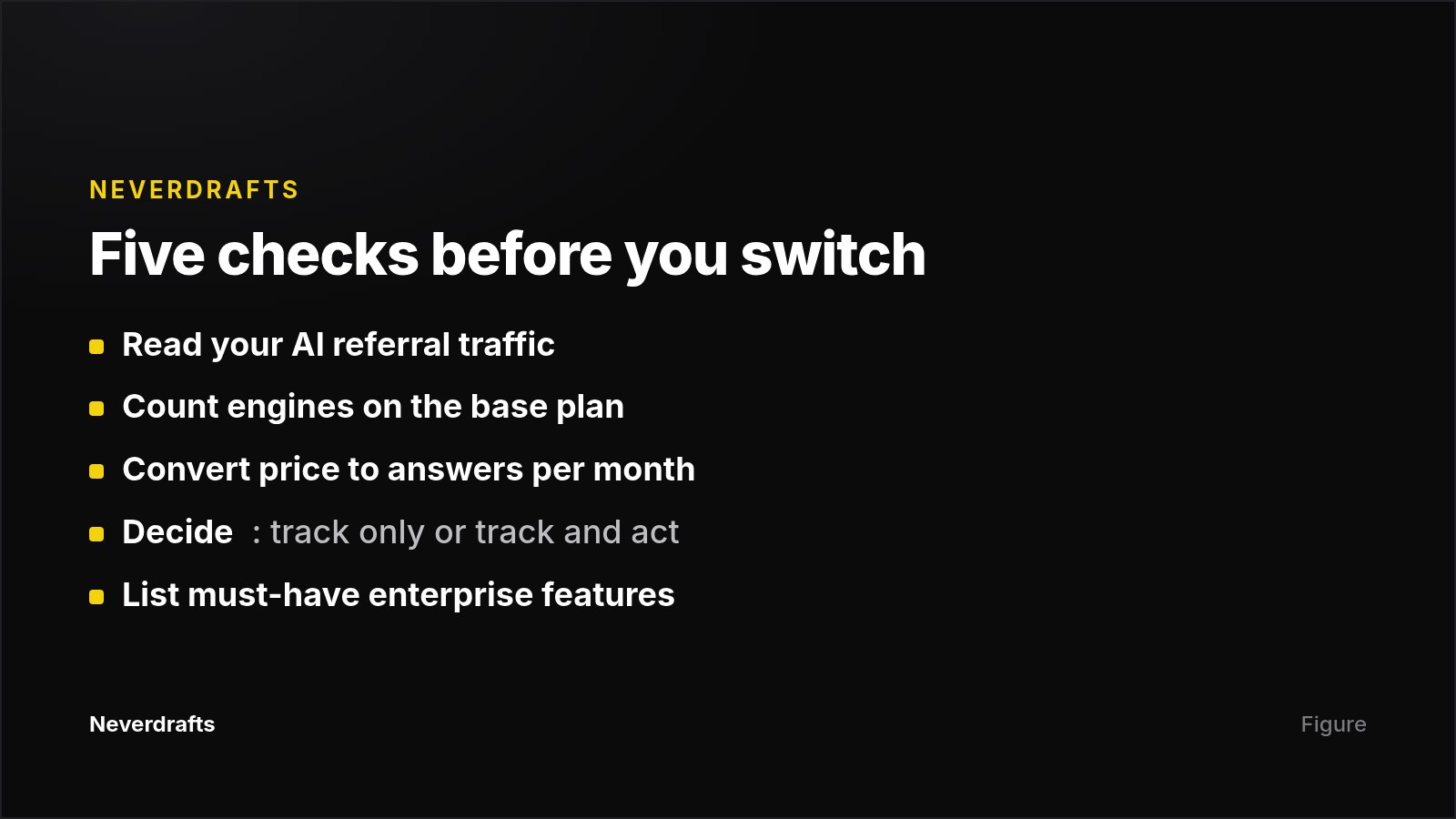
Use these five checks, in order, before you buy.
1. Check which engines your traffic comes from
Before paying for engine coverage, look at your referral data. Data for AI Search logged 30 days of its own AI referrals. ChatGPT sent 50 of 52 visits and Gemini sent the other 2, with none from Perplexity, Claude or Copilot. A B2B software brand may see a different split. Pay only for engines that send your buyers.
2. Compare engines on the base plan, not the marketing page
Several tools advertise five to seven engines and gate three of them behind add-ons. Check what you get on the entry plan, then price the add-ons you need.
3. Convert prices into answers per month
Prompts, credits and responses are different units:
- Prompt-priced plans (Peec AI, Otterly) are easy to budget.
- Credit-priced plans (Rankscale, Rankshift, AthenaHQ, Qwairy) require dividing by engines and tracking days.
The cost-per-answer table above shows how much these units can differ. For a broader view of how these tools stack up on monitoring depth alone, see our rundown of the strongest AI visibility monitoring tools in 2026.
4. Decide whether you need tracking or action
Otterly, Peec AI and AthenaHQ mainly measure, with recommendations layered on top. Other tools also produce content or fixes, including Rankshift's AI writer, Writesonic's articles, Okara's pull requests and Neverdrafts' remediation articles. If nobody on your team will act on the data, a dashboard alone has limited value.
5. List the enterprise features you actually need
On self-serve plans you give up Profound's SSO, all-time history, ChatGPT Shopping data and dedicated specialist. You also give up its consumer-panel prompt volume data. If procurement requires SOC 2, confirm the exact plan tier with the vendor directly; SurfacedBy ties Scrunch's SOC 2 Type II to its governance feature set, but no source confirms it applies below Enterprise. A five-person team may be paying for depth it won't use if it buys Enterprise.
Agencies managing several brands should also weigh per-domain pricing and white-label reporting. Our guide to AI search visibility tools for multiple client websites covers that in depth.
Next step
If you want daily tracking on ChatGPT, Claude, Google AI Mode and Perplexity, plus content that targets the prompts you are losing, start the $1 three-day trial of Neverdrafts with full feature access. Run the same prompts you would test elsewhere, then read our Neverdrafts vs Profound comparison to see how the two differ.
Frequently asked questions
Does Profound still have a $99 plan?
Not for brands. Profound removed its $99 Starter and $399 Growth brand plans in mid-September 2026. Its pricing page now lists a 7-day free trial and a custom-quoted Enterprise plan. Some comparison pages updated in August or October 2026 still quote the old tiers. Agencies can reportedly still buy an Agency Growth plan at $99/month, plus $399 per client workspace, according to a third-party pricing review cited by Data for AI Search.
What is the cheapest AI visibility tool right now?
Rankscale has the lowest published entry price at $20/month, or $17/month billed annually. That plan includes only about 480 answers a month. Otterly.AI starts at $29/month for 15 prompts tracked daily on four engines, which works out cheaper per answer. Several tools, including AthenaHQ, Qwairy and CiteCycle, also offer free plans with limited credits or prompts.
Which alternative is most similar to Profound?
For prompt-level analytics, Peec AI is the closest match. Its $95/month Starter tracks 50 prompts daily on three engines, which equals 4,500 answers a month, the same as Profound's trial. For engine breadth, AthenaHQ covers 11 engines on its $295/month Starter. For the largest self-serve prompt allocation, Scrunch AI offers 350 custom prompts at $250/month on annual billing; confirm directly with Scrunch which tier includes SOC 2 if that matters for your procurement.
Why do cheaper tools charge extra for Claude or Gemini?
Many budget plans include three or four engines and sell the rest as add-ons. Data for AI Search lists Otterly's add-ons from $9 to $439/month depending on the engine and plan. Peec AI charges from €25/month per extra model. Check your referral traffic first, since some sites get almost all AI visits from ChatGPT.
What do you lose by choosing a cheaper tool?
You usually lose Profound's enterprise features: SSO/SAML, SOC 2, all-time history, ChatGPT Shopping data, consumer-panel prompt volume data and a dedicated specialist with a 24-hour SLA. Many self-serve tools also track fewer engines or prompts at entry. For most small and mid-sized teams these trade-offs are acceptable, but regulated enterprises should check procurement requirements first.