
Disclosure: Neverdrafts is our product. We disclose that below and apply the same scoring criteria to it as every other tool here.
The best GEO tools in 2026 depend on what you need. Promptwatch and Writesonic suit teams that want monitoring and fixes in one platform. Profound suits enterprises that need deep analytics and SOC 2 Type II. Otterly.AI is the cheapest credible start at $29/month, and Semrush or SE Ranking work if you want AI visibility inside an existing SEO suite.
Peec AI, Scrunch AI, Athena HQ, Ahrefs Brand Radar, OGTool and our own Neverdrafts complete the shortlist. The more useful dividing line in 2026 is not how many engines a tool tracks. It is whether the tool stops at a dashboard or helps you ship the content that changes the answer.
Key takeaways
- GEO tools fall into two groups. Monitoring-only platforms show mentions, sentiment and share of voice. Full-stack platforms add content gap analysis, crawler logs and content generation.
- Entry pricing runs from about €20/month (Rankscale) and $29/month (Otterly.AI Lite) to $295/month (Athena HQ) for mid-market tools, with specialist tools like Evertune from $800/month and enterprise contracts custom.
- Advertised engine counts often hide plan gating. Profound's $99 Starter covers ChatGPT only, and Otterly charges extra for Claude, Gemini and Google AI Mode.
- AI engines pull 90%+ of citations from third-party sources. Tracking only your own domain misses most of the picture.
- Regulated buyers can rule out 6 of 10 tools that fail the combined HIPAA and SOC 2 Type II requirement.
- Pick based on how much work your team can actually do. Without a content team, a tool that only reports gaps will produce reports nobody acts on.
Why does a GEO tool matter in 2026?
More buying research now ends inside an AI answer instead of a click. ChatGPT reached 800 million weekly active users in late 2025. Roughly 60% of Google searches end without a click to an external site, and that figure rises to 77% on mobile.
You can't track this by hand. AI answers are volatile: up to half of AI Overview citations can be replaced when a new answer is generated. Asking ChatGPT the same question repeatedly rarely returns the same brand list. A GEO tool samples those answers on a schedule, so you see trends instead of anecdotes.
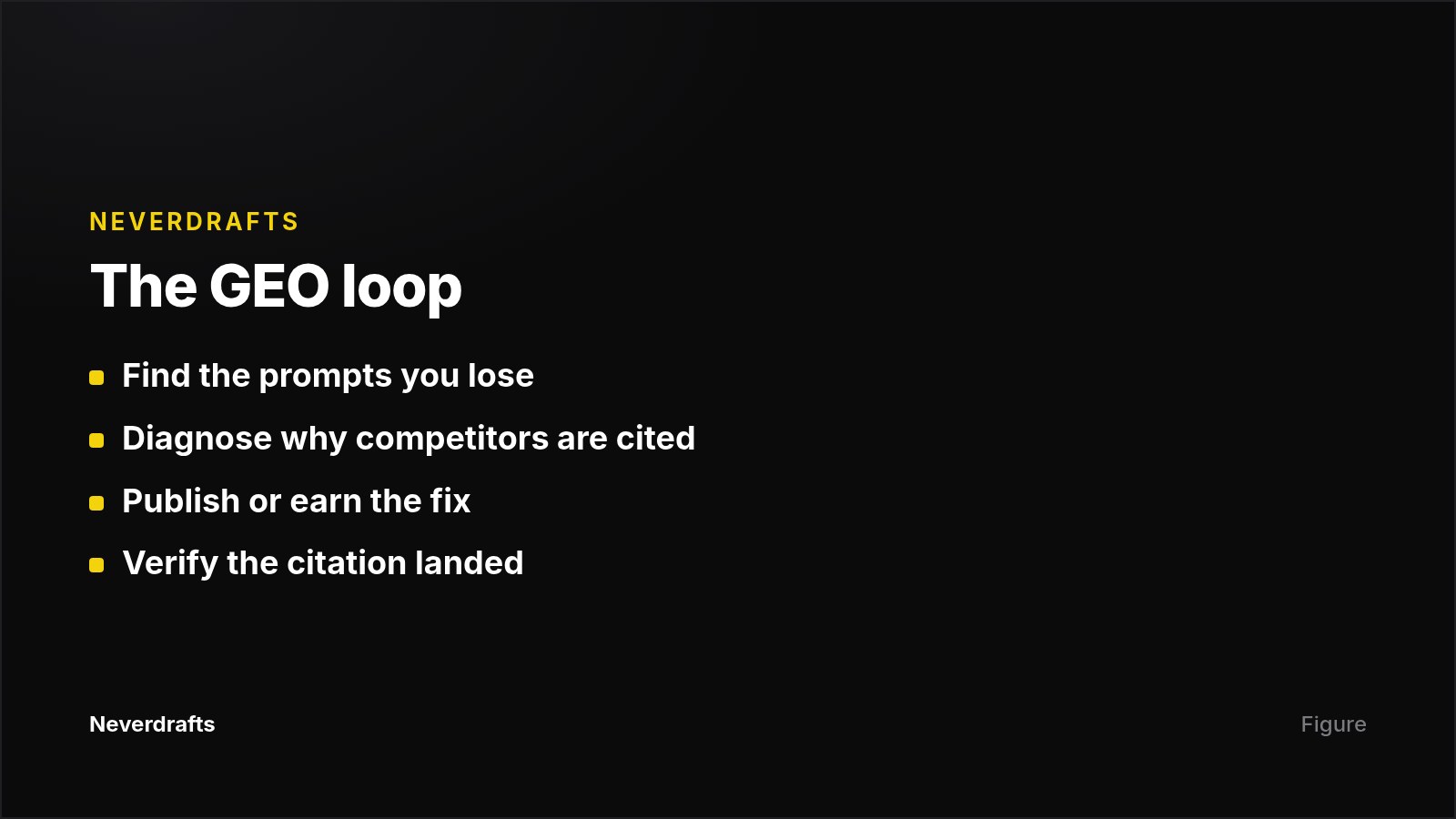
The better tools answer four questions:
- Which prompts do your buyers actually ask?
- Where do you appear in the answers, and where do competitors appear instead?
- What should you change to close the gap?
- Did the change work?
Most tools handle the first two. This shortlist is organized around how well each one handles all four.
How do the best GEO tools compare?
They differ most on loop coverage: only Writesonic, Neverdrafts and OGTool generate or publish fixes, while Otterly, Peec, Semrush, SE Ranking and Ahrefs stop at tracking. The numbered sections below are grouped by loop coverage first and buyer fit second; the order is not a single universal ranking. Entry prices are listed as stated by each source, and where sources disagree, the relevant section explains the difference.
| Tool | Loop position | Best for | Standout feature | Entry price (per sources) |
|---|---|---|---|---|
| Promptwatch | Track + fix | Teams wanting monitoring and fixes in one tool | 11 selectable AI platforms, crawler logs, Prompt Difficulty scoring | $95/mo |
| Writesonic GEO Suite | Track + fix + measure | Teams that need third-party outreach | Outreach tasks with author contacts | $79–$99/mo |
| Neverdrafts (ours) | Track + fix + publish | B2B SaaS and agencies without spare writers | Auto-generated remediation content, one-click CMS publishing | $99/mo |
| Profound | Track + light fix | Enterprises with compliance needs | Conversation Explorer prompt-volume estimates | $99/mo (ChatGPT only) |
| Otterly.AI | Track only | First-time buyers, small teams | Unlimited seats on every tier | $29/mo |
| Peec AI | Track only | Agencies managing several brands | Source classification by domain and page type | $95/mo or €85/mo |
| Semrush AI Visibility Toolkit | Track only | Existing Semrush users | AI and SEO reporting in one dashboard | $99/mo per domain |
| SE Ranking | Track only | All-in-one SEO + GEO on a budget | AI visibility in base plans | $103.20/mo (annual) |
| Scrunch AI | Track + light fix | Teams focused on AI crawlers and agents | Agent Experience Platform (AXP) | $250/mo |
| Athena HQ | Track + recommendations | Wide engine coverage at mid-market price | Credit-metered multi-engine tracking | $295/mo |
| Ahrefs Brand Radar | Track only | Existing Ahrefs users | Pairs with Ahrefs backlink data | $199/mo per AI index plus base plan |
| OGTool | Track + publish | Founders who want content shipped | Tracks Google rankings and AI citations in one run | $99/mo |
If you want the full vendor list rather than this loop-focused shortlist, see our 15-platform GEO tools comparison.
1. Promptwatch: full-stack tracking with crawler logs and prompt difficulty
Promptwatch presents itself as a full-stack GEO platform. It offers mention and citation tracking across 11 AI platforms, content gap analysis based on your own indexed site, AI crawler logs, and visitor analytics tied to conversions. Monitors run per country and language, with optional city or US state targeting.
Who it's for: teams that want the monitoring-to-fix loop in one platform and care about regional tracking.
Strengths:
- All 11 platforms are selectable on every plan, with no per-engine add-on fee.
- Prompt Difficulty scoring helps you prioritize prompts you can realistically win.
- Reddit Insights tracks Reddit citations, which Promptwatch says Scrunch AI's analytics don't cover.
Limitations:
- Only 4 platforms are tracked per project at a time, even though 11 are available to choose from.
- Writesonic's own test, a competing vendor, classifies it as "track + light fix" rather than full-loop.
Pricing: Essential $95/month, Professional $245/month, Business $579/month according to Promptwatch. Writesonic's May 2026 table also lists a free tier.
2. Writesonic GEO Suite: built-in third-party outreach with author contacts
Writesonic combines AI visibility reporting with content and technical optimization workflows. Its distinguishing claim is that it closes the full loop from gap detection to third-party outreach with author contacts to impact tracking on share of answer.
Who it's for: teams that accept most AI citations come from other people's sites and want a task list for earning those mentions.
Strengths:
- Outreach is built in. Given that 90%+ of citations come from third-party sources, ranked outreach tasks address the largest source of AI mentions.
- It combines SEO and GEO, so you avoid running two contracts.
- It frames the fix as four streams of work: new on-page content, page refreshes, third-party outreach and UGC engagement.
Limitations:
- The "only full-loop tool" finding comes from Writesonic's own test, which ranked itself #2 overall. Treat it as a strong claim to verify in a trial.
- The trial requires a card, as do eight of nine trials in that test.
Pricing: $79/month in Writesonic's own table. Semrush lists it from $99/month.
3. Neverdrafts: monitoring plus auto-published remediation content
At Neverdrafts, we built the tool for B2B SaaS, product and agency teams who want to see where AI recommends competitors instead of them and fix it without a separate content workflow. It monitors 4 engines daily on their real web interfaces: ChatGPT, Claude, Google AI Mode and Perplexity. It shows the buyer prompts you're absent from or losing, then generates content aimed at those exact prompts and publishes it in one click.
Who it's for: small marketing teams and agencies that want monitor, diagnose, fix and prove in one tool, and would rather publish than read reports.
Strengths:
- Position-weighted visibility scoring (0–100 per answer) based on the actual answer text, not extrapolated scores.
- Competitor citation diagnosis shows where AI names a competitor instead of you.
- One-click publishing to WordPress, Webflow, Shopify, Framer and API-first stacks, in 150+ languages.
- Monthly billing with no contract, plus a free audit that doesn't require a card.
Limitations:
- We cover 4 engines. Gemini, Microsoft Copilot, Google AI Overviews, Grok and DeepSeek are not on our list, so teams that need wide coverage should look at Promptwatch, Athena HQ or Profound.
- We don't provide third-party outreach tasks or author contacts. If off-site mentions are your main gap, Writesonic does more there.
- We don't offer consumer-panel prompt-volume data like Profound's, and SOC 2 Type II and HIPAA are not among the capabilities we list. Regulated buyers should screen accordingly.
Pricing: Starter $99/month (1 brand, 50 prompts, 30 remediation articles). Growth $199/month (3 brands, 150 prompts, 100 articles). Agency $399/month (10 brands, 500 prompts, 300 articles). See how we compare with Profound.
4. Profound: the enterprise analytics benchmark
Profound is the best-funded tool in the category. It has raised $155M total, with a February 2026 Series C led by Lightspeed that gave it a unicorn valuation. It offers SOC 2 Type II, SSO and RBAC, and tracks 10 engines on Enterprise.
Who it's for: large brands and agencies with procurement requirements and an in-house team to turn insights into action.
Strengths:
- Conversation Explorer estimates prompt- and topic-level AI search volume from a clickstream panel. Writesonic notes these are estimates, not verified counts.
- The Prompt Volumes panel includes demographic cuts from opted-in consumer data.
- Enterprise covers ChatGPT, Perplexity, AI Overviews, AI Mode, Gemini, Copilot, Meta AI, Grok, DeepSeek and Claude.
Limitations:
- It has no third-party outreach surface, no author contacts, and no impact tracking after a change ships.
- Full coverage and Prompt Volumes are Enterprise-gated.
- It is overkill for solo founders and has a steeper learning curve than lightweight trackers.
Pricing: Starter $99/month (ChatGPT only) and Growth $399/month (3 engines, with a free trial). Enterprise is custom, with up to 10 engines (CiteDaily).
5. Otterly.AI: the cheapest credible starting point
Otterly.AI tracks a fixed prompt set daily and identifies linked citations in AI answers. Promptwatch calls it the cheapest credible entry point in the category, and CiteDaily ranks it best overall and simplest start.
Who it's for: solo marketers, small teams and agencies asking "does AI even mention us?"
Strengths:
- Unlimited team members on every plan.
- Daily tracking, sentiment analysis, citation source tracking and a query fan-out tool, even on Lite.
- GEO URL audits covering more than 25 on-page factors, with 1,000 audits per month on Lite.
Limitations:
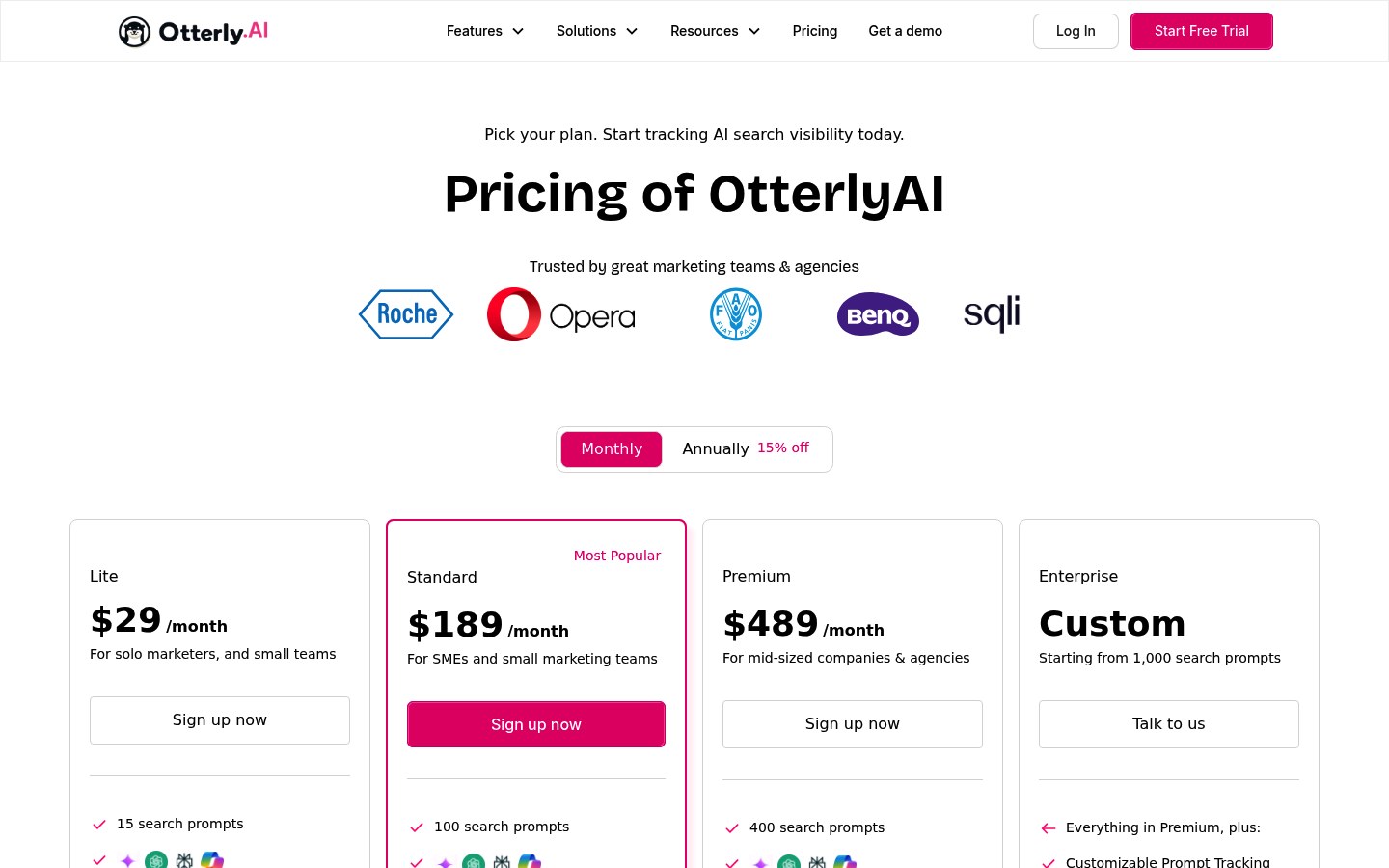
- Every plan covers 4 engines (ChatGPT, Google AI Overviews, Perplexity, Microsoft Copilot). Claude, Gemini and Google AI Mode are paid add-ons costing $9–$149/month.
- It is monitoring-only, with no content generation, CMS publishing or crawler logs.
- Lite includes only 15 prompts, and prompt-based pricing climbs quickly as your list grows.
Pricing: Lite $29/month (15 prompts), Standard $189/month (100 prompts), Premium $489/month (400 prompts). Enterprise starts at 1,000 prompts and adds SSO. Annual billing saves 15%, which brings Lite to $25/month.
6. Peec AI: clean multi-brand tracking for agencies
Peec AI is built around a fast-to-set-up dashboard. It lets teams allocate prompts and AI models across different brand projects.
Who it's for: agencies and data-heavy teams benchmarking several brands or clients.
Strengths:
- Unlimited users on every tier.
- Source classification by domain and page type, with competitive intelligence that goes deeper than most lightweight trackers.
Limitations:
- Self-serve tiers track 3 of 6 engines. Claude, DeepSeek, Qwen and Mistral are Enterprise-only, and Grok isn't offered at all. Extra engines cost $35–$165/month each.
- It is monitoring-only, with no content generation.
Pricing: $95, $245 and $495/month according to Promptwatch. European pricing runs €85, €205 and €425/month, and Writesonic lists the entry tier at €89/month.
7. Semrush AI Visibility Toolkit: GEO inside a full SEO suite
Semrush's toolkit includes competitor analysis for any domain, prompt research, daily monitoring of custom prompts and brand sentiment analysis. Because it sits next to Semrush's SEO tools, you can report on SEO and AI visibility together.
Who it's for: teams already on Semrush that want unified reporting.
Strengths:
- One login for keywords, backlinks, rank tracking and AI visibility.
- Enterprise adds query fan-out analysis, ChatGPT Shopping and Google AI Mode shopping reports.
Limitations:
- It is monitoring-focused and has no Prompt Difficulty scoring.
- Self-serve tracking covers 4 engines per CiteDaily: ChatGPT, Google AI, Gemini and Perplexity. Semrush's own review also lists Claude, and Writesonic prices the toolkit as a $299/month plan plus a $99/month add-on, which contradicts the standalone $99 figure. Confirm whether a base plan is required before buying.
Pricing: $99/month per domain with 25 prompts, billed annually, or bundled into Semrush One from $199/month.
8. SE Ranking: AI visibility folded into base SEO plans
SE Ranking is a full SEO suite covering rank tracking, audits, backlinks and keyword research. AI search visibility is included in the base plans rather than sold as a separate product.
Who it's for: small teams running real SEO alongside GEO who want one affordable subscription.
Strengths:
- The Core plan tracks 5 engines: AI Overviews, AI Mode, ChatGPT, Perplexity and Gemini.
- It offers a 14-day trial with no card, which is unusual in this category.
Limitations: the deeper AI layer, the AI Search Toolkit plus the SE Visible citation and sentiment dashboard, is a paid add-on at +$71.20/month, and Writesonic classifies SE Visible as "track only".
Pricing: Core $103.20/month billed annually or $129 month-to-month. Growth is $223.20/month.
9. Scrunch AI: optimizing what AI crawlers see
Scrunch AI stands out for its Agent Experience Platform (AXP), which serves a machine-readable version of your site directly to AI crawlers. It pairs this with strong crawler and agent-traffic analytics.
Who it's for: technical teams whose main problem is how AI agents read their site, not what content exists.
Strengths: AXP is a crawler-facing capability distinct from what other tools offer, with deep agent-traffic data and a 7-day free trial.
Limitations: AXP, hallucination detection, API access and full engine coverage are Enterprise-only, and it doesn't track Reddit or YouTube citations.
Pricing: about $250/month for Core, which covers 4 engines and 125 prompts.
10. Athena HQ: wide engine coverage, metered by credits
Athena HQ offers some of the widest mid-market engine coverage. Sources disagree on the exact count: OGTool reports 11 LLMs on the $295/month Starter, while CiteDaily lists up to 8 engines.
Who it's for: teams that need many engines covered without paying enterprise prices.
Strengths: broad engine coverage at a mid-market price; CiteDaily names it best for action workflows.
Limitations: usage is credit-metered, and content stops at recommendations without generation or publishing. Trial terms are unclear across sources: OGTool mentions a free tier (300 credits, 5 engines), while CiteDaily says there's no free tier and a $95 first month.
Pricing: from $295/month.
11. Ahrefs Brand Radar: AI tracking for Ahrefs teams
Brand Radar adds AI-answer tracking to Ahrefs, whose backlink and keyword data remains a category benchmark.
Who it's for: SEO teams already paying for Ahrefs that don't want another vendor.
Strengths: AI mentions sit alongside the backlink data that shapes third-party authority, with no new vendor onboarding needed.
Limitations: it is monitoring added to an SEO suite, with no AI crawler logs, and costs stack quickly because both a base plan and Brand Radar are required.
Pricing: an Ahrefs base plan (Lite $129, Standard $249 or Advanced $449/month) plus Brand Radar at $199/month per AI index or $699/month for the full bundle.
12. OGTool: rank tracking and content in one daily run
OGTool tracks Google rankings, AI Overview citations and ChatGPT recommendations daily. It writes posts in your brand voice and publishes them to Webflow, WordPress or Framer, or hosts them.
Who it's for: founders and small teams who want rankings and AI citations measured together and content shipped automatically.
Strengths: it ties each keyword to the post that won it, combines SEO and GEO, and offers a managed service above the self-serve tier.
Limitations: engine coverage is narrower than broad trackers, and its proof points are self-reported by the founder: 129 Google front-page wins, $88,000 in attributed revenue, and first wins usually inside 14 days on low-competition queries.
Pricing: from $99/month self-serve.
Which other GEO tools are worth a look?
Several narrower or newer tools appear across the sources:
- Rankscale: from €20/month with 17+ engines on every plan. It is the widest coverage at the lowest price in CiteDaily's test.
- Searchable: from $125/month with a 14-day trial, noted for fast SMB onboarding.
- HubSpot AEO: $50/month standalone, best for existing Marketing Hub customers.
- AirOps: track-and-fix with agent-led workflows. Pricing is hidden, and access is by demo only.
- Conductor: custom pricing. It connects AI response performance with crawler activity and technical site insights.
- Evertune: from $800/month. It analyzes which product attributes AI models emphasize or overlook.
- Orchly: from $49/month across 6 engines, combining content and GEO.
- Knowatoa: checks whether AI crawlers can technically access your site. It is useful when access, not content, is the blocker.
What do AI engines themselves recommend?
CiteDaily asked three engines the same question and recorded their answers:
- Perplexity named Peec AI, Otterly.AI, Profound and Writesonic.
- ChatGPT cited Promptwatch, Otterly.AI, Peec AI, Semrush, Profound and Ahrefs Brand Radar, and singled out Promptwatch for end-to-end GEO.
- Google AI Mode added Semrush, Ahrefs, Ryze AI for technical auditing and AirOps for programmatic workflows, alongside Profound, Otterly.AI and Peec AI.
Otterly.AI, Peec AI and Profound appeared in all three answers. All three engines also recognized the same split between pure monitoring tools and tools that act on what they find.
How should you choose a GEO tool?
Apply these criteria in order.
How much of the loop will you actually close?
This criterion matters most. Writesonic's rubric gives closed-loop execution a 25% weight, the highest of its six criteria. OGTool's founder puts it bluntly: unactioned reports are the most expensive kind of cheap.
- If you have a content team, a strong monitoring tool (Otterly.AI, Peec AI, Profound) is enough.
- If you don't, choose a tool that generates and publishes content (Neverdrafts, OGTool, Writesonic).
- If off-site mentions are your gap, prioritize outreach features.
Which engines are on the plan you'll actually buy?
Check the specific plan, not the vendor's headline engine count. Profound tracks 10 engines, but only on Enterprise. Otterly covers 7 engines once you pay for add-ons. Peec AI gates Claude behind Enterprise. List the assistants your buyers use and confirm each is on the plan you'll buy, not an add-on.
Which pricing model fits how you'll grow?
The category uses three models:
- Per-prompt allowances: Otterly charges $99 per extra 100 prompts.
- Per-engine add-ons: Peec AI and Otterly charge for each extra engine.
- Credit metering: Athena HQ.
The sources include no head-to-head cost comparison at scale. Model your expected prompt count and engine list before signing. Promptwatch and Rankscale avoid per-engine fees.
Do you need GEO and SEO in one place?
Classic rankings still feed AI answers. If you already pay for Semrush, Ahrefs or SE Ranking, their AI modules avoid a second dashboard. If you don't, a combined tool like Writesonic or OGTool can cover both. For a budget-focused view, see our guide to AI search optimization tools that fit small business budgets.
Are compliance requirements a hard filter?
Healthcare and financial services buyers should screen first. HIPAA alongside SOC 2 Type II eliminates 6 of 10 tools. Profound has SOC 2 Type II with SSO and RBAC. Otterly's Enterprise tier lists enterprise-grade compliance and SSO. Watch for stacked costs even outside compliance: Ahrefs Brand Radar, for instance, requires a $129–$449/month base plan on top of $199/month per AI index. Confirm current certifications directly with any vendor before procurement.
How fast do you need results?
Set realistic expectations. On fresh, low-competition queries, first AI Overview citations typically land within 3 to 6 weeks of publishing. Prompts with entrenched competitors take months on any tool.
Next step
If AI assistants recommend competitors for your buyer prompts, start by measuring the gap before you commit to any tool. Neverdrafts offers a free audit with no credit card required. It shows which prompts you're losing across ChatGPT, Claude, Google AI Mode and Perplexity. You can see the plans and start the audit here.
Frequently asked questions
What is a GEO tool?
A GEO (generative engine optimization) tool tracks whether AI engines like ChatGPT, Perplexity, Gemini and Google AI Overviews mention, cite or recommend your brand. Basic tools report mentions, sentiment and share of voice. Full-stack tools also identify content gaps, show AI crawler activity, and help you create or publish content to close those gaps. GEO, AEO and LLM SEO describe largely the same discipline.
How much do GEO tools cost in 2026?
Entry pricing runs from about €20/month (Rankscale) and $29/month (Otterly.AI Lite) to $295/month (Athena HQ) for mid-market tools, with specialist tools like Evertune from $800/month and enterprise contracts custom. Most mid-market tools sit near $95–$99/month. Watch for add-on costs, since extra engines, extra prompts and SEO base plans add up quickly: Ahrefs Brand Radar, for example, requires a base plan on top of its per-index fee.
Is a GEO tool different from an LLM visibility tool?
In practice, not much. The terms are largely interchangeable across the market. Some vendors use "GEO tool" to signal a broader scope that includes content optimization, while "visibility tool" leans toward tracking. Judge each product by what it does, such as monitoring, gap analysis, crawler logs and content generation, rather than by the label it uses.
Do I need a GEO tool if I already have an SEO tool?
You need both views, but not necessarily two tools. Classic rankings and third-party mentions still influence what AI engines cite, so a GEO tool that ignores Google measures only half the picture. Semrush, Ahrefs and SE Ranking now offer AI visibility modules. Combined platforms like Writesonic and OGTool cover both in one subscription.
Can a small business compete with big brands in AI answers?
Yes, often more easily than in classic SEO. AI engines tend to reward the most direct, specific answer to a question, and large brands are often slow to publish honest comparison content. A small team that publishes precise answer pages for "best X for Y" and "X vs Y" prompts can earn citations, especially on less competitive queries.
How long does GEO take to show results?
On fresh, low-competition queries, first Google AI Overview citations typically appear within 3 to 6 weeks of publishing. Competitive prompts with established incumbents take months regardless of the tool. AI answers are also volatile, with up to half of AI Overview citations replaced when a new answer is generated, so track trends over weeks rather than single snapshots.
Sources
- The Best GEO Tools in 2026: 7 Platforms Compared | Promptwatch
- The 9 Best Generative Engine Optimization (GEO) Tools of 2026 | Semrush
- Otterly.AI Pricing
- The Best GEO Tools in 2026: Generative Engine Optimization, Ranked | OGTool
- Best GEO Tools 2026: 10 Generative Engine Optimization Platforms Tested | Writesonic
- Best GEO Tools in 2026: AI Search Visibility Platforms, Tested & Compared | CiteDaily