
The best GEO tools in 2026 depend on the job you need done:
- Profound: enterprise AI search analytics.
- Peec AI: a clean, multi-engine monitoring dashboard that most teams can set up quickly.
- Writesonic and Neverdrafts: tracking plus content execution. Disclosure: Neverdrafts is our product.
- Semrush, Ahrefs Brand Radar or SE Visible: AI visibility inside an SEO suite you already pay for.
- Otterly.ai and Rankscale: low-cost entry points.
Decide first whether you need monitoring alone, a workflow that turns gaps into published fixes, or AI visibility added to your existing SEO stack. Then compare prices.
Key takeaways
- "GEO tool" covers several different jobs. These include prompt-level visibility tracking, content optimization, crawler reachability, SEO-suite add-ons and free one-off graders, as Geotoolbox's grouped review points out. Buying the wrong category is the easiest mistake to make.
- Entry pricing ranges widely. It runs from free tiers (AthenaHQ, SISTRIX) and $9 AEO Vision or $20 Rankscale plans up to $800/month for Evertune Pro. Enterprise plans are almost always custom-quoted.
- How a tool collects answers matters. A Surfer study cited by Superlines found that API-based visibility data often differs from answers scraped from real ChatGPT and Perplexity interfaces.
- Most AI citations come from other people's websites. AI engines pull 90%+ of citations from third-party sources, so tracking only your own domain misses most of the picture.
- Regulated buyers have a short list. Writesonic's test found that healthcare and finserv teams can rule out 6 of 10 tools on HIPAA plus SOC 2 Type II requirements alone.
- Nobody fully connects citations to revenue yet. Per an independent comparison quoted by Writesonic, none of the major platforms link AI citations to pipeline metrics yet. Treat any ROI claim with care.
What does a GEO tool do, and why does it matter in 2026?
A generative engine optimization (GEO) tool shows you what AI assistants say when someone asks a question your brand should answer. It runs a set of prompts through engines such as ChatGPT, Perplexity, Google AI Overviews, Google AI Mode, Gemini, Claude and Copilot. It then records whether you were mentioned, where you appeared in the answer, how you were described, and which URLs the model cited.
Classic rank tracking tells you where a page sits in a list of blue links. A GEO tool tells you whether you are the answer at all. That distinction now matters because AI answers sit above, or replace, the results people used to click:
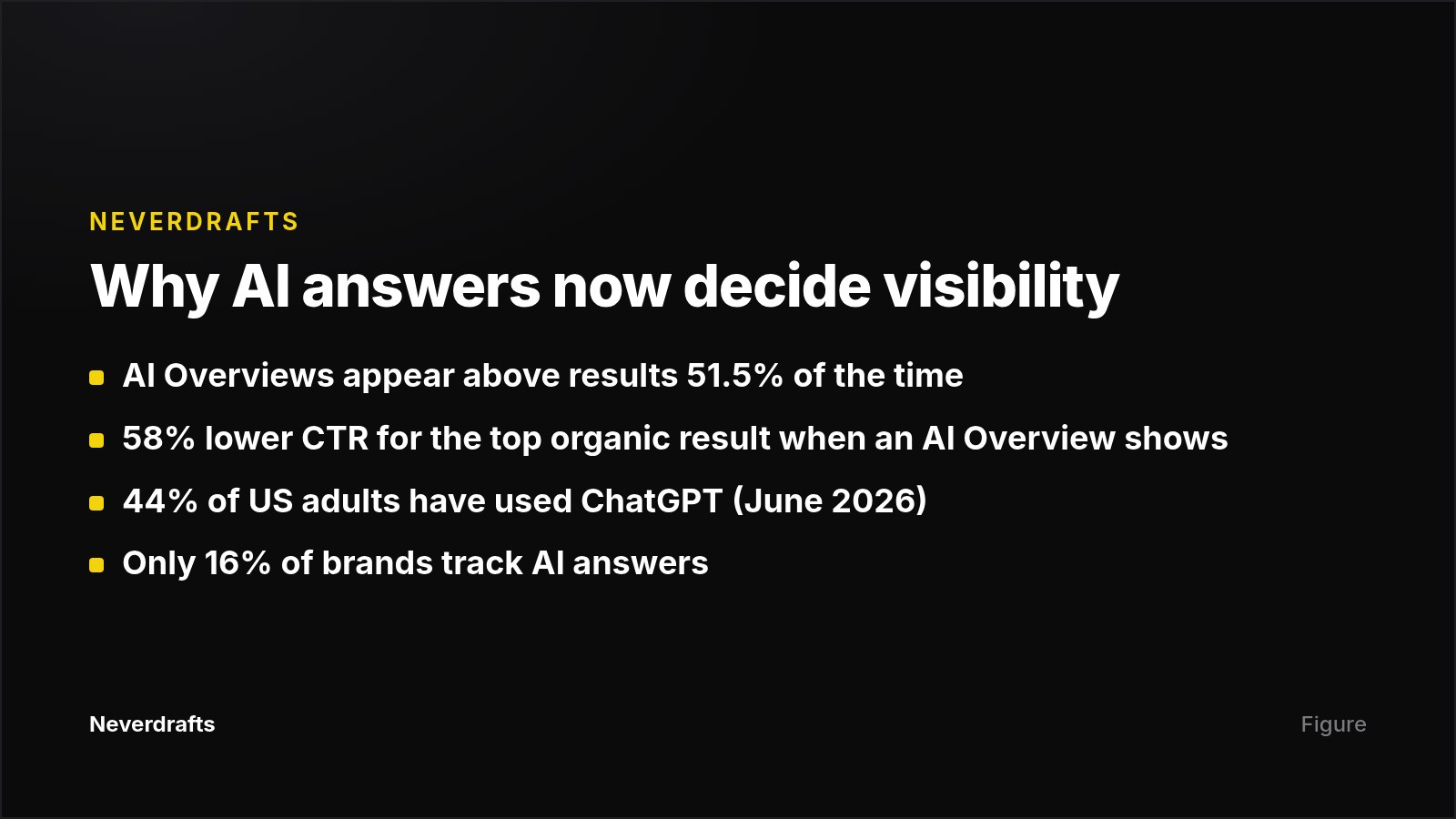
- A 2026 study of 11,500 real queries found AI Overviews appear above the normal results 51.5% of the time.
- A separate study of 55,393 queries found AI Overviews fire on 13.7% of all searches and 64.7% of question-style searches.
- Ahrefs' re-run on December 2025 data found AI Overviews correlate with a 58% lower click-through rate for the top organic result, up from 34.5% in April 2025.
- Pew Research found 44% of US adults had used ChatGPT as of a survey published June 2026, up from 34% a year earlier and 18% in 2023.
Few companies track this channel systematically. Only 16% of brands track their performance in AI answers. Meanwhile, McKinsey projects $750 billion in US revenue will flow through AI-powered search by 2028.
The market is responding. Dimension Market Research estimates the GEO market will reach $1.09 billion in 2026, growing at a 40.6% CAGR.
The traffic itself is still small. Conductor's 2026 AEO Benchmarks Report analyzed more than 17 million AI responses. It found AI referral traffic accounts for 1.08% of all web traffic, with 87.4% of that attributed to third-party sources rather than brand-owned domains. The bigger effect is upstream: buyers asking an AI "what's the best X for Y" often see only a handful of brands named. Being one of them is the point.
How we compiled this list (and what we didn't do)
This round-up synthesizes six published 2026 reviews of the GEO category:
- Metehan's 22-tool ranking
- Profound's 18-platform guide
- Semrush's 9-tool review
- Geotoolbox's category-grouped comparison
- Superlines' 8-tool comparison
- Writesonic's 10-tool rubric test
We cross-checked pricing, engine coverage and capabilities across those sources. Where they disagree, we say so rather than picking the most flattering number.
We did not run our own hands-on benchmark of every tool, and we don't claim to. Five of the six sources are published by vendors that appear in their own lists: Profound, Semrush, Writesonic, Geotoolbox and Superlines.
The Metehan review notes that most best GEO tools roundups are written by a vendor, score that vendor first, and call it research. We publish this article, and our product is on the list, so the same caution applies to us. We've placed Neverdrafts where its documented capabilities put it, with its limitations stated.
Prices change often in this category. Geotoolbox re-verified its pricing in July 2026 and Writesonic on May 23, 2026. Several tools have changed plans since older reviews were written. Confirm current numbers on each vendor's pricing page before you buy.
Best GEO tools in 2026 at a glance
| Tool | Best for | Standout feature | Entry pricing (per sources) |
|---|---|---|---|
| Profound | Enterprise AI search programs | Conversation Explorer prompt-volume estimates; SOC 2 Type II, SSO, RBAC | $99/mo in older reviews; no self-serve brand tier as of July 2026 |
| Peec AI | Clean multi-engine monitoring | Unlimited seats, screenshot audit trails | ~$95/mo (€85–€89 Starter) |
| Writesonic | Tracking plus high-volume content | Action Center for on-page and off-page fixes | $99/mo ($79 annual) |
| Neverdrafts | Small teams and agencies that want fixes published | Auto-drafted remediation content, one-click publishing, AI crawler tracking | $99/mo Starter; $1 three-day trial, no card |
| Scrunch AI | Serving AI-optimized pages to crawlers | Agent Experience Platform (AXP) | $250/mo Core |
| AthenaHQ | Self-serve tracking without a sales call | Free tier plus broad engine list | Free; ~$295/mo Starter |
| Conductor | Enterprises already on Conductor | MCP server, SOC 2, ISO 42001 and 27001 | Custom, usage-based |
| Semrush AI Visibility Toolkit | Existing Semrush users | AI visibility beside SEO reports | $99/mo per domain |
| Ahrefs Brand Radar | Bridging backlinks and AI citations | 464M+ prompt dataset | $199/mo per platform; $699 all models |
| SE Ranking / SE Visible | SE Ranking customers, or standalone | Real browser-collected answers | $99/mo Basic |
| Otterly.ai | Budget prompt tracking | Daily tracking, GEO URL audits | $29/mo |
| Rankscale AI | Broad engine coverage cheaply | 17+ engines on every plan | $20/mo Essentials (credits extra) |
| Evertune | Brand narrative analysis | 100 samples per prompt, consumer panel | $800/mo Pro |
| Goodie AI | Revenue attribution and MCP | Up to 11 engines on Enterprise | $399/mo Explorer |
| AEO Vision | The cheapest ChatGPT-only start | Reddit Insights, Top Cited Domains | $9/mo |
Prices per the sources linked in each tool section; verify on vendor pages before buying.
The following sections go through each tool, grouped loosely by the job they do best: enterprise analytics first, then general monitoring, then execution-focused platforms, then SEO-suite add-ons, budget trackers and specialists. Neverdrafts, our product, sits in the execution tier; it does not appear in the six source reviews we synthesized, and we've flagged its limitations accordingly.
1. Profound: best for enterprise AI search analytics
What it is. Profound is the best-funded and most-cited platform in the category. Founded in New York in 2024, it has raised $155M across Seed through Series C. Its February 2026 Series C, led by Lightspeed, pushed it to unicorn valuation.
Who it's for. Enterprise marketing teams building a company-wide AI search program, with in-house staff to turn insights into content and outreach.
Strengths:
- Broad engine coverage on Enterprise. Writesonic counts 10 engines on Enterprise: ChatGPT, Perplexity, AI Overviews, AI Mode, Gemini, Copilot, Meta AI, Grok, DeepSeek and Claude. Other reviews cite up to nine.
- Prompt research grounded in conversation data. Semrush describes Profound as grounding prompt research in anonymized conversations from real AI users. Writesonic notes that Conversation Explorer's volume figures come from a clickstream panel and are estimates, not verified counts.
- Front-end data collection at scale. Profound's own guide says it tracks all major engines daily on real front-end data across 50+ countries.
- Enterprise governance. It offers SOC 2 Type II with SSO and RBAC, which matters in procurement reviews.
- Agents. A node-based workflow builder for content drafting, plus Shopping Analysis for ecommerce queries.
Limitations:
- Light execution layer. Writesonic's review found no third-party citation outreach surface, no author contact data and no impact tracking after a change ships.
- Too much for small teams. Profound's own comparison concedes it is overkill for teams that only want a lightweight visibility score.
- Unclear self-serve pricing. Older reviews list a $99 Starter on ChatGPT and a $399 Growth plan on three engines. Geotoolbox's July 2026 check found no self-serve brand tier, with Enterprise custom-quoted and a free AEO Report as the entry point.
Pricing. Confirm directly. Expect custom enterprise pricing for multi-engine coverage. Our Neverdrafts vs Profound comparison covers how the two differ in scope.
2. Peec AI: best for clean multi-engine monitoring
What it is. Peec AI is a visibility tracker with a well-designed dashboard. The Metehan review puts it first for most teams: it sets up in minutes, tracks every major engine and gives the whole team a seat.
Who it's for. Marketing teams and agencies that want reliable, readable monitoring and competitive benchmarking. They should also have their own process for acting on the data.
Strengths:
- Unlimited seats and scalable coverage. It tracks six generative engines by default, with up to 11 models on Enterprise.
- Reports you can trust. Profound's guide credits its daily tracking and screenshot audit trails for making reports easy to trust.
- Multi-brand flexibility. Semrush highlights that Peec lets teams allocate prompts and AI models across different brand projects.
- Competitive benchmarking. Geotoolbox's comparison names this as its main strength.
Limitations:
- Limited engines on Starter. Geotoolbox reports the Starter plan lets you pick 3 of six engines: ChatGPT, AI Overviews, AI Mode, Copilot, Perplexity and Gemini.
- Clickstream volume data. Prompt-volume figures are clickstream-based rather than drawn from real conversations.
- No content layer. It has no content creation, and Writesonic classifies it as track only.
Pricing. Sources disagree slightly, likely because of currency and billing differences:
- $95/month entry per Metehan and Semrush
- €85/month Starter per Geotoolbox
- €89/month per Writesonic
Enterprise pricing is custom.
3. Writesonic: best for tracking plus high-volume content
What it is. Writesonic sells a GEO suite that combines visibility reporting with content and technical optimization workflows.
Who it's for. Teams that want monitoring and content production in one contract, especially where content volume is the bottleneck.
Strengths:
- A full fix layer, per its own test. Writesonic's six-criterion test claims it is the only tool that closes the full loop: gap detection, third-party outreach with author contacts, and impact tracking on share of answer.
- Action Center. Metehan describes it as fixing on-page and off-page issues, with all 10 engines available on Enterprise.
- High content throughput. Profound's guide credits its Article Writer with handling research, linking and FAQ generation.
- Combined SEO and GEO in one platform. You avoid running two contracts and two dashboards.
Limitations:
- Contested loop claim. The "only tool that closes the loop" finding comes from Writesonic's own review. Profound's guide argues the opposite: that Writesonic's content runs on SEO methodology with no real prompt-demand data, and no loop between monitoring and content creation. Both are vendors, so test it yourself.
- Limited engines on self-serve. Self-serve tiers cover ChatGPT, Gemini and AI Overviews. Broader coverage requires Enterprise.
Pricing. $99/month, or $79/month billed annually. The free trial requires a card, per Writesonic's own trial table.
4. Neverdrafts: best for small teams that want fixes published, not just reported
Disclosure: Neverdrafts is our product.
What it is. Neverdrafts is an AI visibility monitoring platform that also writes and publishes content. It aims to win back prompts where AI engines recommend competitors instead of you. The workflow runs Monitor, Diagnose, Fix, Prove: track answers, see who gets cited instead of you, auto-draft content targeting those prompts, then check whether AI crawlers start visiting the new pages.
Who it's for. Small businesses, content teams and agencies that don't have staff to turn a visibility dashboard into a publishing schedule. It suits teams whose sites run on WordPress, Webflow, Shopify or Framer.
Strengths:
- Daily answer monitoring. It monitors real ChatGPT, Claude, Google AI Mode and Perplexity answers every day across your tracked prompts.
- Position-weighted scoring. Each AI answer gets a 0–100 visibility score, so being named first counts for more than being named fifth.
- Auto-generated remediation content. It drafts content for prompts where competitors appear instead of you. Publishing takes one click to WordPress, Webflow, Shopify or Framer, or goes through the API.
- Proof of effect. It tracks AI crawler traffic on your site, so you see evidence that engines are fetching the new pages, not only a score change.
- Competitive and brand reporting. Competitor citation analysis shows which domains AI recommends. Brand mentions, sentiment and share of voice are reported across AI engines.
- Language and agency support. Content generation covers 150+ languages, with white-label options for agencies and API access for custom stacks.
- An easy trial. The $1 three-day full-access trial needs no credit card. That's unusual when eight of nine tools with free trials now require a card.
Limitations:
- Four engines. Neverdrafts monitors ChatGPT, Claude, Google AI Mode and Perplexity. It does not list Gemini, Copilot, Grok, DeepSeek, Meta AI or AI Overviews. If your buyers use those, a wider tracker like Rankscale or Peec covers more ground.
- No third-party outreach. The fix layer publishes content to your own site. Most AI citations come from third-party sources, so you'll still need separate PR, review and community work.
- No compliance certifications listed. Its documentation lists no SOC 2, HIPAA or SSO, so regulated buyers should ask before shortlisting it.
- No prompt-volume estimates. It does not advertise prompt-demand data of the kind Profound and Ahrefs offer.
Pricing:
- Starter: $99/month (1 brand, 50 prompts, 30 articles/month)
- Growth: $199/month (3 brands, 150 prompts, 100 articles/month)
- Agency: $399/month (10 brands, 500 prompts, 300 articles/month)
All plans bill monthly and can be cancelled anytime.
5. Scrunch AI: best for serving AI-optimized pages to crawlers
What it is. Scrunch AI combines visibility monitoring with an infrastructure layer called the Agent Experience Platform (AXP). Sitecore bought Scrunch AI in June 2026.
Who it's for. Enterprise and multi-brand teams that want to change what AI crawlers see without redesigning their human-facing site.
Strengths:
- AXP. It serves AI-optimized pages to crawlers without touching the human-facing site.
- Enterprise security and visibility. It holds SOC 2 Type II and offers a real-time bot feed.
- Broad coverage at the top tier. Enterprise covers nine engines.
- Multi-brand tracking. Geotoolbox names enterprise multi-brand tracking as its best fit.
Limitations:
- Narrow entry plan. Core covers only four engines: ChatGPT, Perplexity, AI Overviews and Copilot.
- No content generation yet. Per Profound's guide, content generation isn't shipped yet, and monitored prompts are configured rather than sourced from real conversations.
- Acquisition uncertainty. The Sitecore deal may change packaging and pricing.
Pricing. $250/month Core with a 7-day free trial. Enterprise is custom.
6. AthenaHQ: best for self-serve tracking with a free tier
What it is. AthenaHQ is a visibility tracker with a free entry tier and an Action Center that turns data into recommended next steps.
Who it's for. Teams that want to start without a sales call and expect to automate on-page fixes such as schema and entity markup.
Strengths:
- A genuine free start. The free tier includes 300 credits plus a 10-minute audit.
- Wide engine list. Geotoolbox lists ChatGPT, Perplexity, AI Overviews, AI Mode, Gemini, Claude, Copilot, Grok, DeepSeek and Meta AI.
- Analytics integrations. It connects to GA4 and Google Search Console.
- Automated on-page work. It handles automated schema and entity tagging at scale.
Limitations:
- Opaque prompt volumes. Volume data relies on an undisclosed estimation model.
- Recommendations need editing. They often require real editing before use, per the same review.
Pricing. Free tier, then about $295/month Starter (~$245 billed annually). Metehan describes the Starter plan as covering nine models.
7. Conductor: best for enterprises already on Conductor
What it is. Conductor is a long-established enterprise SEO platform that has extended into AI visibility. It connects AI response performance with crawler activity and technical site insights.
Who it's for. Large organizations that already run on Conductor, or that need heavy compliance credentials and agent-based workflows.
Strengths:
- Compliance depth. It holds SOC 2, ISO 42001 and ISO 27001, and offers an MCP server and AgentStack LLM apps.
- Global, granular tracking. It covers 160+ countries with city-level tracking.
- Technical context. Semrush highlights how it ties AI response performance to crawler activity and technical site insights.
Limitations:
- Keyword-derived prompts. Profound's guide says prompts are synthetic and keyword-derived, updates land twice a week, and bot tracking runs with no feedback loop.
- No published pricing. Expect a sales process.
Pricing. Custom, usage-based, with an Essentials trial available.
8. Semrush AI Visibility Toolkit: best for teams already on Semrush
What it is. An AI visibility add-on that sits inside the Semrush SEO platform. Adobe closed its Semrush acquisition in spring 2026.
Who it's for. SEO teams that already work in Semrush every day and want AI and organic reporting side by side.
Strengths:
- One workflow for SEO and AI visibility. Its own review describes the toolkit as including competitor analysis reports, prompt research, custom daily prompt monitoring and brand sentiment analysis.
- Large prompt dataset. It draws on 289M+ LLM prompts.
- Enterprise extras. These include query fan-out analysis, AI shopping reports for ChatGPT Shopping and Google AI Mode, and ROI attribution across the funnel.
Limitations:
- Coverage gaps outside Enterprise. Profound's guide says Brand Performance covers only four to five engines and updates weekly, with no Claude, Copilot, Grok, Meta AI or DeepSeek. Semrush's own article lists Claude for enterprise tracking, so coverage appears to depend on tier.
- Tight prompt limits. The base add-on allows 25 daily prompts.
- More than lightweight users need. Semrush itself says that if you want a simple mention tracker, it might not be the right fit.
Pricing. $99/month per domain for the toolkit, or a $199/month Starter plan combining SEO and AI visibility. Writesonic's review lists it as a $299/month plan plus a $99/month add-on. Check which bundle applies to you.
9. Ahrefs Brand Radar: best for tying AI citations to backlinks
What it is. Ahrefs' AI visibility product, built into the same environment as its backlink and keyword tools.
Who it's for. Teams already on Ahrefs, and anyone whose GEO strategy centers on earning links and mentions from the domains AI engines cite.
Strengths:
- Huge dataset. It draws on 464M+ prompts and ties citations to backlinks.
- Front-end collection. Profound's guide notes data is collected through the same front-end method Profound uses.
- Six-engine coverage. It covers AI Overviews, AI Mode, ChatGPT, Perplexity, Copilot and Gemini.
- A free entry point. A free AI visibility checker is available.
Limitations:
- Keyword-derived prompts and slow refresh. Prompts are keyword-derived rather than real AI conversations, and most chatbot platforms refresh only monthly.
- Costs add up. Pricing per platform gets expensive if you want every engine.
Pricing. $199/month per platform, or $699/month for all models.
10. SE Ranking / SE Visible: best for SE Ranking customers or a mid-priced standalone
What it is. SE Ranking offers AI visibility as an add-on to its SEO suite. SE Visible is the standalone product.
Who it's for. SE Ranking users, and buyers who want browser-collected answers at a mid-range price without an enterprise contract.
Strengths:
- Real answers. It uses real browser-collected answers rather than API-only sampling.
- Five engines. It covers ChatGPT, Perplexity, Gemini, AI Overviews and AI Mode.
- A free start. You get free daily checks plus a trial.
Limitations:
- Track only. Writesonic classifies it as track only, with no built-in fix layer.
Pricing. SE Visible plans are Basic $99, Core $189 and Plus $355 per month. The SE Ranking add-on runs about €63–79/month.
11. Otterly.ai: best entry-level prompt tracker
What it is. A focused, affordable tracker for daily prompt monitoring and citation detection.
Who it's for. Small teams and beginners who want clear tracking on a modest budget.
Strengths:
- Daily tracking with citation detection. It runs a fixed prompt set daily and identifies linked citations in AI answers.
- On-page audits. GEO URL audits cover more than 25 on-page factors.
- Recommendations for beginners. Profound's guide credits its fast setup and clear GEO recommendations and content briefs.
Limitations:
- Engine add-ons raise the price. Base plans cover four engines: ChatGPT, AI Overviews, Perplexity and Copilot. Claude, Gemini and AI Mode are paid add-ons, so costs climb quickly for broad coverage.
- No real prompt-volume data. Per Profound's guide, prioritization therefore leans on intuition.
Pricing. From $29/month, scaling by prompt count. For more budget picks, see our guide to AI search optimization tools that fit small business budgets.
12. Rankscale AI: best for broad engine coverage on a small budget
What it is. A credit-based tracker with unusually wide engine coverage on every plan.
Who it's for. Budget-conscious teams and agencies that need many engines, including Claude, Grok and DeepSeek, without paying enterprise prices.
Strengths:
- Wide coverage on every plan. All plans include 17+ engines.
- Agency-friendly features. It includes schema audits and white label.
- Low entry price. Geotoolbox calls it the cheapest multi-engine entry point.
Limitations:
- Variable costs. Credit pricing means usage drives cost. The $20 entry price excludes credits.
- Mostly monitoring. Reviews describe it as primarily a tracker, not a content platform.
Pricing. From $20/month Essentials, plus credits. A free Pro trial is available.
13. Evertune: best for analyzing how AI describes your products
What it is. A brand-perception platform that samples AI answers at high volume to reveal how models talk about products and categories.
Who it's for. Brand and reputation teams at larger companies, especially those that care about which product attributes AI emphasizes or omits.
Strengths:
- Statistical depth. Pro includes 100,000 prompts with 100 samples per prompt, plus the EverPanel consumer panel.
- A large consumer panel. Profound's guide describes it as a 25-million-person consumer panel, with Content Studio drafting ready-to-publish posts.
- Narrative analysis. Semrush says it reveals which product attributes AI models emphasize or overlook.
Limitations:
- Topic-level view. It clusters at the topic level rather than measuring prompt-level demand.
- No published SOC 2 Type II, per Profound's guide.
- No free trial, per Semrush.
Pricing. $800/month Pro. Enterprise is custom.
14. Goodie AI: best for revenue attribution and agent access
What it is. A visibility platform positioned around attribution and machine access to its data.
Who it's for. Mid-market and enterprise teams that need to report AI visibility in revenue terms, or pipe GEO data into AI agents through MCP.
Strengths:
- Attribution and broad coverage. It offers MCP access and revenue attribution, with up to 11 engines on Enterprise.
Limitations:
- High entry price. It starts at a higher tier than most self-serve trackers.
- Thin independent coverage. Few of the source reviews cover it in depth, so validate attribution claims in a trial.
Pricing. $399/month Explorer.
15. AEO Vision: the cheapest ChatGPT-only start
What it is. A very low-cost tracker focused on ChatGPT, with citation-level data.
Who it's for. Solo marketers and small businesses that want to see whether ChatGPT mentions them before committing to a bigger tool.
Strengths:
- Citation-level data at $9. Features include Reddit Insights and Top Cited Domains.
Limitations:
- One engine on the entry tier. If your buyers use Perplexity, Gemini or AI Overviews, you'll outgrow it quickly.
Pricing. $9/month for the ChatGPT tier.
Which other GEO tools are worth a look?
Several more tools appear in the 2026 reviews and suit narrower needs.
More visibility trackers:
- Promptwatch: 10 LLMs at the entry tier, with a free plan and $99 paid tier. We compare options in our Promptwatch alternatives guide.
- Searchable: $125/month with a 14-day trial, praised for onboarding speed.
- Gauge: $599 Growth with 600 daily prompts, six platforms and 18 articles a month.
- Gumshoe AI: $99 Starter, $299 Pro, with persona-level share of LLM.
- Nightwatch: €79 entry, six engines at no extra cost, city-level geo data.
- SISTRIX: AI Visibility free during beta, €119 Start with 100 prompts.
- Hall AI: acquired by Tracksuit in July 2026. Its AI visibility now rolls into brand tracking.
Technical and agent-led tools:
- Botify: LogAnalyzer for GPTBot and PerplexityBot, with custom pricing.
- AirOps: content workflows across hundreds of URLs at once, but with a steep learning curve and output that usually needs cleanup.
Content optimizers:
- Surfer SEO: ~€49/month billed yearly, with AI tracking from ~€99.
- Frase: ~$49/month ($39 annual), focused on answer-first content briefs.
Free graders:
- Mangools AI Search Grader: free, covering ChatGPT, Gemini, Mistral, Llama, DeepSeek and Claude.
- HubSpot AEO Grader: free, with about $50/month for ongoing tracking.
These graders give you a one-off snapshot, not ongoing tracking.
Why does a GEO tool's data collection method matter?
Two methodology questions separate tools more than feature lists do.
Live interface capture vs API sampling
Some tools query AI models through their APIs. Others capture what appears in the actual consumer interfaces, the way a real user sees it. A Surfer study, shared by Matt Diggity and cited by Superlines, compared API-based visibility data with answers scraped from the real ChatGPT and Perplexity interfaces. It found that the two often differ.
If a vendor can't tell you which method it uses for each engine, treat its visibility score with caution. Methods named in the sources:
- Front-end or browser capture: Profound and Ahrefs (front-end collection), and SE Visible (real browser-collected answers).
- API-based: Profound's guide describes AirOps as API-based, with US-only data below Enterprise.
Real prompts vs keyword-derived prompts
The second split is where the tracked prompts come from. Profound's guide calls this the most important split: "Some platforms show you what people actually type into answer engines, while others reverse-engineer 'prompts' out of an SEO keyword list."
In practice, the sources describe four approaches:
- Conversation or clickstream panels: Profound's Conversation Explorer, Peec AI's volume data.
- Consumer panels: Evertune.
- Keyword-derived prompts: Ahrefs, Conductor and BrightEdge, per Profound's guide.
- User-configured prompts: Scrunch and Otterly, where you choose what to track.
None of these is automatically wrong. Panel estimates are still estimates. Writesonic notes that Profound's own figures are estimates, not verified counts. Keyword-derived prompts can still track the questions you care about. The point is to know which you're getting, because it drives which gaps the tool tells you to prioritize.
Why answers swing
AI answers are volatile. Writesonic's review notes that if you ask ChatGPT the same question 100 times, the list of recommended brands rarely repeats. It adds that AI Overview content shifts every few hours, with up to half the citations replaced when a new answer is generated.
That's why sampling depth matters. Evertune's 100 samples per prompt is designed for exactly this, and a single daily snapshot can mislead.
How is consolidation changing the GEO market?
The category is consolidating quickly:
- Adobe closed its acquisition of Semrush in spring 2026.
- Sitecore bought Scrunch AI in June 2026, per Geotoolbox.
- Tracksuit acquired Hall AI in July 2026, per Metehan.
- Profound reached unicorn valuation in February 2026.
None of the source reviews forecast exactly how these deals will change pricing or features. Two practical consequences are reasonable to plan for:
- Packaging will keep shifting. Geotoolbox dates every number for this reason. Profound's self-serve tiers already appear to have changed between reviews.
- Suite lock-in becomes a consideration. If you buy AI visibility inside a larger marketing cloud, your GEO roadmap follows that vendor's priorities.
Trial access has tightened too. According to Writesonic, eight of nine tools with free trials now require a credit card, and the no-card-trial era ended quietly between Q1 and Q2 2026. Budget for at least one paid month if you want to compare two or three tools side by side.
How to choose a GEO tool: the criteria we used
The six source reviews weight criteria differently, but they converge on a common set. Here is the order we'd work through them.
1. Decide which job you're buying
Geotoolbox identifies five different jobs sold under the one "GEO tool" label. In practice, most buyers choose between three:
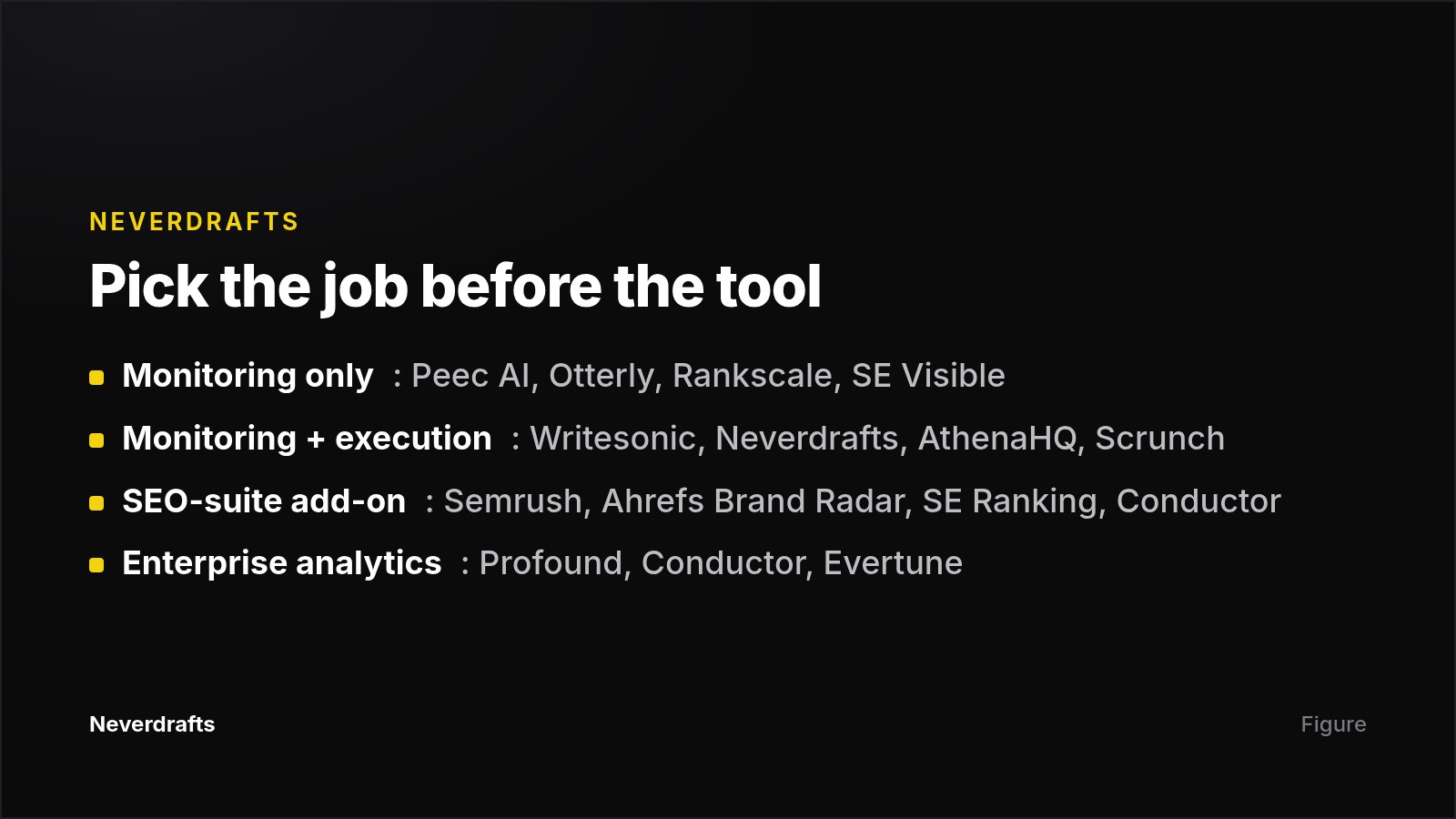
- Monitoring only. You have a content and PR team and need trustworthy data. Look at Peec AI, Otterly.ai, Rankscale, SE Visible or AEO Vision.
- Monitoring plus execution. You need the tool to produce or deploy fixes. Look at Writesonic, Neverdrafts, AthenaHQ or Scrunch. Ask each to show the full chain from gap to published change to measured impact.
- AI visibility inside an SEO suite. You already pay for Semrush, Ahrefs, SE Ranking or Conductor. Start with their add-on before buying a separate tool.
2. Match engine coverage to your buyers
Geotoolbox treats ChatGPT, Perplexity, AI Overviews, AI Mode and Gemini as table stakes. Profound's guide adds that Claude, Copilot, Grok, Meta AI and DeepSeek all shape purchase decisions somewhere. Which ones matter depends on your audience.
Check which engines sit on the plan you'll actually buy, not on Enterprise. Many tools show nine to 11 engines in marketing but cover only three or four at entry level. For a side-by-side view, see our AI brand monitoring tools engine coverage and price comparison.
3. Check citation and source analysis
A mention count isn't enough. The Metehan review scores tools on whether they show the exact URLs and domains the AI pulls from. Because AI engines pull 90%+ of citations from third-party sources, source-level data tells you which review sites, forums and publications to target.
4. Look for sentiment at the dimension level
Being mentioned and being recommended are different things. Metehan recommends sentiment scored at dimension level rather than as one blurry number, so you can see whether AI praises your pricing but questions your support.
5. Confirm data method and refresh rate
Ask three questions:
- Does the tool capture live interfaces or call APIs?
- Where do the prompts come from?
- How often does it refresh?
Refresh rates in the sources range from daily (Peec, Otterly) to twice weekly (Conductor) to weekly or monthly for some suite add-ons.
6. Check the action layer
Metehan wants a tool that tells you what to fix instead of just showing a chart, whether through content briefs, technical audits or earned-media targets. Writesonic's rubric weights closed-loop execution at 25%, the heaviest of its six criteria.
Writesonic also lists four streams of work needed to close a visibility gap: new on-page content, page refreshes, third-party outreach and UGC engagement. No single tool in the sources clearly covers all four, so expect to combine a tool with human work.
7. Check workflow fit and governance
Superlines highlights exports, API access and MCP support so GEO data fits your existing reporting.
For regulated industries, SOC 2 Type II, HIPAA, SSO and RBAC are procurement gates, not nice-to-haves. Profound, Scrunch and Conductor document SOC 2. Evertune has no published SOC 2 Type II, per Profound's guide.
8. Price the plan you'll actually need
Entry prices mislead. Otterly's engine add-ons, Ahrefs' per-platform pricing and Rankscale's credits can all multiply the headline figure. Model your real prompt count, engine list and number of brands before comparing.
What GEO tools can't do for you
Even the best GEO tool doesn't earn citations by itself. It shows where you're missing and, in some cases, drafts or deploys fixes. But the content still has to be useful, and third-party mentions still have to be earned.
Attribution remains the weakest link across the category. Superlines argues that AI traffic attribution and AI bot analytics are what connect visibility to business outcomes. Writesonic quotes an independent comparison stating that none of the leading platforms link AI citations to pipeline metrics yet.
Tools that track AI crawler visits get you partway: proof that engines are fetching your pages. These include Neverdrafts, Scrunch's bot feed, Botify's LogAnalyzer and Conductor. Tools with GA4 integration, such as AthenaHQ, or revenue attribution, such as Goodie AI and Semrush Enterprise, go further. Even so, treat any single "AI revenue" number as directional.
Next step
If your main problem is knowing where competitors get recommended instead of you, and you don't have time to write the fixes, run a short test. Start the Neverdrafts $1 three-day trial, which needs no credit card. Add 10 to 20 prompts your buyers actually ask, and check which competitors ChatGPT, Claude, Perplexity and Google AI Mode cite. If you're weighing it against an enterprise platform, our Neverdrafts vs Profound comparison sets out the differences in scope and price.
Frequently asked questions
What is the best GEO tool in 2026?
There isn't one winner for every team. Peec AI is the most common recommendation for general monitoring. Profound leads for enterprise analytics depth and governance. Semrush or Ahrefs Brand Radar suit teams already on those suites. For tight budgets, Otterly.ai at $29/month and Rankscale at $20/month are the usual starting points. Pick by job first (monitoring, execution or suite add-on), then compare engine coverage and price.
How much do GEO tools cost in 2026?
Prices range from free tiers (AthenaHQ, SISTRIX beta) and $9/month (AEO Vision) to $800/month (Evertune Pro). Most self-serve plans for small and mid-sized teams fall between $79 and $399 per month. Enterprise plans from Profound, Conductor and Scrunch are custom-quoted. Watch for add-ons: extra engines, prompts and credits can push costs well past the headline entry price.
Do I need a dedicated GEO tool if I already use Semrush or Ahrefs?
Not necessarily. If you already pay for Semrush, Ahrefs or SE Ranking, their AI visibility add-ons are the cheapest way to start, because they report alongside your SEO data. The trade-offs are fewer engines on base plans and slower refresh rates for some platforms. Some suites also use keyword-derived prompts. Upgrade to a dedicated tool when you need daily multi-engine tracking or an execution layer.
Which AI engines should a GEO tool track?
At minimum: ChatGPT, Perplexity, Google AI Overviews, Google AI Mode and Gemini, which most reviews treat as table stakes. Claude, Copilot, Grok, DeepSeek and Meta AI all shape purchase decisions somewhere; which ones matter depends on your audience. Check which engines are included on the plan you'll actually buy, since many tools reserve broader coverage for Enterprise tiers.
Are GEO tool visibility numbers accurate?
They're directionally useful but imperfect. AI answers vary between runs, so a single daily snapshot can swing. Tools that query APIs may see different answers than real users, according to a Surfer study comparing API data with live ChatGPT and Perplexity interfaces. Prompt-volume figures are usually panel-based estimates. Ask vendors how they collect answers, how many samples they run and how often they refresh.
Can a GEO tool prove ROI?
Partially. Some tools connect visibility to outcomes through AI crawler tracking, GA4 integration or revenue attribution features. However, an independent comparison cited in 2026 reviews found that none of the leading platforms yet link AI citations to pipeline metrics. Use GEO data to show visibility and engagement trends. Pair it with your own analytics to estimate business impact.
Sources
- Metehan: Best GEO Tools in 2026
- Profound: Best generative engine optimization (GEO) tools for AI search in 2026
- Semrush: The 9 Best Generative Engine Optimization (GEO) Tools of 2026
- Geotoolbox: Best Generative Engine Optimization Tools
- Superlines: Best GEO tools in 2026
- Writesonic: Best GEO Tools 2026: 10 Generative Engine Optimization Platforms Tested