

The best LLM SEO tools in 2026 are Otterly.AI for small budgets (from $29/month), Peec AI for agencies and multi-brand teams that need unlimited seats, Scrunch for teams that want broad engine coverage and are comfortable inside Sitecore, and Profound for enterprises that need analyst-grade data at custom five-figure annual pricing. If you also want the tool to write and publish the content that wins back missing AI answers, our own product, Neverdrafts, handles monitoring and remediation from $99/month. Semrush and Ahrefs add-ons are mainly worth it if you already pay for those suites.
Key takeaways
- Every tool on this list does the same core job: it runs your buyer questions through AI engines on a schedule and reports whether your brand was cited, mentioned or beaten by a competitor. AISEOShift calls that loop commoditized. The differences are depth, engine breadth, seats and price.
- Entry-tier engine coverage varies more than headline marketing suggests. Otterly.AI and Scrunch both track four engines at entry, and Peec lets you pick three.
- None of the mid-market tools connect citations to revenue automatically, so plan for UTM and CRM attribution by hand.
- Published pricing is unreliable in this category. Superlines flagged material documentation conflicts across vendors as of 7 October 2026. Check vendor pages before you budget.
- AI answers vary even for identical prompts. LLMs are non-deterministic, so expect week-to-week noise and read trends rather than single data points.
- Decide on the action layer early. Some tools stop at measurement, some add recommendations, and a few generate or serve content for you.
What does an LLM SEO tool actually measure?
LLM SEO tools, also sold as GEO tools, LLMO platforms or AI visibility trackers, measure whether AI assistants name your brand when buyers ask category questions. RankScope reduces the category to three numbers:
- Citation rate: how often an engine mentions you across a set of tracked prompts.
- Share of voice: your citations as a proportion of every brand named in the same answers.
- Per-engine coverage: both metrics split by platform, because a brand cited constantly in ChatGPT is often absent from Perplexity.
Superlines adds a useful distinction: mentions, citations, sentiment and AI referral traffic answer different questions and should be measured separately. A brand can be mentioned often without a link, or linked often without favorable framing.
Several factors make this category different from rank tracking. Google's AI answers appear in nearly half of all searches, and buyers increasingly get a direct answer with no list of links to scan. If you are not in that answer, your organic ranking does not help you in that channel.
How we compiled this list
We did not run a new benchmark for this article. We built the list from published, dated verification work and flagged conflicts where sources disagree:
- AI Search Tools checked Otterly.AI, Scrunch and Peec AI pricing against official pages around October 2026.
- Superlines checked nine vendors against first-party documentation on 7 October 2026. Superlines is also one of the vendors it compares.
- RankScope verified pricing as of September 2026 using live accounts.
- Zapier researched nearly 50 LLM monitoring tools and tested as many as it could.
- Neverdrafts details come from our own product documentation; disclosed throughout as our product.
Tools below are grouped by team size and action layer, not ranked against each other. If you want a broader category scan that includes content optimizers and all-in-one suites, our comparison of 15 GEO platforms covers more ground. This article stays focused on tools whose main job is tracking and improving LLM citations.
LLM SEO tools compared at a glance
| Tool | Best for | Standout feature | Starting price (as published) |
|---|---|---|---|
| Otterly.AI | Small teams, solo marketers | Per-engine add-ons instead of tier jumps | $29/month (15 prompts) |
| Peec AI | Agencies, multi-brand teams | Unlimited seats, deep source classification | €85/month (50 prompts); conflicting figures published |
| Scrunch | Teams wanting engine breadth, Sitecore users | Agent Experience Platform at Enterprise | ~$250/month (125 prompts) |
| Profound | Enterprises with analysts | Agent-level analytics, data export | Custom, typically five figures/year |
| Semrush AI Visibility Toolkit | Existing Semrush users | Sits inside a familiar SEO suite | $99/month (25 prompts) |
| Ahrefs Brand Radar | Existing Ahrefs users | Index-based tracking, Looker connector | $199 per index or $699 for all |
| ZipTie | Agencies managing brand portfolios | Collection that mimics real user behavior | Configured by engines, prompts and cadence |
| Similarweb | Market research and SEO teams | Side-by-side SEO and GEO tracking | Sales quote |
| Clearscope | Content and editorial teams | Content optimization plus AI tracking | $129/month (50 queries) |
| Superlines | In-house teams and agencies | Action Center recommendations, MCP on all tiers | €79/month (50 prompts) |
| Neverdrafts (our product) | Teams that want monitoring plus published fixes | Auto-generates and publishes content for lost prompts | $99/month (1 brand, 50 prompts) |
Otterly.AI: the cheapest credible way to start tracking
Otterly.AI is the budget pick across nearly every comparison. Zapier names it best for affordability, and AISEOShift calls it the cheapest credible entry for founders and small in-house teams.
Who it suits: solo marketers, small companies, and agencies running lightweight checks across a few clients.
Strengths:
- The Lite plan costs $29/month for 15 prompts across ChatGPT, Google AI Overviews, Perplexity and Copilot.
- Extra engines are add-ons rather than plan upgrades. Gemini and Google AI Mode run $9 to $149/month, and Claude runs $29 to $439/month, depending on base plan. A small team chasing one extra engine can add it without changing tiers.
- It has grown past pure monitoring into what it calls a "Content Intelligence Platform," with a GEO Audit, Content Briefs, and a Content Audit & Prediction tool.
- It reports mentions, sentiment, citations and share of voice against named competitors.
Limitations:
- Fifteen prompts is a small sample for a category where answers fluctuate.
- API access starts at the Standard tier ($189/month).
- Sources disagree on seats. AI Search Tools lists unlimited seats at entry, while AISEOShift describes seat limits on entry plans. Confirm this before committing.
- Its content features are recommendations, not automated publishing.
- Country coverage varies by engine.
Peec AI: built for agencies and multi-brand tracking
Peec AI is the mid-market and agency favorite. It raised $29 million and reached more than $4 million ARR within ten months, which reflects real demand from teams tracking several brands at once. Zapier picks it for smart suggestions.
Who it suits: agencies and mid-market teams where five or ten people need the same client data without per-seat costs.
Strengths:
- Unlimited seats on every plan.
- Support for 115+ languages, useful for international clients.
- AI Search Tools found it has the deepest citation and source classification and the strongest competitive benchmarking of the three mid-market tools it compared.
- Entry users pick any three engines, so you can swap Copilot for Gemini or AI Mode. Enterprise scales to as many as 13 LLM models, including Claude and GPT-5 variants.
- Its "Actions" feature ranks earned and owned recommendations, such as a source that cites your competitor but not you. That helps with outreach planning.
Limitations:
- It ships no site auditing or content generation. Recommendations stop at the recommendation.
- API access is Enterprise only.
- Pricing is contested. AI Search Tools reports Peec's live page at €85 Starter, €205 Pro and €425 Advanced per month. AISEOShift quotes $95 to $495, and Superlines lists the current price as unresolved.
For agency-specific setup questions, see our guide to AI search visibility tools for multiple client websites.
Scrunch: broad engine coverage, now part of Sitecore
Scrunch built its reputation on engine breadth and an unusually developed action layer. Sitecore acquired Scrunch in June 2026, and its roadmap now follows Sitecore's digital experience platform strategy.
Who it suits: teams that need wide engine coverage, especially those already on Sitecore.
Strengths:
- The Core plan runs about $250/month for 125 unique prompts across ChatGPT, Perplexity, Google AI Overviews and Copilot.
- Enterprise reaches nine engines, adding Claude, Gemini, Google AI Mode, Meta AI and Grok.
- Core includes basic content generation and one page optimization per month.
- Enterprise adds the Agent Experience Platform (AXP), a CDN-layer system that detects AI bot traffic and serves a simplified, AI-optimized version of your pages to crawlers without changing what humans see. Scrunch addresses the cloaking question in its FAQ.
Limitations:
- Sources describe its coverage differently. AISEOShift calls it the widest ungated engine coverage, but AI Search Tools found the extra engines on Enterprise, not Core. Check which engines your plan includes.
- Core includes five licenses, with extra seats at $25/month each.
- API and CLI access are Enterprise only.
- Agency Core pricing shows $250/month on some pages and $500/month on the official FAQ.
- If you want an independently run product, Sitecore ownership is worth weighing.
Profound: the enterprise category leader
Profound sits at the top of the market. It has raised $155 million at a $1 billion valuation and counts Fortune 500 companies among its clients.
Who it suits: organizations that treat AI visibility as a board-level metric, with dedicated analysts and formal stakeholder reporting.
Strengths:
- Agent-level analytics that track the upstream prompts and topics shaping AI answers in your category, not only whether you were cited.
- Detailed data export for custom reporting. Superlines lists Enterprise CSV/JSON and API, plus a documented hosted MCP.
- A free 7-day trial covering three engines, one region and one language.
Limitations:
- Pricing is custom and typically reaches five figures annually.
- Several of the less common engines are gated behind Enterprise. Sources differ on the ceiling: AISEOShift says up to ten engines, and Superlines says up to nine.
- Regions and languages are contracted, so global coverage is a negotiation rather than a setting.
We compare the two products directly on our Neverdrafts vs Profound page.
Semrush AI Visibility Toolkit: the add-on for existing Semrush users
Zapier recommends it for existing Semrush users. The appeal is convenience: AI tracking lives next to the keyword and backlink data your team already uses.
Who it suits: SEO teams and agencies already paying for Semrush.
Strengths:
- $99/month with 25 tracking prompts.
- Custom tracking across ChatGPT Search, Google AI Mode, AI Overviews and Gemini. Some summaries also list Perplexity; confirm current engine coverage with Semrush before buying.
- One login and one billing relationship.
Limitations:
- Pricing is per domain, which gets expensive across many brands.
- Location options differ by report, and CSV limits apply.
- Direct MCP access for the AI module is unclear in Semrush's documentation.
- Twenty-five prompts is a small set for a dedicated GEO program.
Ahrefs Brand Radar: index-based tracking for Ahrefs customers
Ahrefs Brand Radar is the natural choice if your team already lives in Ahrefs. Zapier picks it for existing Ahrefs users.
Who it suits: SEO teams and analysts who want AI visibility data inside Ahrefs and in their BI tools.
Strengths:
- Covers six established AI surfaces through its indexes.
- API and MCP access plus a Looker connector are documented, which suits analyst-led reporting.
Limitations:
- Indexes cost $199 each or $699 for all, and custom checks are priced separately.
- Grok collection is paused, and Claude is available only through custom checks.
- The location where an index is sourced can differ from a custom target location, which matters for multi-market brands.
- Plan limits and usage units apply.
ZipTie: deep reporting for brand portfolios
Zapier picks ZipTie for deep analysis and reporting and notes one technical difference. ZipTie tracks responses using methods that mimic real user behavior instead of relying only on APIs, which can better reflect what users actually see.
Who it suits: SEO agencies and in-house teams managing a portfolio of brands.
Strengths:
- Seven selectable engines, with three on the trial.
- Pricing is configured by engine, prompt count and cadence, so you pay for what you track.
- Exports are included, and API/MCP access is a $10/month add-on, a low-cost route to programmatic access.
Limitations:
- Supported countries and collection locations are not fully documented.
- Configurable pricing makes side-by-side budgeting harder than with fixed tiers.
Similarweb: SEO and GEO side by side
Similarweb's strength is context. Zapier picks it for side-by-side SEO and GEO tracking, which helps teams that want AI visibility next to traffic and market data.
Who it suits: marketing, SEO and market research teams.
Strengths:
- Its country matrix lists ChatGPT, Perplexity, Google AI Mode and Gemini.
- Combines GEO data with Similarweb's broader market intelligence.
Limitations:
- Pricing is by sales quote, and module scope is not fully specified.
- Coverage varies by engine.
- Raw exports and API/MCP access for the AI module are unclear.
Clearscope: AI tracking for content teams
Clearscope comes from content optimization and has added AI visibility tracking. Zapier picks it for content creators.
Who it suits: content marketing and editorial teams who want tracking inside a writing workflow.
Strengths:
- Essentials costs $129/month for 50 queries.
- Pricing pages list ChatGPT and Gemini tracking.
- Content exports fit editorial processes.
Limitations:
- Claude availability is unclear.
- Country and location coverage are not fully documented.
- Raw-answer export, API and MCP access are unclear, which limits analyst use.
Superlines: recommendations plus open data access
Superlines publishes one of the comparisons used here and includes itself, which it discloses. Treat its self-assessment accordingly, but its documented specs are useful.
Who it suits: enterprise and in-house marketing teams and agencies.
Strengths:
- Starter costs €79/month for 50 prompts.
- Any three engines on self-service plans, and up to ten on Enterprise.
- MCP on all tiers, exports from Pro, API from Growth.
- Action Center recommendations and interface-based answer collection.
- Unlimited country and language settings are advertised.
Limitations:
- Superlines notes that collection location is a separate consideration from advertised market settings.
- Recommendations guide the work. They do not produce it.
Neverdrafts (our product): monitoring plus published content for lost prompts
Disclosure: Neverdrafts is our product. We're including it here because it fills a gap the independent comparisons above flag repeatedly: none of the tools above connect visibility data to published content.
Neverdrafts tracks which AI systems recommend competitors instead of you, then generates and publishes content aimed at the prompts you are losing. Most tools above stop at measurement or recommendations. We built Neverdrafts to cover the full loop of monitor, diagnose, fix and prove in one tool.
Who it suits: small businesses, content teams and agencies that have visibility data but not the writing capacity to act on it.
Strengths:
- Tracks real ChatGPT, Claude, Google AI Mode and Perplexity answers daily on prompts you define.
- Scores visibility 0–100 per answer based on your position in the response, not only whether you appear.
- Diagnoses why you are absent by showing which sources the AI cites instead of you.
- Generates remediation content for specific lost prompts, in 150+ languages.
- Publishes with one click to WordPress, Webflow, Shopify and Framer, or through an API for custom stacks.
- Tracks AI crawler visits to published pages, giving on-site evidence that the content is being read.
- Reports competitor share of voice, brand mention trends and average ranking.
Pricing: Starter is $99/month for 1 brand, 50 prompts and 30 articles. Growth is $199/month for 3 brands, 150 prompts and 100 articles. Agency is $399/month for 10 brands, 500 prompts and 300 articles. Billing is monthly with no annual commitment, and a $1 three-day trial covers any plan.
Limitations:
- Engine coverage is four platforms. Google AI Overviews, Copilot, Gemini and Grok are not on the tracked list, so teams that depend on those should pair it with another tracker or choose a broader tool.
- Like every tool here, it does not automatically connect citations to revenue. Crawler visits show the content is being read, not that it closed deals.
- Generated content still benefits from editorial review for accuracy and brand voice before you scale publishing.
- The independent comparisons cited in this article do not cover it, so you will need to rely on the trial for evaluation.
Which other tools are worth knowing about?
A few products appear in comparisons without fitting the main list:
- Petra Labs: Zapier's pick for all-in-one enterprise needs.
- Yext Scout: Zapier's pick for local tracking, relevant for multi-location businesses.
- Promptwatch: described as a platform with an agentic execution layer for turning visibility data into published content. It also published the source-count research cited below.
- Adobe LLM Optimizer: the only other platform AI Search Tools found with a content-delivery layer comparable to Scrunch's AXP.
- Free checkers: RankScope dedicates a section of its guide to free LLM SEO checkers for teams that just want a one-off baseline. HubSpot's free AI Search Grader is also a commonly suggested starting point, though it is a baseline tool rather than an ongoing tracker.
If ChatGPT is your main concern, our ChatGPT brand mention tracking comparison goes deeper on that engine.
How to choose an LLM SEO tool
These are the criteria we used to describe the tools above. Work through them in order, because the first two eliminate most options.
Which AI engines does your audience actually use?
Start with engines, not features. RankScope notes that a brand dominating ChatGPT can be nearly invisible on Google AI Overviews, and that "AI visibility" covering only ChatGPT is like a rank tracker that only reports desktop rankings.
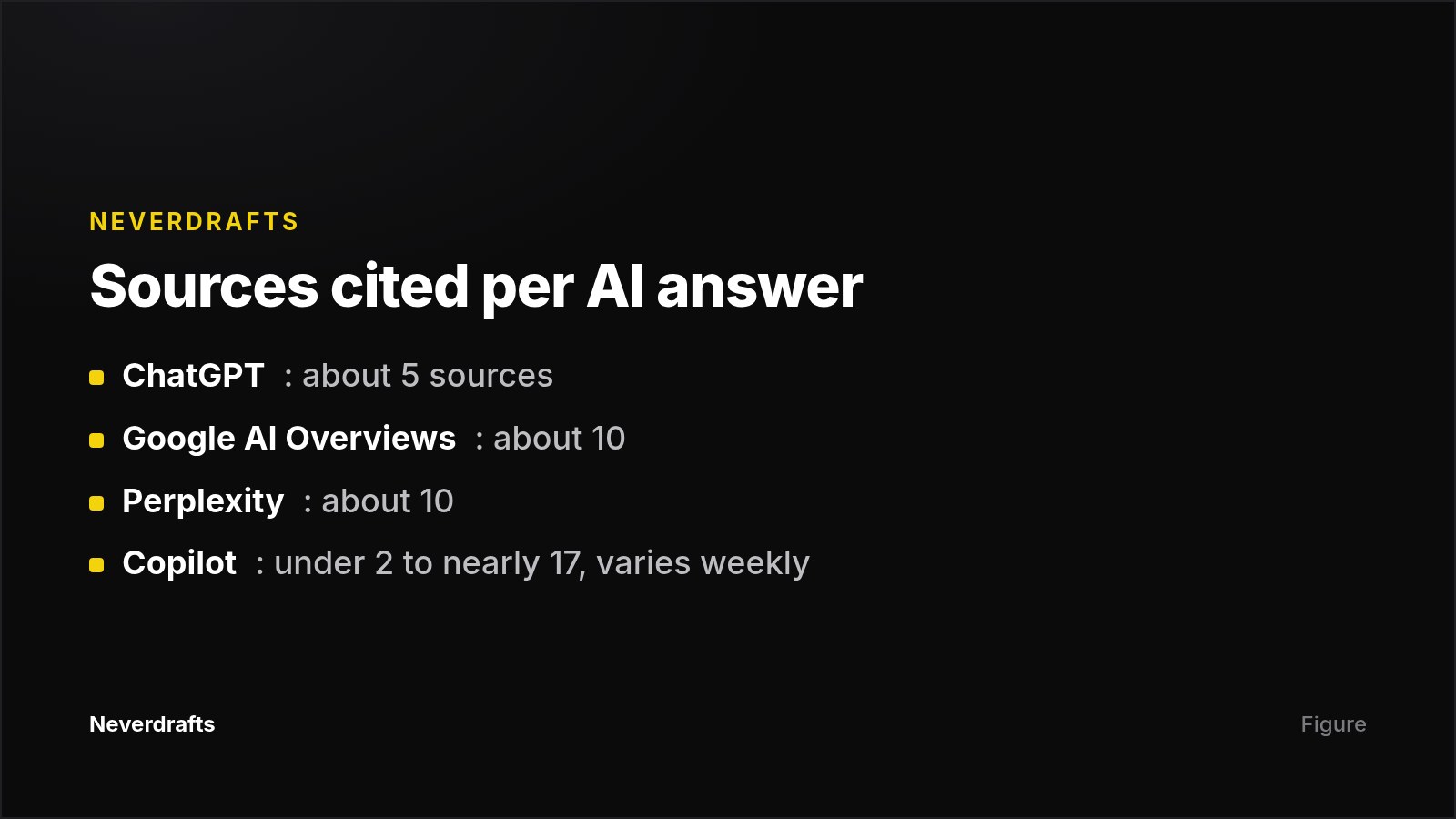
Engine choice also changes how hard each answer is to win. Promptwatch's research found ChatGPT surfaces roughly five sources per web-search answer. Google AI Overviews and Perplexity surface around ten, and Copilot is inconsistent: sometimes under two, sometimes nearly seventeen in a week. Fewer slots means more competition for each one. If ChatGPT is your primary engine, depth of tracking there matters more than breadth across engines you barely need.
Then check what your plan includes, not what the vendor tracks at its top tier. Entry plans across Otterly.AI, Scrunch and Peec cover three or four engines, and the rest cost more.
Can you track your own prompts at a useful volume?
Custom prompt tracking separates purpose-built GEO platforms from SEO tools with add-ons. Your buyers ask specific questions that a vendor's prompt library will miss.
AISEOShift recommends loading the 20 to 30 questions your buyers actually ask into every trial instead of using sample prompts. That number also works as a sanity check: a 15-prompt plan can cover one product line, not a whole category.
Can you see the actual answers and cited sources?
A visibility percentage tells you where you stand. The list of source URLs each engine cited tells you what to do next. AISEOShift calls that list your content roadmap and advises factoring it into real cost if a trial hides it behind a higher tier.
Look for forensic detail too. RankScope argues that good tools show exactly what changed in a response, when, and what it looked like before and after. Without that, you cannot connect your content changes to movement in AI answers.
How many people and brands need access?
Seat models vary widely:
- Peec AI offers unlimited seats on every plan.
- Scrunch Core includes five licenses, with extra seats at $25/month each.
- Semrush prices per domain.
- Neverdrafts prices by brand count (1, 3 or 10).
RankScope advises agencies to filter hard on multi-client dashboards, white-label reporting and export quality before anything else.
What happens after the dashboard?
Tools fall into three groups by action layer:
- Measurement only: visibility scores, share of voice and citation sources.
- Recommendations: Peec's Actions, Otterly's GEO Audit and Content Briefs, and Superlines' Action Center tell you what to fix.
- Execution: Scrunch's content generation and AXP, Neverdrafts' generated and published content, and agentic platforms like Promptwatch do some of the work.
If your team has writers with spare capacity, recommendations are enough. If not, the gap between insight and publishing is where most programs stall.
Will the vendor and its integrations still fit in a year?
This category moves fast, and the tool you pick today may not be the tool you're using in twelve months. Sitecore's June 2026 acquisition of Scrunch is the clearest example: the product now follows a larger DXP roadmap rather than an independent one, which is fine if you already use Sitecore and a real consideration if you wanted a standalone tool. Peec's $29 million raise and $4 million-plus ARR in ten months, and Profound's $155 million raise at a $1 billion valuation, are the kind of funding signals worth tracking too, since well-funded vendors change pricing and features faster than bootstrapped ones.
Integration access also varies more than most comparisons mention. Superlines documents MCP on all tiers, with exports starting at Pro and API at Growth. ZipTie gates API/MCP behind a $10/month add-on, while Otterly's API starts at its Standard tier and Peec and Scrunch both reserve API access for Enterprise. If you plan to pipe visibility data into a BI tool or a content workflow, check the tier where programmatic access actually unlocks, not just whether the vendor's homepage mentions an API. Zapier treats workflow integrations as a bonus differentiator rather than a baseline expectation, which matches what we found: most of this category still assumes you'll export a CSV and work from there.
How will you handle noise in the data?
Zapier warns that the same prompt on the same engine at the same time can produce different answers. Some practical habits:
- Track enough prompts that one volatile answer does not swing your score.
- Compare refresh cadence across vendors. Superlines points out that alerts do not make scheduled collection continuous.
- Report multi-week trends to stakeholders, not daily movement.
- Note the collection method. API-based and browser-like collection can produce different results.
How will you prove ROI?
No mid-market tool closes this loop for you. You'll still be doing UTM and CRM attribution by hand. Measure AI referral traffic separately from mentions and citations, as Superlines recommends. Decide before you buy which metric your budget owner will accept.
Quick match by team type
- Solo marketer or small business on a tight budget: Otterly.AI.
- Agency or multi-brand team: Peec AI or ZipTie. Choose Neverdrafts (ours) if you also need content produced.
- Small team with no writing capacity: Neverdrafts (ours).
- Sitecore customer or engine breadth priority: Scrunch.
- Enterprise with analysts and governance: Profound.
- Already paying for an SEO suite: Semrush or Ahrefs Brand Radar as a first step.
- Editorial team: Clearscope.
Next step
Write down the 20 to 30 questions your buyers actually ask an AI assistant. Then run them through a short trial of two tools from the list above. If you want to see whether the monitor-and-publish approach fits your team, Neverdrafts offers a $1 three-day trial on any plan: load those prompts, review which sources the AI cites instead of you, and check the generated content before you publish anything.
Frequently asked questions
What is the difference between LLM SEO, GEO and LLMO?
They describe the same work: improving how often AI assistants such as ChatGPT, Perplexity and Google AI Overviews cite or recommend your brand. Vendors use the labels fairly interchangeably; Zapier calls the discipline generative engine optimization (GEO), while RankScope groups GEO tools, LLMO platforms and AI visibility trackers into one category measuring the same thing. The core metrics are the same under any name: citation rate, share of voice and per-engine coverage, measured across a set of tracked buyer prompts.
How much do LLM SEO tools cost?
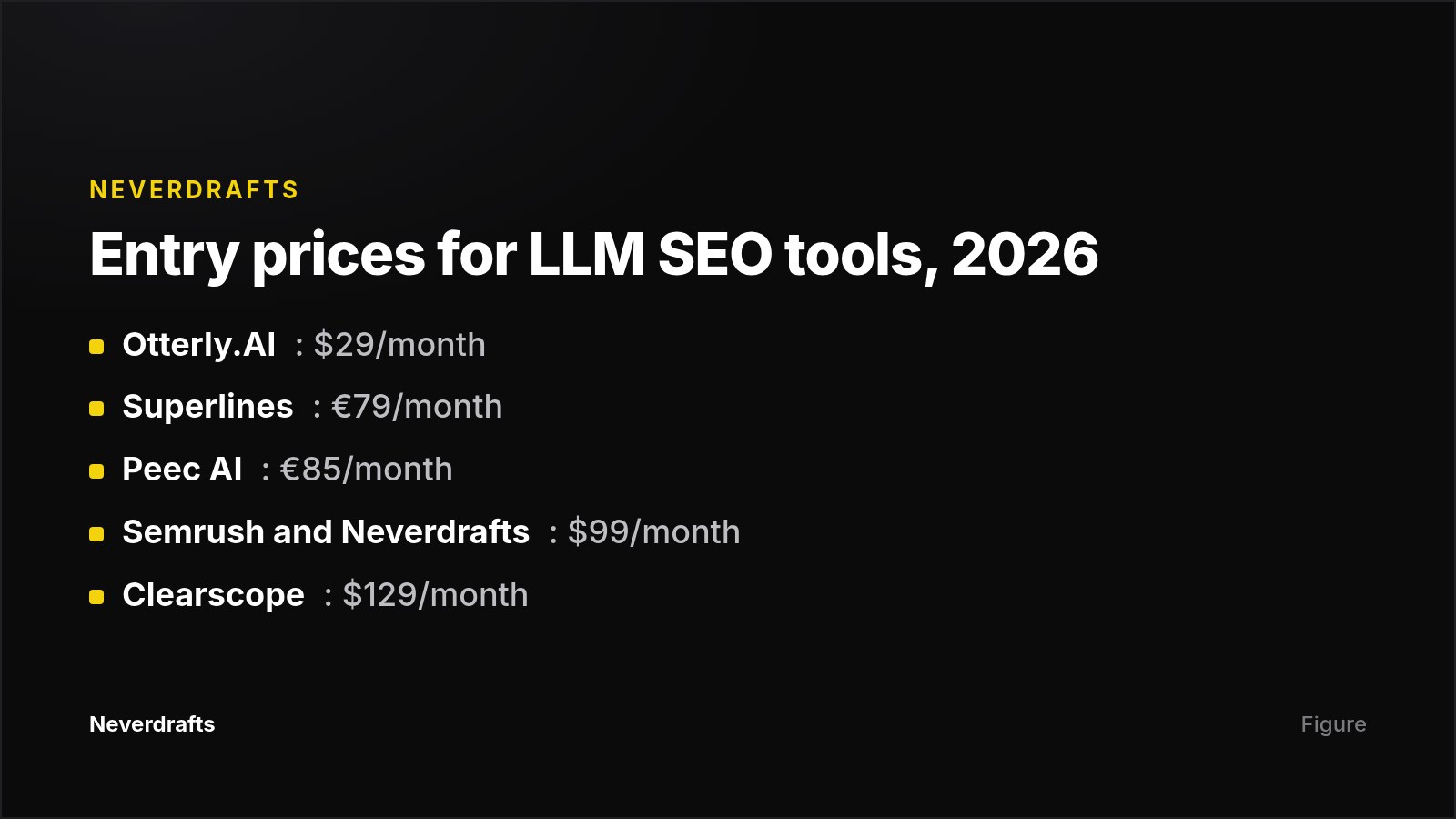
Published entry prices start around $29/month (Otterly.AI) and rise through €79–€85/month (Superlines, Peec AI), $99/month (Semrush), $129/month (Clearscope) and about $250/month (Scrunch). Enterprise platforms such as Profound use custom contracts that typically reach five figures a year. Vendors publish conflicting figures, so confirm current pricing on each vendor's own page before budgeting.
Do I need a dedicated tool if I already use Semrush or Ahrefs?
Not always. If you mainly want a baseline and already pay for Semrush or Ahrefs, their AI add-ons are a reasonable first step. Dedicated tools usually offer more custom prompts, deeper citation-source detail, competitor benchmarking and broader engine choice. Teams running an active GEO program, or agencies reporting AI visibility to clients, usually outgrow the add-ons.
Why do my AI visibility scores change from week to week?
LLMs are non-deterministic, so the same prompt on the same engine can return different answers even at the same moment. Engines also change which sources they cite and how many. Some week-to-week movement is noise. Track enough prompts to stabilize your averages, compare multi-week trends, and look at the actual answer changes before reacting to a single drop.
Can any LLM SEO tool show revenue from AI citations?
No major tool automatically connects citations to revenue. Teams still rely on UTM parameters, analytics referral data and CRM attribution set up by hand. Measure AI referral traffic separately from mentions and citations, since each answers a different question. Agree on which metric matters to your budget holder before choosing a tool.
Sources
- [S1] Zapier, "The 9 best AI visibility tools in 2026": https://zapier.com/blog/best-ai-visibility-tool/
- [S2] RankScope, "Best LLM SEO Tools in 2026": https://rankscope.ai/blog/llm-seo-tools
- [S3] AI Search Tools, "Otterly.AI vs Scrunch vs Peec AI: Official AEO Feature Comparison for 2026": https://ai-search-tools.com/guides/otterly-ai-vs-scrunch-vs-peec-ai-official-aeo-feature-comparison-for-2026
- [S4] AISEOShift, "Otterly vs Peec vs Profound vs Scrunch": https://aiseoshift.com/blog/otterly-vs-peec-vs-profound-vs-scrunch/
- [S5] Superlines, "AI Search Visibility Tools Comparison 2026": https://superlines.io/articles/best-ai-visibility-tools