
Direct answer
The best LLM SEO tools in 2026 are Otterly.AI for small budgets ($29/month), Peec AI for SEO teams that want clean daily analytics ($95/month), and Profound for enterprise programs. If you already pay for SE Ranking, Semrush or Ahrefs, start with their AI tracking add-ons. PromptRush offers the lowest cost per recorded answer. If you want a tool that also fixes gaps instead of only reporting them, look at Writesonic or Neverdrafts, which pair tracking with content generation.
Disclosure: Neverdrafts is our product. It is evaluated below by the same criteria as every other tool, including its limitations.
Key takeaways
- Buy on the entry plan, not the homepage. The engine count a vendor advertises usually belongs to its most expensive plan. The plan you can afford often covers fewer engines than the homepage advertises, according to RankScope's October 2026 review.
- Compare cost per 1,000 recorded answers. By that measure, entry plans run from about $5.07 (PromptRush Lite) to $81.94 (AthenaHQ Starter). Headline price says little about what you get.
- Expect three price bands. Budget monitors cost under $100/month, mid-market trackers $189 to $499/month, and enterprise platforms are sold on custom contracts.
- Prices move constantly. When RankScope re-checked twelve competitors in September 2026, every one had changed a price, plan or engine list since May. Check vendor pages before you buy.
- Monitoring alone does not improve visibility. Most tools report gaps. Fewer help you close them with content or publishing workflows.
- Start with the free baselines. Bing Webmaster Tools and Google Search Console now include AI performance reports at no cost.
What does an LLM SEO tool actually do?
An LLM SEO tool runs a list of buyer questions through AI engines on a schedule. Then it reports whether your brand was named, how it was described, who was named instead, and which pages were cited. RankScope describes the workflow plainly: the products are sold as LLM visibility tools, LLM tracking tools, GEO tools and AI visibility platforms, but "the labels differ, the job does not."
The category exists because search behavior is shifting. Gartner predicted traditional search engine volume would drop 25% by 2026 as users move to AI chatbots and virtual agents.
Two technical points shape how much you can trust any tool's numbers:
- LLMs are non-deterministic. The same prompt on the same engine at the same time can produce different answers. Treat any single snapshot as noise and read trends instead.
- Collection method matters. Some tools capture answers the way a real user sees them in the interface. Others query APIs. Zapier's reviewer notes that tools mimicking real user behavior can produce more accurate results because they better reflect what users actually see.
There is also healthy skepticism about the category. Forrester's Nikhil Lai argued that answer engine optimization is "significantly, but not fundamentally, different from SEO". Google's 2026 guidance calls optimizing for generative AI search "still SEO". In practice, that means these tools are most useful as a measurement layer on top of sound SEO, not as a replacement for it.
Which LLM SEO tools are worth comparing? Summary table
Twelve tools cover most buying situations, from $19/month budget monitors to enterprise platforms on custom quotes. Prices below are entry-plan prices as reported by the cited sources. RankScope read every price on vendor pages on 15 October 2026. Gracker verified its figures in June 2026.
| Tool | Best for | Standout feature | Entry price |
|---|---|---|---|
| Otterly.AI | Solo marketers, lean teams | Unlimited team members on every tier | $29/mo |
| Peec AI | Growing SEO teams | Clean daily analytics, unlimited seats | $95/mo |
| Neverdrafts | Teams that want tracking plus published fixes | Auto-generated remediation articles with one-click publishing | $99/mo |
| Profound | Enterprise GEO programs | Deepest enterprise feature set, SOC 2 Type II | Custom quote; $499/mo self-serve reported June 2026 |
| SE Ranking | Agencies wanting SEO + GEO in one plan | Full SEO suite included, 5 LLMs | $129/mo |
| Semrush | Existing Semrush users | AI tracking inside a familiar suite | $199/mo |
| Ahrefs (custom prompts / Brand Radar) | Existing Ahrefs users | Custom prompts as a low-cost add-on | $50/mo custom prompts (free with Ahrefs Lite); Brand Radar $828/mo all-in |
| Writesonic | All-in-one GEO + SEO + content | Engines included without add-on fees | $199/mo |
| RankScope | Tracking both Google AI surfaces | Answers recorded in a real browser | $49/mo |
| PromptRush | Lowest cost per answer | About $5.07 per 1,000 answers | $19/mo |
| Rankscale | Broad engine coverage cheaply | 9 engines on the $99 Pro plan | $99/mo |
| Scrunch | High monthly response volume | 5,000 responses/month on Core | $250/mo |
Which plan gives you the most answers per dollar?
A recorded answer is one prompt run once on one engine. RankScope computed cost per 1,000 answers by using vendor-stated response counts where available. Otherwise it multiplied prompts × engines × 30 daily runs. That method assumes daily runs per engine, which vendors usually imply but don't always state.
| Plan | Monthly price | Answers/month | Cost per 1,000 answers |
|---|---|---|---|
| PromptRush Lite | $19 | 3,750 | $5.07 |
| RankScope Professional | $149 | 18,000 | $8.28 |
| SE Ranking Core | $129 | 15,000 | $8.60 |
| AIclicks Starter | $59 | 4,650 | $12.69 |
| Otterly.AI Lite | $29 | 1,800 | $16.11 |
| Ahrefs custom prompts Basic | $50 | 2,500 | $20.00 |
| Rankscale Pro | $99 | about 4,800 | $20.63 |
| Peec AI Starter | $95 | 4,500 | $21.11 |
| Scrunch Core | $250 | 5,000 | $50.00 |
| AthenaHQ Starter | $295 | 3,600 | $81.94 |
Source: RankScope, 15 October 2026.
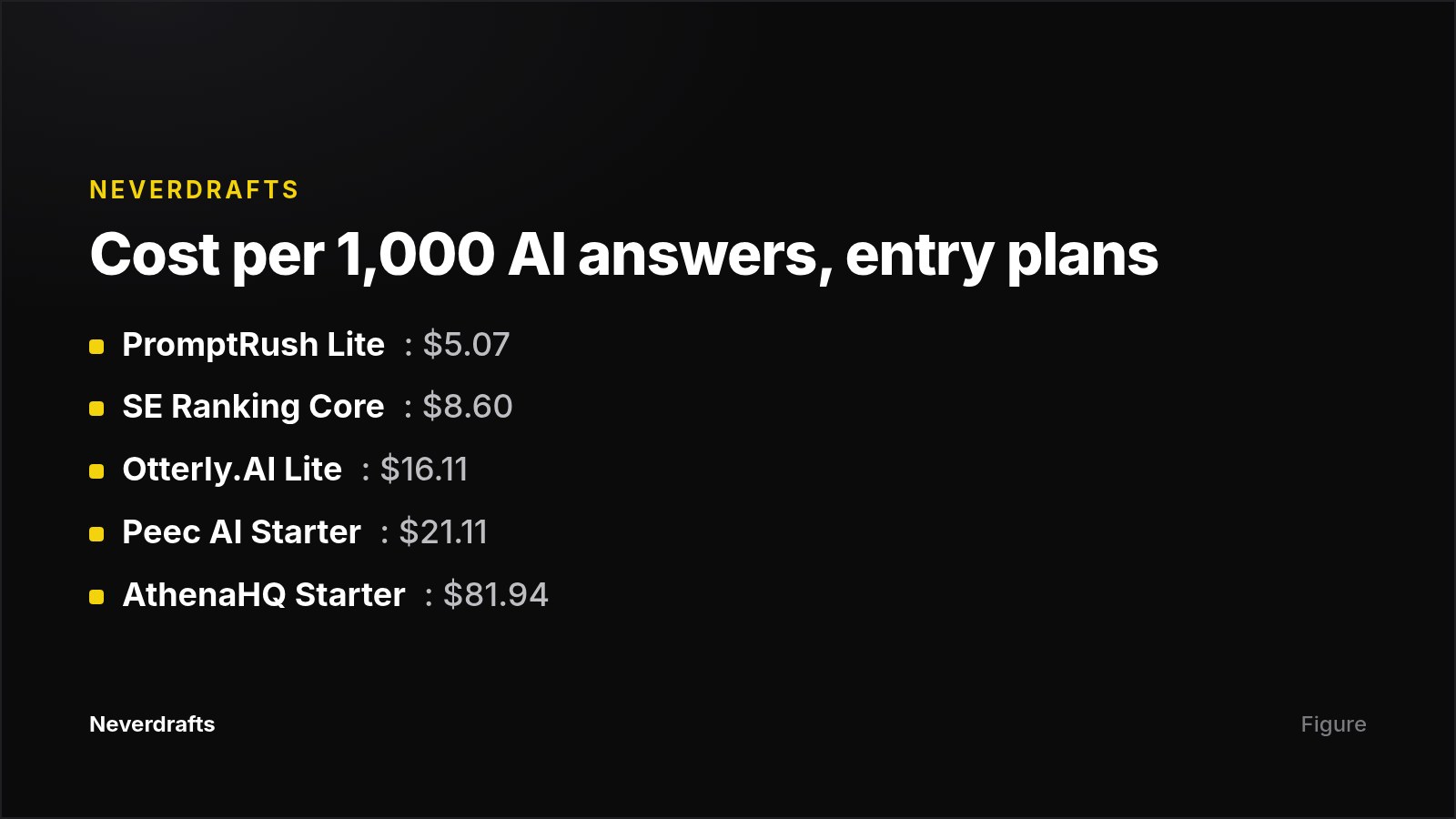
Cost per answer is not the whole decision. As RankScope puts it, an engine your buyers do not use is worth nothing at any price. A cheap plan that skips the engine your customers rely on is a false economy.
Otterly.AI: the cheapest serious monitor
Otterly.AI is a dedicated AI search monitor built for small teams. Zapier's reviewer, who researched nearly 50 tools, named it the best pick for affordability. Gracker called it the cheapest serious monitor.
Who it's for: solo marketers and lean teams that need daily tracking without an enterprise contract.
Strengths:
- Unlimited team members on every tier, so there are no per-seat fees.
- Brand visibility and sentiment analysis, citation source tracking, a crawlability audit, and recommendations included even on Lite.
- Standard and above add API access, MCP access, Agent Analytics and a Data Studio connector.
- Unlimited countries and languages on all plans.
Limitations:
- The four default engines are ChatGPT, Google AI Overviews, Perplexity and Microsoft Copilot. Claude, Google AI Mode and Gemini cost extra.
- Lite includes only 1 workspace and 3 recommendations per week.
- It is monitoring-first. Gracker notes you still need a separate workflow to act on the gaps.
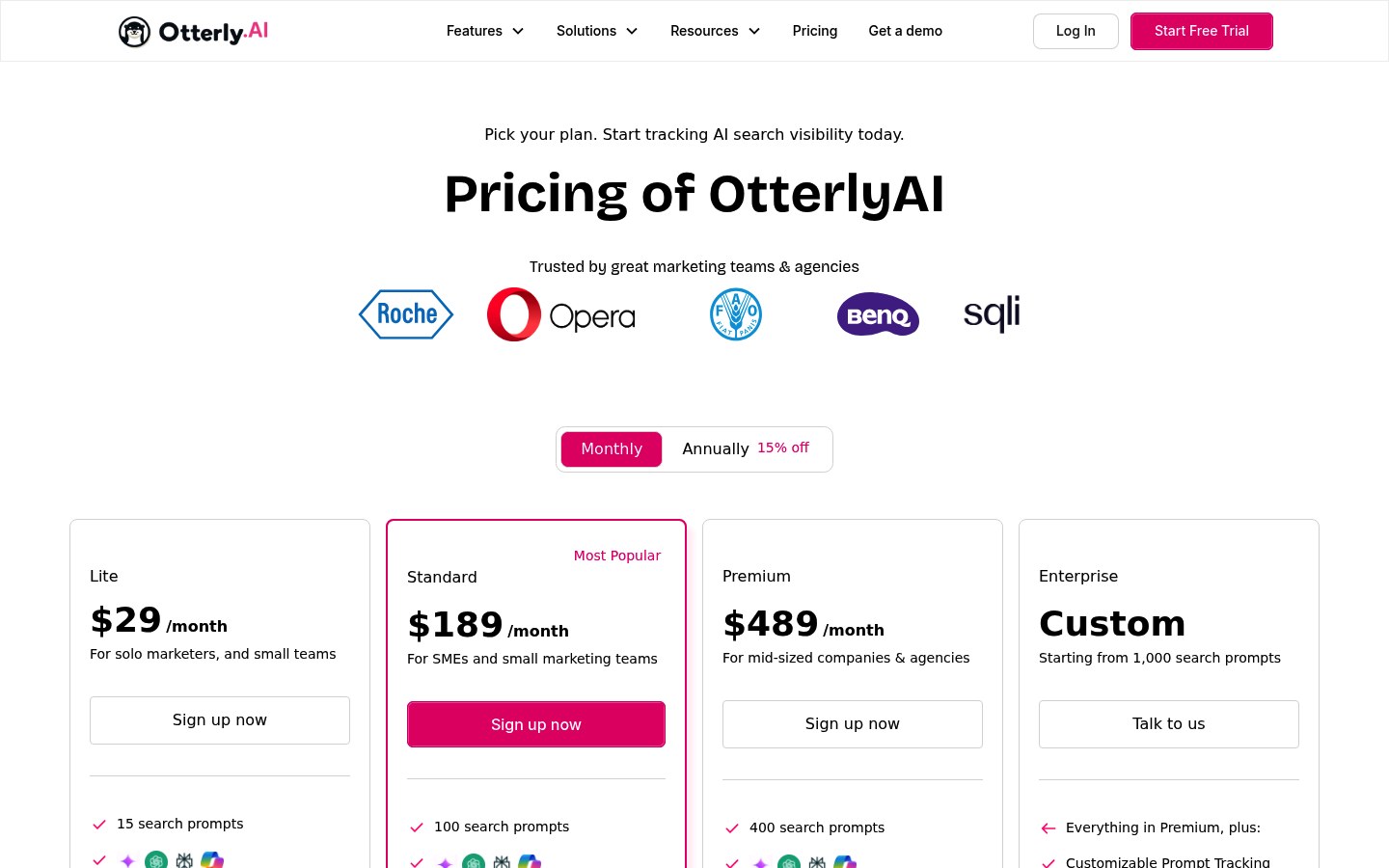
Pricing: Lite $29/month for 15 prompts, Standard $189/month for 100 prompts, Premium $489/month for 400 prompts. Enterprise is custom, starting from 1,000 prompts. Annual billing takes 15% off. Standard and Premium can add 100 extra prompts for $99.
Peec AI: clean daily analytics for growing SEO teams
Peec AI describes itself as an "AI search analytics" tool. Gracker calls it the fastest-growing challenger, and Zapier picked it for smart suggestions.
Who it's for: marketing and SEO teams that want reliable daily visibility data without enterprise pricing.
Strengths:
- Unlimited user seats on every plan.
- A strong price-to-depth ratio at the mid-market level.
- Daily refresh on the entry plan, with any 3 models you choose, per RankScope.
Limitations:
- Extra models are paid add-ons, so the headline price climbs if you need broad coverage.
- At $21.11 per 1,000 answers, the Starter plan sits mid-table on cost efficiency.
Pricing: Starter $95/month for 50 prompts and 3 models, Pro $245/month for 150 prompts, Advanced $495/month.
Neverdrafts: tracking that ends in published content
Disclosure: Neverdrafts is our product.
Neverdrafts monitors which AI systems recommend your competitors instead of you. It then generates and publishes content aimed at winning those answers back. It is built for B2B SaaS companies, agencies and product teams.
Who it's for: teams that want the full loop (monitor, diagnose, fix, prove) and don't have writers available to act on every gap a dashboard reveals.
Strengths:
- Daily monitoring of real ChatGPT, Claude, Google AI Mode and Perplexity answers.
- Position-weighted visibility scoring from 0 to 100 per answer, showing where in each response you appear.
- Remediation articles generated automatically for the prompts you are losing.
- One-click publishing to WordPress, Webflow, Shopify and Framer, plus an API for custom stacks.
- An AI bot-traffic tracker that shows AI crawlers visiting your published pages.
- Competitor citation diagnosis, sentiment analysis, white-label reports for agency clients, and content in 150+ languages.
Limitations:
- Google AI Overviews, Gemini and Microsoft Copilot are not among the monitored engines. If those surfaces matter to your buyers, pair it with another tracker or choose a tool that covers them.
- On raw tracking volume, budget monitors such as PromptRush ($5.07 per 1,000 answers) and SE Ranking ($8.60) give you more answers per dollar. If you already have a writing team, the content-generation allowance may be paying for something you don't need.
- No customer names or usage figures are published yet. You'll need to judge results with your own free audit.
Pricing: Starter $99/month (1 brand, 50 prompts, 30 remediation articles), Growth $199/month (3 brands, 150 prompts, 100 articles), Agency $399/month (10 brands, 500 prompts, 300 articles). Billing is monthly with no contract, and a free audit requires no credit card. For a direct comparison with the enterprise leader, see Neverdrafts vs Profound.
Profound: the enterprise category leader
Profound is one of the largest dedicated GEO platforms. Wikipedia lists it alongside Scrunch, Ahrefs and Semrush as among the largest tools used for GEO. Gracker ranks it first for enterprise and cites a reported $1 billion valuation.
Who it's for: enterprise brands and agencies with budget for a serious, multi-surface GEO program.
Strengths:
- SOC 2 Type II and HIPAA compliance plus SSO, which matters for regulated buyers.
- Enterprise features including Agent Analytics and Prompt Volumes.
- Wide engine coverage: Gracker lists 10+ engines, and RankScope lists 9 engines on Enterprise.
Limitations:
- The entry price rules out small teams.
- It is generic across industries, so vertical buyers such as cybersecurity vendors get no specialized prompt library.
- Public pricing is inconsistent across sources. In June 2026, Gracker verified a $499/month self-serve entry point. By October 2026, RankScope found custom quotes only, with a 7-day free trial on 3 engines as the only public plan. Confirm with sales.
Pricing: custom or quote-based in the most recent check. Earlier self-serve pricing started at $499/month.
SE Ranking: the best-value SEO suite with AI tracking
SE Ranking combines traditional SEO tools (rank tracking, backlink monitoring, site audits) with an AI search tracker. Writesonic's review rates it best for SEO and GEO with competitor analytics.
Who it's for: mid-sized agencies and in-house teams that want one subscription for both SEO and GEO.
Strengths:
- Tracks brand mentions and citations in multiple languages across AI Overviews, AI Mode, ChatGPT, Perplexity and Gemini.
- Stores cached AI answers so you can see exactly how your brand was framed.
- Lists the top-cited sources for your prompts and provides competitor AI monitoring.
- At $8.60 per 1,000 answers, it is one of the cheapest options, and that price includes the full SEO suite.
Limitations:
- Writesonic lists no automated sentiment analysis as a con.
- Gracker notes that SEO suites which added AI tracking later — it names Semrush, Ahrefs and Conductor — trail AI-first tools on per-engine depth. The same trade-off is worth testing for yourself with SE Ranking before committing.
Pricing: Core $129/month, or $103.20/month billed annually, with 100 prompts on 5 LLMs refreshed daily and a 14-day free trial.
Semrush: AI tracking for teams already on Semrush
Semrush markets its offering under "AI SEO" and "AI Visibility". Zapier recommends its AI Visibility Toolkit for existing Semrush users.
Who it's for: teams whose keyword research, audits and reporting already run through Semrush.
Strengths:
- One login and one data model for classic SEO and AI visibility.
- Daily refresh on 50 prompts on the SEO + AI Starter plan, per RankScope.
- A free account to explore before paying.
Limitations:
- RankScope found the engines included on the entry plan were not stated on the pricing page.
- AI tracking was added to an existing SEO suite, so per-engine depth trails AI-first tools.
- At $199/month, it is expensive if you only want AI tracking.
Pricing: SEO + AI Starter $199/month, or $165.17/month billed annually.
Ahrefs: low-cost custom prompts for Ahrefs users, Brand Radar at enterprise prices
Ahrefs sells two different products that get confused in comparisons: a low-cost "custom prompts" add-on, and the separate Brand Radar product. Zapier recommends Ahrefs for existing Ahrefs users. Gracker tested Brand Radar hands-on and lists 6 engines tracked.
Who it's for: SEO teams already paying for Ahrefs who want AI visibility data next to their backlink and keyword data, and are clear on which product they're buying.
Strengths:
- Custom prompt tracking is included free with Ahrefs Lite ($129/month) at the Basic level.
- Flexible checks: you choose the refresh frequency and how to split checks across platforms.
Limitations:
- Capacity on custom prompts Basic is spread thin: 2,500 checks works out to 80 prompts daily on 1 platform.
- Brand Radar, the full 6-engine product, costs $828/month all-in — not the $50/month entry price that applies only to custom prompts.
Pricing: custom prompts Basic $50/month (about $20.00 per 1,000 checks); Brand Radar $828/month all-in.
Writesonic: GEO tracking bundled with content tools
Writesonic is a GEO platform that combines AI visibility tracking with SEO and content creation tools. Note that the Writesonic review cited here is published by Writesonic, which ranks itself first in its own comparison.
Who it's for: businesses that want tracking, benchmarking and content production in one platform.
Strengths:
- Monitors ChatGPT, Perplexity, Google AI Overviews, Gemini, Claude, Grok, DeepSeek, Copilot and more, with no extra fees for additional engines.
- An Action Center gives on-page, off-page and technical recommendations, and content can be generated in-platform.
- Citation and source tracing, AI crawler analytics, and prompt-level insights.
- AI Traffic Analytics is available on a free tier.
Limitations:
- Even its own review lists a learning curve due to the depth of features.
- No independent cost-per-answer figure appears in the sources, so value is harder to compare.
Pricing: paid plans start at $199/month.
RankScope: both Google AI surfaces, recorded in a real browser
RankScope tracks ChatGPT, Google AI Overviews, Perplexity and Google AI Mode. It published the most transparent pricing comparison in this category, while disclosing that it makes RankScope.
Who it's for: teams that care about both Google AI surfaces and want answer-level history on their own prompts.
Strengths:
- Answers are recorded in a real browser rather than pulled only from APIs.
- Professional costs $8.28 per 1,000 answers, second only to PromptRush in the comparison.
- A free AI visibility checker is available.
Limitations:
- The Starter plan covers only 2 engines (ChatGPT and AI Overviews). RankScope acknowledges this puts Starter in the bottom half of its own value table.
- No Claude, Gemini or Copilot on the listed plans.
Pricing: Starter $49/month (40 prompts, 2 engines), Professional $149/month (150 prompts, 4 engines), Agency $399/month (400 prompts). Annual billing lowers Starter to $39 and Professional to $124.
PromptRush: the lowest price per recorded answer
PromptRush rarely appears in AI-generated recommendations, which tend to favor brand-name tools. On raw value, though, it leads RankScope's comparison.
Who it's for: budget-conscious marketers who want daily multi-model data and will interpret it themselves.
Strengths:
- 25 prompts on 5 models daily, for about $5.07 per 1,000 answers.
- A 30-day money-back guarantee lowers the risk of trying it.
Limitations:
- Claude is a paid add-on.
- 25 prompts is a small sample for a brand with several product lines.
- The sources say little about its reporting, sentiment or recommendation features. Test before relying on it.
Pricing: Lite $19/month.
Rankscale: nine engines for under $100
Rankscale offers some of the broadest engine coverage on a self-serve plan.
Who it's for: teams that need to watch many engines, including both Google AI surfaces, on a modest budget.
Strengths:
- The Pro plan covers 9 engines including both Google AI surfaces for $99/month.
- A low-cost Essentials tier starts at $17/month (yearly billing only).
- A Pro trial is available.
Limitations:
- Pricing is credit-based (1,200 credits). Answer volume depends on credit usage, which RankScope estimated at about 4,800 answers a month at a typical 0.25 credit per query.
- Refresh frequency is not stated.
Pricing: Pro $99/month, or about $20.63 per 1,000 answers.
Scrunch: an enterprise-leaning tracker now owned by Sitecore
Scrunch is one of the startups Wikipedia lists among the largest GEO tools. Sitecore announced its acquisition of Scrunch and describes the discipline as "answer engine optimization."
Who it's for: teams in or evaluating the Sitecore ecosystem, and teams that need a high volume of monthly tracked responses.
Strengths:
- 125 prompts and 5,000 responses a month on the entry plan.
- Covers ChatGPT, Perplexity, AI Overviews and Copilot.
- A 7-day trial.
Limitations:
- At $50.00 per 1,000 answers, it costs several times more per answer than the budget leaders.
- No Gemini, Claude or AI Mode on the Core plan.
Pricing: Core $250/month.
Which other LLM SEO tools are worth a look?
These did not get full sections, but each fits a specific need:
- LLMrefs: 500 prompts for $79/month, with weekly reports across 11 listed engines. Good for broad prompt coverage when you don't need daily data.
- Trakkr: Growth costs $100/month for 8 models, including Grok, DeepSeek and Meta AI.
- AthenaHQ: Starter covers 11 engines for $295/month, though it has the highest cost per answer in the comparison.
- ZipTie: Zapier's pick for deep analysis and reporting. It tracks responses using methods that mimic real user behavior.
- GrackerAI: the only tool Gracker identified as built exclusively for cybersecurity vendors, with paid plans from $79/month on annual billing.
If you mainly need dashboards and alerts, our round-up of AI visibility monitoring tools goes deeper on monitoring-only options.
How should you choose an LLM SEO tool?
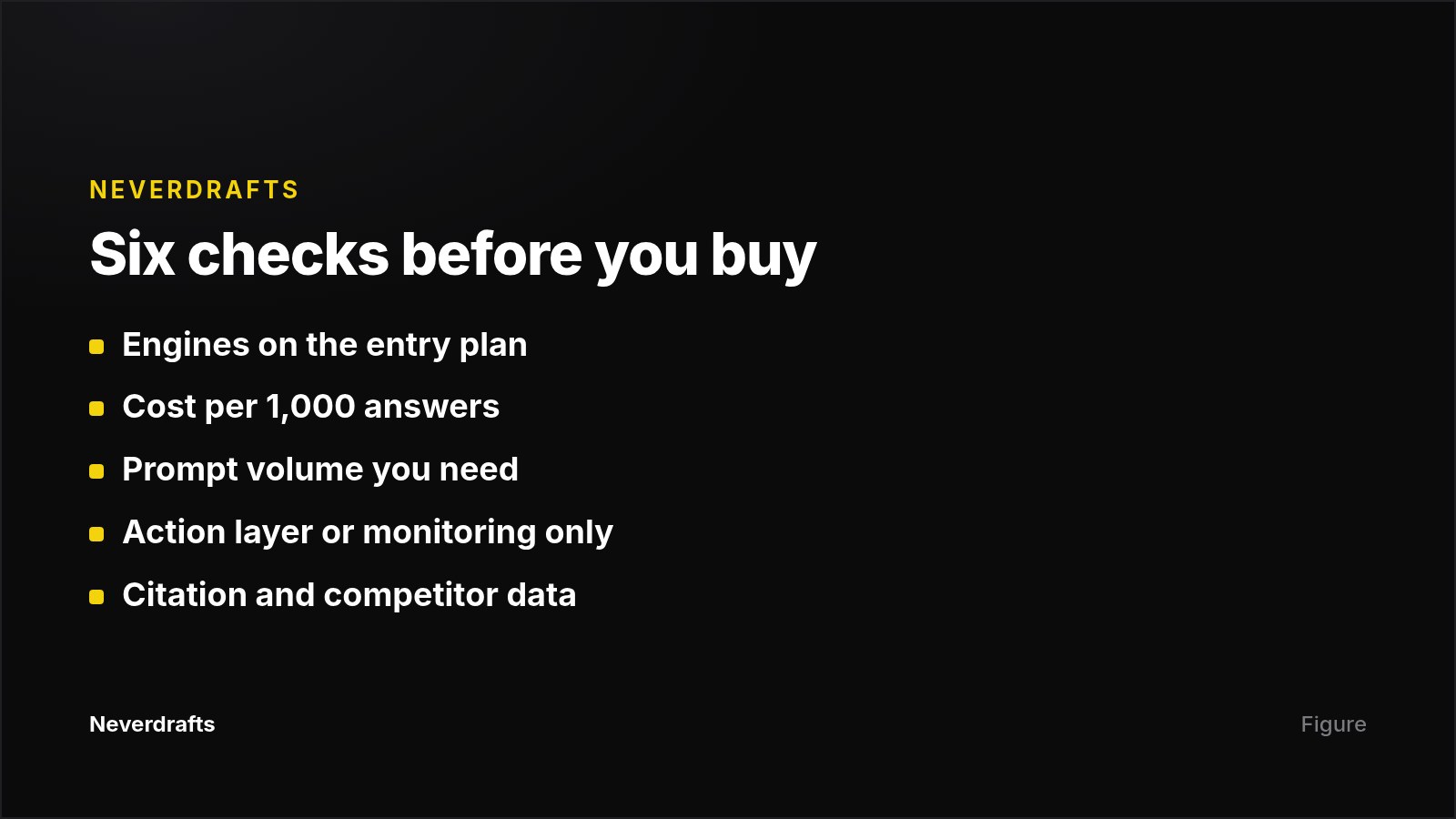
No tool checks every box yet. Zapier's reviewer says this is such a new category that no app does everything. Use these criteria, roughly in this order.
1. Match engines to where your buyers ask
List the AI surfaces your customers actually use, then check which ones the entry plan covers. Most tools track ChatGPT, Perplexity and Google AI Overviews. Fewer cover Gemini and Microsoft Copilot as well. Extra engines are paid add-ons on several plans — Otterly, Peec AI and PromptRush all charge separately for some models — so the headline price climbs if you need broader coverage.
2. Calculate cost per 1,000 answers
Multiply prompts × engines × runs per month, then divide the price by that number. This one figure exposes the gap between a $29 plan that records 1,800 answers and a $129 plan that records 15,000.
3. Size your prompt list honestly
A 15-prompt plan suits a single product with a narrow set of core questions; agencies and multi-product companies will typically need far more. Otterly's own tiers scale from 15 to 400+ prompts, which gives a rough sense of how demand grows with account size. Because LLM answers vary from run to run, more prompts and more frequent runs give you a steadier signal.
4. Decide whether you need an action layer
Gracker weights the "action layer" at 20% of its scoring, asking whether the tool helps you fix gaps or only reports them. If no one on your team will write the content a dashboard calls for, a monitoring-only tool will show you the same losses every week. Our guide to GEO tools that track, diagnose and fix covers this split in more detail.
5. Check citation and competitor data
You want to know which domains and pages the engines cite, and who wins the prompts you lose. Citation source detection reveals your high-performing pages, misinformation sources and partnership opportunities.
6. Discount vendor rankings
Several of the most-cited "best of" lists are published by vendors that include their own product: Writesonic ranks itself #1 in its own comparison, and both Gracker and RankScope feature their own tools alongside competitors. RankScope deserves credit for disclosing that it did not test competitors' output accuracy. The practical fix is to run the same 10–20 prompts through two or three free trials and compare the results yourself.
7. Use the free baselines first
Before paying anything, check the AI Performance report in Bing Webmaster Tools and the generative AI performance reports in Google Search Console. They won't cover ChatGPT or Perplexity, but they give you first-party data to sanity-check whatever a paid tool reports.
Next step
To find out which prompts you are currently losing to competitors, start with a free Neverdrafts audit at neverdrafts.com. It requires no credit card. Run the same prompts through one budget tracker from this list, such as Otterly.AI or PromptRush, and compare what each reports. Then decide whether you need monitoring alone or monitoring plus published content.
Frequently asked questions
What is the difference between LLM SEO, GEO and AEO?
They describe the same practice: improving how your brand appears in AI-generated answers. The term "generative engine optimization" comes from a 2023 paper later presented at KDD 2024. Vendors use different labels, including AEO, LLMO, AIO and AI SEO. Google's 2026 guidance treats it all as "still SEO," while Bing uses "generative engine optimization" in its documentation.
How much do LLM SEO tools cost?
Entry plans range from about $17–$19/month (Rankscale Essentials, PromptRush Lite) to custom enterprise contracts. Gracker groups the market into three bands: under $100/month, $189 to $499/month, and enterprise deals from $26,800/year. Comparing cost per 1,000 recorded answers is more useful than comparing headline price.
Can I track AI visibility for free?
Partly. Bing Webmaster Tools offers an AI Performance report, and Google Search Console offers generative AI performance reports, both at no cost. Many paid tools also offer trials: Profound, Scrunch, LLMrefs and SE Ranking all list trials, and Semrush has a free account. Free reports won't cover ChatGPT, Claude or Perplexity answers.
Why do results change from day to day?
LLMs are non-deterministic: the same prompt on the same engine can return different answers even at the same moment. Engines also update their models and retrieval sources. Read trends across weeks rather than reacting to single results, and prefer tools that run prompts daily.
Should I use my existing SEO suite or a dedicated AI tool?
If you already pay for Semrush, Ahrefs or SE Ranking, start there, since the marginal cost is low. Gracker notes that suites which added AI tracking later — naming Semrush, Ahrefs and Conductor — trail AI-first tools on per-engine depth. Move to a dedicated tool when you need more engines, more prompts or deeper competitor and citation analysis.
Do LLM SEO tools actually improve visibility?
Monitoring alone does not. The tool shows where you are missing, and your content and authority work changes the outcome. The industry debates how effective third-party tools are. Pick a tool whose output your team will act on, and judge it by whether your tracked prompts improve over several months.
Sources
- Zapier — The 9 best AI visibility tools in 2026
- RankScope — Best LLM SEO Tools in 2026: 17 LLM Visibility and Tracking Tools Compared
- Writesonic — Top 12 LLM Tracking Tools for AI Visibility in 2026
- Gracker — Top 15 LLM Tracking Tools for AI Visibility in 2026
- Otterly.AI — Pricing
- Wikipedia — Generative engine optimization
- Neverdrafts — Homepage and pricing
- Neverdrafts vs Profound