
The best AI visibility monitoring tools in 2026 are Profound for enterprises that need the widest engine coverage, the Semrush AI Visibility Toolkit for teams already on Semrush, Peec AI for agencies and marketing teams, Otterly.AI as the cheapest credible starting point at $29/month, and Ahrefs Brand Radar for Ahrefs users who also want YouTube, Reddit and TikTok data. The tools differ less in features than in which AI engines your plan actually covers, how each one collects answers, and whether it separates brand mentions from URL citations. Scrunch suits teams whose site is being misread by AI crawlers. Neverdrafts (Disclosure: Neverdrafts is our product.) suits small teams that want monitoring and remediation content in one tool.
Key takeaways
- Check engine coverage at the price you will pay. According to Aissist's August 2026 comparison, four of the six leading tools advertise AI engines that their cheapest paid plan does not include.
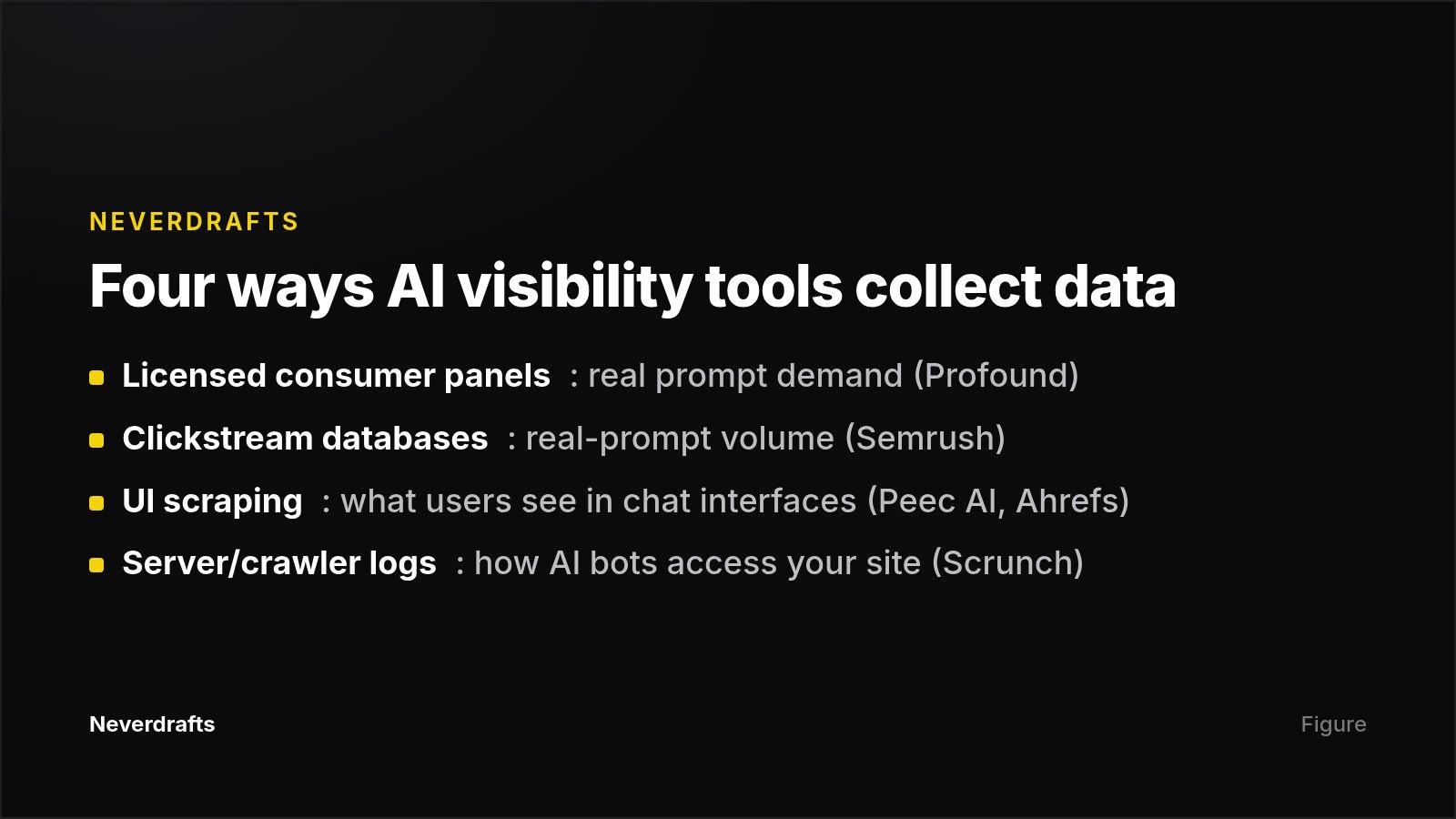
- Data collection method explains conflicting numbers. Licensed user panels, clickstream data, scraped chat interfaces and server crawler logs measure different things. That is why three trackers can report three different numbers for the same brand in the same week.
- Mentions and citations are different metrics. A brand can be named often while its pages earn zero citations. Choose a tool that reports both, and check our tool-by-tool breakdown below.
- Entry prices are misleading. Ahrefs Brand Radar starts at $199/month for one platform but costs $699/month for all platforms. Scrunch covers all six engines for $250/month billed yearly.
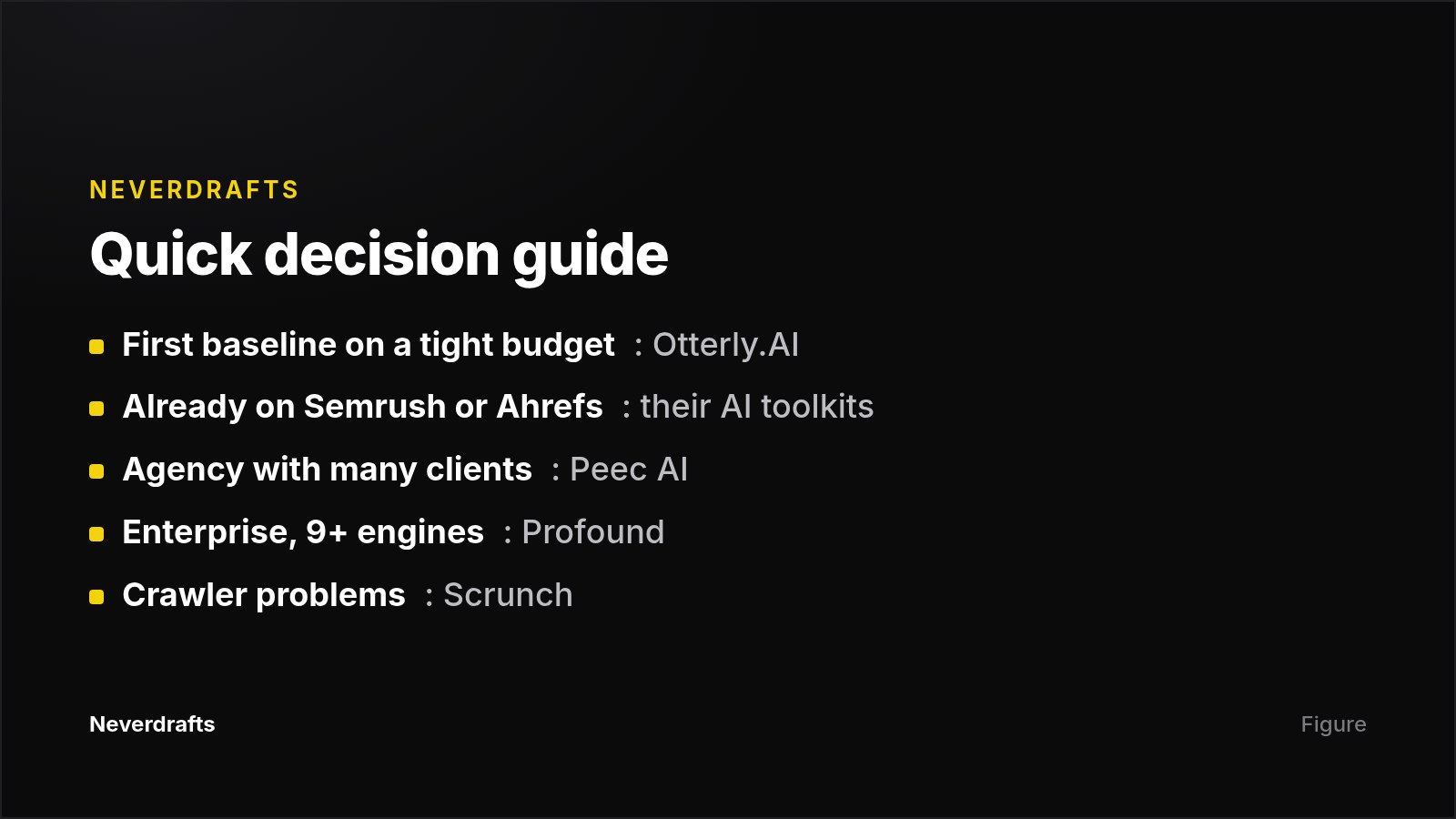
- Match the tool to your stage. Start with the cheapest tool that covers your buyers' engines. Upgrade once the data is driving decisions.
- Monitoring alone does not improve visibility. Some tools stop at dashboards. Others, including Writesonic, Mentionova and Neverdrafts, connect tracking to content production.
Why does AI visibility monitoring matter in 2026?
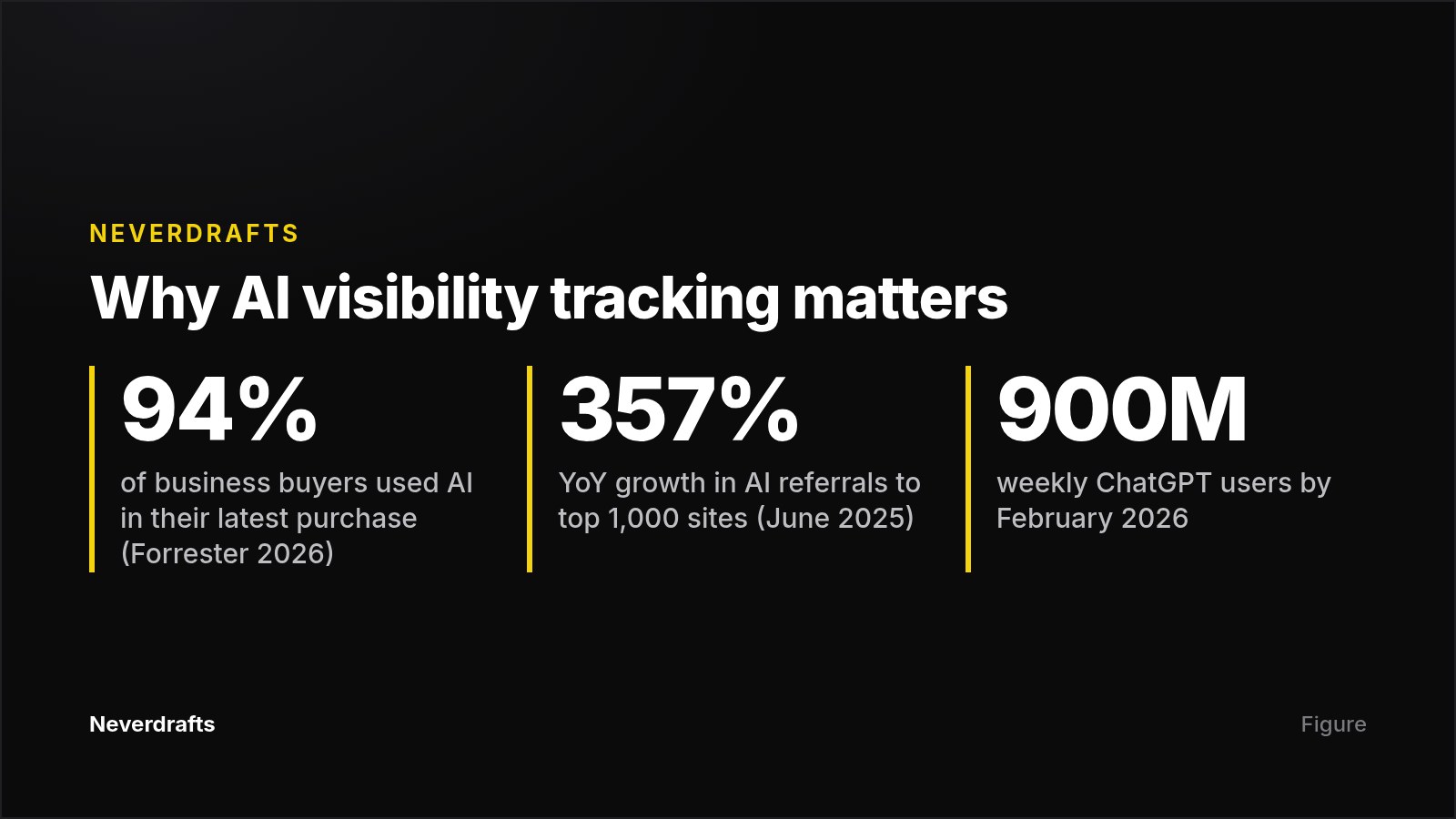
AI assistants are now a primary research channel for buyers. Forrester's 2026 Buyers' Journey Survey of 18,000 global business buyers found that 94% used AI during their most recent purchase. In G2's 2026 survey, 76% of business buyers used ChatGPT for work and 62% used Gemini.
The traffic is growing too. AI referrals to the top 1,000 websites were up 357% year-on-year in June 2025, reaching 1.13 billion visits, according to Similarweb data cited by Exposure Ninja. ChatGPT crossed 900 million weekly users by February 2026. Mentionova's research puts AI referral conversion at 14.2% versus 2.8% for traditional Google traffic. That figure comes from a vendor, so treat it as directional.
Traditional rank trackers cannot see any of this. AI visibility tools replace keyword positions with metrics such as mention rate, citation frequency, share of voice and sentiment inside AI-generated answers.
How we built this list
This round-up draws on published hands-on reviews from Zapier, Exposure Ninja and AnswerManiac, along with Aissist's pricing and data-method audit and SEO-day's use-case ranking. Where sources disagree on prices or engine counts, we show both figures and do not pick the flattering one.
Prices in this category change often. Every figure below carries its source, and you should confirm current pricing on the vendor's page before buying. For a broader field that includes optimization-focused platforms, see our comparison of 15 GEO tools.
Summary: the best AI visibility monitoring tools compared
| Tool | Best for | Standout feature | Entry price | Engines at entry price | Mentions vs. citations |
|---|---|---|---|---|---|
| Profound | Enterprise brands, large agencies | Up to 9 engines; licensed consumer prompt panel | $99/mo billed yearly (ChatGPT only); Growth from $399/mo | 1, ChatGPT | Tracks citation and sentiment separately |
| Semrush AI Visibility Toolkit | Existing Semrush users | AI Strategic Opportunities; prompt research | $99/mo per domain add-on; Semrush One $199/mo | 4 named, Perplexity weekly | Reports Mentions and Cited Pages as separate metrics |
| Peec AI | Agencies and marketing teams | Daily UI scraping; Looker Studio and API exports | ~€89–$95/mo | 3 of 6 on brand plans | Offers source analysis |
| Otterly.AI | Freelancers, startups, first baseline | Lowest entry cost; unlimited workspaces | $29/mo | 4, Claude/Gemini/AI Mode extra (S6 reports 7 at $29) | Citation analysis of most-cited URLs |
| Ahrefs Brand Radar | Existing Ahrefs users; non-web surfaces | YouTube, Reddit and TikTok coverage | $199/mo (1 platform); $699/mo (all) | 1 platform at entry | Tracks mentions and citations |
| Neverdrafts | Small teams wanting tracking plus content | Auto-generated remediation content; AI crawler visit tracking | $99/mo (1 brand, 50 prompts) | 4 (ChatGPT, Claude, Google AI Mode, Perplexity) | Includes competitor citation analysis |
| Scrunch | Sites misread by AI crawlers | Real CDN/server crawler logs | $250/mo billed yearly | 6, no surcharge | Not specified in sources |
| ZipTie | Deep analysis and reporting | Tracking that mimics real user behavior | Not stated in sources | Not stated in sources | Not specified in sources |
| Writesonic | Small content teams | Monitoring plus article production | Professional from $249/mo | 3 tracked at self-serve (10 advertised) | Not specified in sources |
| AthenaHQ / Athena | Mid-market growth teams | GA and Search Console traffic connection | Self-serve from $295/mo | Not stated in sources | Offers citation intelligence |
| Mentionova | Teams prioritizing Reddit | Reddit thread discovery and reply drafting | Not stated in sources | 6 (pricing not stated) | Shows the source cited instead of you |
1. Profound: best for enterprise-scale coverage
Profound is the most heavily funded specialist in the category. It raised a $96M Series C at a $1B valuation in February 2026, which brought total funding to $155M. Exposure Ninja calls it the most comprehensive AI platform tracker. It supports ChatGPT, Google AI Overviews, AI Mode, Gemini, Microsoft Copilot, Meta AI, Grok and Perplexity, and its top tier reaches up to nine engines, including DeepSeek.
Who it is for: Enterprises and well-funded scale-ups with dedicated analytics or BI support. SEO-day describes it as analyst-led: it delivers mostly raw data, dashboards and exports.
Strengths:
- Data combines daily browser-captured prompts with a licensed opt-in consumer panel. That gives it real prompt-demand data, which Aissist rates as its main advantage.
- Agent Analytics shows AI crawler behavior, and the platform tracks shopping visibility in ChatGPT for e-commerce.
- OpenSend lists citation and sentiment tracking among its core features, so it reports both metrics rather than only one.
- Integrations include GSC, GA, Adobe Analytics, Looker, Slack, CDN and CMS connectors, with SOC 2 and SSO/SAML on Enterprise.
- G2 rating of 4.5 from 1,128 reviews (August 2026).
Limitations:
- The $99/month plan, billed yearly, covers ChatGPT only.
- The API is Enterprise-only.
- Exposure Ninja found that its strategic opportunities lack prioritisation, and that it is the most expensive option once you want the full value.
Pricing: Starter $99/month. Growth starts at $399/month. Enterprise is custom.
2. Semrush AI Visibility Toolkit: best inside an existing SEO suite
Semrush adds AI visibility tracking to its SEO platform. The toolkit benchmarks how often your brand appears in AI answers, shows where competitors outrank you, and suggests next actions. Exposure Ninja's founder Tim Cameron-Kitchen says it shows "why you're showing up or not" and which sites you need citations on.
Who it is for: Brands already paying for Semrush, and small to mid-sized businesses with established SEO or content processes.
Strengths:
- AI Strategic Opportunities groups actions by what to do now, what takes time, and what is urgent because it is hurting brand perception.
- Prompt research works like keyword research for AI, with AI volume, difficulty and intent.
- An AI Search Site Audit flags crawl issues that could block citations.
- The Visibility Overview reports Mentions, Monthly Audience and Cited Pages as distinct metrics, so you can see mention volume and citation volume side by side.
- Data comes from a real-prompt clickstream of 317M+ prompts plus Semrush-run prompt tracking. G2 rating is 4.4 from 4,031 reviews, the largest review base in the category.
- Semrush Enterprise AIO adds tracking by product, persona, region and category, and covers nine engines.
Limitations:
- Engine coverage at the entry tier is narrow. Exposure Ninja lists ChatGPT, AI Overviews, AI Mode and Gemini, with no Perplexity. Aissist says Perplexity is included but refreshes weekly, not daily. Confirm before buying if Perplexity matters to you.
- The $99 plan includes 25 tracked prompts, which is a small set.
Pricing: $99/month per domain as an add-on to Semrush plans, which start at $139.95/month for Pro. Semrush One bundles SEO and AI features for $199/month.
3. Peec AI: best for agencies and marketing teams
Peec AI is a dedicated generative-engine visibility platform. It passed $4M in revenue in its first ten months. AnswerManiac calls it the agency and marketing-team favorite because it pairs real analytics with a workflow built for daily use.
Who it is for: In-house marketing teams and agencies that want serious tracking without enterprise setup. Perplexity's own answers to this question recommend it for dedicated monitoring.
Strengths:
- Data comes from daily UI scraping, explicitly not model APIs, so results reflect what users see in the interface.
- Alerts flag sudden gains or losses on individual prompts, which helps during launches and campaigns.
- SEO-day lists supported engines as ChatGPT, Gemini, Claude, Perplexity, DeepSeek and Grok, with prompt discovery, source analysis, sentiment and competitor benchmarks. OpenSend's reading of the self-serve plans lists a different set — ChatGPT, Perplexity, Gemini, Google AI Overviews, Google AI Mode, Microsoft Copilot and Grok, with Claude depending on plan. Confirm the current list for your plan before buying; this is one of the clearer source disagreements in the category.
- Exports via CSV, Looker Studio or API support custom client reports.
Limitations:
- Brand plans include 3 of 6 engines. All six require agency plans, which bill per credit.
- Exposure Ninja notes that its strategic recommendations are less developed, with Actions still in beta, and that prompt volume depends on plan.
- Its G2 score of 4.8 comes from only 18 reviews.
Pricing: From around €89/month, or $95/month in Aissist's August 2026 reading.
4. Otterly.AI: best budget entry point
Otterly.AI is the most affordable credible option and appears on nearly every published shortlist. Zapier names it best for affordability.
Who it is for: Freelancers, startups and lean teams that need a first baseline before committing a larger budget.
Strengths:
- Converts keywords into AI-friendly prompts and runs GEO audits covering 25+ on-page factors.
- Citation analysis shows the most-cited URLs in AI answers, a feature that separates mentions from actual citation performance.
- Unlimited workspaces let agencies keep clients separate, and plans include unlimited seats.
- Pairs daily prompt checks with real crawler events. G2 rating is 4.7 from 54 reviews.
- A free trial is available before you commit to a paid plan.
Limitations:
- Engine counts vary by source. AnswerManiac says it tracks 7 engines at $29. Aissist and OpenSend say standard plans cover ChatGPT, AI Overviews, Perplexity and Copilot, with Claude, Gemini and AI Mode as paid add-ons. Verify the engine list for your plan directly with the vendor.
- Otterly does not publish its collection method for prompt data.
- It focuses on monitoring rather than diagnosis or content production.
Pricing: Lite plan from $29/month.
5. Ahrefs Brand Radar: best for Ahrefs users and non-web surfaces
Ahrefs Brand Radar adds AI mention and citation tracking to the toolset many teams already use for backlinks and rankings. AnswerManiac calls it the value pick for existing customers because the marginal cost is low and the data sits next to existing SEO work.
Who it is for: Teams already in the Ahrefs ecosystem, and brands that care about YouTube, Reddit and TikTok as well as AI answers.
Strengths:
- Aissist rates it best for non-web surfaces (YouTube, Reddit, TikTok). Reddit is a meaningful share of AI citations, so this coverage matters.
- Prompts come from People Also Ask data and run against each chatbot's web UI.
- AnswerManiac confirms it tracks both mentions and citations rather than only one.
- G2 rating is 4.5 from 714 reviews.
Limitations:
- Billing is per month plus per check, where one check is one prompt on one platform in one location. Costs rise quickly as you add engines and markets.
- The entry tier covers one platform. All platforms cost $699/month.
- AnswerManiac notes it will not match a dedicated tool on depth.
Pricing: From $199/month for a single platform. $699/month for all platforms.
6. Neverdrafts: best for small teams that want monitoring plus remediation content
Disclosure: Neverdrafts is our product.
At Neverdrafts, we built the platform after losing AI answers to competitors ourselves. It tracks prompts where AI recommends a competitor instead of you, generates content aimed at those exact prompts, publishes it to your CMS, and then tracks AI crawler visits to show whether the fix was picked up.
Who it is for: Small businesses, content teams and agencies that would otherwise pay for a monitoring tool and a writer separately. It fits teams that need prompt-level gaps closed, not only reported. If you run WordPress specifically, our WordPress-focused guide covers that setup.
Strengths:
- Monitors real ChatGPT, Claude, Google AI Mode and Perplexity answers daily through the interface rather than API extrapolation.
- Scores visibility 0–100 per response, weighted by where your brand appears in the answer text.
- Includes sentiment per mention, competitor citation analysis showing which domains AI prefers, and a diagnostics layer that explains why a prompt favors a competitor. This separates mention tracking from citation tracking rather than reporting a single blended number.
- One-click publishing to WordPress, Webflow, Shopify, Framer and API-first stacks.
- AI bot-traffic tracking adds a proof layer beyond dashboard metrics.
Limitations:
- Covers four engines. Gemini, Microsoft Copilot, Grok, DeepSeek and Meta AI are not tracked, so Profound or Scrunch fit better if you need that breadth.
- No published analytics connectors (GA, Search Console, Looker) beyond CMS integrations, and no published API or warehouse exports for BI teams.
- No public customer case studies or third-party review scores yet. Profound and Semrush have large G2 review bases.
- Prompt allowances are modest at the entry tier: 50 prompts on Starter.
Pricing: Starter $99/month (1 brand, 50 prompts, 30 remediation articles). Growth $199/month (3 brands, 150 prompts, 100 articles). Agency $399/month (10 brands, 500 prompts, 300 articles). Billing is monthly with cancel-anytime terms, and a free audit is available with no card required. For a direct comparison with the enterprise leader, see Neverdrafts vs. Profound.
7. Scrunch: best when AI crawlers are misreading your site
Scrunch combines prompt tracking with real CDN and server crawler logs, plus machine-readable site delivery. It measures both what AI says about you and how AI bots access your pages.
Who it is for: Teams that suspect technical issues, such as blocked crawlers, JavaScript-heavy pages or poor structure, are why AI answers ignore or misstate them.
Strengths:
- Covers all six engines Aissist tracked, with no surcharge at the entry price.
- Server-log data shows actual crawler behavior rather than inferred behavior.
- G2 rating is 4.6 from 73 reviews.
- Better normalized value than its headline suggests. Aissist notes that a tool advertising "from $199" costs more than twice the one advertising "from $250" once you track five engines.
Limitations:
- The entry price is higher than Otterly or Peec for teams that only need one or two engines.
- The emphasis on crawler and technical data may be more than a small team needs for a first baseline.
- Sources do not specify whether it separates mentions from citations in its reporting.
Pricing: $250/month billed yearly, or $300 month to month.
8. ZipTie: best for deep analysis and reporting
Zapier picks ZipTie for deep analysis and reporting, and Perplexity's answers recommend it for detailed citation analysis. Zapier highlights that ZipTie tracks LLM responses using methods that mimic real user behavior rather than relying only on APIs. That approach can produce results closer to what users actually see.
Who it is for: SEO and GEO specialists who want granular citation and response data for reporting.
Strengths:
- Collection that mirrors real user behavior.
- Strong focus on citation-level analysis.
Limitations:
- Our sources give no G2 score, pricing or engine list for ZipTie; request all three before evaluating.
9. Writesonic: best for small content teams that publish fast
Writesonic links AI visibility tracking to content creation. Teams see mentions, sentiment and citing prompts in ChatGPT, Perplexity, Gemini and AI Overviews, then produce fact-checked, SEO-optimized articles with internal linking. Content refresh alerts flag pages that are losing AI visibility.
Who it is for: Small content teams that care more about speed than deep analytics.
Strengths:
- Tracking and drafting happen in the same workflow.
- Refresh alerts tie visibility drops to specific pages.
Limitations:
- Aissist excluded it from its shortlist because its self-serve tiers track three engines, not the ten advertised.
- Analytics are lighter than dedicated monitoring tools.
Pricing: Professional plans start at $249/month.
10. AthenaHQ / Athena: best for mid-market growth teams tied to traffic data
SEO-day lists a platform called Athena that connects AI visibility to content optimization and to traffic data through Google Analytics and Search Console. It offers prompt volume tracking, unlimited competitor monitoring, citation intelligence and agency workspaces. Aissist separately evaluated a tool called AthenaHQ and reported a 4.9/5 G2 rating. Our sources do not explicitly confirm these are the same product, so we attribute each fact to its source below.
Who it is for: B2B SaaS companies, DTC brands and agencies that want to connect AI visibility to sessions and conversions, per SEO-day's description of Athena.
Strengths (Athena, SEO-day):
- Traffic integration helps answer the "did visibility drive visits?" question.
- Unlimited competitor monitoring.
- Citation intelligence, which suggests it separates citation tracking from plain mention tracking, though the sources do not detail the reporting format.
Strengths (AthenaHQ, Aissist):
- A 4.9/5 G2 rating in August 2026.
Limitations:
- Aissist did not list AthenaHQ because the company had $2.2M raised and 12 employees as of August 2026. That is a vendor-risk consideration for long contracts.
Pricing: Self-serve plans start at $295/month, per SEO-day's description of Athena.
11. Mentionova: best for Reddit-heavy categories
Mentionova tracks ChatGPT, Perplexity, Claude, Gemini, Google AI Overviews and Reddit. It frames its workflow as track, diagnose, ship and measure. The Reddit coverage stands out: OpenSend reports that Reddit accounts for 40% of AI citations, and Mentionova finds relevant threads, ranks them by citation impact, and drafts human-reviewed replies.
Who it is for: B2B SaaS, fintech, developer tools and DTC brands where Reddit discussion shapes AI answers.
Strengths:
- Automated generation of category, comparison and defensive prompts.
- A daily brief of overnight changes and competitor gains, including the source cited instead of you and the competitor named — an explicit mentions-versus-citations distinction baked into the product.
- Content Grids for research, outlines, drafts and CMS publishing.
Limitations:
- The main published description appears in a page that ranks Mentionova first and cites Mentionova's own research. Weigh it as vendor-adjacent until independent reviews accumulate.
- No pricing is stated in our sources.
Which other tools are worth knowing?
Several other platforms show up in serious evaluations:
- Similarweb: Zapier's pick for side-by-side SEO and GEO tracking.
- Petra Labs: Zapier's pick for all-in-one enterprise needs.
- Clearscope: Recommended for content creators.
- Yext Scout: Recommended for local tracking.
- Botify: Combines crawl data, log files and Search Console data for enterprise sites with thousands or millions of URLs.
- SE Ranking / SE Visible: Strong prompts per dollar, though Aissist notes it covers five engines and seven markets.
- Conductor: Enterprise-grade, with no published price.
Google AI Mode also surfaces OptimizeGEO, and ChatGPT mentions PromptWatch. Neither has detailed coverage in the published buyer guides we reviewed. For a wider set focused on how chatbots describe your brand, see our 12-tool brand monitoring comparison.
How do you choose the right AI visibility monitoring tool?
SEO-day's advice holds: most teams do not need the most powerful tool. They need the one that fits their stack, team size and way of working. These are the criteria we used to rank the tools above.
1. Does it cover your buyers' engines at the price you will pay?
For B2B in 2026, AnswerManiac recommends covering at least ChatGPT, Perplexity, Gemini and Google AI Overviews. Read the pricing page, not the homepage. Profound's entry plan covers one engine, Peec's brand plans cover three, and Ahrefs' entry plan covers one platform.
2. How does it collect data?
Ask each vendor whether it uses a licensed panel, clickstream, UI scraping, APIs or crawler logs. Tools that query the real interface generally reflect what users see better than API-based tools. Also expect some noise: LLMs are non-deterministic, so the same prompt on the same engine at the same time can still return different answers.
3. Does it separate mentions from citations?
If a tool reports only one, you will misread your own performance. A high mention rate with no citations means the engine knows your name but is not sending anyone to your content. From the sources reviewed here, Semrush, Ahrefs Brand Radar, Otterly, Peec, Profound, Mentionova and Neverdrafts each have some documented feature separating the two; Scrunch, Writesonic, ZipTie and AthenaHQ do not have this detail confirmed in our sources. Use the mentions-vs-citations column in the summary table above as a starting checklist, then confirm directly with the vendor.
4. Can you edit prompts and track named competitors?
Canned prompts rarely match how your buyers phrase questions. Share of voice is only meaningful against a defined competitive set, so confirm that you can add both your own prompts and specific rivals.
5. What does it cost once normalized?
Compare at a realistic workload, for example 200 prompts across five engines. Zapier recommends calculating cost per prompt, how it scales with run frequency, engine count, and target regions. Billing units vary: per domain (Semrush), per brand (Profound, Scrunch), per credit (Peec agency plans) and per check (Ahrefs). Aissist's worked example found that once you track five engines, the tool advertising "from $199" (Ahrefs) costs more than twice the one advertising "from $250" (Scrunch), because Ahrefs bills per check while Scrunch includes all six engines at its headline price.
6. Do you need monitoring or execution?
Decide whether you only need a report or whether you also want gaps closed through content, outreach or technical fixes. Dashboard-first tools (Profound, Otterly) suit teams with writers already in place. Execution-oriented tools (Writesonic, Mentionova, Neverdrafts) suit teams without that capacity.
7. Does the tool match your stage?
AnswerManiac's rule is blunt: do not buy Profound to run your first baseline, and do not run a Fortune 500 program on a $29 plan.
Next step
If you want to see which prompts you are losing before choosing any tool, run a free Neverdrafts audit at neverdrafts.com. It requires no card and shows where AI answers name competitors instead of you. Compare those results against a trial from one of the monitor-only tools above to decide whether you need tracking alone or tracking plus content.
Frequently asked questions
What is an AI visibility monitoring tool?
An AI visibility monitoring tool tracks how often, and in what context, AI platforms such as ChatGPT, Perplexity, Gemini and Google AI Overviews mention, cite or recommend your brand. Instead of keyword rankings, these tools report mention rate, citation frequency, share of voice against competitors, and sentiment. Most also show which specific prompts trigger your brand and which trigger competitors instead.
Why do different AI visibility tools show different numbers for the same brand?
They collect data in different ways. Some use licensed panels of real user prompts, some use clickstream databases, some scrape chat interfaces, and some read server crawler logs. Each measures something slightly different. AI models are also non-deterministic, so the same prompt can return different answers even run at the same time. Compare trends within one tool over time rather than absolute numbers across tools.
How much do AI visibility tools cost?
Entry prices run from $29/month (Otterly.AI) through roughly €89–$95 (Peec AI) and $99 (Semrush add-on, Profound Starter, ChatGPT only) up to $250–$399/month (Scrunch, Profound Growth); enterprise is custom. Headline prices often exclude engines. Ahrefs Brand Radar costs $199/month for one platform and $699/month for all of them. Normalize by prompts, engines and billing frequency before comparing.
Which AI engines should a tool track?
Track the engines your buyers use. For most B2B teams, the minimum is ChatGPT, Perplexity, Gemini and Google AI Overviews. G2's 2026 survey found 76% of business buyers use ChatGPT for work and 62% use Gemini. Broader coverage such as Copilot, Meta AI, Grok or Amazon Rufus is offered by platforms like Profound, and often sits on higher tiers — Profound's own entry plan, for example, covers ChatGPT only.
Is an AI visibility tool enough to improve my rankings in AI answers?
No. Monitoring tools measure visibility but do not change it. Improving it usually requires publishing or updating content that answers the prompts you are losing, earning citations on sources AI trusts (Reddit is a large share), and fixing crawl issues. Some tools include content or technical workflows. Others expect your team to act on the data.
Do I need a separate tool if I already use Semrush or Ahrefs?
Not necessarily. Semrush's AI Visibility Toolkit ($99/month per domain add-on) and Ahrefs Brand Radar (from $199/month) keep AI data next to your SEO data. The trade-off is coverage. Semrush's entry tier tracks a limited engine set, and Ahrefs charges more for each added platform. Dedicated tools usually offer broader engine coverage or deeper analytics.
Sources
- Zapier: The 9 best AI visibility tools in 2026
- Exposure Ninja: The 3 Best AI Visibility Tools for 2026: Tested & Compared
- SEO-day: The 7 best AI visibility tools to win AI search in 2026
- Aissist: Best AI Visibility Tools 2026: 6 AEO Trackers Compared
- OpenSend: AI visibility tracking tools
- AnswerManiac: Best AI Visibility Tracking Tools in 2026