

The best PromptWatch alternatives in 2026 are LLM Pulse for unlimited seats and a low price per prompt, Otterly AI for the cheapest entry at $29/month, Profound for enterprise compliance and AI search demand data, and Peec AI for multilingual tracking and agency workflows. If you need a tool that also writes and publishes content to win back lost prompts, look at Neverdrafts, Profound (Agents, on Growth and above), or Writesonic (monitoring plus AI articles). If native GA4/GSC integration is the deciding factor, AthenaHQ is the option built for that. For historical, market-level data, Ahrefs Brand Radar is the reference point. Disclosure: Neverdrafts is our product.
Key takeaways
- PromptWatch is a capable platform. Teams usually leave over seat limits of 1-5 per plan, pricing that climbs at higher prompt tiers, and a 7-day trial.
- Several PromptWatch features only appear on higher tiers. Crawler logs, city-level tracking and custom reports start at $245/month.
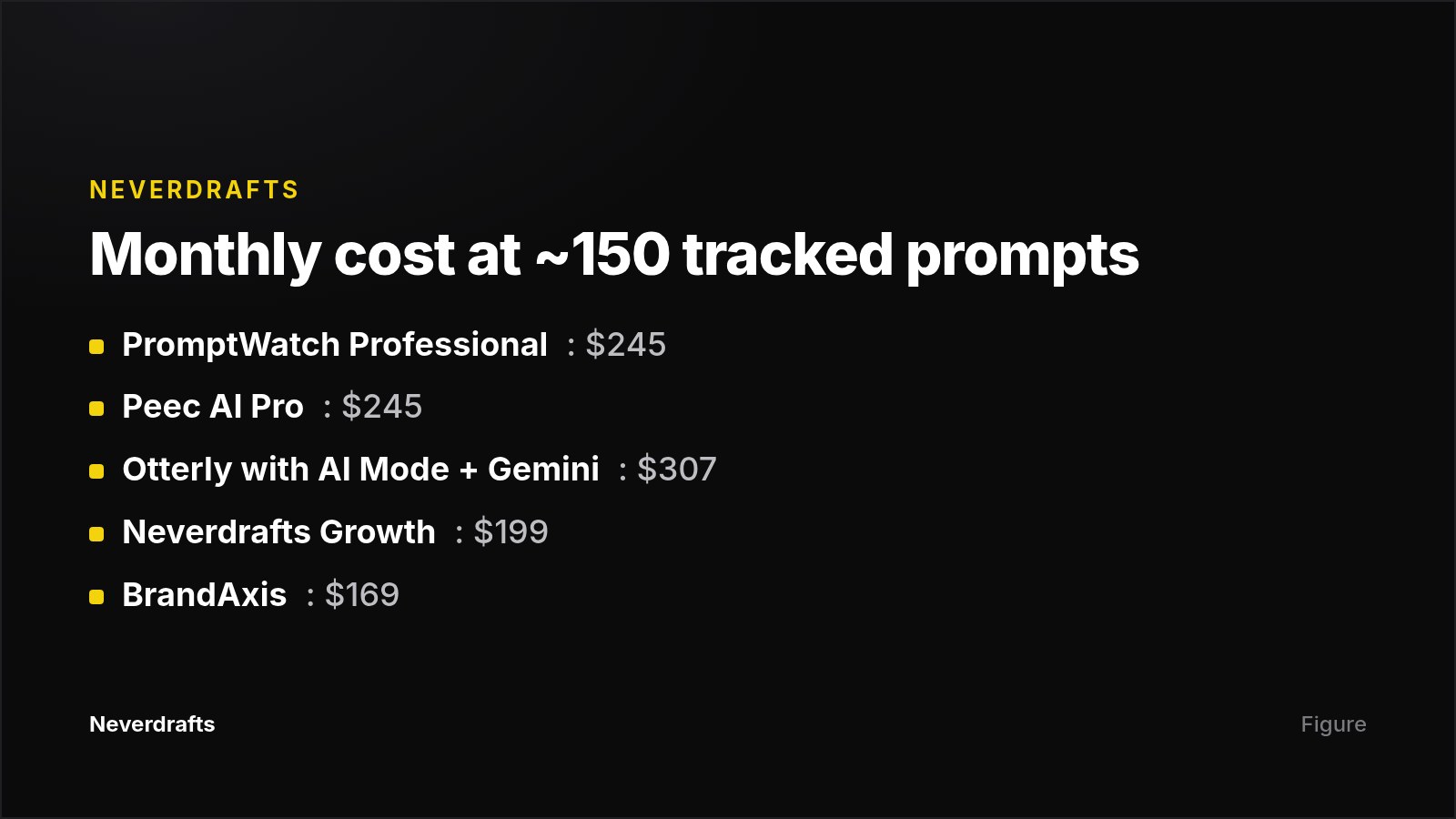
- At 150 prompts, LLM Pulse costs €99/month versus PromptWatch's $245/month. At 350 prompts, BrandAxis costs $349 versus $579.
- Headline prices mislead when engines are sold as add-ons. Otterly's 150-prompt setup reaches $307/month once AI Mode and Gemini are added.
- Choose based on your actual prompt volume, the engines you need included, seat count, and whether you want monitoring only or monitoring plus content execution.
Why do teams look for PromptWatch alternatives?
PromptWatch has grown quickly. It launched on April 1, 2025, signed its first 100 customers in the first week, and reports more than 1,840 organizations as customers, including Duolingo, Fireflies and Monks. It passed €2 million ARR in May 2026 and announced a €6 million seed round on July 14, 2026, led by seed + speed Ventures. It collects data by scraping the user interfaces of ChatGPT, Gemini, AI Overviews, Perplexity and others rather than calling APIs.
Scale does not make it the right fit for every team. The same friction points come up across the comparison pages we reviewed:
- Seat caps. PromptWatch limits team seats to 1-5 depending on plan, and its Professional plan includes two. Agencies reach that ceiling quickly.
- Price at volume. Plans run from $99 to $579 per month. Some sources list the entry tier at $95, so check the vendor page before you buy.
- Feature metering. The Essential tier caps content agents at 5 generations a month, about one draft a week.
- Pricing and integration transparency. One review notes that tiers don't disclose prompt limits or feature breakdowns without contacting sales, and that no GA4, Google Search Console or BI integrations are disclosed.
- Scoring methodology. A hands-on evaluation argues that mixing branded and non-branded prompts inflates the visibility score. You will always appear for prompts that contain your own brand name, so a blended score is a weak KPI.
- UI complexity. A G2 reviewer describes a steep learning curve and a UI that "gets quite busy with all the knobs, buttons, and features."
A note on naming: PromptWatch tracks how AI assistants mention your brand. It is not a prompt-engineering or LLM observability tool like PromptLayer or Langfuse, which developers use to debug their own LLM applications. This list covers only brand-visibility tools. If you are building an LLM app, you need a different category.
PromptWatch alternatives compared at a glance
| Tool | Best for | Standout feature | Starting price |
|---|---|---|---|
| LLM Pulse | Best overall value | Unlimited seats, brand sentiment, app store tracking | €49/mo, 50 prompts, 5 models |
| Otterly AI | Budget entry | Gartner Cool Vendor 2025, Semrush App Center | $29/mo, 15 prompts |
| Profound | Enterprise compliance | SOC 2 Type II, HIPAA, prompt volume data | $99/mo billed yearly, ChatGPT only |
| Peec AI | Multilingual and agency teams | Unlimited users, sentiment, country-level tracking | ~$95/mo, 50 prompts, 3 models |
| Ahrefs Brand Radar | Historical and market-level analysis | 412M+ prompt corpus | $199/mo per AI index |
| Semrush AI Visibility Toolkit | Existing Semrush users | Prompt Research with volume estimates | $99/mo per domain |
| AthenaHQ | Analytics-integrated teams | Native GA4 and GSC on self-serve | $295/mo |
| BrandAxis | Focused, low-cost tracking | Sentiment and city-level on every tier | Free; paid from $19/mo |
| Neverdrafts | Teams that want tracking plus published fixes | Auto-generated remediation content, one-click CMS publishing | $99/mo, 50 prompts, 30 articles |
Tools below are grouped by use case rather than ranked; the order does not imply one platform outperforms another. Prices come from vendor comparison pages published between January and September 2026. Pricing in this category changes often.
1. LLM Pulse: best overall value and unlimited seats
LLM Pulse offers the lowest price per prompt paired with unlimited seats: €99/month for 150 prompts versus PromptWatch's $245 at the same tier. It is a bootstrapped platform that tracks ChatGPT, Perplexity, Google AI Mode, AI Overviews and Gemini and focuses on auditable measurement. It suits agencies and growing teams that have outgrown PromptWatch's seat caps.
Strengths:
- Unlimited team seats on every plan, compared with 1-5 at PromptWatch
- Brand sentiment analysis, query fan-out and iOS/Google Play app store tracking
- Full white-label portal on your own domain
- GA4/Plausible and Google Search Console integrations, plus a GEO Writer, GEO Testing and ChatGPT Shopping tracking
Pricing: Starter €49/month (50 prompts), Growth €99/month (150), Scale €299/month (450), with higher tiers up to €1,199/month for 2,400 prompts.
Limitations: LLM Pulse does not offer crawler log analysis, which is PromptWatch's clearest technical advantage. Claude is not among the five standard models. The comparison figures above come from LLM Pulse's own blog, so confirm them yourself.
2. Otterly AI: best budget entry point
Otterly AI has the lowest entry price in the market at $29/month, roughly a third of PromptWatch's Essential plan. It suits solo marketers and small teams testing AI visibility tracking before committing a larger budget.
Strengths:
- Gartner Cool Vendor 2025 and a 4.9/5 G2 rating across 250+ reviews
- Base plans cover ChatGPT, Google AI Overviews, Perplexity and Copilot, with market-level and language-level breakdowns
- Available in the Semrush App Center, with free GEO tools for keyword research and content checking
- 14-day trial, no card required
Pricing: Lite $29/month (15 prompts), Standard $189/month (100), Premium $489/month (400).
Limitations: Google AI Mode and Gemini are paid add-ons that scale with plan tier, which pushes a 150-prompt setup to $307/month. The jump from $29 to $189 is steep. Otterly also moved to client-based plan limits in July 2026, which changes the cost math for agencies.
3. Profound: best for enterprise compliance and demand data
Profound is the option most often cited when procurement requires formal compliance certification, holding SOC 2 Type II and HIPAA compliance alongside G2 Winter 2026 Leader status. It is also the best-funded platform in this category, having raised $58.5M from Sequoia, Kleiner Perkins and NVIDIA. Its customers include MongoDB, Ramp, Figma and Zapier, and one review reports that Ramp boosted AI visibility 7x.
Strengths:
- SOC 2 Type II and HIPAA compliance
- Prompt Volumes, which show real demand data for what people ask AI and are unique in the category
- ChatGPT Shopping tracking, Agent Analytics for AI crawlers, and Agents for content generation
- 10+ platforms at the enterprise tier, including Claude, Grok, Copilot, Meta AI and DeepSeek
Pricing: Starter $99/month (ChatGPT only, 50 prompts), Growth $399/month (ChatGPT, Perplexity, Google AI Overviews, 100 prompts), Enterprise custom.
Limitations: The entry tier covers a single engine, and broader coverage requires moving up a tier rather than adding it piecemeal. Plans are billed yearly, and API access and SSO are gated to enterprise. Growth costs more than PromptWatch Professional for similar breadth. If budget is the obstacle, see our guide to affordable Profound alternatives for small businesses.
4. Peec AI: best for multilingual tracking and agencies
Peec AI matches PromptWatch on price at both entry tiers but pairs it with unlimited users on its Starter plan and sentiment analysis that reviewers often call best in class. It suits brands operating across countries and agencies that want a polished interface.
Strengths:
- Tracking in 14+ languages with country-level breakdowns at no extra prompt cost. Airefs cites 115+ language support, so the figure depends on what is counted.
- UI scraping that records what real users see, backed by $30M+ in funding
- Credit-based agency plans from $245, used by 2,500+ teams, rated 4.9 on G2
- 14-day free trial
Pricing: Starter ~$95/month (50 prompts, 3 models), Pro $245/month (150 prompts). This matches PromptWatch at both tiers.
Limitations: Every self-serve plan limits you to 3 engines chosen from a list of 7. Adding Claude, Gemini, DeepSeek or Grok costs €20-30 each per month. There is no free plan, and Starter is locked to one project and one country.
5. Ahrefs Brand Radar: best historical and market-level data
Ahrefs Brand Radar has the deepest historical data in the category, while most tools only have data from your start date. It does not run your own prompt list. Instead, it queries a 412M+ prompt corpus across seven AI surfaces, retroactively, on any brand. Its prompts come from real search behavior rather than invented queries. It suits data-driven teams that want share of voice across a market, including competitors' history before you started tracking.
Strengths:
- Historical depth that predates your own tracking start date
- Built on Ahrefs' crawler infrastructure and used by 3,000+ companies
- Useful as a companion to a daily prompt tracker
Pricing: $199/month per AI index, with bundles from $398 to $699.
Limitations: No Claude or Meta coverage. Prompt checks are metered, and Ahrefs' own pages quote conflicting prices for platform access.
6. Semrush AI Visibility Toolkit: best if you already use Semrush
The Semrush AI Visibility Toolkit's standout advantage is Prompt Research, which treats AI prompts the way Semrush treats keywords, with volume estimates and competing brands side by side, inside a dashboard many SEO teams already use.
Strengths:
- Brand Performance reports on share of voice, sentiment and perception drivers
- Daily prompt tracking
- Semrush One bundles from $199/month include the full SEO platform, with prompt tracking in 220+ countries
Pricing: $99/month standalone for 25 prompts on one domain across five AI surfaces. A realistic build-out with an extra seat and more prompts lands around $265/month.
Limitations: Priced per domain, with no trial, $60-per-50-prompt add-ons, a weekly brand-performance refresh, and no Claude.
7. AthenaHQ: best for native analytics integrations
AthenaHQ is the strongest pick when GA4 and Google Search Console connections are a hard requirement, which is exactly the integration gap reviewers flag at PromptWatch. It suits mid-market teams that need AI visibility data inside their existing reporting stack.
Strengths:
- 8+ LLMs on all plans: ChatGPT, Perplexity, Google AI Overviews, AI Mode, Gemini, Claude, Copilot and Grok
- Native GA4 and GSC on the self-serve plan, with case studies showing 10x citation rate growth
- An agentic workflow in which the agent acts on findings
Pricing: $295/month, with free credits to start.
Limitations: It has the highest self-serve entry price on this list, excluding enterprise-only tiers. The sources we reviewed give less detail on its prompt limits than on other tools, and none document that it generates or publishes content.
8. BrandAxis: best for focused tracking at the lowest cost
BrandAxis undercuts PromptWatch at every tier while including visibility, answer rank, sentiment and cited sources across ChatGPT, Google AI Overviews and Perplexity, refreshed daily, on its lowest paid plan. It suits teams that want the tracking loop without paying for content tooling they will not use.
Strengths:
- Sentiment, citations, competitor benchmarking and city-level tracking included on every tier
- Free plan (5 prompts, ChatGPT)
- 40% cheaper than PromptWatch at 350 prompts
Pricing: $19/month (20 prompts), $69 (50), $169 (150), $349 (350).
Limitations: It covers three engines, with no content agents and no crawler-log analytics. API, webhooks, Looker Studio and MCP integrations are still in development. As with LLM Pulse, the comparison comes from the vendor's own blog.
9. Neverdrafts: best for turning lost prompts into published content
Disclosure: Neverdrafts is our product.
Neverdrafts closes a gap the tools above leave open: it monitors, generates remediation content, publishes it, and measures whether AI crawler traffic followed. It monitors where AI recommends competitors, generates content aimed at the prompts you are losing, publishes that content, and measures AI crawler traffic. It suits teams whose problem is less "where am I missing?" and more "who will write the fix?"
Strengths:
- Monitors real ChatGPT, Claude, Google AI Mode and Perplexity answers daily on the web interfaces, not through APIs
- Position-weighted visibility scoring, from 0 to 100 per response, based on where you appear in each answer
- Auto-generated remediation content, with one-click publishing to WordPress, Webflow, Shopify, Framer and API-first stacks
- AI bot crawler tracking to show whether citations turned into visits, plus competitor share of voice
- White-label dashboards and client reporting for agencies, and generated content in 150+ languages
Content volume is the main contrast with PromptWatch. PromptWatch Essential caps content agents at 5 generations a month. Our Starter plan includes 30 remediation articles a month, and its pricing page lists the full monitor, diagnose, fix and prove loop on that tier.
Pricing: Starter $99/month (1 brand, 50 prompts, 30 articles), Growth $199/month (3 brands, 150 prompts, 100 articles), Agency $399/month (10 brands, 500 prompts, 300 articles). A $1, 3-day trial gives full access to any plan. Billing is monthly with no contract.
Limitations: We track four engines: ChatGPT, Claude, Google AI Mode and Perplexity. Gemini and Google AI Overviews are not on our list, while LLM Pulse and Otterly cover them. Our visibility metrics are position-weighted scoring and competitor share of voice; we don't list sentiment scoring or analytics integrations among our features. We also don't offer a historical prompt corpus like Ahrefs'. The 3-day trial is short. None of the third-party comparisons cited here evaluate Neverdrafts, so weigh our claims accordingly.
Which other PromptWatch alternatives are worth a look?
These did not make the main list but fit specific needs:
- Airefs: $24/month entry with Reddit monitoring and an optional done-for-you service.
- Scrunch AI: $250/month, 8 models on Growth, focused on delivering content to AI agents.
- SE Ranking / SE Visible: $89/month add-on with unlimited seats and an SEO suite bundled in.
- Writesonic: $79/month billed annually, combining monitoring and AI articles.
- Brandlight: enterprise tier, reported at $4K to $15K per month, aimed at large brands and PR teams.
- Chosenly: B2B-focused. It filters out branded and non-actionable prompts and citations so scores reflect real buyer questions.
How do you choose the right PromptWatch alternative?
We compared tools on the criteria buyers raise most often. Use them in this order.
- Price at your real prompt volume. Entry prices hide the curve. Compare the tier you will actually use, whether that is 150 or 350 prompts, not the starting tier.
- Engines included versus sold as add-ons. Otterly and Peec sell extra engines as add-ons, and Profound's Starter covers ChatGPT only, so broader coverage means a higher tier. List the engines your buyers use, then price that exact configuration.
- Seats and clients. For agencies, unlimited seats (LLM Pulse, Peec Starter, SE Ranking) or multi-brand plans matter more than headline price.
- Metered versus included features. Check whether sentiment, city-level tracking, crawler logs and content generation come on your tier or several tiers up.
- Scoring methodology. Ask whether branded prompts are separated from non-branded ones. A score inflated by your own brand name can't guide decisions.
- Historical depth. Most tools only have data since your start date. If you need a baseline before you begin, that points to Ahrefs.
- Monitoring or execution. Decide whether you need a dashboard or a tool that produces fixes. Our breakdown of 13 LLM SEO tools by track, optimize and execute covers that split in detail.
When should you stay with PromptWatch?
PromptWatch remains a strong choice in some cases:
- You need crawler log analysis connected to your CDN.
- You want coverage of 10 platforms, including Mistral and Meta AI, which most competitors skip.
- You value its CMS integrations with WordPress, Webflow and Framer.
Chosenly's hands-on evaluation also rates its competitor onboarding highly: it pulls a competitor's name automatically from a pasted link.
Next step
If your main frustration with PromptWatch is the content cap rather than the dashboard, test Neverdrafts on the prompts you are losing. The $1, 3-day trial gives full access to any plan, so you can run one monitor-to-publish cycle and compare the output. For a direct feature-by-feature view, see our PromptWatch alternatives page.
Frequently asked questions
What is the cheapest PromptWatch alternative?
BrandAxis has a free plan and paid tiers from $19/month for 20 prompts. Airefs starts at $24/month, and Otterly AI at $29/month for 15 prompts. Entry prices only tell part of the story. Otterly charges extra for AI Mode and Gemini, so compare the cost at the prompt volume and engine set you will actually use.
How much does PromptWatch cost in 2026?
Sources list the Essential plan at $95-99/month for 50 prompts and Professional at $245-249/month. Higher tiers reach $579/month at 350 prompts. BrandAxis's comparison also lists a free PromptWatch plan with 10 prompts on ChatGPT. Crawler logs, city-level tracking and custom reports start at the $245 tier. Content agents are capped at 5 generations a month on Essential. There is a 7-day free trial.
Which PromptWatch alternatives offer unlimited seats?
LLM Pulse includes unlimited team seats on every plan, starting at €49/month. Peec AI includes unlimited users on its Starter plan at about $95/month. SE Ranking's SE Visible add-on also offers unlimited seats. PromptWatch, by comparison, limits seats to 1-5 depending on plan, with two on Professional.
Is PromptWatch the same as PromptLayer or Langfuse?
No. PromptWatch tracks how AI assistants like ChatGPT and Perplexity mention your brand, which is a marketing and GEO use case. PromptLayer and Langfuse are prompt-engineering and observability tools that developers use to monitor their own LLM applications. Many comparisons mix up the two categories, so confirm which problem you are solving before choosing.
Which alternative is best for enterprise compliance?
Profound is the option most often cited for enterprise compliance. It holds SOC 2 Type II and HIPAA certifications and G2 Winter 2026 Leader status, and it has raised $58.5M. Its Starter plan covers only ChatGPT. Full platform coverage, API access and SSO require Enterprise pricing.
Do AI visibility tools use real AI interfaces or APIs?
It varies. PromptWatch and Peec AI scrape the user interfaces that real people see, which reflects actual answers more closely than API responses. Ahrefs Brand Radar queries a large pre-built prompt corpus instead of your own list. Ask each vendor how it collects data and how often answers refresh.
Sources
- LLM Pulse: Best Promptwatch Alternatives in 2026
- Promptwatch: About
- Prompt Reach: 9 Best PromptWatch Alternatives in 2026
- Chosenly: Best PromptWatch alternative for B2B
- Airefs: Best Promptwatch Alternatives in 2026
- BrandAxis: 9 best Promptwatch alternatives for AI visibility tracking (2026)
- Neverdrafts: Pricing