
Free and cheap AI visibility platforms exist, but "free" almost always means a one-time snapshot, a starter credit allowance, or access bundled with another paid product rather than ongoing tracking. The cheapest dedicated recurring tracker in 2026 is Otterly.AI Lite at $29/month, or $25/month billed annually, which covers 15 prompts across ChatGPT, Google AI Overviews, Perplexity and Microsoft Copilot. Nightwatch, LLMrefs Pro, GrackerAI and Peec AI fill out the under-$100 tier, while Hall and LLMrefs also offer limited free tiers. Most teams that need hundreds of prompts, wider engine coverage or content help end up paying $189–$499 a month.
Key takeaways
- True free recurring plans are rare. Most free offers are snapshots (Ahrefs' AI Visibility Checker, GrackerAI's free score), trial credits, or features included with another subscription, such as Amplitude.
- Otterly.AI Lite is the cheapest dedicated daily tracker at $29/month for 15 prompts, a point Gracker's review also makes.
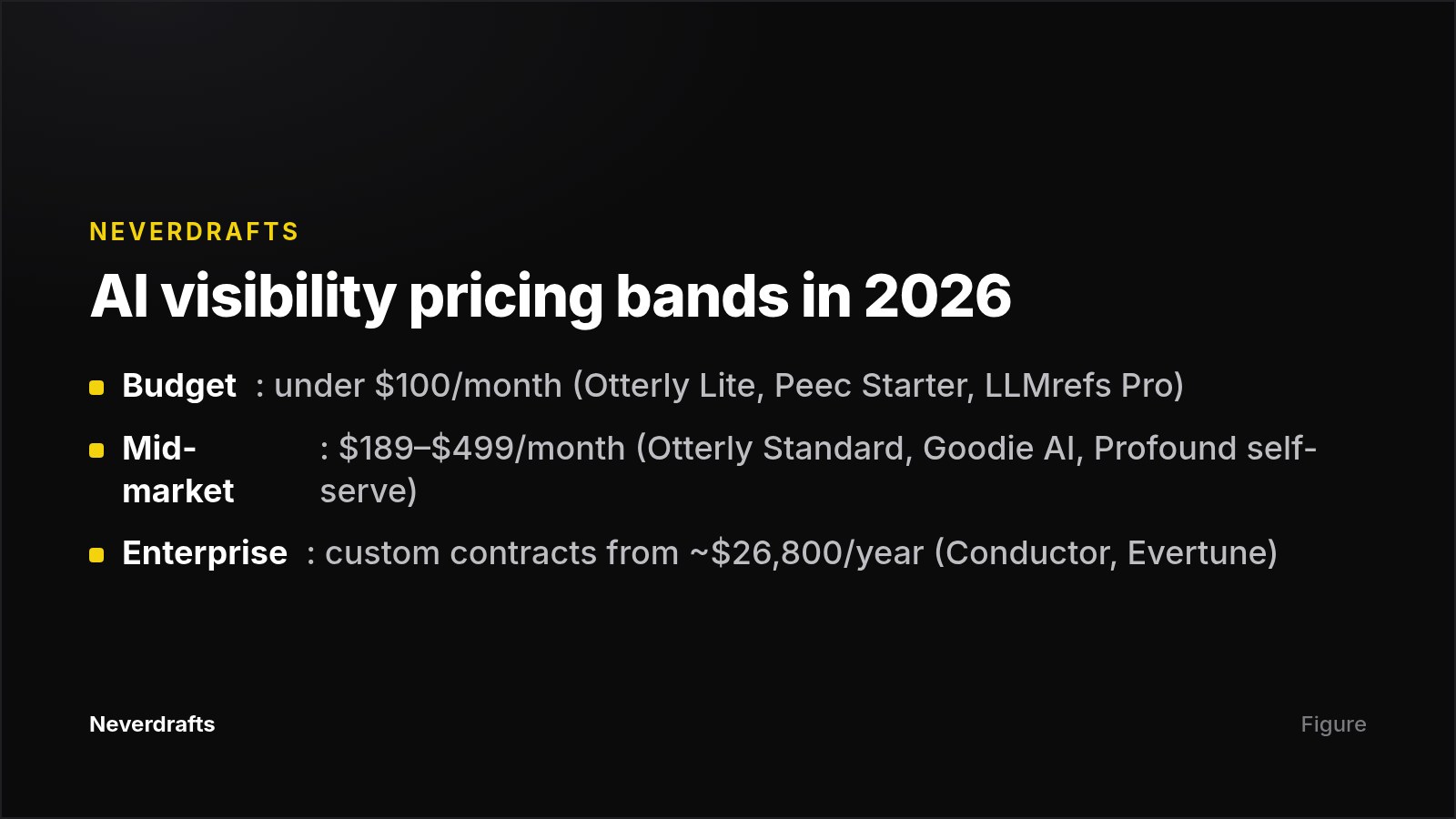
- Pricing falls into three bands: budget monitors under $100/month, mid-market trackers at $189–$499/month, and enterprise contracts from $26,800/year.
- Compare cost per tracked prompt, not headline price. Budget plans land around $1.60–$2.00 per prompt per month, and engine coverage per prompt varies.
- Most cheap plans report rather than fix. Only a few budget-to-mid options include recommendations or content generation, so check the action layer before you buy.
What does "free" actually mean for AI visibility tools?
A "free" AI visibility plan usually falls into one of five categories, and only one of them gives you ongoing monitoring at no cost. Knowing which type you are signing up for saves setup time and prevents disappointment when the data stops refreshing.
The five kinds of free offers
- One-time snapshots or scores. You enter a domain or brand and get a single report. Ahrefs offers a free AI Visibility Checker that needs no signup, and GrackerAI offers a free score. Gracker also describes Goodie AI's free offering as a snapshot tool with no automated prompt discovery, with paid plans starting from $295/month. None of these three track change over time.
- Starter credit allowances. Some third-party summaries describe AthenaHQ as giving new accounts a batch of starter credits for testing, but we can't confirm the exact figure against a citable, vendor-published source — treat any specific number you see elsewhere as unverified and check AthenaHQ's own pricing page. Whatever the real allowance is, it functions as an experimentation budget, not a renewable monthly plan.
- Bundled access. Amplitude's AI visibility feature is free but included with Amplitude plans. It costs nothing extra only if you already pay for Amplitude.
- Genuine free tiers. Hall has a free tier, with paid plans starting at $199/month, and LLMrefs offers free plans, with Pro from $79/month. These are the closest thing to free recurring tracking, though our sources don't document their refresh frequency or prompt limits in detail.
- Time-limited trials. Some summaries mention a short free trial on Semrush's AI Visibility add-on, but we couldn't confirm the trial length against a citable source — check Semrush's own pricing page for current terms before assuming a specific window.
Why the distinction matters
AI answers change constantly, and a single snapshot can't tell you whether you are gaining or losing ground. ChatGPT alone has over 800 million weekly active users, and Gartner predicted that traditional search volume would drop 25% by 2026 as users move to AI assistants. If those answers matter to your pipeline, you need trend data. Trend data requires recurring checks, and recurring checks are what vendors charge for.
The practical approach is to use free snapshots to decide whether you have a problem, then pay for the smallest recurring plan that tracks the prompts that matter most.
Which AI visibility platforms have a free option in 2026?
At least nine platforms offer some kind of free entry point, though they vary widely in what you get. The table below groups them by type of free access so you can see which ones give you recurring data.
| Platform | Type of free access | What you get | Paid plan starts at |
|---|---|---|---|
| Ahrefs | Free snapshot | One-off AI Visibility Checker, no signup | Brand Radar $828/month all-in |
| GrackerAI | Free score | Visibility score for cybersecurity vendors | $79/month annual, $99/month monthly |
| Goodie AI | Free snapshot | Snapshot tool; no automated prompt discovery, per Gracker | $295/month, per NoGood |
| Amplitude | Bundled | AI visibility included with Amplitude plans | Requires an Amplitude plan |
| Hall | Free tier | Free tier (limits not documented in our sources) | $199/month |
| LLMrefs | Free plans | Basic LLM tracking | Pro from $79/month |
| AthenaHQ | Starter credits | Unverified credit allowance for testing — check vendor site | $295/month |
| Semrush | Trial | Unverified short trial of AI Visibility add-on — check vendor site | $99/month add-on |
| Neverdrafts | Free audit | One-time audit of where AI recommends competitors, no credit card | $99/month Starter |
Disclosure: Neverdrafts is our product.
Ahrefs AI Visibility Checker
Ahrefs' free checker is the fastest way to get a baseline, because it requires no account. It returns a single snapshot. If you want recurring tracking inside Ahrefs, Brand Radar costs $828/month all-in, which puts it outside most budgets. Gracker also notes that SEO suites like Ahrefs added AI tracking as an add-on, so per-engine depth trails AI-first tools.
Amplitude
Amplitude ranked third in NoGood's list as the pick for product-led teams that need AI visibility tied to revenue, and it costs nothing extra for existing customers. If you already run product analytics in Amplitude, try this before paying for anything else. If you don't already use Amplitude, the free access doesn't apply to you.
Hall and LLMrefs
These two are the most credible genuine free tiers. NoGood lists Hall as best for startups and SMBs getting started with AI visibility and LLMrefs as best for budget-conscious teams needing basic LLM tracking. The gap between Hall's free tier and its $199 paid plan is large, so check the free plan's actual prompt and engine limits on Hall's own site before you build workflows around it — our sources don't document them.
AthenaHQ credits and the Semrush trial
Both suit short experiments, not ongoing tracking, and both have unverified specifics in the sources available to us. AthenaHQ's paid plans start at $295/month, and it is aimed at agencies and eCommerce brands at scale. Semrush's AI Visibility Toolkit is a $99/month add-on, with Semrush One from $199/month. Confirm current credit allowances and trial lengths on each vendor's pricing page, then use the window to answer one specific question, such as "Do competitors dominate our top ten buying prompts?"
What is the cheapest paid AI visibility tracker?
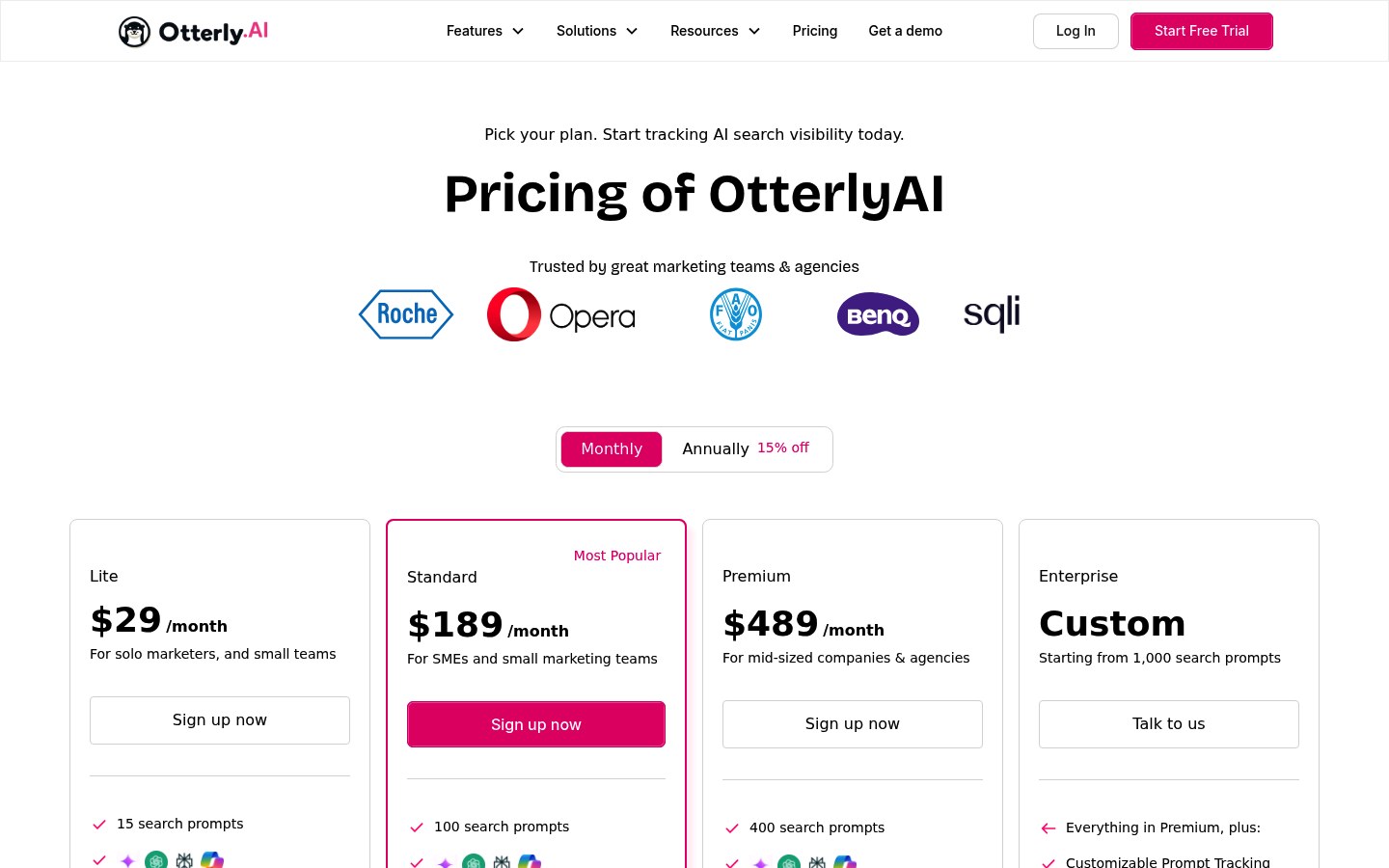
Otterly.AI Lite is the cheapest dedicated tracker with daily recurring checks. It costs $29/month, or $25/month on annual billing with the 15% annual discount. Gracker's 2026 review describes Otterly as the cheapest serious monitor at $29/month.
What Otterly Lite includes
According to Otterly's pricing page, the Lite plan includes:
- 15 search prompts
- Tracking of 4 AI engines: ChatGPT, Google AI Overviews, Perplexity and Microsoft Copilot
- Claude, Google AI Mode and Gemini available as paid add-ons
- Daily tracking frequency
- Unlimited team members, unlimited brands and competitors, and 1 workspace
- Brand visibility and sentiment analysis, citation source tracking and share of voice metrics
- 3 recommendations per week
- 1,000 GEO audits per month
- AI prompt research and query fan-out tools
That is a lot of capability for $29. The main constraint is the prompt count. Fifteen prompts covers a narrow slice of the questions buyers ask, and the single workspace makes Lite awkward for agencies.
Where Otterly's pricing goes next
The jump from Lite to Standard is steep. Standard costs $189/month ($160 annual) for 100 prompts and adds API access, MCP access, agent analytics, unlimited workspaces and unlimited recommendations. Premium is $489/month ($422 annual) for 400 prompts. On Standard and Premium you can add 100 extra prompts for $99.
There is no middle step between 15 and 100 prompts. If you outgrow 15, your bill rises roughly six-fold.
The engine-count discrepancy
Gracker's comparison table lists Otterly as tracking six engines, while Otterly's own pricing page lists four base engines plus three paid add-ons (Claude, Gemini, Google AI Mode). Treat anything beyond the base four as an added cost rather than assuming it's included, and confirm engine coverage directly on Otterly's pricing page before you buy.
Which AI visibility plans cost under $100 a month?
About eight dedicated options start under $100 a month, alongside add-ons for traditional SEO suites. The table below compares them on starting price, prompts and fit.
| Tool | Starting price | Prompts or credits | Engines | Best for |
|---|---|---|---|---|
| Otterly.AI Lite | $29/month ($25 annual) | 15 prompts | 4 base, 3 add-ons | Solo marketers and lean teams |
| Nightwatch | From $39/month | Not documented in our sources | Not documented in our sources | Traditional SEO teams adding LLM monitoring |
| SE Ranking | From $65/month + AI add-on | Varies by plan | Not documented in our sources | All-in-one SEO teams |
| LLMrefs Pro | From $79/month | Not documented in our sources | Not documented in our sources | Budget LLM tracking |
| GrackerAI | $79/month annual, $99 monthly | Varies by plan | 3 on Starter, 4 on Scale, up to 10 on Enterprise | Cybersecurity vendors |
| Peec AI Starter | $95/month | 50 prompts | 3 models | Fast-growing SEO teams |
| Surfer SEO AI Tracker | $95/month add-on | 25 prompts | Not documented in our sources | Content-first teams |
| Semrush AI Visibility | $99/month add-on | Varies | Not documented in our sources | Existing Semrush users |
| Neverdrafts Starter | $99/month | 50 prompts, 30 articles/month | 4 (ChatGPT, Claude, Google AI Mode, Perplexity) | Teams that want monitoring plus content fixes |
Rankscale has also been described in some summaries as offering a low-cost, credit-based Essentials plan, but the price and credit figures we've seen aren't backed by a citable source, so we've left it out of the table. If you're considering it, confirm current pricing and what a "credit" actually buys directly on Rankscale's site.
Peec AI
Peec AI is the strongest dedicated tracker near the $100 line. The Starter plan costs $95/month for 50 prompts and 3 AI models, with unlimited user seats on every plan. Gracker calls it the fastest-growing challenger, with a strong price-to-depth ratio. Pro is $245/month for 150 prompts and Advanced is $495/month. Extra models are add-ons, so the headline price climbs if you need more engines.
GrackerAI
GrackerAI is a vertical tool. Gracker describes it as the only tool in its round-up built exclusively for cybersecurity vendors, pairing engine monitoring with AI article generation. If you sell security software, its security-specific prompt library is a real advantage. If you don't, the Starter plan's three engines are thin compared with Otterly Lite at a third of the price. Gracker publishes the review and builds GrackerAI, so weigh its ranking accordingly.
Nightwatch, SE Ranking and LLMrefs
Nightwatch starts at $39/month and suits traditional SEO teams that want to dip into LLM monitoring without leaving a rank tracker. SE Ranking starts at $65/month plus an AI add-on, per NoGood's listing; our sources don't document which plan tier that figure maps to or how many AI platforms it covers. LLMrefs Pro at $79/month is the natural upgrade path from its free plan.
Surfer SEO and Semrush add-ons
Surfer's AI Tracker is a $95/month add-on for 25 prompts, which makes sense if you already write content in Surfer. Semrush's add-on is $99/month. Both are cheap only if you already pay for the base product. Otherwise the real cost is the suite subscription plus the add-on.
What does Neverdrafts' $99 plan include, and who is it for?
Neverdrafts is an AI visibility monitoring and optimization platform whose Starter plan costs $99/month for 1 brand, 50 prompts, 30 articles a month and 4 tracked engines. It belongs in the cheap tier on price, but it is built for a different job than Otterly or Peec. It monitors where AI recommends competitors instead of you, then generates content aimed at winning those answers back.
What you get
Based on our product fact sheet, Neverdrafts checks real ChatGPT, Claude, Google AI Mode and Perplexity answers daily using the live interfaces rather than APIs, scores visibility from 0–100 per response weighted by prominence rather than mere appearance, and surfaces the citing domains AI engines pull from when they name competitors. It auto-generates remediation content for prompts where you're losing visibility, in 150+ languages, and publishes in one click to WordPress, Webflow, Shopify and Framer, or via API. It also tracks AI crawler traffic to your site, so you can see whether bots actually visited the pages you published.
The free entry point is a one-time audit with no credit card required, showing where AI recommends competitors. Plans are billed monthly with no contracts.
Honest limitations
- No free recurring plan. The audit is a snapshot, like Ahrefs' checker. Ongoing tracking starts at $99.
- More expensive than Otterly Lite. If you only want to watch 15 prompts, Otterly costs less than a third as much.
- Different engine mix. Neverdrafts tracks Claude and Google AI Mode in the base plan, but its fact sheet doesn't list Microsoft Copilot, Gemini or Google AI Overviews, which Otterly's base plan covers in part.
- Best value depends on using the content. If you already have a writing team and only want data, a monitoring-only tool is a better fit.
Best for
Small teams and agencies that want monitoring and remediation content in one subscription, instead of paying for a tracker plus a separate content tool. The Growth plan ($199/month, 3 brands, 150 prompts, 100 articles) and Agency plan ($399/month, 10 brands, 500 prompts, 300 articles, white-label reporting) cover multi-brand use.
How much does each tracked prompt actually cost?
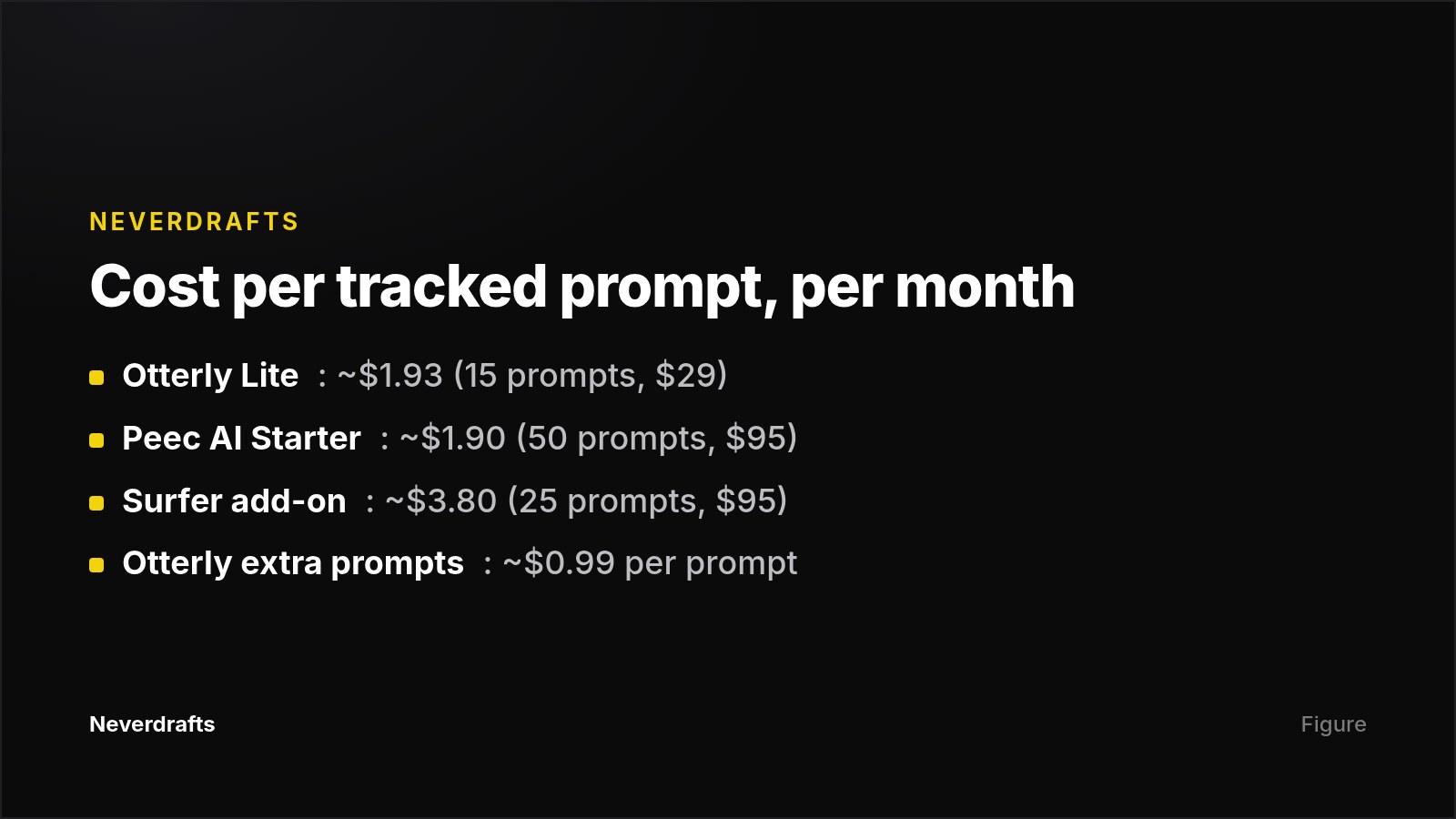
On budget and mid-tier plans, a tracked prompt typically costs between about $0.80 and $3.80 a month, and most entry plans cluster near $1.60–$2.00. Headline prices hide this, because vendors bundle different prompt counts, engines and extras. The figures below are calculated from each vendor's published price and prompt allowance.
| Plan | Monthly price | Prompts | Cost per prompt per month | What else is bundled |
|---|---|---|---|---|
| Otterly Lite (monthly) | $29 | 15 | ~$1.93 | 4 engines, daily checks, 3 recs/week |
| Otterly Lite (annual) | $25 | 15 | ~$1.67 | Same as above |
| Otterly Standard | $189 | 100 | ~$1.89 | API, MCP, agent analytics |
| Otterly Premium | $489 | 400 | ~$1.22 | Same as Standard, more audits |
| Otterly extra prompts | $99 per 100 | 100 | ~$0.99 | Standard and Premium only |
| Peec AI Starter | $95 | 50 | ~$1.90 | 3 models, unlimited seats |
| Peec AI Pro | $245 | 150 | ~$1.63 | More prompts |
| Surfer AI Tracker | $95 add-on | 25 | ~$3.80 | Requires Surfer subscription |
| Neverdrafts Starter | $99 | 50 | ~$1.98 | 30 articles/month, 4 engines |
| Neverdrafts Agency | $399 | 500 | ~$0.80 | 10 brands, 300 articles, white-label |
Why per-prompt cost isn't the whole story
A prompt tracked on four engines delivers more data than a prompt tracked on three. Otterly's Lite prompt runs across four base engines daily, while Peec's Starter covers 3 AI models. Dividing price by prompts × engines gives a fairer comparison of how many individual AI answers you're paying to observe. Bundled extras change the math too: a plan that includes content generation replaces spending on a writer or a separate tool, and a plan that requires a base subscription (Surfer, Semrush) costs more than its add-on price suggests.
Otterly's per-prompt price barely changes between Lite and Standard, so the real cost of upgrading is the jump in total spend, not the per-prompt rate. Meaningful per-prompt savings only show up at higher volumes — Otterly Premium, its $99-per-100 extra-prompt packs, Peec Pro, and Neverdrafts Agency all land below the entry-tier rate. If you already know you'll need 100+ prompts within a few months, size your first plan to that near-term need rather than upgrading in small steps.
Are 15 tracked prompts enough?
Fifteen prompts is enough to monitor your highest-value buying questions, but not enough to measure overall share of voice. Otterly positions its Lite plan explicitly for solo marketers and small teams, which signals the tier is built for a narrow, curated prompt list rather than comprehensive coverage.
How to spend 15 prompts well
If you are on a 15-prompt plan, pick prompts by commercial intent rather than volume. A sensible split for a small business:
- 5 category prompts that a buyer asks before they know brands, such as "best accounting software for freelancers"
- 4 comparison prompts naming you and a key competitor, such as "[your brand] vs [competitor]"
- 3 problem prompts describing the pain your product solves
- 2 brand prompts asking directly about your company, to catch inaccurate or negative descriptions
- 1 rotating slot for testing new phrasings each month
Otterly includes an AI prompt research tool and query fan-out tool on Lite, which helps you find real phrasings before you commit slots.
Signs you've outgrown 15
- You track only one phrasing per topic and can't tell whether a result is stable or a fluke
- You sell in multiple countries or languages and need separate prompts for each
- You serve several distinct customer segments with different questions
- You manage more than one brand or client
At that point, 50 prompts (Peec Starter, Neverdrafts Starter) or 100 prompts (Otterly Standard) is the realistic next step. Gracker scores "prompt depth and discovery" at 20% of its evaluation weight, which reflects how much prompt coverage shapes the usefulness of the data.
Which AI engines do cheap plans cover?
Most cheap plans cover ChatGPT, Perplexity and Google AI Overviews, and fewer include Gemini, Claude and Microsoft Copilot without add-ons. Gracker found that most tools track ChatGPT, Perplexity and Google AI Overviews, while fewer cover all six surfaces including Gemini and Microsoft Copilot.
Coverage by tool
| Tool | Entry price | Engines in base plan | Paid add-ons |
|---|---|---|---|
| Otterly Lite | $29 | ChatGPT, Google AI Overviews, Perplexity, MS Copilot | Claude, Gemini, Google AI Mode |
| Peec AI Starter | $95 | 3 models | Extra models |
| GrackerAI | $79–$99 | 3 on Starter | 4 on Scale, up to 10 on Enterprise |
| Neverdrafts Starter | $99 | ChatGPT, Claude, Google AI Mode, Perplexity | None listed |
| Goodie AI (for comparison) | $295 | 11+ including Gemini, Claude, DeepSeek, Grok, Meta AI, Copilot, Amazon Alexa+ | Not applicable |
| Profound (for comparison) | $499 | 10+ on full plans | Full multi-engine on custom Enterprise |
Which engines matter for you
Start with where your buyers ask questions. ChatGPT is the default for most audiences given its scale. Google AI Overviews and AI Mode matter if you depend on organic search traffic, since NoGood notes that AI Mode went from beta experiment to default search experience. Beyond that, ask customers or your sales team which assistant they actually used to find you, then check whether your shortlisted plan tracks it in the base price or only as a paid add-on.
NoGood weights engine coverage at 25% of its ranking, arguing that "ChatGPT alone just isn't enough in 2026." On a budget, two or three well-chosen engines tracked daily usually beat ten engines tracked shallowly.
Do budget tools help you fix visibility gaps, or only report them?
Most budget tools are monitoring-first: they show where you're missing, and you supply the fix. A small number include recommendations, and fewer still generate content. This is the biggest gap in most "cheap AI visibility tool" lists, and it decides how much extra work or spending a $29 plan really implies.
What "action layer" means
Gracker defines the action layer as whether a tool only reports, or helps you fix gaps with content recommendations or generation, and weights it at 20%. NoGood's equivalent "actionability" criterion covers content recommendations, optimization hubs, and workflow integrations.
How the cheap tier stacks up
- Otterly Lite includes 3 recommendations per week, a GEO audit, crawlability audit and content audit. Standard unlocks unlimited recommendations. It doesn't write content, and Gracker's review notes you still need a separate workflow to act on the gaps it finds.
- Peec AI is positioned around clean, daily AI visibility analytics. Our sources don't document content generation on its Starter plan.
- NoGood ranks Surfer's AI Tracker for content-first teams optimizing for AI citations.
- GrackerAI pairs monitoring with AI article generation, but for cybersecurity vendors only.
- Neverdrafts generates remediation content for losing prompts and publishes it to your CMS, then tracks AI crawler visits to those pages.
- Goodie AI, at $295/month, has an Optimization Hub and AEO Content Writer, which is the kind of action layer most budget tools lack.
Reviewers disagree on some tools
NoGood ranks Goodie AI first for end-to-end AEO from $295/month, while Gracker excluded it as a free snapshot tool with no automated prompt discovery and no accuracy layer. Both reviews come from companies with their own interests: NoGood is an agency running AEO campaigns, and Gracker builds GrackerAI. When reviewers disagree this sharply, run the tool's trial or snapshot yourself.
What the total cost looks like
If your tracker doesn't write content, the real monthly cost is the tracker plus whatever it costs to produce fixes, whether that's staff time, freelancers or a writing tool. A $29 monitor plus a content workflow can cost more in practice than a $99 plan that bundles both. It can also cost less if you already have writers. Our guide to choosing content platforms by workflow stage covers how to make that call.
Should you use an SEO suite add-on or a dedicated AI tracker?
Choose an SEO suite add-on if you already pay for the suite and need light AI coverage, and choose a dedicated AI tracker if AI visibility is a priority in its own right. Gracker notes that pure SEO suites like Semrush, Ahrefs and Conductor added AI tracking as an add-on, so their per-engine depth trails AI-first tools. NoGood is blunter, describing some legacy platforms as having "sticky-tacked on an AI dashboard".
When the bundle wins
- You already pay for Semrush, SE Ranking or Ahrefs and use it daily
- You want AI results next to classic rankings, backlinks and audits in one report
- AI visibility is one metric among many, not a separate program
SE Ranking's AI tracking starts from $65/month plus an AI add-on, per NoGood, making it one of the cheaper bundled options among teams already comparing SEO suites.
When a dedicated tool wins
- You don't use an SEO suite, so the base subscription is pure overhead
- You need per-engine breakdowns, citation source analysis and sentiment, not a blended score
- You want prompt discovery and daily checks
For a team that only needs AI visibility, Semrush's $99 add-on on top of a Semrush One plan from $199 costs far more than Otterly Lite or Peec Starter. For a deeper comparison of dedicated monitors, see our roundup of AI visibility monitoring tools.
What should agencies look for in a cheap plan?
Agencies should prioritize workspaces, brand limits and white-label reporting over the lowest headline price, because the cheapest plans are built for one brand. Cost per client is the number that matters.
How budget plans handle multiple clients
- Otterly Lite allows unlimited brands and competitors but only 1 workspace, and 15 prompts spread across clients goes nowhere. Standard adds unlimited workspaces. Otterly also offers special pricing for agency partners.
- Peec AI includes unlimited user seats on every plan, useful when client stakeholders want logins.
- Neverdrafts Agency covers 10 brands and 500 prompts for $399/month, with white-label reports and dashboards, which works out to about $40 per brand per month.
- AthenaHQ is positioned for agencies and eCommerce brands at scale, but starts at $295/month.
A quick cost-per-client check
Divide the plan price by the number of clients you can realistically serve within its prompt limit. If each client needs 30 prompts, Otterly Standard's 100 prompts covers about three clients ($63 each), and Otterly Premium's 400 covers about thirteen ($38 each). Run the same math on every shortlisted plan before signing, and confirm agency terms directly with vendors not covered in detail here.
When does a free or cheap plan stop being enough?
A cheap plan stops being enough when you need more prompts, more engines or help producing fixes than its limits allow. Gracker's price bands make the next step clear: budget monitors under $100/month, mid-market trackers at $189 to $499/month, and enterprise platforms above that.
Upgrade triggers
- Prompt ceiling. You've rotated your 15 or 50 prompts and keep wanting to track more.
- Engine gaps. Customers mention finding you through Gemini or Copilot, and your plan doesn't track it.
- Reporting needs. Leadership wants API exports or dashboards in a BI tool. Otterly's API and Data Studio connector start on Standard.
- Compliance. Profound carries SOC 2 Type II and HIPAA compliance plus SSO; its self-serve plans start at $499/month, with full multi-engine access reserved for custom Enterprise plans.
- Execution bottleneck. You see the gaps clearly but can't produce content fast enough to close them.
What's above the mid-market
Enterprise tools are priced for different buyers. Conductor runs about $26,800/year, and Evertune starts at $3,000/month for Fortune 500 brands. Most small businesses and agencies never need this tier. If you're weighing Profound specifically, our comparison of cheaper AI visibility tools than Profound covers the alternatives.
How do you test a cheap AI visibility plan before committing?
Run a one-to-two-week test with a fixed prompt list and a manual spot-check, because none of our sources independently verify the accuracy of budget tools. A short, structured trial tells you more than any review.
Evaluation checklist
- Get a free baseline first. Run Ahrefs' free checker or a vendor's free audit to see whether you have a visibility problem worth paying to track.
- Write your prompt list before signing up. Use the 5-4-3-2-1 split above so every tool is tested on the same questions.
- Confirm refresh frequency. Otterly publishes daily tracking; for others, ask directly whether checks run daily, weekly or on demand.
- Spot-check manually. Ask three of your prompts in ChatGPT and Perplexity yourself and compare with what the tool reports. Responses vary between sessions, so look for consistent patterns rather than exact matches.
- Check engine coverage against your buyers. Confirm the engines you care about are in the base price, not add-ons.
- Look for the "why." Does the tool show citation sources, the domains AI is pulling from? Gracker weights citation and source analytics at 10%.
- Test the action layer. Count how many usable recommendations or content pieces you get in the trial period.
- Read the cancellation terms. Annual billing saves 15% on Otterly, but locks you in. Monthly billing is safer for a first tool.
- Calculate cost per prompt and per client using your real requirements, not the plan's maximum.
Treat every price as a snapshot
Gracker warns that the market is young and fast-moving, so treat every number as a snapshot. Prices in this article reflect vendor pages and reviews published in 2026. Confirm current pricing on each vendor's site before buying.
Next step
If you want to know whether AI assistants are recommending competitors instead of you before paying for any tracker, start with the Neverdrafts free audit, which needs no credit card. Use the results to pick your first 15–50 prompts, then decide whether a monitoring-only plan or a monitor-plus-content plan like our $99 Starter fits your team. If you're also comparing enterprise options, our Neverdrafts vs Profound comparison lays out the differences.
Frequently asked questions
Is there a completely free AI visibility tracker?
Genuine free recurring plans are uncommon. Hall offers a free tier and LLMrefs offers free plans, both with limits our sources don't fully document. Amplitude's AI visibility is free only if you already pay for Amplitude. Other free options, such as Ahrefs' AI Visibility Checker, GrackerAI's free score and Goodie AI's free snapshot, are one-time reports rather than ongoing tracking. AthenaHQ has been described as offering a starter credit allowance, but we couldn't confirm the exact figure, so treat any specific number as a test budget rather than a renewable monthly plan.
What is the cheapest AI visibility tool with daily tracking?
Otterly.AI Lite is the cheapest dedicated tool with published daily tracking. It costs $29 a month, or $25 a month billed annually, for 15 prompts across ChatGPT, Google AI Overviews, Perplexity and Microsoft Copilot. Claude, Gemini and Google AI Mode cost extra. It includes unlimited team members but only one workspace, which limits agency use.
How many prompts should a small business track?
Start with 15 to 50 prompts focused on buying intent: category questions, comparisons with named competitors, problem-based questions and a few direct brand queries. Fifteen covers your most valuable questions but won't measure broad share of voice. Move to 50 or 100 prompts when you serve several segments, markets or languages, or when one phrasing per topic stops giving reliable trends.
Are SEO suite add-ons cheaper than dedicated AI trackers?
Only if you already pay for the suite. Semrush's AI Visibility add-on is $99 a month, but Semrush One starts at $199 a month, so a new user pays about $298. Surfer's AI Tracker is a $95 add-on for 25 prompts. Reviewers also note that suite add-ons track each engine in less depth than dedicated AI-first tools.
Do cheap AI visibility tools write content to fix gaps?
Most don't. Budget monitors like Otterly and Peec focus on tracking, though Otterly Lite includes three optimization recommendations per week. Tools that generate content tend to be vertical, like GrackerAI for cybersecurity, or priced higher, like Goodie AI from $295 a month. Factor in the cost of producing content yourself when comparing plan prices.