
Key takeaways
- AI visibility is measured through four signals: mentions, citations, sentiment and share of voice (HubSpot). Rankings alone don't capture it.
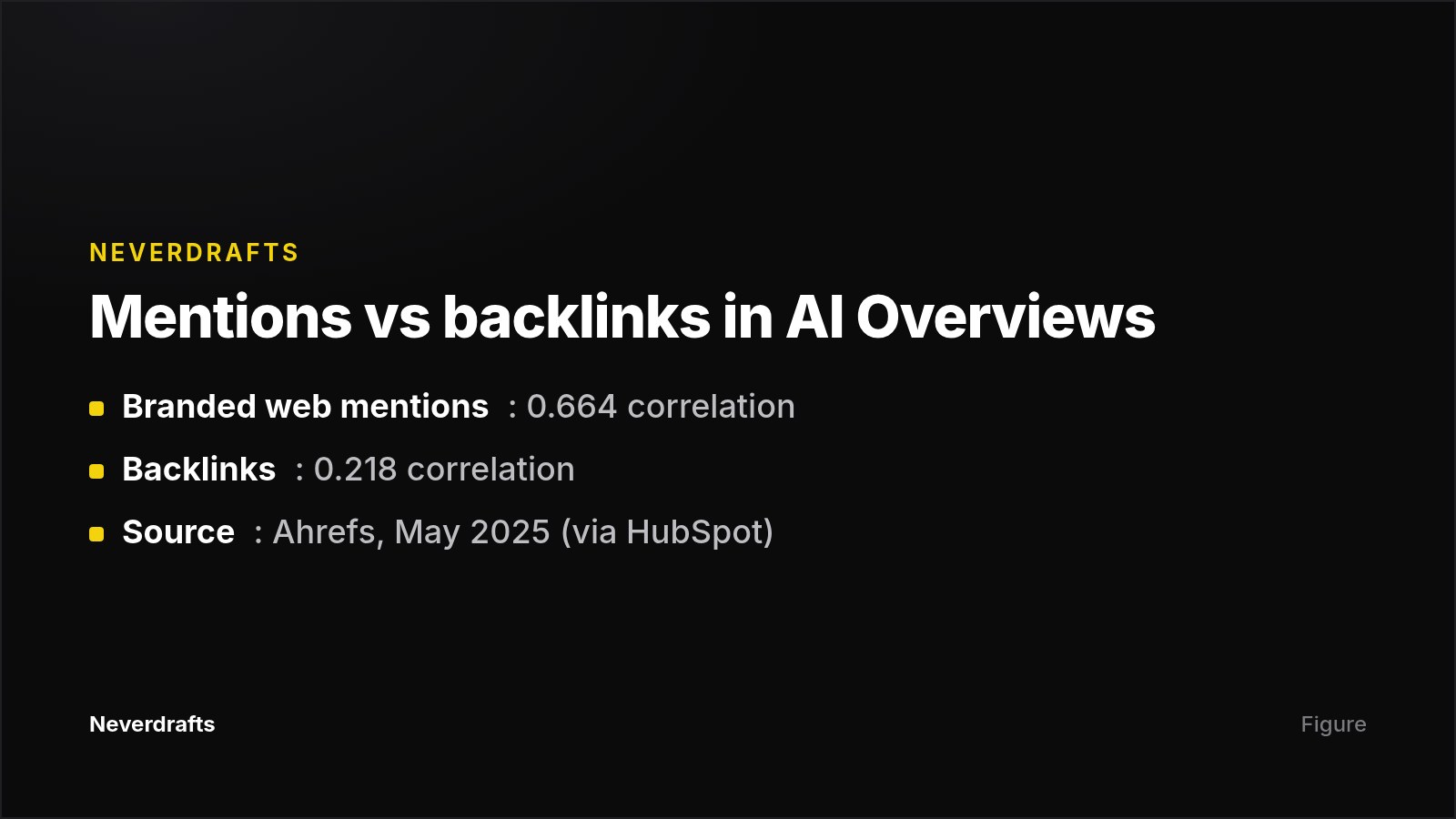
- Off-site signals carry a lot of weight. In an Ahrefs study, branded web mentions correlated with AI Overview appearance at 0.664, versus 0.218 for backlinks.
- Crawlability is a precondition. If you block OpenAI's search crawler, your site won't appear in ChatGPT search answers.
- Google says its AI features are rooted in core Search ranking and quality systems, so solid SEO is still the foundation.
- Original, first-hand content gets cited more than content that restates common knowledge. Generic "commodity" content usually does not.
- Track the same prompts separately on each platform, over time. One good answer is not a trend.
Why does AI visibility matter now?
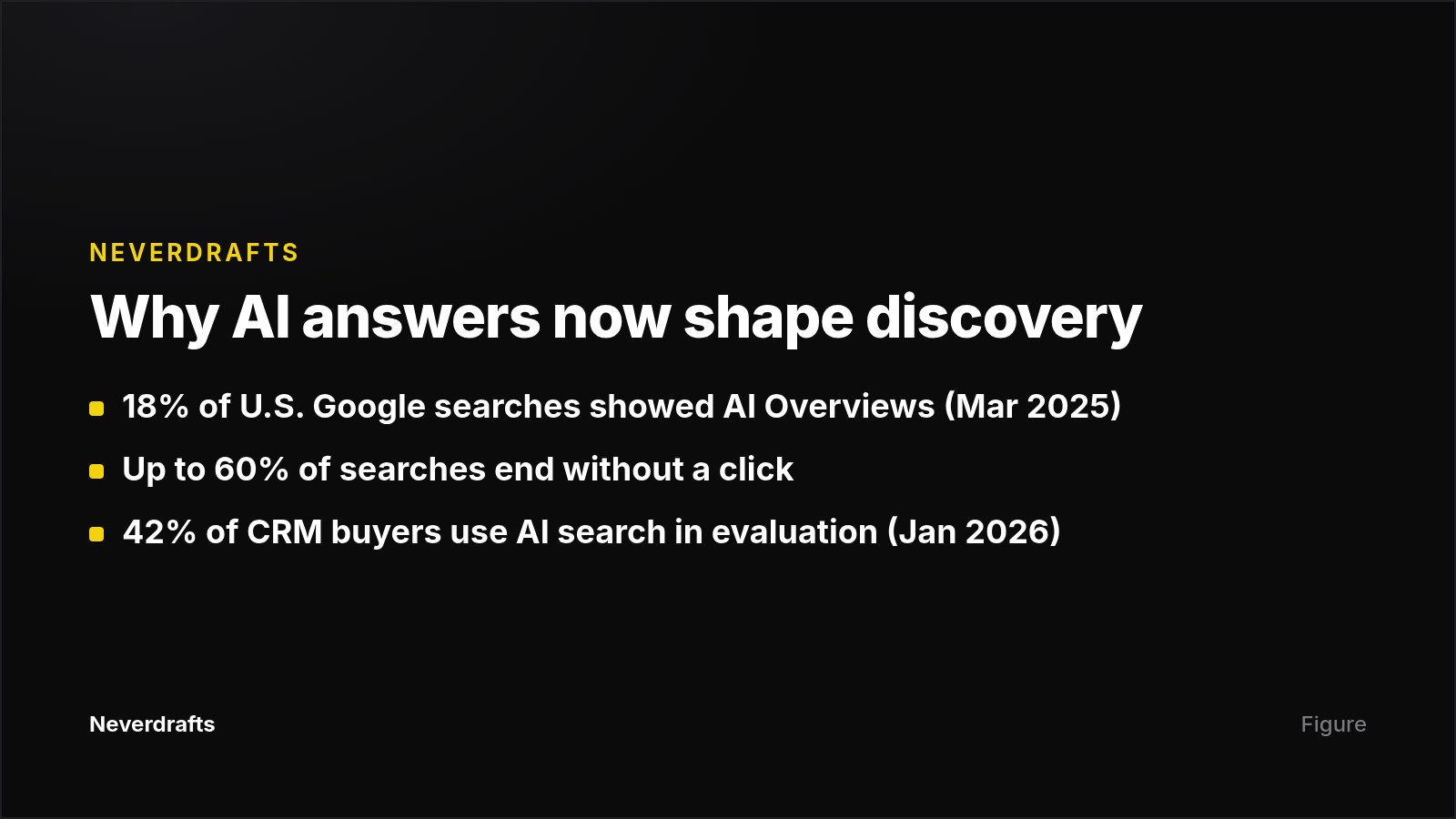
More of the buying journey happens inside AI interfaces, and much of it never shows up in your analytics. Pew Research found Google's AI Overviews appeared in 18% of U.S. Google searches in March 2025. Other figures point the same way:
- Up to 60% of searches end without a click.
- 31% of Gen Z start queries in AI or chat tools instead of search engines.
- In software buying, 42% of CRM buyers used AI search during evaluation as of January 2026.
A buyer can read about your company in Gemini or ChatGPT, form an opinion and shortlist competitors without ever visiting your site. That is why Sitecore frames AI visibility as a measurable part of brand performance: whether you appear, how accurately you are described, and how often competitors appear when you don't.
What do you need before you start?
You don't need a large budget, but a few things should be in place first.
- A list of your core facts: current product names, who each product is for, pricing model, key capabilities and known limitations, all in one place.
- Access to robots.txt, CDN settings and your CMS, or a developer who can change them.
- Accounts on the engines your buyers use: typically ChatGPT, Gemini, Perplexity, Claude and Google with AI Overviews.
- A simple log. A spreadsheet works. Record the prompt, platform, date, answer and cited sources for each check.
- A named owner. Corrections and updates stall without one.
Step 1: Build a prompt set from real buyer questions
Begin with what buyers ask, not your keyword list. Sitecore recommends starting with questions that influence a buying decision: who the product is for, what problem it solves, what evidence supports your claims.
Actions:
- Write a few dozen realistic prompts across your category as a practical starting point. Mix discovery prompts ("best invoicing tool for freelancers"), comparisons ("X vs Y for small teams"), problem prompts ("how to reduce churn in a subscription business") and branded prompts ("is [your brand] good for agencies?").
- Run each prompt on every engine you care about, and log results separately per platform.
- For each answer, record whether you were mentioned, whether you were cited with a link, the tone of the description, and which competitors appeared.
What good looks like: a baseline share of voice — how often you appear relative to competitors across a consistent prompt set.
Common mistake: testing only branded prompts. Asking "what is [Brand]?" will usually produce an answer about you. The prompts that matter are unbranded ones where competitors can be named instead. Our guide on how to monitor what AI chatbots say about your brand covers this in more depth.
Step 2: Make sure AI crawlers can actually read your site
No content work helps if engines can't fetch your pages. Check robots.txt, CDN or firewall bot rules, noindex tags, and any pages that hide key content behind scripts or pop-ups.
OpenAI separates its crawlers by purpose (OpenAI docs):
| User agent | Purpose | If you block it |
|---|---|---|
| OAI-SearchBot | Surfaces sites in ChatGPT search features | Won't appear in ChatGPT search answers, except possibly as navigational links |
| GPTBot | Crawls content that may be used to train foundation models | Signals your content shouldn't be used for training |
| ChatGPT-User | Visits pages during user-initiated actions | Not used for automatic crawling; robots.txt rules may not apply |
| OAI-AdsBot | Checks landing pages submitted as ChatGPT ads | Only visits pages submitted as ads |
These settings are independent: you can allow OAI-SearchBot and disallow GPTBot. OpenAI notes it can take about 24 hours for robots.txt changes to take effect for search. Check rules for ClaudeBot, PerplexityBot and Google-Extended too, so you aren't blocking something by accident.
For Google's AI features, a page must be indexed and eligible to be shown in Google Search with a snippet. A noindex tag or a blocked snippet removes you from AI Overviews and AI Mode as well.
Common mistake: a security team adds a blanket "block AI bots" rule at the CDN level, marketing never finds out, and citations quietly drop.
Step 3: Rewrite key pages so answers are easy to extract
Answer engines pull individual passages rather than whole pages. Your product, pricing, comparison, FAQ and support pages should each answer a specific question clearly.
Actions, based on HubSpot's AEO best practices:
- Put the core answer in the first 40–60 words of a section, then add detail.
- Write headings in natural language: questions, definitions, comparisons, instructions.
- Make each section self-contained, so it makes sense if quoted alone.
- Use bullets, numbered lists and tables instead of long paragraphs.
- Add structured data (FAQ, HowTo, Article and Product schema).
- Show update dates, timestamps and author names, on-page and in schema.
- Call out key facts and figures that can be quoted directly.
A before/after example: a heading like "Our Solution" becomes "Who is [Product] for?", followed by one sentence naming the customer type, the problem solved and a key limitation. Sitecore stresses the same clarity: give each section a descriptive heading.
Common mistake: building a new page for every prompt variation. Google warns that producing pages mainly to manipulate AI responses violates its scaled content abuse policy. Strengthen the most relevant existing page first.
Step 4: Publish content that only you could have written
Google says unique, compelling content will likely influence your presence in generative AI search more than any other suggestion in its guide. Commodity content like "7 Tips for First-Time Homebuyers" restates common knowledge. Non-commodity content like "Why We Waived the Inspection & Saved Money" offers a first-hand, expert take.
Actions:
- Publish original research, benchmarks or data from your own product or customer base. HubSpot lists original research as a direct way to raise your chances of being cited.
- Write from experience: implementation lessons, teardown analyses, honest "what we got wrong" posts.
- Support text with high-quality images and video, which Google's AI features can surface too.
- Google's query fan-out fetches results for several related queries at once, so cover closely related subtopics within the same strong page rather than creating separate pages for each.
Common mistake: using AI tools to mass-produce generic posts. If a model could have written it without you, it has little reason to cite you. AI-assisted content still has to meet Google's Search Essentials and spam policies.
Step 5: Build mentions where answer engines look
Answer engines weigh what others say about you, so earn accurate mentions on the reviews, forums, press and community sites they cite most. LLMs give weight to how your brand is described in reviews, news articles and community discussions, and unlinked mentions count. Answer engines also draw on multiple sources for each answer, so no single domain guarantees a place.
Where to focus:
- Community platforms. Reddit, YouTube and LinkedIn are the three most-cited third-party sources across answer engines combined, according to Peec AI. Contribute genuinely rather than dropping links.
- Review sites relevant to your category, such as G2, Capterra or Trustpilot. Ask happy customers for specific, detailed reviews.
- Industry press and niche communities. As Krista Doyle of Fan Out put it, for B2B "a mention from a niche industry community often carries more retrieval weight than a generic high-DA backlink ever did."
- Reference sources like Wikipedia and Wikidata, where your company meets their notability rules.
- Partner and integration listings, which often describe your product in their own words.
What good looks like: when you check which sources an AI answer cites in your category, your brand appears in several of them, described accurately.
Common mistake: treating this as link building. The goal is to be discussed accurately and often, whether or not there is a link.
Step 6: Correct misrepresentation and keep your facts consistent
An answer might use an old product name, list a feature you dropped, or say you serve a market you don't. Any of these can cost you a deal.
Actions, following Sitecore's correction workflow:
- Prioritize errors that could lead a buyer to rule you out, or expect something you don't provide.
- Save the question, answer, platform, date and cited sources as evidence.
- Trace the error to its source: often an outdated page of your own, a partner listing, a review or old press coverage.
- Update your own pages first, then ask third-party publishers to correct theirs, with a current reference.
- Assign an owner to each correction and record when it goes live.
- Review related pages after every launch, rename or change in availability.
Consistency matters in both directions. HubSpot advises aligning messaging across owned, earned and paid channels to build trust with AI systems. Be realistic about limits: you can influence the sources AI systems use, but you can't guarantee what an external platform will say.
Step 7: Measure across engines and repeat
Re-run your prompt set on a regular schedule — monthly is a practical starting point — and compare results per platform. Sitecore recommends tracking the same questions over time, separately per engine, to see whether updated pages earn citations and whether your brand is represented more accurately. Track mentions, citations, sentiment and share of voice, and note which pages you updated and when.
No source we reviewed publishes a reliable timeline for when content changes show up in AI answers. The only firm figure is OpenAI's roughly 24-hour delay for robots.txt changes. Judge progress on repeated checks, not a single response.
You can do this by hand with a spreadsheet, or use a dedicated tool. At Neverdrafts, we track real answers from ChatGPT, Claude, Google AI Mode and Perplexity daily, recording actual answer text and cited sources rather than extrapolated scores. We score each response by position, show which sources lead engines to name competitors, and generate content aimed at the prompts you're losing. See how it works.
On ROI: vendor-reported results are encouraging but self-reported. HubSpot says leads from AEO converted 3x better than other sources internally, and that its own AEO strategy produced a 1,850% increase in qualified leads. Use your own baseline from Step 1 to judge your results.
What mistakes stop brands from appearing in AI answers?
The most common blockers are technical, such as blocked crawlers and hidden content, and strategic, such as ignoring off-site sources and letting facts drift out of sync.
- Blocking crawlers without realizing it. Check robots.txt and CDN rules for every major AI user agent.
- Measuring rankings only. A top-ranked article can be entirely absent from AI answers.
- Ignoring off-site sources. Your website is one input among many.
- Publishing volume over value. Scaled, near-duplicate pages risk spam policies and rarely earn citations.
- Inconsistent facts. If your pricing page, partner listing and review profile disagree, models may repeat the wrong version.
- One-off checks. AI answers vary between runs and platforms, so track trends.
- Hiding key information. Content tucked into scripts or pop-ups is harder to retrieve.
For a sequenced version of these tactics, see our 10-step sequence for brand authority.
Next step
Run your first baseline before changing any content. Our free audit needs no card and returns results in about 30 seconds, giving you a starting baseline for Steps 3 through 6.
Frequently asked questions
Is AEO different from SEO?
Yes, in goal, though tactics overlap heavily. SEO ranks pages and drives clicks. AEO gets your brand mentioned or cited in AI answers, measured by mentions, citations, sentiment and share of voice. Google says its AI features rely on core Search ranking systems, so technical SEO and helpful content remain the foundation; AEO adds a stronger focus on off-site mentions.
Do I need to allow GPTBot to appear in ChatGPT?
No. OpenAI treats its crawlers independently. OAI-SearchBot controls ChatGPT search visibility; GPTBot controls training use. You can allow one and disallow the other. Blocking OAI-SearchBot means you won't appear in ChatGPT search answers, though you may still appear as a navigational link.
How long does it take to see results?
There's no published, reliable timeline. OpenAI notes robots.txt changes take about 24 hours to apply to search; everything else depends on re-crawl frequency and category competition. Re-check the same prompts monthly and judge trends across several runs, not one answer.
Does schema markup help with AI visibility?
Yes, alongside other signals. HubSpot recommends FAQ, HowTo, Article and Product schema, plus dates and author information, to help engines parse page structure. Schema won't rescue thin content, but it makes well-written, clearly structured pages easier to extract.
Can I fix what AI says about my brand?
You can influence it, not control it. Find the inaccurate claim, trace its source, update your own pages, and ask third-party publishers to correct theirs using a current reference. Re-check the same prompts over time to see whether the error recurs.
Sources
- Sitecore: How to improve brand visibility in AI search
- Google Search Central: Optimizing your website for generative AI features on Google Search
- HubSpot: Answer engine visibility: The playbook for marketers
- HubSpot: How to Increase AI Visibility With HubSpot (AEO guide)
- OpenAI Platform: Overview of OpenAI crawlers