

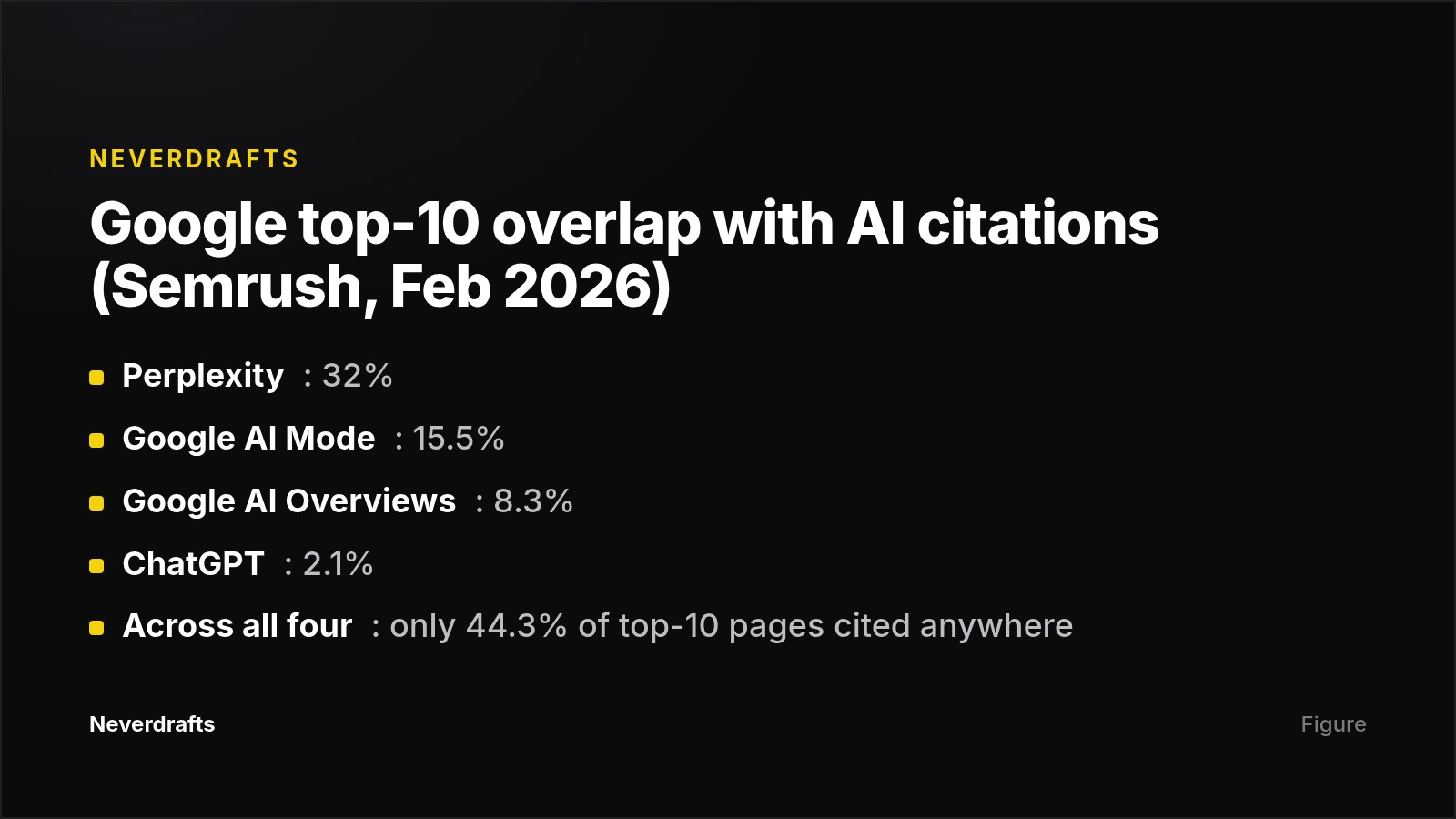
AI visibility improves when three things are true at once: AI systems can crawl and parse your pages, your content answers specific buyer questions directly in the first paragraph, and independent sources on the web corroborate what you claim about yourself. Ranking well on Google is not enough — in a February 2026 test of 10 SaaS queries, only 44.3% of pages ranking in Google's top 10 appeared in at least one AI-generated answer across four platforms. The work below is a ten-step sequence: audit first, fix structure and schema, build third-party authority, then publish against the prompts you are losing and measure on a fixed cadence.
Key takeaways
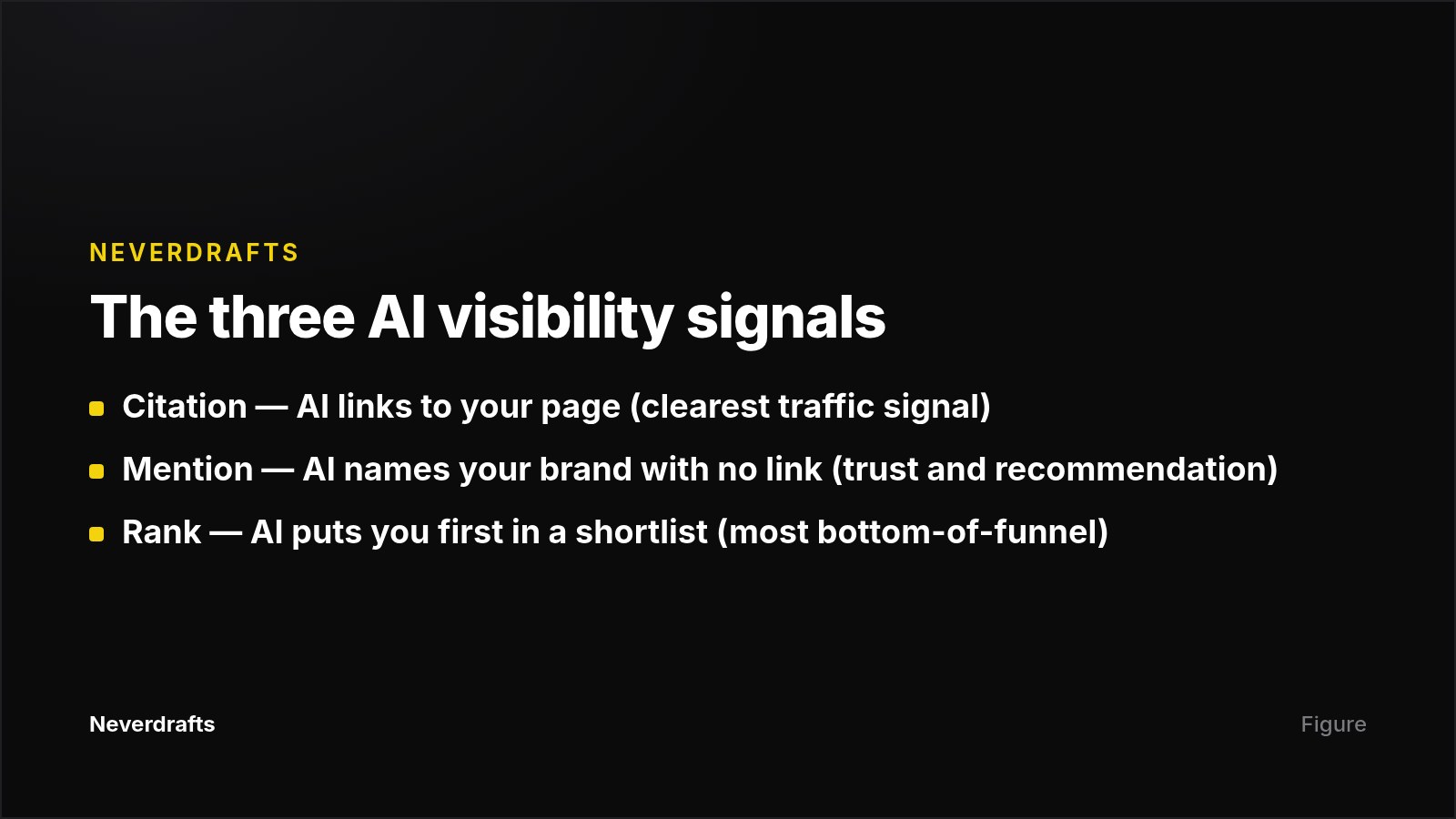
- AI visibility means how often your brand is mentioned, cited, or ranked in answers from ChatGPT, Claude, Gemini, Google AI Mode and Perplexity — three separate signals that need separate tracking, per MO Agency's 2026 breakdown.
- Traditional rankings transfer poorly. Overlap between Google's top 10 and AI citations ranged from 32% on Perplexity to 2.1% on ChatGPT in Semrush's February 2026 test.
- Earned media does the heavy lifting: Launchmetrics cites industry studies showing over 80% of what LLMs cite about a brand traces back to earned media, and Gartner predicts PR budgets will double in the coming year.
- Google states there are no additional technical requirements for AI Overviews and AI Mode beyond being indexed, snippet-eligible, and meeting Search's technical requirements.
- Deloitte's GEO methodology is four steps: audit 50–100 buyer prompts, implement semantic schema, write answer-first content, and build a defensible authority footprint.
- The payoff is disproportionate: Semrush estimates AI search visitors convert 4.4x better than traditional organic visitors, and projects AI channels will drive as much business value as traditional search by 2027.
How AI visibility differs from traditional SEO
It helps to be precise about what has changed, because the temptation is to assume this is SEO with a new acronym stapled on.
Semrush describes AI visibility optimisation as an extension of SEO rather than a replacement: core signals like relevance to a query, authority and page experience still matter. What differs is the output. AI systems do not simply return a list of links — they assemble a composite answer from multiple sources, and how they select and use content from those sources depends on factors including how your brand is mentioned elsewhere on the web, how recent your content is, and how easy your content is to understand (Semrush).
MO Agency frames the same shift as a set of paired contrasts (MO Agency):
| Traditional SEO | AI visibility |
|---|---|
| Rank in search results | Become part of the AI answer |
| Earn clicks | Earn citations and recommendations |
| Focus on keywords | Focus on entities, facts, and trust |
| Optimise pages | Optimise content, schema, and authority |
It also separates three overlapping disciplines that get used interchangeably: SEO helps you rank in search results, AEO (answer engine optimisation) shapes the answer inside LLMs, and GEO (generative engine optimisation) focuses on being surfaced and cited by generative engines. MO Agency's summary of the practical consequence: the goal is no longer only to rank, it is "to become the sentence that the AI says out loud."
Deloitte draws the line in similar terms from the enterprise side. Where SEO focuses on keywords and backlinks to drive clicks, GEO focuses on semantic fitness and entity authority to drive recommendations, with the objective of making your brand's data "so clear, authoritative, and easy to extract that AI models choose it as their 'Source of Truth'" (Deloitte).
None of this makes SEO optional. Google's own documentation is explicit that eligibility for AI Overviews and AI Mode runs through ordinary Search indexing, and that existing SEO fundamentals remain worth following (Google). The accurate mental model is a second layer stacked on the first, not a replacement for it.
What you need before you start
This is not a one-afternoon project, and most of it is unglamorous. Before Step 1, get these in place:
- Access to your CMS and the ability to edit page templates. Schema changes and answer-first rewrites both require editing published pages, not just drafting new ones.
- Google Search Console verified for your domain. Google reports AI Overviews and AI Mode traffic inside the Performance report under the "Web" search type, so this is your only first-party view of that traffic (Google).
- A spreadsheet or a tracking tool. Semrush's guide recommends logging prompt, platform, date, mention, citation, position and sentiment in a simple sheet as your baseline (Semrush).
- Accounts on the AI platforms your buyers use — at minimum ChatGPT and one of Gemini, Claude or Perplexity. Deloitte's audit step spans ChatGPT, Copilot, Gemini and Perplexity (Deloitte).
- A list of verifiable facts about your business: locations, service scope, named experts, review counts, awards, measurable outcomes. You will need these to replace unprovable superlatives in Step 5.
- A named owner. AI answers change between platforms and over time, so this needs a person whose job includes re-running the checks, not a one-off consultant engagement.
One honest caveat up front: the published sources on this topic do not give timelines for how long optimisation takes to show up in AI answers, nor documented ROI case studies. Treat anyone promising a fixed number of weeks with suspicion, and set your own baseline so you can judge movement yourself.
Step 1: Run an AI visibility audit before you change anything
You cannot improve a number you have never measured. Deloitte's first GEO step is explicit: test 50–100 real buyer prompts across ChatGPT, Copilot, Gemini and Perplexity and record what comes back. Deloitte also notes that this kind of data usually requires an update to your existing martech inventory — in other words, expect to invest in tooling you do not currently own.
Concrete actions
- Write down 50 prompts a real buyer would type — not keywords, full questions.
- Run each one on at least two platforms. (Sources do not address personalisation effects, but as practitioner advice: use a fresh chat with no prior context so your own history does not skew what comes back.)
- For each result, log: were you mentioned, were you cited with a link, where did you appear relative to competitors, and was the description accurate. Deloitte's audit questions include "Are you mentioned?" and "Is the sentiment accurate?" (Deloitte).
- Screenshot the answers. MO Agency's recommended starting move is to ask ChatGPT, Claude and Gemini "best [your category] in [your market]" and screenshot what you get (MO Agency).
- Note who is being cited instead of you. Deloitte lists this among its audit questions: "Who is the AI citing instead of you?" (Deloitte).
What good looks like
A single spreadsheet with one row per prompt-platform pair, dated, with a link or screenshot for every row. You should be able to say, in one sentence, "we appear in X of 50 prompts on ChatGPT and Y of 50 on Perplexity, and the three domains cited most often instead of us are A, B and C."
Common mistakes
- Auditing branded prompts only. "What is [your brand]?" will almost always mention you. The competitive picture lives in non-branded prompts, which is also what Deloitte's "Share of Model" metric measures (Deloitte).
- Auditing on one platform and generalising. Overlap with Google's top 10 was 32% on Perplexity but 2.1% on ChatGPT in Semrush's test — these systems behave very differently (Semrush).
- Skipping sentiment. An inaccurate or lukewarm mention is a different problem than absence, and it needs a different fix. Semrush lists sentiment — positive, neutral or negative framing — as one of four per-prompt metrics for exactly this reason.
Step 2: Build a prompt list that mirrors how buyers actually ask
Your prompt list is the equivalent of a keyword list in traditional SEO, and it is the asset everything else gets measured against. Semrush recommends building it around buying-journey stages (Semrush):
- Research: "what is X," "how does X work," "best practices for X"
- Comparison: "X vs Y," "best tools for [activity in your niche]," "alternatives to Y"
- Evaluation: "is X worth it," "X pricing," "pros and cons of X," "X reviews"
Concrete actions
- Ask your sales team for the ten questions prospects ask most often, in the prospect's own words. Semrush's guide also suggests asking customers, prospects and sales directly which AI tools your audience turns to regularly.
- Mine Google's People Also Ask boxes for the keywords you already target — the PAA section surfaces questions real users are asking, and they are often similar to the prompts your audience uses (Semrush).
- Search relevant subreddits for your primary keywords, sort by "Top," and lift the recurring questions. Semrush's reasoning: the questions that rise to the top reflect what your audience is actually asking (Semrush).
- Favour long, specific phrasings. Semrush advises thinking about highly specific phrases relevant to your brand, because they are closer to how people actually phrase questions in AI platforms (Semrush) — "best invoicing software for a two-person design studio in the UK" rather than "invoicing software."
- Tag each prompt by funnel stage and by whether it is branded or non-branded.
What good looks like
50–100 prompts, mostly non-branded, weighted toward comparison and evaluation prompts where a recommendation actually decides a purchase. MO Agency describes rank — where the AI puts you in a shortlist — as the most bottom-of-funnel signal, "where the buying decision is often made" (MO Agency).
Common mistakes
- Reusing your keyword list verbatim. Head keywords rarely resemble how anyone phrases a question to an assistant.
- Building a list so large you never re-run it. Semrush suggests running the full list once per week; size your list to that cadence, not to your ambition.
- Ignoring platform selection. If your analytics already shows referral traffic from a specific AI platform, Semrush calls that a clear signal to prioritise it (Semrush).
Step 3: Fix the technical foundation so AI systems can read you at all
Before any content work, confirm that AI systems are allowed to fetch your pages and that your pages are eligible to be shown. Google is blunt about this: to be eligible as a supporting link in AI Overviews or AI Mode, a page must be indexed, eligible to appear in Search with a snippet, and meet Search's technical requirements — with no additional technical requirements.
It is also worth knowing how the answers get assembled. Google explains that both AI Overviews and AI Mode can use a "query fan-out" technique — issuing multiple related queries across subtopics and data sources — and that during answer generation its models identify additional supporting web pages, surfacing a broader and more diverse set of links than traditional web results (Google). That is genuinely an opportunity for sites that would not rank for the head query but answer a subtopic well.
Concrete actions
- Check
robots.txtand any CDN or hosting layer actually permits crawling. Google lists this first among its SEO fundamentals for AI features. - Audit your pages for
noindex,nosnippet,data-nosnippetandmax-snippetdirectives. These are exactly the controls Google names for limiting what appears from your pages — if someone set them years ago for a different reason, you are opted out of AI features too (Google). - Decide deliberately on
Google-Extended, which Google points to for restricting AI training and grounding in some of its other systems (Google). - Make sure important content exists as text. Google explicitly advises ensuring important content is present as text, supported by high-quality images and video where relevant — content locked inside an image or a failed client-side render is content no model can extract (Google).
- Make your content easy to find through internal linking across the site, another of Google's named fundamentals.
- Confirm your structured data matches the visible text on the page — Google states this requirement directly.
- Verify the site in Search Console so you can quickly detect and diagnose potential technical issues, and see AI-feature traffic in the Performance report.
- Keep Merchant Center and Business Profile information current if they apply to you (Google).
What good looks like
Every page you care about returns a 200, is indexed, renders its key content as server-side text, has internal links pointing to it, and has no snippet-suppressing directives. Google also notes that clicks from result pages containing AI Overviews tend to be higher quality, with users more likely to spend more time on the site — so this eligibility is worth protecting.
Common mistakes
- Blocking crawlers wholesale in a panic about AI, then wondering why you disappeared from AI answers.
- Assuming GEO replaces SEO. Deloitte answers this directly: "SEO is the foundation that allows AI bots to find your site. GEO is the layer that ensures the AI chooses and cites your content once it finds it. You need both" (Deloitte).
- Changing preview settings and expecting instant effects. Google notes recrawling can take anywhere from days to months depending on how often its systems determine a page should be refreshed, and that you can request recrawling after making changes.
Step 4: Rewrite your key pages answer-first
Generative systems use retrieval-augmented generation: they pull passages, then compose. Deloitte's warning is specific — "if your page takes 500 words to get to the point, the AI will skip you for a competitor who defines the solution in the first paragraph" (Deloitte).
Deloitte sets out three properties that models prioritise: content that is factual and direct, highly structured, and third-party validated. The first two are on-page work; the third is Step 7.
Concrete actions
- Put the direct answer in the first two or three sentences of every page. Lead with the answer, then provide the context, and embed statistics into that context (Deloitte).
- Use a clear H2/H3 hierarchy with descriptive, question-shaped headings that mirror prompts from Step 2. Deloitte names H2/H3 hierarchies, bulleted lists and comparison tables as the structural formats models favour.
- Convert dense paragraphs into bulleted lists and comparison tables.
- Add FAQ blocks that mirror the real prompts people ask AI, as MO Agency recommends (MO Agency).
- Make each section self-contained. MO Agency's framing is that AI engines often answer "best X" queries by lifting sentences directly from pages and then naming the source — so if a model lifts one H2 block out of context, it should still make sense and still name what it refers to.
- Keep terminology consistent across the site. MO Agency lists consistent wording as a practical rule, because inconsistent naming weakens the entity signal.
What good looks like
Someone reading only your headings, first paragraph and bullet lists gets the full answer. MO Agency's phrasing of the target: pages now need to be easy to extract, easy to verify and easy to trust — content that works for both humans and machines.
Common mistakes
- Burying the answer under a brand story, a founder anecdote, or three paragraphs of context-setting.
- Writing headings like "Our approach" or "Benefits" that match no prompt anyone has ever typed.
- Treating this as a blog-only exercise. Your homepage, top service pages and pricing pages are the ones models consult for category and capability facts. MO Agency's action list starts with rewriting the homepage and top service page.
- Removing so much prose that the page stops being useful to a human reader. Google's stated best practice remains creating helpful, reliable, people-first content (Google).
Step 5: Replace vague claims with quantified, verifiable facts
AI systems cross-reference your site against independent sources. MO Agency's summary of the mechanism: "LLMs extract, verify, and trust, so false or fluffy claims are more likely to be ignored" (MO Agency). Deloitte says the same thing from the model's side: LLMs cross-reference your site with independent reviews on G2, Reddit and niche journals to verify your claims (Deloitte).
Concrete actions
- Inventory every superlative on your site: "leading," "best-in-class," "world-class," "trusted by thousands."
- For each one, either attach a specific, checkable fact — location, service scope, named certifications, award names and years, review counts and ratings, measured outcomes — or delete it. MO Agency's worked example contrasts "We're a leading SEO agency," which is difficult for AI systems to verify or quote confidently, with a stronger claim that includes specific, measurable and verifiable details such as location, service scope, awards, reviews or results.
- State the facts a model needs in order to classify you: what category you are in, who you serve, where you operate, and what you do not do.
- Make sure the same facts appear identically on your site, your G2 or Capterra listing, your LinkedIn page, and any directory profile. MO Agency's point is that AI visibility depends on being consistently described, classified and validated in more than one place.
- Remove anything you cannot prove. MO Agency's rule is blunt: if a claim is not provable, it should be removed.
What good looks like
Any sentence on your key pages could be quoted by a model and defended by a journalist. Instead of "we serve businesses of all sizes," you have "we work with B2B SaaS companies between 10 and 200 employees, primarily in the UK and Ireland."
Common mistakes
- Replacing one unprovable claim with a vaguer one to be safe. Vagueness is equally unquotable.
- Quantifying claims on the blog but leaving marketing copy untouched on the pages that define your category.
- Contradicting yourself across channels — a different category descriptor on your homepage, your G2 profile and your LinkedIn bio teaches models that your identity is unstable.
Step 6: Declare your brand entity with JSON-LD schema
Schema is the one place where you control exactly what machines consume. MO Agency reports that AI engines preserve JSON-LD more faithfully than body copy, which means what you declare in schema is often what machines consume — and that schema descriptions should be treated as marketing copy, not as metadata (MO Agency). Deloitte's second GEO step is the same instruction from the enterprise side: use advanced JSON-LD schema to define your brand entity, telling the AI exactly what category you lead, who your experts are, and what problems you solve in a machine-readable format (Deloitte).
Concrete actions
- Add
Organizationschema sitewide with a full description, category, founders or named experts, locations, andsameAslinks to your profiles on other platforms. - Choose the most specific type available for each page. MO Agency's guidance:
BlogPostingbeatsArticlefor a blog post,ServicebeatsWebPagefor a service page, andFAQPageis ideal for pages with FAQs. - Write schema descriptions with deep semantic facts rather than ad-style copy — what you do, for whom, where, and why you are credible (MO Agency).
- Add
FAQPagemarkup to the FAQ blocks you created in Step 4 so the question-and-answer pairs are explicitly machine-readable. - Validate the markup and confirm it matches the visible page text, which Google names as a requirement (Google).
A minimal Organization block looks like this:
{ "@context": "https://schema.org", "@type": "Organization", "name": "Your Brand", "description": "What you do, for whom, where you operate, and why you are credible.", "url": "https://example.com", "sameAs": [ "https://www.linkedin.com/company/yourbrand", "https://www.g2.com/products/yourbrand" ] } What good looks like
Every important page carries a specific type, your organisation schema is identical sitewide, and your sameAs array points to the third-party profiles you actually maintain.
Common mistakes
- Leaving a generic plugin-default description in place — that description may be exactly what a model repeats about you, given how faithfully JSON-LD is preserved.
- Marking up pages with
WebPageorArticlewhen a more specific type exists. - Declaring things in schema that do not appear on the page, which breaks Google's structured-data requirement and undermines trust at the same time.
Step 7: Build an off-page authority footprint
This is the step most teams underinvest in, and it is the one with the strongest evidence behind it. Launchmetrics cites industry studies showing over 80% of what LLMs cite about a brand traces back to earned media — which Launchmetrics defines as what voices outside a brand's paid channels say about it: press, podcasters, Substackers, celebrities, influencers, and consumer conversations.
Launchmetrics' chief strategy officer Arnaud Roy found, while building the company's AI Visibility metric, that because LLMs rely on fresh media content to answer real-time questions they cannot resolve from training data alone, editorial coverage from authoritative press outlets carries significant weight in shaping AI-generated responses (Vogue). CMO Alison Bringé's shorthand: "PR is definitely the new SEO."
Deloitte describes the same effect in mechanical terms: AI models look for patterns of trust, and when the AI sees the same positive entity relationship — its example is "Brand X is the leader in SOC 2 compliance" — across five different trusted domains, that fact solidifies (Deloitte).
Concrete actions
- Pitch substantive editorial coverage, not just product announcements. KCD CEO Rachna Shah points to the value of deeper storytelling across multiple surfaces — podcasts, Substacks, and longer features (Vogue).
- Claim and complete your profiles on the review platforms relevant to your category — G2, Capterra, Clutch — and encourage detailed, specific reviews rather than star ratings alone (Deloitte, MO Agency).
- Get included in independent listicles and expert roundups in your category — MO Agency names listicles alongside verified reviews as trust-strengthening signals.
- Participate honestly in communities like Reddit where your category is discussed — Deloitte names Reddit explicitly among the sources models cross-reference.
- Aim for repetition of the same entity relationship across several trusted domains, not one prestige hit in isolation.
- Reallocate budget consciously. Launchmetrics expects budget reallocation to come primarily from SEO and search engine marketing; Bringé cites Gartner's prediction that PR budgets will double in the coming year as brands prioritise presence in AI-generated narratives (Vogue). Shah's counterpoint is worth holding alongside it: she encourages brands to split media budget across more diverse surfaces rather than simply moving money from one line to another.
What good looks like
Five or more independent, reputable domains describe you in consistent terms, and at least some of that coverage is recent. MO Agency's framing is that even a well-written page struggles if the rest of the web is silent about you.
Common mistakes
- Optimising the homepage endlessly while no third party has written about you in two years.
- Chasing low-quality link placements. Models are cross-referencing for corroboration, not counting links.
- Treating PR and SEO as separate teams with separate reporting. The AI answer merges them whether you do or not — which is precisely why Launchmetrics built an intelligence layer to connect earned media performance to LLM results.
Step 8: Publish content that targets the prompts you are losing
Steps 1 and 2 produce a list of prompts where competitors are named and you are not. That list is your content brief queue — far more precise than a keyword gap report, because each row is an actual sentence a buyer typed.
Concrete actions
- Sort your losing prompts by commercial value. Evaluation and comparison prompts usually outrank research prompts here, because that is where a shortlist forms and, per MO Agency, where the buying decision is often made.
- For each priority prompt, check what is currently cited. If the answer cites a comparison listicle, you need a comparison asset; if it cites a documentation page, you need a precise reference page.
- Write one page per prompt cluster, answer-first, with the specific facts a model would need in order to quote you confidently.
- Include the formats Deloitte names as model-friendly: H2/H3 hierarchy, bullets, and comparison tables.
- Update existing pages before writing new ones when a near-match already exists. Freshness matters — Semrush lists how recent your content is among the factors influencing how AI systems choose and use sources (Semrush).
- Re-run the target prompt after publication and log whether the mention, citation or rank changed.
What good looks like
A visible loop: losing prompt in, published page out, prompt re-tested, result logged. Over a quarter you should be able to point at specific prompts where your position moved and specific pages that caused it.
Common mistakes
- Publishing generic "ultimate guides" that match no prompt in your list.
- Writing for the model at the expense of the reader. Google's stated best practice is still helpful, reliable, people-first content, and that is the same content that is easy to quote (Google).
- Publishing and never re-testing, which leaves you unable to tell what worked.
- Expecting same-week movement. Google notes recrawling alone can take days to months depending on refresh frequency, and no source in the current literature documents how long AI answers take to reflect new content.
Step 9: Track citations, mentions and rank on a fixed cadence
AI answers change frequently, differ between platforms, and do not appear clearly in traditional analytics tools — which is precisely why manual checking does not scale, as MO Agency puts it (MO Agency). Pick a cadence and hold it.
The four metrics Semrush recommends tracking per prompt (Semrush):
- Mentions — whether your brand appears in the AI-generated answer at all
- Citations — whether the answer includes a link to your site
- Position — where in the response your brand appears relative to other brands mentioned
- Sentiment — whether your brand is described positively, neutrally or negatively
MO Agency's three-signal model maps onto the same idea and explains why each matters: citations are the clearest traffic-driving signal because they point back to your content; mentions without links still matter because they show recommendation and trust even when there is no click; rank — being placed first in a shortlist — is the most bottom-of-funnel signal (MO Agency).
Concrete actions
- Run the full prompt list once per week and note what has changed since the last check (Semrush).
- Keep columns for prompt, platform, date, mention, citation, position and sentiment so trends survive staff changes.
- Add share of voice against your named competitor set — Semrush lists share of voice and visibility trend over time among the metrics a dedicated tool can track.
- Cross-check against Search Console, where AI Overviews and AI Mode traffic is folded into the "Web" search type in the Performance report (Google).
- Track time on site and conversions for that traffic in analytics — Google reports that clicks from results containing AI Overviews tend to be higher quality, with users more likely to spend more time on the site.
- Move to a dedicated tool once manual tracking stops scaling. Semrush notes tools save significant time and surface insights manual tracking cannot easily capture.
What good looks like
A dated time series, not a snapshot. One screenshot proves nothing; twelve weekly data points across four platforms show direction.
Common mistakes
- Treating one bad week as a trend. Answers vary between runs, which is part of why both Semrush and MO Agency recommend a repeated cadence rather than spot checks.
- Tracking mentions only. A mention with no citation drives no traffic; a citation with negative sentiment can actively cost you deals.
- Letting personalisation contaminate the test. Sources do not cover this, but as practitioner advice, run prompts without your own chat history in play so you are measuring the model's default answer rather than one tuned to you.
Step 10: Report AI visibility in business terms
AI visibility only survives a budget review if it is reported the way the rest of marketing is. Two vocabularies already exist for this.
Deloitte frames success as Share of Model (SOM) and Citation Rate, monitored with AI visibility trackers to see how often your brand appears in non-branded prompts compared with competitors (Deloitte).
Launchmetrics has taken a brand-perception route with AI Visibility (AIV), launched alongside New York Fashion Week and designed to sit next to the long-standing Media Impact Value (MIV) metric. Its brand ranking now shows both MIV and AIV scores plus the share of value from each, includes a callout section for brands that stand out in AI search, tells brands which editorial voices cite them in AI search, and compares AI search results across different cities (Vogue). Bringé describes the purpose as giving brands a way to quantify their AI discoverability, see what LLMs are presenting about them to consumers, and compare that with their general MIV.
Concrete actions
- Report share of model on non-branded prompts monthly, against a fixed competitor set.
- Report citation rate: what percentage of tracked prompts produce a link to your site.
- Tie AI-referred sessions to conversions. Semrush's estimate that AI search visitors convert 4.4x better than traditional organic visitors — likely because they arrive having already researched their options — is the argument for funding this work even at modest traffic volumes (Semrush).
- Show which editorial sources are being cited in your category, and hand that list to whoever runs PR. Identifying the editorial voices that cite brands in AI search is exactly what Launchmetrics built into its dashboard.
- Frame the timeline with the projection that AI search channels will drive as much business value as traditional search by 2027 and surpass it soon after, and with ChatGPT's reported 900 million-plus weekly users (Semrush).
Common mistakes
- Reporting raw mention counts with no competitor benchmark.
- Promising a payback period the evidence does not support. Published sources do not currently document how long AI visibility work takes to produce measurable ROI — say so rather than inventing a number.
- Keeping the data inside the SEO team when the strongest lever, earned media, sits with PR.
Which tools track AI visibility, and where Neverdrafts fits
Manual tracking gives you a defensible baseline; it stops scaling once you are running dozens of prompts across four engines every week. Four options appear in the current literature, and they solve different halves of the problem.
Disclosure: Neverdrafts is our product.
| Tool | What the sources say it does | Best for |
|---|---|---|
| Manual spreadsheet | Log prompt, platform, date, mention, citation, position and sentiment, then re-run weekly (Semrush) | Getting a first baseline at zero cost |
| Semrush AI Visibility Toolkit | Scores a brand's overall AI search presence — Semrush ran Shopify through it to see overall presence and room to improve | Teams that want a single presence score rather than prompt-by-prompt logs |
| Getmd.ai | Tracks citations, mentions and rankings across multiple AI engines, as demonstrated in MO Agency's webinar | Marketers who want the three-signal view in one place |
| Launchmetrics AIV | AI Visibility score alongside Media Impact Value, plus which editorial voices cite a brand and city-level comparisons of AI search results | Consumer and fashion brands measuring AI presence as a PR metric |
| Neverdrafts | Monitors daily ChatGPT, Claude, Google AI Mode and Perplexity answers against tracked prompts, scores position-weighted visibility 0–100 per answer, auto-generates remediation content for the prompts you are losing, publishes to your CMS, and tracks AI crawlers hitting those pages | Small teams and agencies that want monitoring and the content fix in the same loop |
The research behind this article does not evaluate these tools against one another; the rows above report only what each source states about its own product, so treat the table as a map of categories rather than a ranking.
Neverdrafts is built for Steps 1, 8 and 9 specifically: it monitors which AI systems recommend competitors instead of you, diagnoses why by citing the sources the AI is using, generates content aimed at those exact prompts, publishes one-click to WordPress, Webflow, Shopify, Framer or an API-first stack, and then shows AI crawlers visiting the published pages as evidence. It also tracks cited domains, sentiment, brand mentions and share-of-voice trends, supports remediation content in 150+ languages, and offers white-label reports and dashboards for agencies. Plans run $99/month for Starter (1 brand, 50 prompts, 30 articles per month), $199/month for Growth (3 brands, 150 prompts, 100 articles), and $399/month for Agency (10 brands, 500 prompts, 300 articles), with a $1 three-day full-access trial and no contracts.
Two limits worth stating plainly. It covers four engines — note that Deloitte's audit step also includes Copilot, which Neverdrafts does not track, so a Copilot-heavy audience will need a manual check alongside it. And it does not do Step 7: no monitoring-and-publishing tool secures a feature in a trade publication or persuades a customer to write a detailed G2 review, and those remain the highest-leverage inputs according to the earned-media evidence. Budget for both.
If you are weighing monitoring platforms against each other, our comparison of AI visibility monitoring tools in 2026 covers engine coverage and scoring approaches in more detail, and our breakdown of engine coverage and pricing sets the cost side side by side. If you are considering outsourcing instead, we have also written up nine alternatives to hiring a GEO agency.
Mistakes to avoid when your brand still is not showing up
If you have done the ten steps and the numbers have not moved, work through these in order.
You are optimising for Google and assuming AI follows
The most common false assumption. In Semrush's February 2026 test, the overlap between Google's top 10 and ChatGPT's citations was 2.1% (Semrush). You can hold position 1 for your main keyword and be invisible in AI answers. Check both, separately, always.
Nobody outside your own domain talks about you
If your brand appears on your website and nowhere else, models have nothing to corroborate. Deloitte's authority step and MO Agency's off-page lever both point the same way: mentions on independent publications, review platforms and community threads are what convert a claim into a fact a model will repeat.
Your claims are unverifiable
"Award-winning," "trusted by industry leaders," "the leading platform for X" — none of these survive verification, and unverifiable claims are more likely to be ignored (MO Agency). Replace them with facts a third party could check.
Your page buries the answer
If the definition of what you do appears in paragraph six, retrieval systems will use a competitor's paragraph one (Deloitte).
Your schema says something different from your page
Google requires structured data to match the text visible on the page (Google). A mismatch costs you eligibility and consistency at the same time.
You blocked the crawlers
Check robots.txt, noindex, nosnippet and max-snippet before assuming a content problem. And note Google's caution that after you change preview settings it can take days to months for recrawling to reflect the change (Google).
You are tracking branded prompts and calling it visibility
Share of Model is measured on non-branded prompts for a reason (Deloitte). "Best [category] for [use case]" is the prompt that matters.
You are ignoring sentiment and accuracy
A model that describes you inaccurately is a different problem from one that omits you. Launchmetrics built its dashboard partly so brands can see what the LLMs are presenting about their brand to consumers (Vogue). Fix the source that is producing the wrong description, not just the page.
You expected results on a schedule nobody has published
The current sources do not document how long AI visibility work takes to pay back, or provide ROI case studies. Set a baseline, hold the cadence, and judge movement against your own data rather than a borrowed benchmark.
You treat this as a one-time project
Answers change, models update, competitors publish. MO Agency's whole argument for tooling is that tracking multiple prompts across multiple AI engines every week is a reporting and workflow challenge — a standing operation, not a campaign.
What the research does not settle
Worth naming, so you can plan around the gaps rather than into them. The published sources used here do not provide: documented ROI case studies or timelines for AI visibility work; a prioritisation framework for choosing platforms when budget is tight; guidance on whether B2B and B2C approaches should differ; detail on the cost or benefit of the emerging ad formats Deloitte mentions in ChatGPT; analysis of brand safety when models amplify negative third-party mentions; or a head-to-head evaluation of the measurement tools now on the market. Where this article gives advice beyond the sources — on personalisation during testing, for example — it is flagged as practitioner judgment.
Next step
Start with the audit, because everything downstream depends on it: pick 50 buyer prompts, run them on ChatGPT and one other engine, and log mention, citation, position and sentiment for each. If you would rather have that running daily against four engines with the content fixes generated and published from the same place, Neverdrafts offers a $1 three-day full-access trial with no contract, and plans from $99/month. Whichever route you take, keep the earned-media work in the plan alongside it — that is where most LLM citations about a brand originate.
Frequently asked questions
What exactly is AI visibility?
AI visibility is how often and how prominently your brand is mentioned, cited, or recommended in AI-generated responses across platforms like ChatGPT, Perplexity, Claude, Gemini and Google AI Mode (Semrush, MO Agency). It is measured by three signals — citations (a link to your page), mentions (your name with no link), and rank (your position in a shortlist) — rather than by keyword positions and clicks.
Does GEO replace traditional SEO?
No. Deloitte answers this directly: SEO is the foundation that lets AI bots find your site, and GEO is the layer that ensures the AI chooses and cites your content once it finds it — you need both (Deloitte). Google likewise states that standard SEO fundamentals apply to AI features, with no additional technical requirements beyond being indexed and snippet-eligible (Google).
Can I pay to appear in ChatGPT answers?
Not for the core answer. Deloitte notes that while ad-supported models are emerging and ChatGPT is launching an advertising option in the near future, the core answer layer is driven by organic authority and data retrieval, and high-quality structured information is the only way to win the primary recommendation spot (Deloitte). The sources do not detail costs or benefits of those emerging ad formats.
How do I see AI traffic in my analytics?
Google reports pages appearing in AI Overviews and AI Mode within Search Console's Performance report under the "Web" search type, alongside the rest of your search traffic (Google). Beyond Search Console, track conversions and time on site in analytics tools. Google notes clicks from results containing AI Overviews tend to be higher quality, with users more likely to spend longer on the site.
Which AI platform should I prioritise first?
Start with the platform your customers actually use — Semrush suggests asking customers, prospects or your sales team directly, and checking whether referral traffic from a specific AI platform already shows in your analytics (Semrush). The current sources do not offer a ranked prioritisation framework for limited budgets, so first-party evidence from your own audience is the most reliable guide.
How important is PR compared with on-site optimisation?
Very. Launchmetrics cites industry studies showing over 80% of what LLMs cite about a brand traces back to earned media, and notes that because LLMs rely on fresh media content for real-time questions, editorial coverage from authoritative outlets carries significant weight (Vogue). Gartner's prediction that PR budgets will double reflects that shift. On-site work still matters, but it is not sufficient alone.
How often should I re-check my AI visibility?
Semrush recommends running your full prompt list once per week and noting what has changed since the previous check (Semrush). MO Agency's point is that doing this manually across multiple prompts and multiple engines quickly becomes a workflow problem, which is the usual trigger for moving to a dedicated tool (MO Agency).
Sources
- Vogue — Meet fashion's newest engagement metric: AI visibility
- Google Search Central — AI features and your website
- Semrush — AI visibility: What it is and how to grow yours in 2026
- Deloitte — The GEO Methodology: How to Win the AI Answer Layer in 2026
- MO Agency — AI Visibility in 2026: How to Get Cited, Mentioned, and Ranked
- Neverdrafts — homepage and pricing
- Neverdrafts — The strongest AI visibility monitoring tools in 2026
- Neverdrafts — AI brand monitoring tools: engine coverage and price comparison
- Neverdrafts — Nine alternatives to hiring a GEO agency