

The strongest Searchable alternatives in 2026 are GrackerAI for B2B SaaS and cybersecurity teams that want diagnosis and execution, Otterly.AI for the lowest-cost reliable tracking (from $29/month), and Peec AI for marketing teams that want structured daily reporting. For multi-brand teams that want monitoring, content and publishing in one loop, Neverdrafts is worth evaluating. Disclosure: Neverdrafts is our product. Enterprise buyers should shortlist Profound and Scrunch AI. Teams already paying for Semrush or Ahrefs can usually add AI tracking to their existing stack.
Key takeaways
- Searchable has three documented weak spots. Its $125/month Pro plan allows one project, and you need Scale at $400/month for more. Its recommendations are generic across verticals, and the step between finding a gap and getting it fixed is thin.
- The cheapest credible replacements are Rankscale at €20/month and Otterly.AI Lite at $29/month. Both trade depth for price.
- Engine coverage on the plan you can actually buy matters more than the headline number. "Tracks 10 engines" often applies only to the custom enterprise tier.
- Prices in this category shift within a quarter. Ahrefs, Semrush, ZipTie and AthenaHQ repriced or repackaged in Q3 2026.
- Before you pay any vendor, check that AI crawlers can reach your site. A blocking robots.txt rule or WAF setting can make every tracker report zero mentions.
Which Searchable gap are you actually trying to fix?
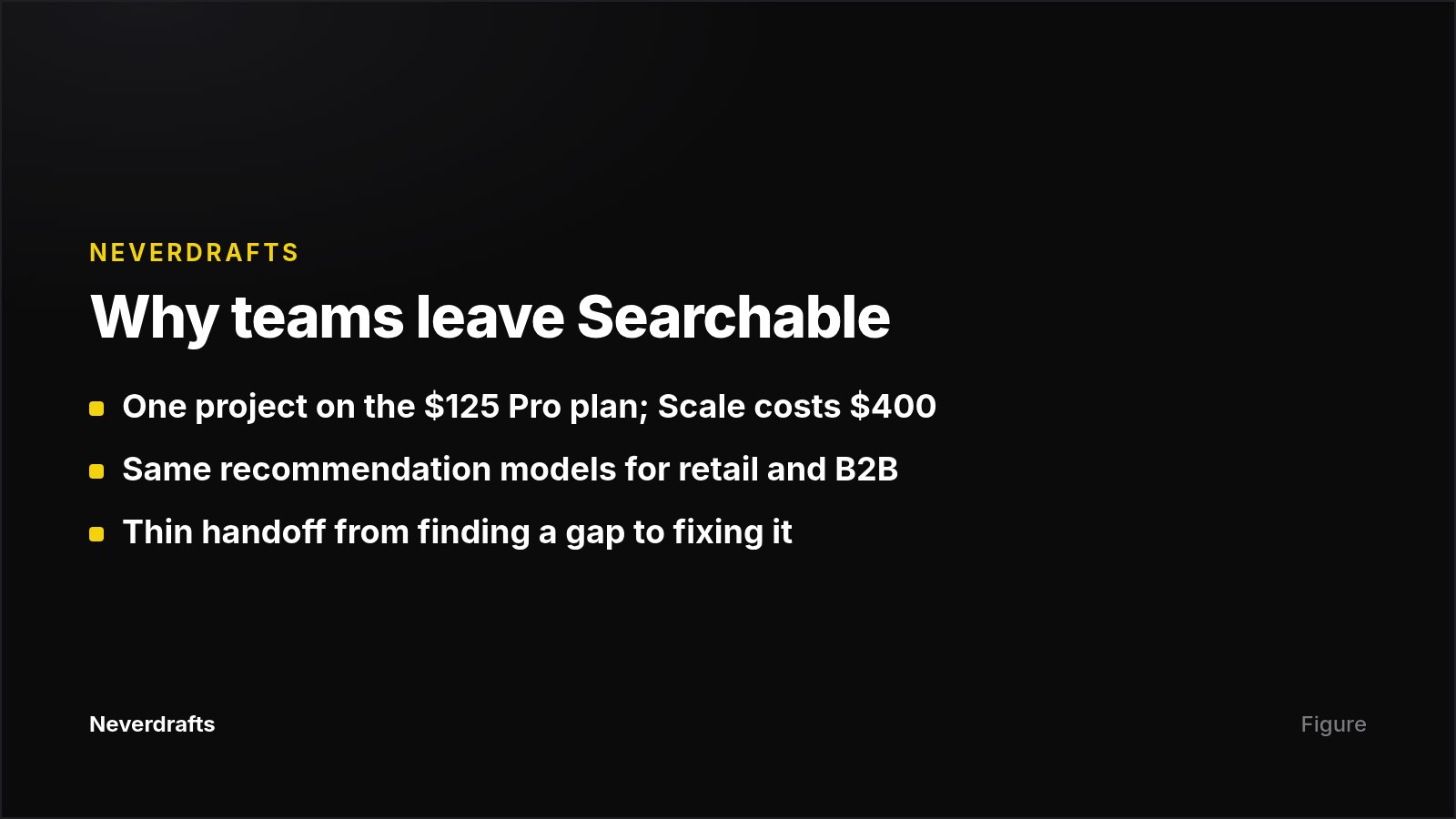
Most teams leave Searchable for one of three documented reasons: the one-project cap on the $125 Pro plan, generic cross-vertical recommendations, and a thin handoff from finding a gap to fixing it.
Searchable is a UK-based platform that tracks brand mentions and citations across up to nine answer engines, benchmarks share of voice against competitors, runs technical site audits and generates AI-optimized articles. It also lets you pick engines during onboarding rather than unlocking them by tier, and it offers unlimited seats on every plan. Those are real advantages, and not every alternative matches them.
All three reasons teams cite for leaving are documented by Gracker.ai:
- Project limits. Pro at $125/month covers one project. A second product, a separately tracked region or a single side client pushes you to Scale at $400/month.
- Generic recommendations. Searchable serves e-commerce, B2B software, agencies and enterprise marketing teams from the same models. Teams selling technical products report guidance that "reads like it was written for a retail catalog."
- Monitoring-first architecture. You get visibility data and content generation. The handoff from "here is a gap" to "here is who fixes it" is weak.
Identify which of these applies to you before you read the list. A team hitting the project cap needs a different tool than a team frustrated by generic advice.
Searchable alternatives compared at a glance
| Tool | Best for | Standout feature | Entry price (per sources) | Engines at entry tier |
|---|---|---|---|---|
| Searchable (baseline) | Agencies, e-commerce | Engines chosen at onboarding, unlimited seats | $125/mo | Up to 9 |
| GrackerAI | B2B SaaS, cybersecurity | Diagnostic agents plus task syncing | $99/mo ($79 annual) | 3 (10 on Enterprise) |
| Otterly.AI | Budget monitoring | 15 prompts, unlimited team members | $29/mo ($25 annual) | 4, plus add-ons |
| Peec AI | Marketing teams wanting structured reporting | Brand perception and SKU-level tracking | $95/mo (geotoolbox lists €85/mo) | Choose 3 |
| Neverdrafts | Multi-brand teams wanting monitor-to-publish | Remediation articles plus bot-traffic proof | $99/mo | 4 |
| Profound | Enterprise citation reporting | Clean citation reporting | Custom (7-day trial) | 3 on trial, 9 on Enterprise |
| Scrunch AI | Mid-market and enterprise | Persona-based analysis | $250/mo | 4 (9 on Enterprise) |
| Semrush AI Visibility Toolkit | Existing Semrush users | SEO and AI data in one account | From $99/mo per domain | 5 |
| Ahrefs Brand Radar | Existing Ahrefs users | Benchmarking on large prompt data | Bundled from Ahrefs Lite; $199/mo standalone | Varies by plan |
| AthenaHQ | Agencies | 11 models, unlimited agency seats | $295/mo (~$245 annual) | 11 |
| Rankscale | Lowest-cost breadth | 10 surfaces including Claude, DeepSeek, Mistral | €20/mo | 10 surfaces |
| SE Visible | SEO plus AI in one stack | Five engines at entry | $99/mo | 5 |
Pricing compiled from Gracker.ai (August 2026), geotoolbox (September 2026) and vendor pricing pages. Neverdrafts pricing is from our own pricing. Confirm current rates before you buy.
1. GrackerAI: best for B2B SaaS and cybersecurity teams
GrackerAI is an AEO and GEO platform built for cybersecurity and B2B SaaS companies. It addresses Searchable's "generic recommendations" gap most directly. According to GrackerAI's own comparison, it uses vertical-tuned analysis models, a cybersecurity prompt library and diagnostic agents that explain why a page lost a citation. Keep in mind that this description is vendor-authored.
Who it suits: technical B2B marketing teams that sell products like SIEM, zero trust or identity software and need recommendations written for that buyer.
Strengths:
- Tracks up to 10 engines: ChatGPT, Perplexity, Google AI Mode, Microsoft Copilot, Google AI Overviews, Gemini, DeepSeek, Grok, Claude and Brave Leo.
- Visibility Diagnosis runs an agent on any prompt you're missing from. It returns either a content brief or a prioritized gap report.
- Built-in Tasks sync to Asana, ClickUp, Notion and Jira. This is the clearest answer on this list to Searchable's thin execution layer.
- A read-only MCP connector lets you query your visibility data from Claude.
- Its content engine generates new articles and rewrites pages that fail to earn citations.
Limitations:
- The Starter plan tracks 100 prompts weekly rather than daily. It covers 3 engines and includes 1 seat.
- All 10 engines and multi-product tracking require the custom-priced Enterprise plan.
- The vertical tuning is a benefit only if you are in its verticals. E-commerce brands gain little.
Pricing: Starter is $99/month ($79 annual). Scale is $499/month ($399 annual) for 200 daily prompts, 4 engines, 10 articles and 4 seats. A 7-day trial requires a card.
2. Otterly.AI: best low-cost replacement for pure tracking
Zapier's tested roundup names Otterly.AI best for affordability. It does not try to be a content platform. It tracks, audits and recommends.
Who it suits: solo marketers and small teams that want daily tracking without a $100+ commitment.
Strengths:
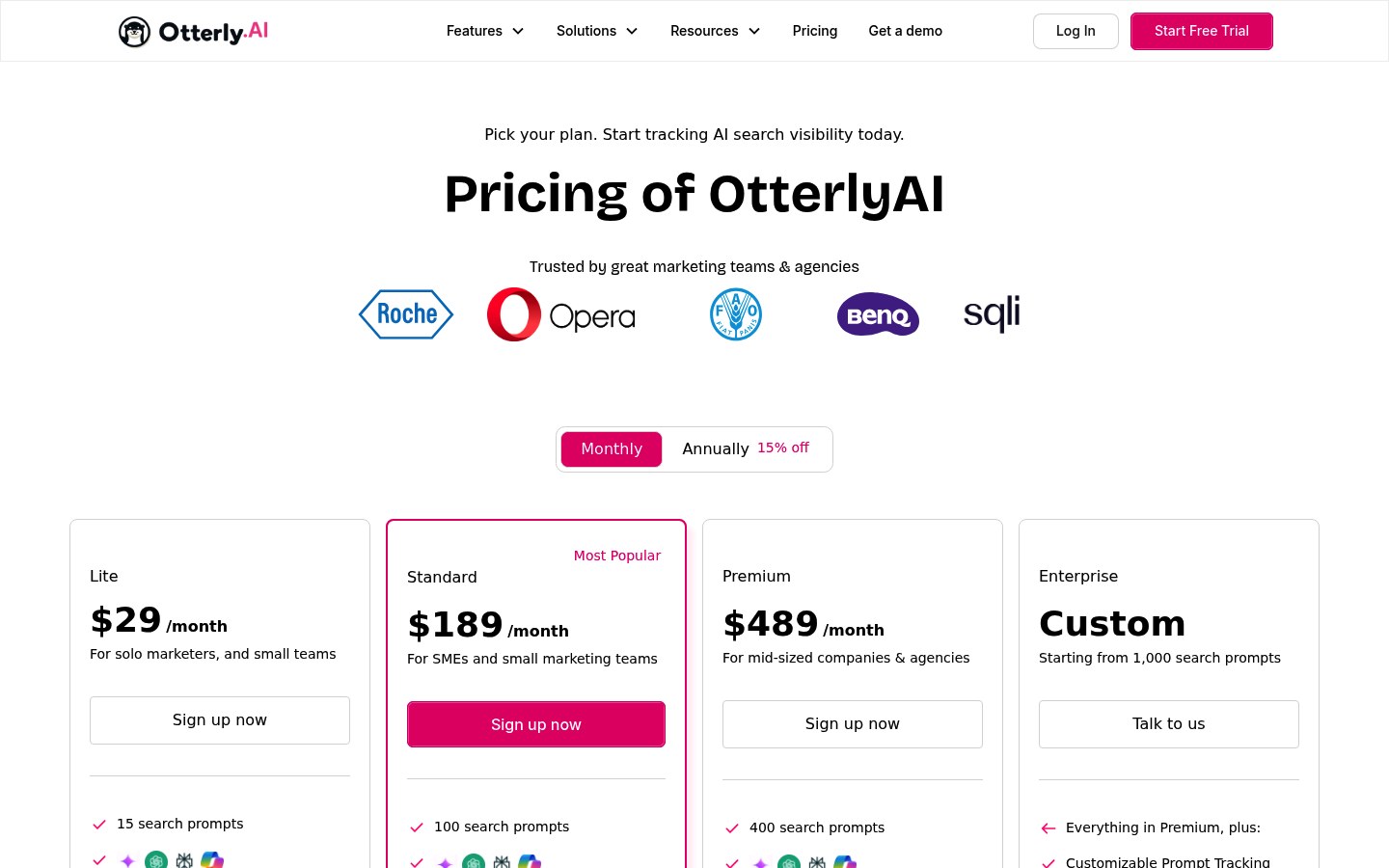
- Lite at $29/month includes 15 prompts across ChatGPT, Google AI Overviews, Perplexity and Microsoft Copilot, tracked daily.
- Every tier includes unlimited team members. That matches Searchable's unlimited seats.
- Lite includes 1,000 GEO URL audits per month, a crawlability audit, citation source tracking and sentiment analysis.
- Standard and above add unlimited workspaces, API access and MCP access.
Limitations:
- Claude, Google AI Mode and Gemini are paid add-ons rather than included.
- Lite is limited to 1 workspace and 3 recommendations per week.
- Extra prompts cost $99 per 100, so costs rise quickly as prompt volume grows.
- It does not generate content, so you still need a separate process to act on gaps.
Pricing: Lite is $29/month. Standard is $189/month for 100 prompts. Premium is $489/month for 400 prompts. Annual billing saves 15%, bringing those to $25, $160 and $422.
3. Peec AI: best for structured reporting and brand perception
Peec AI positions itself as AI search analytics for marketing teams and SEO agencies. Zapier picked it for smart suggestions. Its pricing page also shows one of the deepest measurement layers in the category.
Who it suits: SEO and content teams that need to report visibility, position, sentiment and share of voice to stakeholders. It also suits e-commerce brands that need product-level data.
Strengths:
- Unlimited users on every plan, with daily tracking from Starter up.
- Brand perception features include attribute scoring, recurring "objections" AI raises against your brand, and fact-checking of AI claims against facts you set.
- AI Shopping features include Shopify or CSV catalog upload and SKU-level visibility and win rate.
- Source classification labels each cited domain as competitor, editorial, reference or UGC.
- The Advanced plan adds 5 projects, multi-country tracking and a Looker Studio integration.
Limitations:
- Self-serve plans let you choose only 3 models. The full set of up to 13 is Enterprise-only.
- Starter includes 1 project, so the project cap is similar to Searchable's Pro.
- Peec is analytics-only. There is no content generation.
- API access is listed only on Enterprise.
Pricing: Starter is $95/month for 50 prompts. geotoolbox lists it at €85/month. Pro adds 150 prompts and 2 projects, and Advanced offers 350 prompts and 5 projects. Pro and Advanced prices were not stated in our sources.
4. Neverdrafts: best for multi-brand teams that want monitoring through publishing
Neverdrafts is our product, so weigh this entry with that in mind. It tracks real ChatGPT, Claude, Google AI Mode and Perplexity answers daily on the prompts your buyers ask. It then diagnoses why you are absent, generates content aimed at the exact prompts you are losing, and publishes it. It targets Searchable's first and third gaps: project limits and the gap between finding a problem and fixing it.
Who it suits: brands and agencies managing several brands or clients that want one tool to go from "we're missing from this answer" to a published page.
Strengths:
- Position-weighted visibility scoring from 0 to 100 shows where you appear in each AI answer, not just whether you appear. Scores come from real web interfaces rather than APIs.
- Remediation content is generated for the specific lost prompts. It publishes in one click to WordPress, Webflow, Shopify and Framer, with an API for custom stacks.
- An AI bot-traffic tracker shows crawlers from those AI systems visiting your pages. That gives you a receipt that remediation content is being fetched.
- Reports cover citation volume, sentiment, citing domains and share of voice against competitors.
- White-label reporting is available for agencies, and content generation supports 150+ languages.
Limitations:
- It tracks four engines. GrackerAI covers 10 on Enterprise, Rankscale covers 10 surfaces, and Searchable covers up to 9. If Gemini, Copilot, DeepSeek or Grok matter to your buyers, look elsewhere or pair tools.
- It has no vertical-tuned models comparable to GrackerAI's cybersecurity focus.
- It has none of Peec's e-commerce-specific features such as SKU-level tracking.
Pricing: Starter is $99/month for 1 brand, 50 prompts and 30 articles. Growth is $199/month for 3 brands, 150 prompts and 100 articles. Agency is $399/month for 10 brands, 500 prompts and 300 articles. Billing is monthly with no contract, and a free audit requires no credit card. We publish a direct Neverdrafts vs Searchable comparison if you want the head-to-head.
5. Profound: best enterprise alternative for citation reporting
Profound is the enterprise reference point in this category. Gracker.ai describes it as the pick for enterprise teams that want clean citation reporting.
Who it suits: large brands with procurement processes, dedicated GEO staff and a budget for custom contracts.
Strengths:
- Enterprise coverage reaches 9 engines.
- geotoolbox lists it first, as its pick for enterprise depth.
- A 7-day free trial lets you test before engaging sales.
Limitations:
- No published self-serve brand tier. Pricing is custom.
- The trial covers 3 engines: ChatGPT, Gemini and AI Overviews. Gracker.ai lists the trial at 1 engine, so confirm what you will get.
- It does not generate content, so it does not address Searchable's execution gap.
Pricing: custom Enterprise only. If budget is the constraint, see our roundup of AI visibility toolkit alternatives.
6. Scrunch AI: best mid-market option for persona-based analysis
Scrunch AI sits between budget trackers and full enterprise platforms. geotoolbox highlights it for enterprise use and AI-readable delivery. Gracker.ai notes its persona-based analysis for mid-market teams.
Who it suits: mid-market teams whose buyers ask different questions depending on role, such as a CFO versus an engineer evaluating the same product.
Strengths:
- Persona-based analysis segments visibility by buyer type.
- Core includes 4 engines, and Enterprise expands to 9.
- A 7-day trial is available.
Limitations:
- At $250/month, Core costs twice Searchable Pro while tracking fewer engines than Searchable's maximum.
- No content generation.
- Full engine coverage requires Enterprise.
Pricing: from $250/month for Core.
7. Semrush AI Visibility Toolkit: best if you already use Semrush
Semrush added AI visibility tracking to its SEO suite. Zapier recommends it for existing Semrush users. The main argument for it is consolidation: one login, one bill and SEO data next to AI data.
Who it suits: SEO professionals and agencies already running Semrush who don't want another vendor.
Strengths:
- 5 engines at entry: ChatGPT, AI Overviews, AI Mode, Gemini and Perplexity. That is more than Otterly, Peec or GrackerAI include at entry.
- Available standalone or bundled into SEO + AI Search plans.
- A free checker and trial are available.
Limitations:
- Pricing is per domain, so multi-brand tracking multiplies cost, which is the same issue as Searchable's project cap.
- It is a module inside a larger SEO suite rather than a dedicated GEO workflow.
- Its pricing changed during Q3 2026, according to geotoolbox.
Pricing: from $99/month per domain standalone. For a deeper look at the competition here, see our Semrush AI Toolkit alternatives.
8. Ahrefs Brand Radar: best for benchmarking on large prompt datasets
Ahrefs Brand Radar fills the same role for the Ahrefs ecosystem. geotoolbox rates it best for benchmarking on big prompt data.
Who it suits: teams already paying for Ahrefs that want competitive benchmarking without onboarding a new tool.
Strengths:
- Custom Prompts cover all platforms, Claude included, and are free on Lite and above.
- Its large indexed prompt dataset helps with category-wide benchmarking.
Limitations:
- It is not bundled with the $29 Ahrefs Starter plan.
- Indexed data is priced per platform, so full coverage is expensive.
- No content generation or task workflow.
- Prices are inconsistent across sources. Gracker.ai lists $129/month bundled, while geotoolbox notes it was repriced recently.
Pricing: Index costs $199/month per platform or $699/month for all platforms, according to geotoolbox's September 2026 check.
9. AthenaHQ: best for agencies that need many seats and many models
AthenaHQ is geotoolbox's pick for agencies, mainly because of unlimited agency seats and 11 models.
Who it suits: agencies where account managers, strategists and clients all need dashboard access, and where broad model coverage is part of the pitch.
Strengths:
- 11 models at entry, the broadest entry-level coverage in our sources.
- Unlimited agency seats.
- A free credit tier lets you test without committing.
Limitations:
- $295/month is more than double Searchable Pro.
- It was among the vendors that repriced in Q3 2026, so confirm current terms.
- Our sources did not document content or execution features.
Pricing: $295/month (~$245 annual). Agencies packaging this into client work may find our guide on building AI visibility monitoring into an SEO retainer useful.
10. Rankscale: best for the widest coverage on the smallest budget
Rankscale is geotoolbox's pick for budget breadth. It tracks 10 surfaces, including Claude, DeepSeek and Mistral, for €20/month (roughly $22).
Who it suits: small businesses and freelancers who want to see how they appear across many engines, including less-tracked ones like Mistral, before investing in a larger platform.
Strengths:
- €20/month, roughly $22 USD.
- 10 surfaces, including engines most entry tiers skip.
- A Pro trial is available.
Limitations:
- It uses a credit system, so actual monthly cost depends on how many prompts and engines you run.
- Our sources did not document project limits, content features or workflow integrations.
- It is a tracking tool only.
Pricing: from €20/month.
11. SE Visible: best for combining SEO and AI tracking at $99
SE Visible fits teams that want SEO and AI tracking in one stack without committing to Semrush or Ahrefs.
Who it suits: SEO professionals who want five-engine coverage at a single published price.
Strengths:
- $99/month covers ChatGPT, Gemini, AI Mode, AI Overviews and Perplexity.
- A 10-day trial is longer than most competitors offer.
Limitations:
- Our sources did not document project or seat limits, content generation or integrations. Ask the vendor about these before switching from Searchable.
Pricing: $99/month.
Other Searchable alternatives worth a look
A few more tools appear in the comparisons with less detail available:
- Knowatoa: from $59/month, 3 to 7 engines, with AI agent drafting. Gracker.ai names it alongside Otterly as one of the most affordable entry points.
- Goodie AI: from $399/month, 5 to 13 engines, aimed at enterprise retail, travel and commerce brands, with optimization actions included.
- ZipTie: Zapier's pick for deep analysis and reporting. It tracks responses using methods that mimic real user behavior rather than relying only on APIs, which Zapier notes can better reflect what users see.
- AirOps: free to start, with task-based pricing and workflow-based content generation for content teams operating at scale.
What does it cost to get past Searchable's one-project limit?
Searchable's documented pain point is paying $400/month for Scale as soon as you need a second project. This is what the same jump costs elsewhere, based on what each source states:
| Tool | Multi-project or multi-brand plan | Price |
|---|---|---|
| Searchable | Scale | $400/mo |
| Otterly.AI | Standard (unlimited workspaces) | $189/mo |
| Neverdrafts | Growth (3 brands) / Agency (10 brands) | $199/mo / $399/mo |
| Peec AI | Pro (2 projects) / Advanced (5 projects) | Not stated in sources |
| GrackerAI | Enterprise (multi-product tracking) | Custom |
| Semrush AI Visibility Toolkit | Per domain | $99/mo per domain |
Two caveats apply. First, "project," "workspace" and "brand" are not defined the same way across vendors, so check what each unit includes. Second, prompt volume and engine count change the comparison. Otterly's 100 prompts across 4 engines and our 150 prompts across 4 engines are not identical products. The table tells you where the price jump happens, not which tool is better.
How accurate is any of this tracking?
None of these tools gives you ground truth. LLMs are non-deterministic: the same prompt on the same engine at the same time can return different answers. Paul Dyer, CEO of the agency /prompt, as quoted by geotoolbox, told Digiday: "If you use three different tools and give them the same prompts, you get three different answers."
That has practical consequences when you switch from Searchable:
- Expect your numbers to change. A new tool may show different share of voice for the same prompts. That doesn't mean Searchable was wrong or the new tool is right.
- Watch trends rather than single readings. Daily tracking matters because one run tells you little. Weekly tracking, as on GrackerAI's Starter, gives you fewer data points to average.
- Ask how answers are collected. Some tools query APIs, while others capture the real web interface. Zapier notes that methods mimicking real user behavior can better reflect what users see.
No source we reviewed publishes comparative accuracy rates or variance ranges across platforms. Be skeptical of any vendor claiming its numbers are definitively correct.
Check crawler reachability before you switch
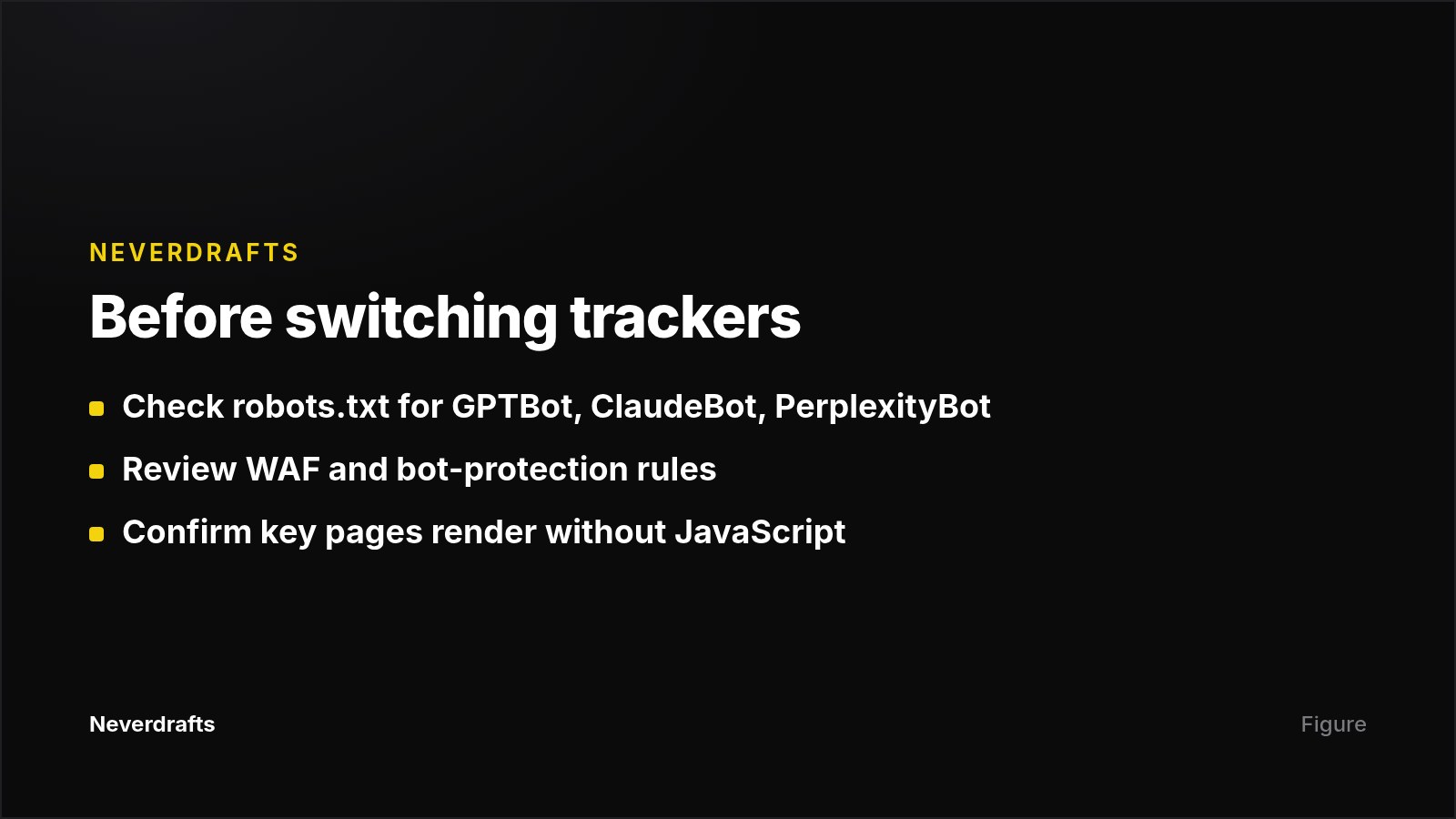
Confirm AI crawlers like GPTBot, ClaudeBot and PerplexityBot can fetch your site before paying for any tracker — a step geotoolbox points out that most vendor pages skip, since there's no subscription to sell in telling you this.
GPTBot, ClaudeBot and PerplexityBot need to fetch your pages to learn what your brand does. On Google's side, Google-Extended governs Gemini training and grounding, while AI Overviews and AI Mode use regular Googlebot.
A robots.txt rule copied from an old template, an aggressive WAF or a JavaScript-only render can make you invisible to several engines at once. In geotoolbox's experience, teams pay $300+ a month to track engines their own CDN is blocking. The dashboard shows zero mentions, the team rewrites content, and the real fix was a single firewall rule.
If your Searchable dashboard has shown persistent zeros on specific engines, check reachability before concluding the tool is the problem. Switching vendors won't fix a blocked crawler.
How to choose the right Searchable alternative
We assessed each tool against Searchable using the criteria below. They draw on Zapier's evaluation framework and geotoolbox's insistence on per-tier coverage.
Engine coverage on the tier you'll buy
Searchable's selectable engines are a strong baseline. Many alternatives limit engines by tier, such as Peec's 3 on self-serve, Profound's 3 on trial and Scrunch's 4 on Core. List the engines your buyers actually use, then check whether your target plan includes them. Ignore the vendor's maximum.
Projects, brands and seats
If the project cap is why you're leaving, compare the cost of the plan you'll need in six months, not today. Searchable includes unlimited seats. Otterly, Peec and AthenaHQ match that, while GrackerAI Starter includes one seat.
Recommendations that fit your vertical
If Searchable's advice felt generic, test each alternative with five prompts from your real sales conversations. Judge whether the recommendations name sources, page types and competitors that matter in your category.
What happens after a gap is found
Decide whether you want a dashboard or a workflow. Pure trackers include Otterly, Peec, Profound, Scrunch, Rankscale and Semrush. Tools with execution layers include GrackerAI (tasks and rewrites), Neverdrafts (content and publishing), AirOps (workflows) and Knowatoa (agent drafting). Searchable sits in between.
Total cost at your real prompt volume
Entry prices are misleading. Model the add-ons as well, including Otterly's $99 per 100 extra prompts, Peec's model limits, Rankscale's credits and per-domain pricing at Semrush. Zapier suggests calculating cost per prompt as you scale frequency, engines and regions.
Who wrote the comparison
Most rankings for this query come from vendors. geotoolbox points out that Profound's list ranks Profound first, Frase's ranks Frase first, and Backlinko, owned by Semrush, puts Semrush first. Gracker.ai's Searchable comparison ranks GrackerAI first. This article includes our own product. Use free trials to verify claims yourself.
Next step
If you're leaving Searchable because of the project cap or the gap between finding a problem and fixing it, start with our free audit. It shows where AI answers recommend competitors instead of you, and it doesn't require a credit card. Then compare the specifics in our Neverdrafts vs Searchable breakdown before you decide. Whichever tool you pick, run a crawler reachability check first.
Frequently asked questions
What is the cheapest Searchable alternative?
Rankscale is the lowest-priced option in our sources at €20/month, covering 10 surfaces on a credit system. Otterly.AI Lite costs $29/month, or $25 billed annually, for 15 prompts across 4 engines with unlimited team members. Both are tracking-only tools without content generation, so they suit teams that just need visibility data rather than an end-to-end workflow.
Which Searchable alternative tracks the most AI engines?
At entry level, AthenaHQ covers 11 models for $295/month, and Rankscale covers 10 surfaces for €20/month. At the top end, Goodie AI reaches up to 13 engines, Peec AI tracks up to 13 on Enterprise, and GrackerAI covers 10 on Enterprise. Always check coverage on the specific tier you plan to buy, because maximum figures often apply only to custom-priced plans.
Why do AI visibility tools show different results for the same prompts?
LLMs are non-deterministic, so the same prompt can return different answers even moments apart. Tools also differ in how they collect answers: some use APIs, while others capture the real user interface, which Zapier notes can better reflect what users see. Results and cost also shift with the frequency, engines and regions you choose to track. Expect some variance between any two tools, and focus on trends over weeks rather than single readings when judging progress.
Is Searchable still a good choice for some teams?
Yes. Searchable tracks up to nine engines, lets you select engines during onboarding instead of locking them behind tiers, includes content generation and offers unlimited seats on every tier. If you run one project, sell in a non-technical category and have a team that acts on visibility data, it remains a reasonable platform at $125/month.
Should I check AI crawler access before buying a tracker?
Yes. A blocking robots.txt rule, WAF setting or JavaScript-only render can make your site invisible to GPTBot, ClaudeBot or PerplexityBot. In that case, any tracker will report few or no mentions regardless of content quality. geotoolbox notes this failure is common and expensive. A few minutes checking access can save months of paying to track a problem one rule change would fix.