
The strongest Semrush AI Visibility Toolkit alternatives in 2026 depend on the job:
- Enterprise research: Ahrefs Brand Radar and Profound.
- Lean budgets: Peec AI and Otterly.ai.
- Replacing a full SEO suite: SE Ranking.
- Fixing gaps, not just measuring them: xSeek, ZeroRank and Neverdrafts.
Semrush's toolkit costs $99 a month per domain for 25 tracked prompts across five engines, and Copilot and Claude are reserved for its Enterprise tier. Most alternatives beat it on prompts per dollar, engine coverage, or both.
Disclosure: Neverdrafts is our product.
Key takeaways
- Semrush's standalone AI Visibility Toolkit is $99/month with 25 prompts, no free trial, and $60/month per 50 extra prompts.
- Budget trackers such as Otterly.ai start at $29/month for 15 prompts. Searchable and SE Ranking offer 100 prompts for roughly $125–$129/month.
- Ahrefs Brand Radar costs $828/month minimum for all six platforms once you include the base Ahrefs subscription.
- Most tools on this list measure visibility. Only a few help you change it, and that "measure vs. move" split matters more than raw engine counts.
- Our sources disagree on several vendors' prices and engine lists, so treat every number here as a starting point and confirm on the vendor page before buying.
How do the leading alternatives compare at a glance?
On prompts per dollar, Searchable, SE Ranking and ZeroRank lead; on enterprise research depth, Profound and Ahrefs Brand Radar lead. Prices below come from the sources cited in each section. Where sources disagree, the table shows the range and the item section explains the discrepancy.
| Tool | Best for | Standout feature | Entry pricing (per sources) | Copilot / Claude |
|---|---|---|---|---|
| Semrush AI Visibility Toolkit (baseline) | Existing Semrush users | One login with SEO, PPC, content | $99/mo per domain, 25 prompts | Enterprise only |
| Ahrefs Brand Radar | Market research at scale | 354M search-backed prompt index | $199/mo per platform; $828/mo all six incl. base | Copilot yes, Claude available |
| Profound | Enterprise analytics | Published prompt volume data | Custom; one source lists $499/mo Lite | Claude on Enterprise |
| Peec AI | Clean cross-engine tracking | Simple dashboards, competitor diffs | $89–$95/mo, 50 prompts | Copilot selectable, Claude Enterprise |
| Otterly.ai | Cheapest credible start | Low entry price, focused engine list | $29/mo, 15 prompts | Copilot yes, Claude via API |
| SE Ranking | SEO suite swap | AI modules inside a full SEO suite | $89 (add-on)–$129/mo | Not listed |
| Neverdrafts | Teams that want losing prompts fixed and published | Auto-generated remediation articles plus CMS publishing | $99/mo, 50 prompts, 30 articles | Claude yes, Copilot not listed |
| Searchable | Content-led teams | 8 engines at mid-tier price | $125/mo, 100 prompts | Both yes |
| ZeroRank | Guided in-house execution | Unlimited prompts, 17 platforms | $76/mo (annual) | Both yes |
| xSeek | Marketing leads who want an action plan | Written action plans, Claude Code integration | $249.99/mo, 50 prompts | Both yes |
| AthenaHQ | Competitive intel, alerts | Action guidance, credit model | Free tier; Starter $295/mo | Copilot yes, Claude on Starter |
| Scrunch AI | Shaping how assistants answer | Agent Experience Platform, SOC 2, SSO | $250–$300/mo | Copilot yes, Claude Enterprise |
What does the Semrush AI Visibility Toolkit cost and cover in 2026?
It helps to know exactly what you are replacing. Many roundups quote Semrush's bundle prices as if they were the toolkit price. They are separate products.
The standalone toolkit. Semrush's knowledge base lists the toolkit at $99 per month, including:
- 1 folder and 1 domain for Brand Performance analysis
- 300 daily queries in AI Analysis reports and 1,000 daily queries in Prompt Research
- 25 prompts for Prompt Tracking
- AI Search Checks in Site Audit for up to 100 pages
- 10 CSV exports daily
The toolkit covers six report areas:
- Visibility Overview, with an AI Visibility Score
- Competitor Research
- Prompt Research, which Semrush describes as "keyword research for AI"
- Brand Performance (share of voice, sentiment, narratives)
- Daily Prompt Tracking
- An AI Search Site Audit that flags crawler blockers
Add-ons and seats. Extra Brand Performance domains are $99 per domain per month, and 50 more prompts cost $60/month. In corporate accounts, each subuser who needs toolkit access requires another $99 license.
Bundles. Semrush One combines SEO and AI Visibility into three tiers:
- Starter at $199/mo, or $165.17/mo billed annually, with 50 prompts
- Pro+ at $299/mo, or $248.17/mo annually, with 100 prompts
- Advanced at $549/mo, or $455.67/mo annually, with 200 prompts
The bundles also raise SEO limits, from 5 to 40 monitored websites and 500 to 5,000 daily-tracked keywords.
Engines. Self-serve plans cover ChatGPT, Google AI Overviews, Google AI Mode, Perplexity and Gemini. Microsoft Copilot, Claude, Grok and DeepSeek sit on the Enterprise AIO tier.
Ownership. Adobe completed its acquisition of Semrush on April 28, 2026 and plans to fold it into its CX Enterprise products. Self-serve plans looked unchanged when arobis checked. No source yet explains what the acquisition means for the AI roadmap, so that remains an open question for long-term buyers.
Why do teams look for a Semrush AI toolkit alternative?
The same four complaints recur across the reviews in our sources.
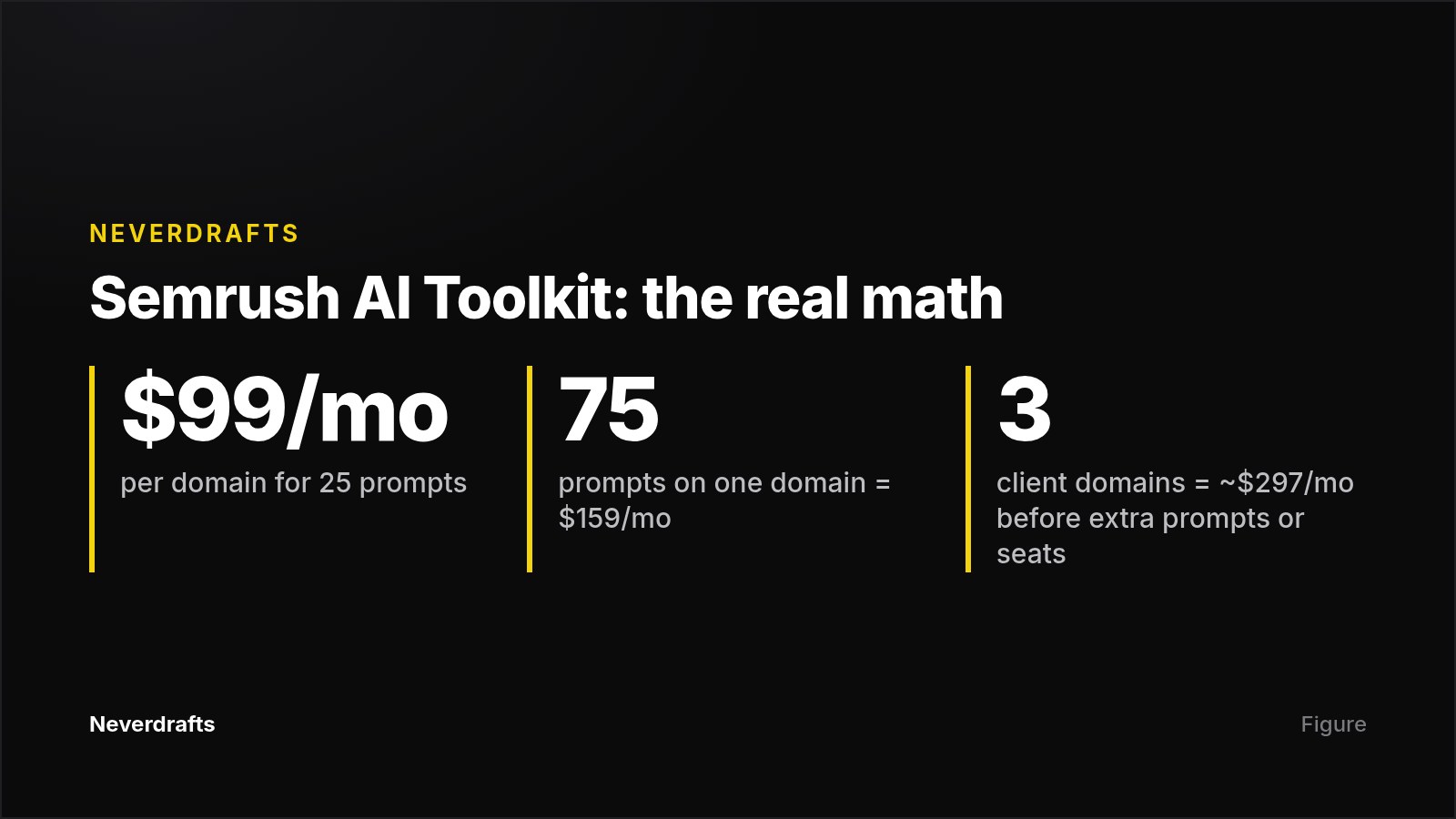
- 25 prompts is thin. A B2B SaaS company with a few personas and use cases exceeds 25 buyer prompts on day one. Adding 50 more brings you to $159/month for 75 prompts, still on one domain. That works out to about $3.96 per prompt at the base tier and about $2.12 per prompt with the add-on.
- Per-domain pricing hurts agencies. Three clients on the standalone toolkit is roughly $297 a month before extra prompts or seats.
- No Copilot or Claude below Enterprise. For B2B buyers whose customers live in Microsoft 365, the missing Copilot coverage is a real gap.
- It measures but doesn't move. Like most trackers, it tells you where you're absent from AI answers, not how to get cited.
There is also a stacking cost. xSeek calculates that Semrush Pro plus the AI Toolkit comes to $238.95/month at monthly billing. That puts it in the same range as dedicated AI visibility tools.
The pressure behind all this is real. The same source cites a Gartner forecast that search engine volume will drop 25% by 2026 as chatbots absorb queries. It also cites a Bain survey finding that 80% of US consumers use AI summaries for at least some queries.
When should you stay on Semrush instead?
Stay if you are a single-domain Semrush user whose buyers don't rely on Copilot or Claude. More precisely, stay on the Semrush toolkit if all of these apply:
- You already run SEO, PPC and content inside Semrush.
- You track a single domain.
- 25 to 75 prompts covers your buyer questions.
- Your buyers don't rely on Copilot or Claude.
One login and one invoice has value. The teams that usually gain from switching are multi-domain agencies, budget-tight startups, teams needing Copilot or Claude data, and anyone who doesn't use the rest of Semrush.
If you're unsure the category justifies spend at all, our breakdown of when AI search visibility is worth the investment for small SaaS walks through that decision first.
Ahrefs Brand Radar: best for market research at scale
What it is. Brand Radar is Ahrefs' AI visibility product. It runs on an index of 354 million search-backed prompts and is sold as an add-on to an Ahrefs subscription rather than as a standalone tool.
Who it's for. SEO teams already on Ahrefs Lite or higher who want keyword and brand data in one workspace without adding a second vendor.
Strengths:
- Research breadth. You can study how a market appears in AI answers across a large prompt index instead of only a handful of custom prompts.
- Coverage of six platforms, with Copilot included and Claude available.
- Custom prompt tracking starting from $50/month, per arobis.
Limitations:
- Cost for AI-only use cases. At $828/month minimum for full coverage, the rest of the Ahrefs platform needs to earn its keep.
- It is a measurement tool. It reports visibility and doesn't generate fixes.
Pricing. $199/month per individual AI platform or $699/month for all six, on top of Ahrefs plans that start at $129/month.
Profound: best for enterprise analytics and board-level reporting
What it is. Profound runs structured prompt sets across assistants and turns the results into dashboards, benchmarks and competitive trends for leadership. xSeek calls it the most-cited enterprise pick when buyers move upmarket from Semrush.
Who it's for. Enterprise teams with a real GEO budget, multiple stakeholders, and a need for defensible benchmarks.
Strengths:
- Published daily prompt volume data, so you can decide which prompts to prioritize.
- Attribution integrations with Vercel, Cloudflare and major CDN providers to credit AI agent traffic back to its source.
- SOC 2 compliance and content workflows inside the platform.
- Up to nine engines on Enterprise, including Claude.
Limitations:
- Premium budget and a sales cycle.
- Sources disagree on access. Arobis lists a free trial with 50 prompts. xSeek reports no self-serve trial and onboarding too heavy for a five-person team.
- Rankability lists the Lite tier's engines as ChatGPT, Perplexity and Google AIO, so the broader coverage appears tied to higher tiers.
Pricing. Custom per xSeek and arobis. Rankability lists from $499/month (Lite).
Peec AI: best for clean, simple cross-engine tracking
What it is. Peec focuses on AI search analytics for marketing teams. It helps you identify the prompts that matter, monitor mentions across assistants, and organize the sources and citations behind each answer.
Who it's for. Teams that want fast cross-engine visibility without heavy setup. xSeek also highlights its fit for multi-country tracking inside Europe.
Strengths:
- Clean reporting that non-technical stakeholders can read.
- Brand and citation views that explain why an answer did or didn't include you.
- 50 prompts at entry, double Semrush's base allowance.
Limitations:
- Engine access varies by plan. Arobis reports that the entry plan covers three models, with Copilot selectable and Claude on Enterprise.
- Cost can scale with prompt volume and regions, so model total cost before rollout.
Pricing. Sources vary:
- Rankability: from $89/month
- Arobis: $95/month ($80 annual) with 50 prompts
- xSeek: custom pricing for Pro+
No source explains the gap between the $89 and $95 figures, which may reflect billing term, region or the date each source was checked. Confirm the price for your market on Peec's own pricing page.
Otterly.ai: best for the cheapest credible start
What it is. Otterly is a focused, low-cost tracker built around the engines with the highest usage by real people. Its stated rationale is "high signal, low noise" rather than coverage of fringe tools.
Who it's for. Small teams, solo marketers and anyone testing AI visibility before committing budget.
Strengths:
- Among the lowest entry prices among paid dedicated trackers (tied with RadarKit): $29/month for 15 prompts.
- Unlimited team members on the Lite plan, per xSeek.
- Copilot tracking, which Semrush only offers on Enterprise.
Limitations:
- Only 15 prompts at entry, fewer than Semrush's 25.
- Engine coverage depends on plan. Otterly's help center, dated July 7, 2026, lists Google AI Overviews, ChatGPT, Perplexity, Google AI Mode, Gemini, Microsoft Copilot and Claude, tracking Claude via API using the Sonnet model with web search. Arobis and xSeek list four engines at entry, and arobis describes Claude as an add-on.
- It measures visibility and doesn't produce fixes.
Pricing. From $29/month (Lite).
SE Ranking: best suite-style swap for Semrush
What it is. SE Ranking offers several AI modules inside a full SEO suite: AI Visibility, AIO Tracker, AI Mode Tracker and ChatGPT Visibility. Rankability calls it the closest suite-style peer to Semrush.
Who it's for. Teams that want one vendor for traditional SEO and AI search, at lower cost than Semrush's bundles.
Strengths:
- 100 prompts plus a full SEO suite for $129/month, about $1.29 per prompt.
- Competitive SMB and agency pricing.
- A realistic full replacement, not only an AI add-on.
Limitations:
- Arobis lists five engines with no Copilot or Claude.
- Rankability notes that Perplexity and Gemini were on the roadmap at its time of writing. Confirm which modules your plan includes.
Pricing. Sources vary:
- Rankability: from $89/month as an add-on
- xSeek: $103.20/month (annual)
- Arobis: $129/month
Neverdrafts: best for teams that want losing prompts fixed, not only flagged
Disclosure: Neverdrafts is our product.
What it is. Neverdrafts is a GEO platform that runs a monitor → diagnose → fix → prove loop:
- Monitor. It checks real ChatGPT, Claude, Google AI Mode and Perplexity answers daily on your tracked prompts.
- Diagnose. It shows which sources AI cites instead of you when you lose a prompt.
- Fix. It auto-generates remediation articles targeted at those specific losing prompts and publishes them in one click to WordPress, Webflow, Shopify, Framer or a custom API.
- Prove. An AI bot-traffic tracker shows which crawlers visit the published pages.
Who it's for. B2B SaaS teams, agencies and product teams whose main bottleneck is producing and publishing the content that wins answers back, rather than analyzing dashboards.
Strengths:
- At the same $99/month as Semrush's toolkit, Starter includes 50 tracked prompts instead of 25, plus 30 remediation articles per month.
- Position-weighted visibility scoring (0–100 per response) shows where in an answer you appear, not only whether you appear.
- Claude coverage at entry, which Semrush reserves for Enterprise.
- Sentiment tracking, content generation in 150+ languages, and white-label reports for agencies.
Limitations:
- Four engines. Gemini, Google AI Overviews and Microsoft Copilot aren't listed, so teams whose buyers rely on those should look elsewhere or pair tools.
- It is not positioned as an SEO suite, so it does not replace the rest of Semrush for keyword research or audits.
- It is built around remediation. If you only want benchmarking across a large research index, Ahrefs Brand Radar or Profound are closer fits.
Pricing.
- Starter: $99/month (1 brand, 50 prompts, 30 articles)
- Growth: $199/month (3 brands, 150 prompts, 100 articles)
- Agency: $399/month (10 brands, 500 prompts, 300 articles)
A $1 three-day full-access trial is available, with monthly billing and no contracts. A feature comparison against Profound is on our Neverdrafts vs Profound page.
Searchable: best for content-led teams that want more engines
What it is. Searchable is a mid-priced tracker aimed at content-led teams.
Who it's for. Teams that want roughly Semrush-level spend with four times the prompts and broader engine coverage.
Strengths:
- $125/month for 100 prompts across 8 engines, about $1.25 per prompt.
- Copilot and Claude included at entry.
Limitations:
- It is a measurement tool. Arobis classifies it as "measure" rather than "move."
- Our sources give less detail on its workflow features than on its pricing, so trial it before committing.
Pricing. From $125/month.
ZeroRank: best for guided in-house execution on a budget
What it is. ZeroRank pairs very wide engine coverage with some execution guidance.
Who it's for. In-house teams that want to track many platforms and receive direction on what to do next, without enterprise pricing.
Strengths:
- $76/month billed annually with unlimited prompts and 17 platforms, including Copilot and Claude.
- Rated "measure, some action" by arobis, so it goes beyond a raw score.
Limitations:
- The headline price requires annual billing.
- Our sources don't detail how its guidance works, so assess its recommendations during a trial.
Pricing. $76/month (annual).
xSeek: best for marketing leads who want a written action plan
What it is. xSeek tracks citations across ChatGPT, Claude, Gemini, Perplexity, Copilot, xAI and Google AI Overviews. It then generates a written action plan naming specific pages to rewrite and content gaps to fill.
Who it's for. Marketing leads at 10–200 person companies who want clear next steps rather than another dashboard.
Strengths:
- Explicit action plans instead of monitoring alone.
- Claude Code integration, so writers can apply suggested edits from their editor.
- Built and operated from Canada, which matters for teams that care about data residency under PIPEDA.
- SSO/SAML and a 99.99% uptime SLA on the Scale tier.
Limitations:
- Higher entry price. Starter at $249.99/month is more than double Semrush Pro's annual price, and xSeek frames it as a bet that the action plan saves more time than it costs.
- 50 prompts and 10 "opportunities" at entry.
Pricing. Per xSeek's June 2026 pricing:
- Starter: $249.99/month (50 prompts, 1 website, 2 users)
- Growth: $499.99/month (150 prompts, 3 websites, 5 users)
- Scale: custom (500 prompts)
AthenaHQ: best for competitive intelligence with alerts
What it is. AthenaHQ is a GEO platform with competitor monitoring, alerting and action guidance.
Who it's for. Growth-stage and mid-market teams that want playbooks without an enterprise stack. xSeek positions it for high-touch enterprise GEO programs.
Strengths:
- Broad engine list: ChatGPT, Perplexity, Google AIO and AI Mode, Gemini, Claude, Copilot and Grok, per Rankability.
- Guidance on what to fix next, rated "measure, some action."
- A free tier to start, according to arobis.
Limitations:
- Credit-based pricing, per arobis and Rankability, so model expected usage before buying.
- Sampling details require contacting sales.
Pricing. Free tier; Starter $295/month, with Claude included on Starter.
Scrunch AI: best for brands that need to shape answers at enterprise scale
What it is. Scrunch combines monitoring with an Agent Experience Platform (AXP), a structured, AI-readable content layer that aligns assistant answers with your approved sources.
Who it's for. Brands that need to actively influence how assistants describe them and have the budget for a sales-assisted rollout.
Strengths:
- Optimization infrastructure, not only reporting.
- Enterprise controls: SOC 2, SSO and a Data API.
- 125 prompts at entry, with Copilot included.
Limitations:
- Claude is Enterprise-only, per arobis.
- Enterprise pricing and deployment.
Pricing.
- Arobis: $250/month
- Rankability: from $300/month
Which other tools deserve a place on your shortlist?
Several narrower tools appear in the sources and suit specific needs.
Nightwatch and LLMrefs
Nightwatch combines rank tracking with AI prompts and unlimited seats, from €79/month billed yearly with 50 prompts. It covers six engines, including Claude but not Copilot, and suits agencies that want classic rank tracking and AI data together.
LLMrefs Pro is $79/month and covers ChatGPT, Gemini and Perplexity. It adds CSV exports, an AI content A/B tester and an llms.txt generator. Its indie footprint means you should check support expectations.
Rankability
Rankability starts from $166/month on annual plans and ties prompt testing and citation mapping into its content optimizer. It suits agencies that want the "see it → fix it" loop inside existing content workflows.
Budget and entry-level options: RadarKit, Slate, and ZipTie
Three tools compete on the lowest possible cost of entry:
- RadarKit starts at $29/month for 15 prompts across six engines, with Copilot but no Claude. Arobis highlights its cheap tracking plus AI agents.
- Slate's free Solo plan tracks 4,500 prompt answers across ChatGPT and Google AI modes at no cost, making it the easiest way to test the category before committing budget.
- ZipTie is $69/month for three engines: AIO, ChatGPT and Perplexity, built for solo marketers.
Arobis AI and HubSpot
Arobis AI is a done-for-you service rather than a tracker. HubSpot bundles a 25-prompt AEO tracker for $50/month ($45 annual) for teams already on its platform.
For a narrower view of ChatGPT-specific trackers, see our ChatGPT brand mention tracking tools comparison.
How should you choose a Semrush AI toolkit alternative?
Match the tool to your engines, your scale, and how much execution help you need. We compared the tools above on five criteria drawn from the frameworks used by arobis and Rankability, and each maps to a question you can ask during a trial.
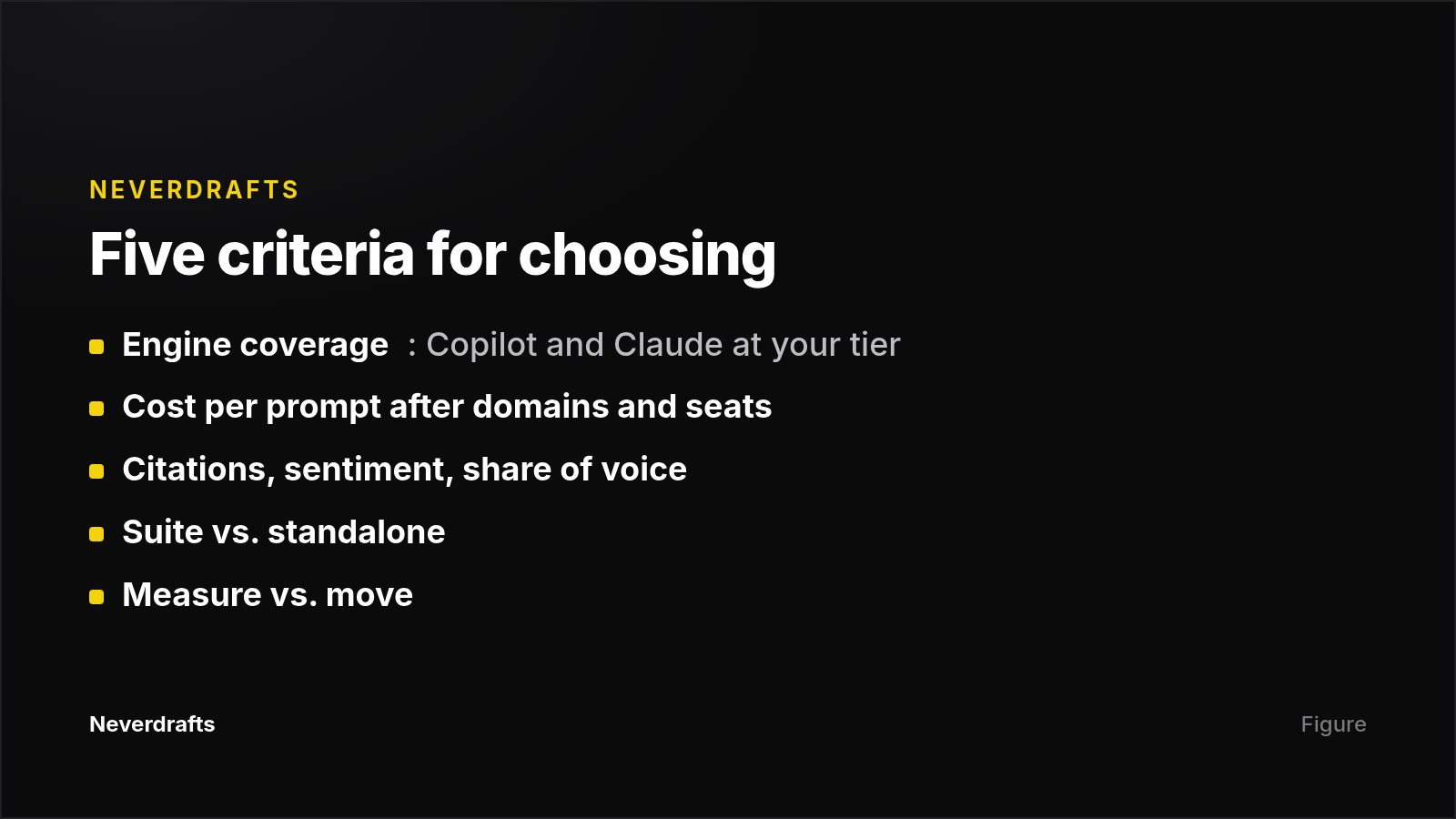
1. Does it cover the engines your buyers use?
List the assistants your customers rely on first.
- B2B buyers in Microsoft 365: Copilot is not optional. Semrush's self-serve plans, SE Ranking and Nightwatch leave a gap there.
- Developer or technical audiences: Claude matters more. Check whether it is included at entry or gated behind Enterprise, as it is for Peec, Scrunch and Semrush.
2. What is the real cost at your scale?
Ignore headline prices and calculate cost per tracked prompt, then add domains and seats. Using figures from the sources:
- Semrush: about $3.96 per prompt
- Otterly: about $1.93
- Peec (arobis pricing): about $1.90
- SE Ranking: about $1.29
- Searchable: about $1.25
- ZeroRank: unlimited prompts on annual billing
Agencies should model per-domain charges separately. That is where Semrush's pricing scales fastest.
3. What do you get beyond a visibility number?
Look for four things:
- Citation sources, so you can see who is cited instead of you
- Sentiment
- Competitor share of voice
- Position within the answer
A score without citation data tells you that you lost but not why.
4. Do you need a suite or a standalone tool?
If you still use Semrush for keyword research and audits, a standalone tracker layered alongside it may beat a full migration. If you want one vendor, SE Ranking or Ahrefs Brand Radar are the realistic suite options.
5. Does it measure, or does it help you move?
This is the criterion that separates tools most sharply. Most tools report visibility. A smaller group helps change it:
- Guidance: ZeroRank and AthenaHQ
- Written action plans: xSeek
- Content-layer infrastructure: Scrunch
- Generated and published content: Neverdrafts
Decide whether your team has the capacity to act on a dashboard. If not, pay for execution. Our 10-step sequence for improving AI visibility covers what that work involves.
One practical note: prices in this category change quarterly. xSeek verified its figures on June 1, 2026 and arobis on September 26, 2026, and the two already disagree on several vendors. Confirm on the vendor page before procurement.
Next step
If your main problem is knowing you lose prompts to competitors but lacking the capacity to fix them, start a $1 three-day Neverdrafts trial. Load the same 25 prompts you track in Semrush, compare the position-weighted scores and cited sources, and review the remediation drafts before publishing anything. If you need Gemini, AI Overviews or Copilot data, pair it with a tracker that covers those engines.
Frequently asked questions
Does Semrush offer a free trial of the AI Visibility Toolkit?
No. Semrush's knowledge base states that the AI Visibility Toolkit does not offer a free trial, and a paid subscription is required. Several alternatives do offer low-risk starts: Slate has a free Solo plan, AthenaHQ has a free tier, and Otterly.ai starts at $29/month. Profound's trial availability is reported inconsistently across sources, so confirm directly with the vendor.
Which Semrush alternative tracks Microsoft Copilot and Claude at the lowest price?
Per arobis's September 2026 pricing, ZeroRank covers both Copilot and Claude from $76/month on annual billing, with unlimited prompts across 17 platforms. Searchable includes both at $125/month for 100 prompts. Otterly.ai tracks Copilot from $29/month, but sources differ on whether Claude is included at entry or sold as an add-on.
Is Ahrefs Brand Radar cheaper than Semrush for AI visibility?
Usually not. Brand Radar costs $199/month per AI platform or $699/month for all six, on top of an Ahrefs subscription starting at $129/month, for a minimum of $828/month for full coverage — well above Semrush's $99/month per domain. Brand Radar's value lies in its 354-million-prompt research index, not its price.
What happened to Semrush after the Adobe acquisition?
Adobe completed its acquisition of Semrush on April 28, 2026 and plans to fold it into its CX Enterprise products. When arobis checked its pricing in September 2026, self-serve plans looked unchanged. No source has yet detailed long-term roadmap changes for the AI Visibility Toolkit, so watch for plan updates at renewal.
How many prompts do I actually need to track?
That depends on your personas and use cases. Arobis notes that a B2B SaaS company with three personas can exceed 25 buyer prompts on day one. Most tools start between 15 and 100 prompts, and ZeroRank offers unlimited prompts. Start with the questions buyers ask before purchasing, then expand to competitor comparisons and category queries.