
AI visibility monitoring becomes a sellable agency service when you treat it as a layer on top of an existing SEO retainer: build a fixed prompt universe per client, track it daily in a multi-client platform, report five stable metrics, and run a monthly loop that turns citation gaps into content and digital PR work. The tooling is the cheap part — entry-level platforms start at $29/month — and your margin comes from interpretation, execution and reporting, not from reselling a dashboard.
Key takeaways
- The AI search visibility services market is worth $4.39 billion in 2026 and growing at 19.55% CAGR, while only 14% of marketers track AI visibility — the gap is the sales pitch.
- Sell it as an "AI-search layer" on an existing retainer, not a standalone product. Most agencies run two tools side by side: an SEO platform for rankings and a purpose-built AEO platform for AI answers.
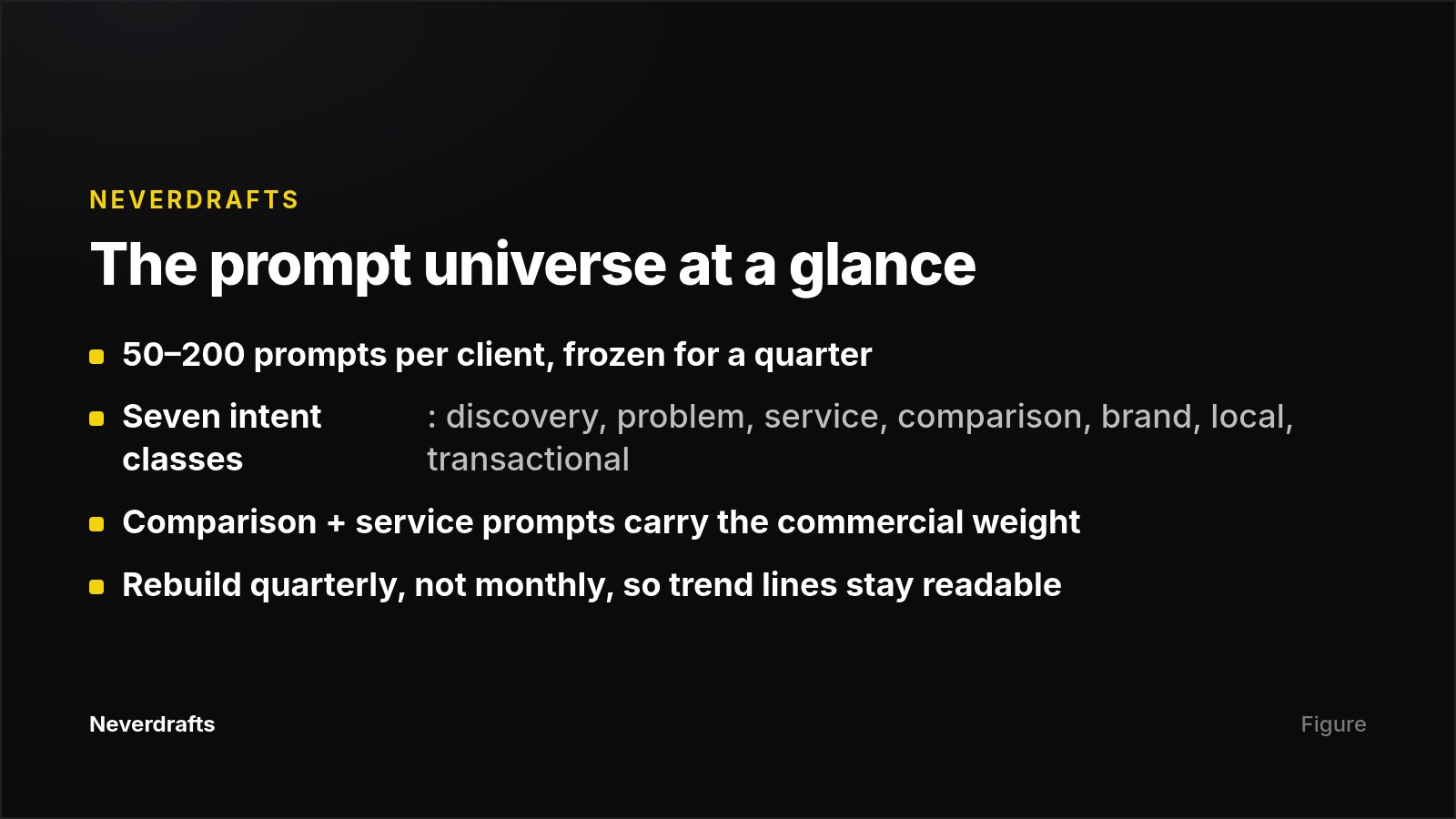
- Build 50–200 commercially meaningful prompts per client, classified by discovery, problem, service, comparison, brand, local and transactional intent. The prompt list is the deliverable clients actually pay for.
- Track five metrics only: AI Visibility, Share of Voice, Citation Share, Recommendation Rate, and Accuracy/Sentiment. Anything more becomes noise in a CMO report.
- ChatGPT, Claude and Google AI Overviews are the coverage baseline; Perplexity, Gemini, Copilot, Grok, Meta AI and DeepSeek are situational.
- Check whether a platform watches real user prompts or infers demand from an SEO keyword database and presents it as prompt data — that distinction decides how defensible your client advice is.
What you need before you start
You can launch this service with four things, and you probably already have three of them.
- A monitoring platform with per-client workspaces. Per-client workspaces are the baseline; pitch environments that let you pull up a prospect's AI visibility live on a sales call are the upgrade worth paying for.
- A prompt research process. Someone on your team needs to sit with the client's sales lead for an hour and extract the questions buyers actually ask.
- A content and digital PR capability. Monitoring names the problem; content workflows fix it. If you cannot publish or earn mentions, you are selling a dashboard.
- An analytics setup that can isolate AI referral traffic. GA4 or your preferred analytics tool, plus server log access if you want to see AI crawlers.
What you do not need: a new department, a rebrand, or a separate contract. The fastest path to revenue is an amendment to existing retainers.
Step 1: Position AI visibility as a layer on the retainer, not a new product
Agencies that launch "GEO services" as a standalone line item run into a procurement problem: the client has no budget line for it, no benchmark to compare it against, and no idea whether it replaces SEO. Framing it as an additional layer inside the existing SEO scope avoids all three objections.
Concrete actions
- Rewrite your SEO scope document to add a fourth workstream alongside technical, content and off-page: "AI answer visibility".
- Define the deliverable in one sentence: "We track the prompts your buyers ask AI assistants, report whether you appear, and fix the gaps."
- Bring the market context into the first conversation. Gartner projects traditional search traffic will decline 25% by 2026, and ChatGPT reached 900 million weekly active users in early 2026, more than double a year earlier.
- Use the conversion argument for commercial buyers: AI search traffic reportedly converts at 14.2% versus Google's 2.8%, roughly five times more valuable per session.
What good looks like: the client signs an amendment, not a new contract, and the AI layer appears as its own section in the monthly report from month one.
Common mistake: promising that AI visibility replaces organic traffic. It does not. Traditional rank tracking measures fixed positions; AI monitoring deals with probabilistic answers that shift based on phrasing, personalization and source selection. Say that out loud before the client discovers it in month two.
Step 2: Build the client's prompt universe
The prompt universe is the spine of the whole service. Everything downstream — metrics, content briefs, competitor benchmarks, reports — is derived from this list, so build it deliberately and freeze it for at least a quarter.
How many prompts and where they come from
Common agency practice is 50–200 commercially meaningful prompts per client, and that is the range we work to. In our experience, smaller lists leave you interpreting single-answer swings, and much larger ones grow your tool bill and your report length faster than they grow the insight. Sources include:
- Sales call recordings and the objections that come up repeatedly.
- The client's support inbox and live chat transcripts.
- Existing high-intent keyword sets, rewritten as full questions.
- Competitor comparison queries the client already loses on.
Classify every prompt
Tag each prompt with one of seven classifications so you can report by intent rather than by raw count:
- Discovery — "what is X", "how does X work"
- Problem — "how do I fix X"
- Service — "who provides X"
- Comparison — "best X for Y", "A vs B"
- Brand — "is [client] any good", "[client] reviews"
- Local — "X near me", "best X in [city]"
- Transactional — "cheapest X", "X pricing"
Comparison and service prompts are where budget gets won or lost. When prospects ask "best [solution] for [use case]", engines generate narrative answers citing three to five brands — if the client is not on that shortlist, they are invisible to that buyer.
What good looks like: a shared sheet with every prompt, its classification, the competitor set you expect to see, and a note on why it matters commercially.
Common mistake: letting the tool auto-generate the prompt list and shipping it unreviewed. Auto-generated prompts skew toward informational phrasing and miss the exact wording a buyer uses.
Step 3: Decide which AI engines you will track — and say so in the contract
Engine coverage is the single most misunderstood part of this service, because tools advertise wildly different lists and clients assume "AI" means all of them.
ChatGPT, Claude and Google AI Overviews are the foundation. Whether you also need Perplexity, Gemini, Copilot, Grok, Meta AI or DeepSeek depends entirely on where the client's buyers are. Coverage in the market ranges from single-engine trackers to platforms claiming 10 or more.
Concrete actions
- Pick a fixed engine set per client segment (for example: B2B SaaS gets ChatGPT, Perplexity, Google AI Overviews and Claude; local services gets ChatGPT and Google AI Overviews with geo-specific checks).
- Write the engine list into the scope document with refresh frequency. Some platforms check daily; on others, most engines refresh monthly.
- Confirm geographic coverage before onboarding international clients. Base plans vary from one country and one language to unlimited regions and 115+ languages.
If you are still shortlisting, our breakdown of AI brand monitoring tools by engine coverage and price maps which platforms cover which engines at which tier.
What good looks like: the client can name the four or five engines you monitor and knows you are not monitoring the rest.
Common mistake: buying the broadest engine list available without checking underneath it. Check refresh frequency and data source per engine before you pay for the longest list — some platforms run daily on real user prompts while others derive prompts from keyword databases and refresh monthly.
Step 4: Choose a multi-client platform (and be honest about what it does not do)
Most agencies end up running two tools side by side: the SEO platform they already live in, plus a purpose-built AEO platform for the AI side. Evaluate the AI-side tool on five things: client and prospect management, answer engine coverage, data quality, content creation workflows, and reporting and integrations.
One agency-focused review weights the criteria explicitly: AI engine coverage 25%, citation and prompt analytics 20%, content and optimization workflow 20%, agency and multi-client features 15%, AI traffic attribution 10%, pricing and scalability 10%. Note that the publisher ranks its own product first in that same list, so treat the weighting as a template for your own scorecard rather than as an endorsement.
| Platform | Agency fit | Entry price | Agency strength | Known limitation |
|---|---|---|---|---|
| Profound | AEO as a scaled service across many clients | $99/mo | Agency Mode with client workspaces and pitch environments; tracks 1.9+ billion real user prompts | Overkill for teams wanting a lightweight visibility score |
| Peec AI | Clean client dashboards | $89/mo | Daily tracking with screenshot audit trails | Monitoring only — no content generation |
| Otterly AI | Solo marketers and small agencies starting out | $29/mo | Fast setup, clear recommendations, content briefs | No real prompt-volume data, no in-platform content generation |
| Neverdrafts (our product) | Agencies wanting monitoring plus remediation content in one tool | $99/mo, Agency tier $399/mo (our own pricing) | White-label reporting, 10 brands and 500 prompts on Agency, one-click publishing | Four engines only; built for AI answer visibility, not blue-link rank tracking |
| Rankability | Agencies bundling SEO and AI visibility | $199/mo | One workflow across SEO, AI visibility, content and client reporting | AI visibility is keyword-configured, not real prompt demand |
| Scrunch AI | Agencies wanting referral economics | $250/mo | Referral commission, prospecting licenses, co-marketing funds | No content generation; prompts are configured, not pulled from real conversations |
| SE Visible | Budget-conscious agencies wanting SEO + AEO | $99/mo | Multi-brand support built into every tier | Thinnest engine coverage; no content workflows |
| Ahrefs Brand Radar | Agencies already standardised on Ahrefs | $199/mo add-on | AI monitoring inside an already-adopted SEO tool | Keyword-derived prompts; most engines refresh monthly |
For a longer evaluation of the monitoring-only field, see our review of the strongest AI visibility monitoring tools in 2026.
Where Neverdrafts fits
Disclosure: Neverdrafts is our product.
Neverdrafts is built for the agency that wants monitoring and the fix in the same tool. It monitors real ChatGPT, Claude, Google AI Mode and Perplexity answers daily across tracked buyer prompts, scores visibility 0–100 on a position-weighted basis per response, and diagnoses which citing domains AI uses when it recommends a competitor instead of your client. From there it auto-drafts remediation content aimed at the prompts the client is losing, publishes in one click to WordPress, Webflow, Shopify, Framer or an API-first stack, and tracks AI crawlers hitting those pages as proof the work landed. Published content supports 150+ languages.
For agency use, the relevant tier is Agency at $399/month: 10 brands or clients, up to 500 tracked prompts and 300 remediation articles per month, with white-label client reporting and dashboards. In the best case, with all ten brand slots filled, that is roughly $40 per client in tool cost. Smaller shops can start on Starter at $99/month (1 brand, 50 prompts, 30 articles) or Growth at $199/month (3 brands, 150 prompts, 100 articles). There is a $1 three-day full-access trial, cancel anytime, no contracts.
Honest limitations. Neverdrafts tracks four engines, not ten — a deliberate scope choice on the view that those engines reflect buyer behaviour better than a broader but less-monitored list. If a client insists on Copilot, Grok or DeepSeek coverage, it is not the tool. It is built for AI answer visibility and remediation content rather than classic blue-link rank tracking, so most agencies keep their existing SEO platform alongside it. And prompt caps are per plan, so an agency with ten enterprise clients each needing 200 prompts will outgrow the Agency tier.
Best for: agencies that want one system to monitor, draft the fix, publish it and show crawler evidence — rather than stitching a monitor, a content tool and an analytics layer together.
Common mistake at this step: picking on price alone. A $29/month tool that cannot generate content forces you to buy a content tool and a reporting tool, and you end up administering three products across a dozen accounts. Our guide to affordable Profound alternatives compares the lower tiers on that basis.
Step 5: Set the baseline and lock in five metrics
Run the full prompt universe before you do any optimization work. That first run is your baseline, and it is also your best sales asset for renewals.
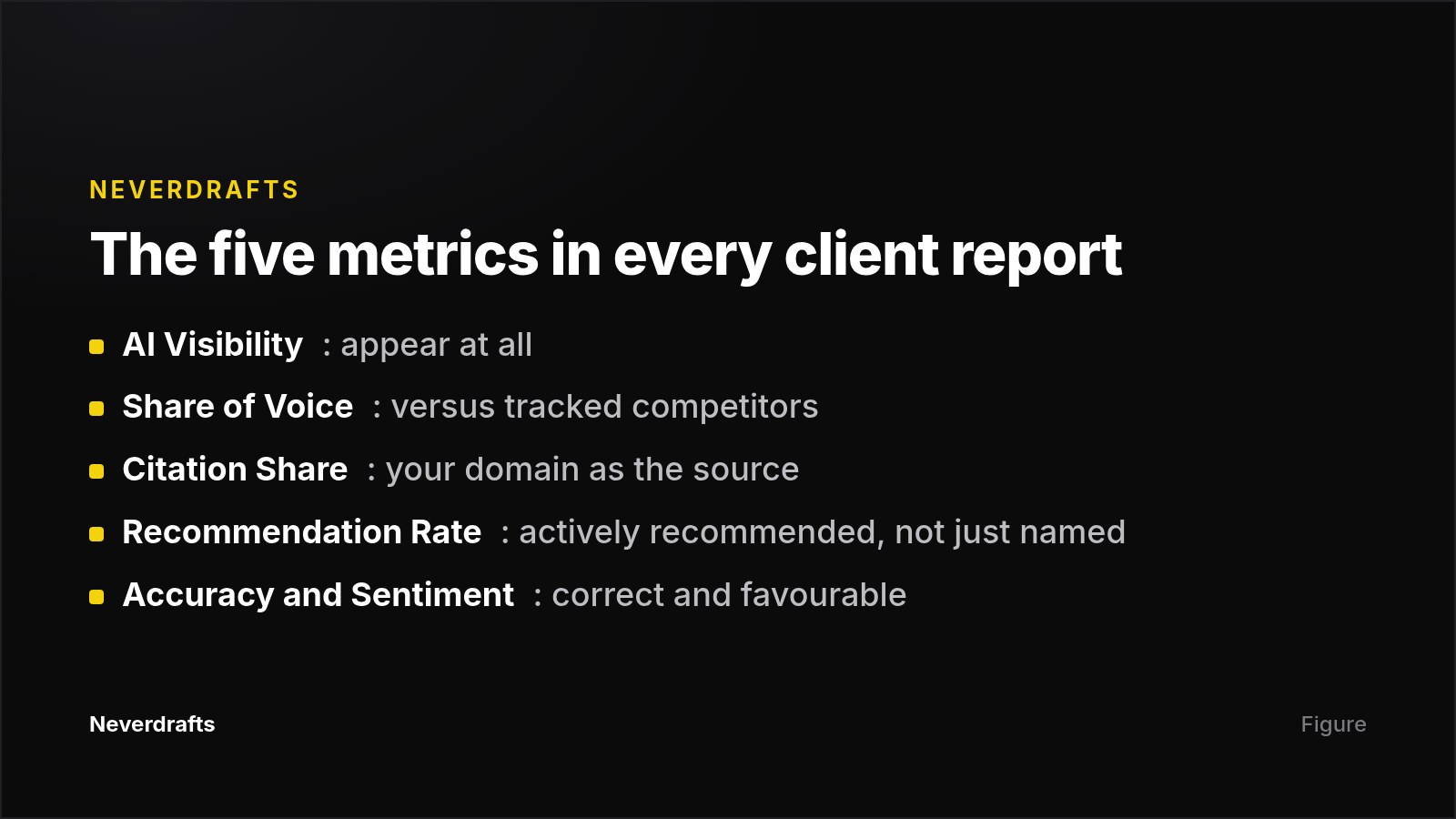
Report these five metrics and nothing else:
- AI Visibility — the share of tracked prompts where the brand appears at all.
- Share of Voice — the brand's presence relative to the tracked competitor set.
- Citation Share — how often the client's own domain is cited as a source versus third-party domains.
- Recommendation Rate — how often the brand is actively recommended, not just mentioned.
- Accuracy and Sentiment — whether the description is correct and whether the tone is positive, neutral or negative.
Capture screenshots or response snapshots for the baseline. Platforms that keep screenshot audit trails make the "we moved from invisible to cited" story verifiable months later, when the client's CFO asks.
What good looks like: a one-page baseline with the five numbers, the three competitors beating the client most often, and the ten prompts with the biggest commercial gap.
Common mistake: starting optimization before the baseline run completes. Without a clean before-state, everything you do afterwards is unprovable.
Step 6: Run a monthly loop from citation gaps to published work
This is where agency margin lives. Monitoring names the problem; the loop fixes it. A workable monthly cadence:
Week 1 — Diagnose. Pull the prompts where the client is absent or ranked below competitors. For each, note which domains the engines cited instead. You are looking for patterns: is the client losing to competitor-owned pages, to review sites, to Reddit threads, or to trade publications? A brand that dominated blue links for years can vanish from AI answers if engines shift toward Reddit threads and YouTube as primary sources.
Week 2 — Brief. Convert the top 8–12 gaps into briefs. Two types:
- Owned content for prompts where the engines cite vendor pages — comparison pages, pricing explainers, use-case pages, specific question-answer pages.
- Earned placements for prompts where the engines cite third parties — directory listings, review-site profiles, guest contributions, community answers.
Week 3 — Publish and place. Ship the owned content, submit the earned placements, and update structured data and internal linking on the affected pages.
Week 4 — Re-measure and report. Re-run the affected prompts, log movement, and write the narrative.
If you are deciding how to resource the writing side of this loop, our comparison of automated content creation tools by workflow covers where generation genuinely saves hours and where it adds editing cost.
Two practical notes. First, expect asymmetry: clawing back citations is slower than losing them, because you are competing on sources and authority, not page tweaks. Tell clients to expect a quarter, not a fortnight. Second, on llms.txt — Google has clarified that these files are not needed for Google Search and will not positively or negatively impact visibility or rankings, though it is fine to maintain them for other systems. Do not sell llms.txt as a Google ranking tactic.
What good looks like: every published asset traces back to a named prompt in the universe, and the month's report shows movement on those prompts specifically.
Common mistake: publishing generic AI-written filler at volume. Tools that produce content on SEO methodology with no real prompt-demand data behind it fill the calendar without moving citations.
Step 7: Set up AI traffic attribution before the client asks for it
Visibility metrics answer "are we mentioned". Attribution answers "did it matter". AI traffic attribution — the ability to attribute sessions and leads back to AI engines — is a genuine differentiator and is absent from many monitoring platforms.
Set up three layers, in order of effort:
- Referral segmentation. Create a dedicated channel group or segment in analytics for referrals from AI assistant domains, so AI-sourced sessions stop landing in "direct" and "other".
- Crawler evidence. Monitor AI bot hits in server logs or via a tool that tracks AI crawlers on your pages. Crawl activity on a newly published page is the earliest available signal that the fix is being ingested — well before a citation appears.
- Lead-level tagging. Add a "how did you hear about us" field or capture the landing-page-plus-referrer pair on form submission, so sales can confirm AI-sourced pipeline.
Be candid with clients about the limits. There is no established industry framework for attributing revenue to AI visibility improvements the way traffic-to-lead models work in traditional SEO. What you can honestly report is directional: citation gains on commercial prompts, crawler activity on the pages you shipped, and AI referral sessions and their conversion behaviour.
What good looks like: the monthly report contains an AI referral session count, a conversion rate for that segment, and a crawler-activity note per new asset.
Common mistake: presenting AI referral traffic volume as the headline number in month one. Volume is usually small early on; the conversion quality is the story.
Step 8: Price and package the service
There is no public benchmark for what agencies charge for AI visibility monitoring, so price from your cost base and your delivery hours rather than from a market rate that does not exist yet.
Three packaging models that work:
- Retainer uplift (simplest). Add a fixed monthly amount to the existing SEO retainer covering monitoring, the monthly loop and reporting. Scope it by prompt count so it scales naturally.
- Prompt-tier pricing. Tie the price to tracked prompts — for example a 50-prompt tier, a 150-prompt tier and a 500-prompt tier, mirroring how the platforms themselves meter. This makes upgrades a conversation about coverage rather than about your fees.
- Audit plus retainer. Sell a one-off baseline audit (prompt universe build, baseline run, gap analysis, 90-day roadmap) as a paid entry product, then convert to the monthly loop. The audit also works as a pitch asset for prospects who are not ready to switch agencies.
Do the unit economics before you quote. Platform costs range from $29/month at the entry level to $250/month and up for technical and enterprise tiers, with agency tiers that spread across 10 brands landing in the low tens of dollars per client. Your real cost is the delivery hours: prompt research, gap analysis, briefing and reporting.
Also check the partner economics on the tool side. Some platforms offer referral commission, prospecting licenses and co-marketing funds; others refer qualified inbound leads to partner agencies by focus area. That can offset tooling cost entirely at modest scale. If clients are weighing you against a specialist GEO shop, our rundown of alternatives to hiring a GEO agency is a useful framing document for that conversation.
What good looks like: your AI layer carries a gross margin comparable to your content or technical SEO workstreams, and prompt-count upgrades are the default growth path.
Common mistake: bundling it free into existing retainers "to prove value". You will absorb the tool cost and the delivery hours, and clients will never assign it a budget line afterwards.
Step 9: Report in language a CMO can repeat in a board meeting
Your report has one job: make an executive able to explain, in thirty seconds, whether the brand is winning or losing in AI answers.
Structure every monthly deliverable the same way:
- Headline. AI Visibility this month versus last, one sentence.
- Competitive position. Share of Voice against the named competitor set, with the specific prompts where a competitor displaced the client.
- What we shipped. The assets published and placements earned, each tied to a prompt.
- What moved. Prompts that changed state, with screenshots.
- Next month. The three gaps you are attacking and why they matter commercially.
Keep competitor reporting specific. "Competitor X is now cited in 7 of your 12 comparison prompts, mainly via their pricing page and two review-site profiles" is actionable. "Share of voice down 4%" is not.
Use the same five metrics every month, even in months where movement is flat. Changing the metric set mid-engagement destroys the trend line and reads as hiding a bad month.
Common mistake: exporting the platform's raw dashboard as the report. Agencies that do this get compared to the tool's $29 price tag at renewal.
Mistakes to avoid when launching this service
- Selling engine breadth you cannot service. Promising ten engines then reporting on four erodes trust faster than any metric decline.
- Treating keyword-derived prompts as real demand. Some platforms infer prompt demand from an SEO keyword database and dress it up as prompt data. That is fine if disclosed, damaging if presented as "what people actually ask ChatGPT".
- Ignoring answer volatility. AI responses shift with phrasing, personalization and source selection. Set expectations that week-to-week movement on a single prompt is normal and that trends over 30–90 days are the signal.
- Skipping the accuracy check. A brand that is mentioned but described wrongly — outdated pricing, wrong category, discontinued product — has a bigger problem than one that is absent. Audit the factual content of answers, not just presence.
- Letting monitoring become the whole service. If the client's visibility does not move in 90 days, they will cancel a monitoring subscription and keep the content retainer. Competitive advantage comes from interpretation and execution, not the software.
- Forgetting the pitch motion. With 86% of marketers not tracking AI visibility, a free ten-prompt visibility snapshot is one of the strongest cold outreach assets available to an SEO agency right now. Platforms with pitch environments let you run this live on the call.
Next step
If you want the monitoring, the remediation content and the proof in one place, run your own agency's prompt universe through Neverdrafts before you put it in front of a client — the way our founder built and tested the product on Neverdrafts' own prompts before selling it. Neverdrafts offers a $1 three-day full-access trial with no contract. Load 20 prompts, look at which domains AI cites when it recommends a competitor, and decide whether the diagnosis is good enough to show a client. If it is, the Agency plan at $399/month covers 10 client brands, 500 tracked prompts and white-label reporting. To weigh it against the enterprise option first, see how Neverdrafts compares to Profound.
Frequently asked questions
How much should an agency charge clients for AI visibility monitoring?
There is no published market benchmark yet, so price from delivery hours plus tooling. Platform costs run from $29/month for entry-level tools to $250/month and up, and agency tiers spread across 10 clients bring per-client tool cost into the low tens of dollars. The billable work is prompt research, gap analysis, briefing, execution and reporting — price that at your normal retainer rate.
Can I just use Semrush or Ahrefs instead of a dedicated AI visibility tool?
You can start there, and many agencies do because the data sits beside the SEO suite they already use daily. The trade-offs are real: in Ahrefs Brand Radar, prompts are keyword-derived rather than real AI conversations and most engines refresh monthly, and Semrush's engine coverage is narrower than the SEO product implies. Most agencies end up running both an SEO platform and a purpose-built AEO tool.
How many prompts should I track per client?
Between 50 and 200 is the range most agencies work to, and it is the one we use. Weight the list toward comparison, service and transactional prompts, since those are where AI answers directly influence a purchase shortlist — when a buyer asks "best [solution] for [use case]", engines cite three to five brands and the shortlist is the whole game.
How long before clients see results from AI visibility work?
Plan for a quarter before meaningful movement on competitive prompts. Regaining citations is slower than losing them because you are competing on sources and authority rather than page-level tweaks. Low-competition brand and long-tail prompts can move sooner; contested "best X for Y" prompts usually require both owned content and third-party placements to shift.
Do I need to add an llms.txt file for clients?
Not for Google Search. Google has clarified that llms.txt files are not needed for Google Search and will not positively or negatively impact visibility or rankings, though maintaining one for other systems is fine. Treat it as optional housekeeping, not a ranking tactic, and never bill it as a core deliverable of an AI visibility engagement.
Which AI engines matter most for a local services client?
Start with the baseline set — ChatGPT, Claude and Google AI Overviews — and add Perplexity or Gemini only if the client's buyers are there. The more important check for local work is geographic support: confirm the platform runs geo-specific checks on the plan you are buying, because base-plan coverage ranges from one country and one language to unlimited regions and 115+ languages.