
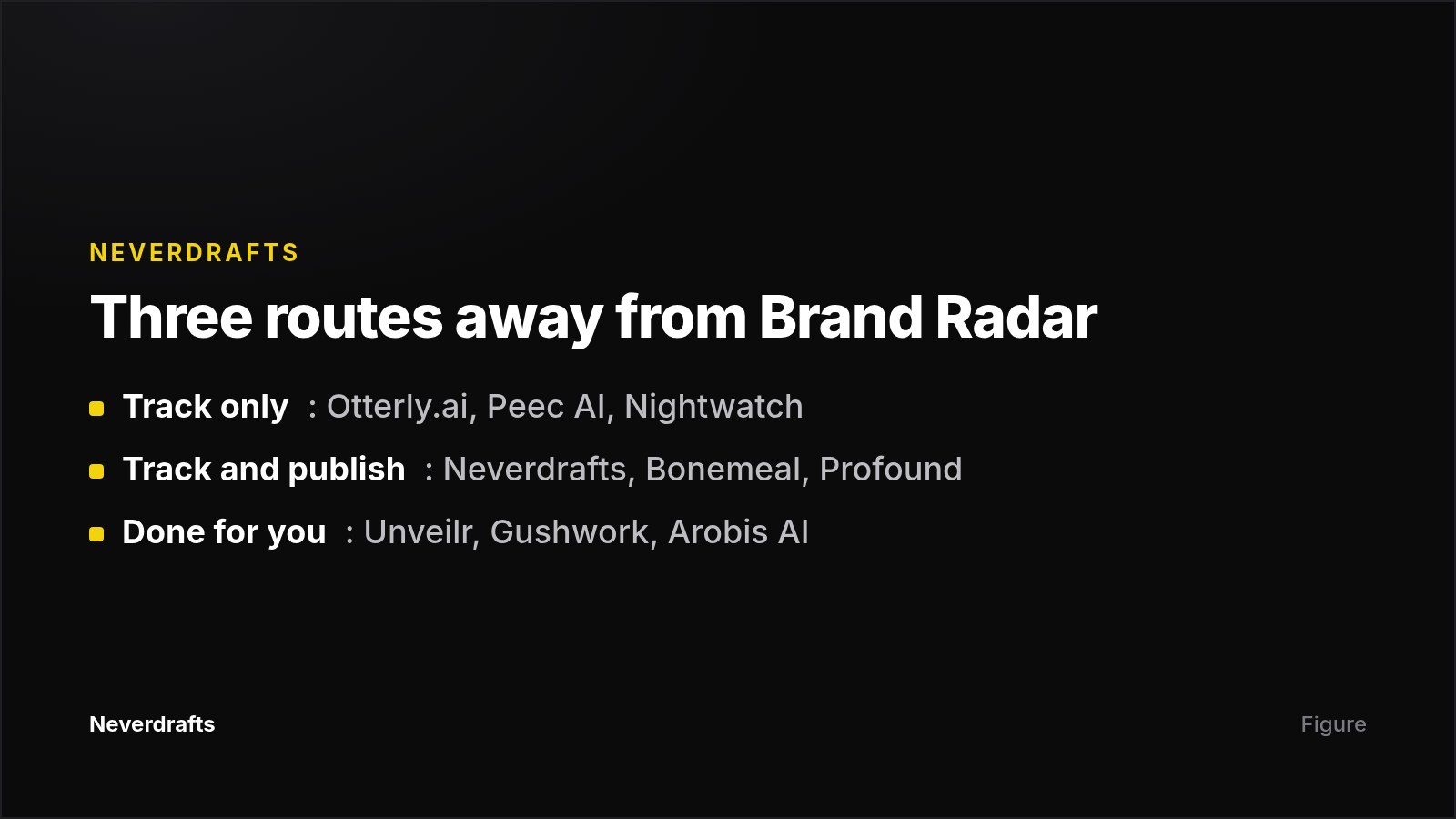
The best Ahrefs Brand Radar alternatives in 2026 fall into three groups. Low-cost trackers include Otterly.ai from $29/month and Peec AI from $95/month. Platforms that monitor and then produce content include Neverdrafts, Bonemeal and Profound. Managed services that do the work for you include Unveilr, Gushwork and Arobis AI. Brand Radar is still a good choice for established brands already paying for Ahrefs, but it only reports AI visibility. It does not write or publish the pages that would change it.
Key takeaways
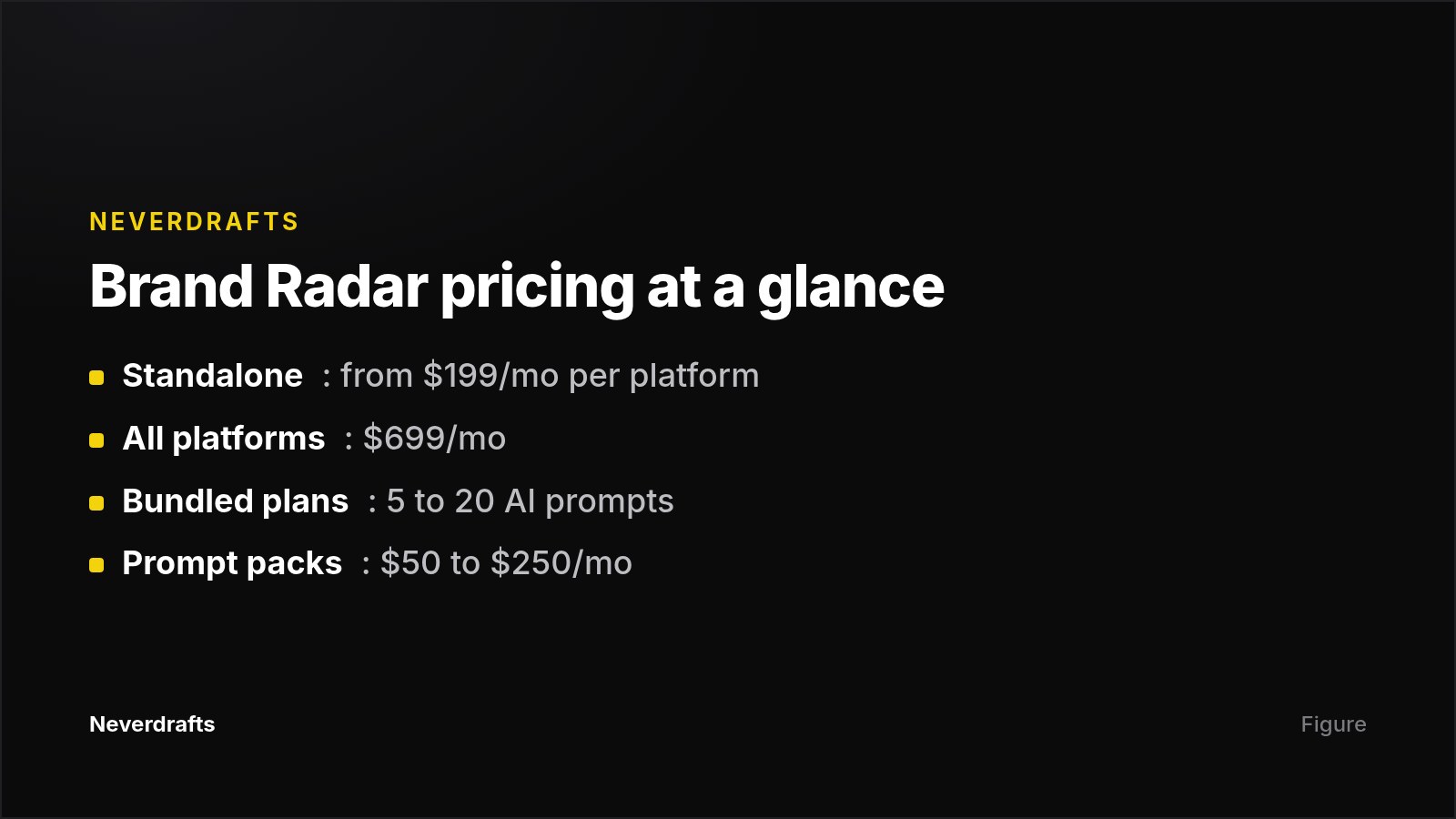
- Brand Radar is sold standalone from $199/month for a single platform, or $699/month for all platforms. The bundled Ahrefs plans (Lite $129, Standard $249, Advanced $449) include only 5, 10 or 20 tracked AI prompts.
- Its main strength is a huge index of 405+ million search-backed prompts. That index is also its weak spot for new or niche brands, which may show limited coverage.
- For the lowest entry price, choose Otterly.ai. For CRM-linked reporting, choose HubSpot AEO. For broad engine coverage including Meta AI and DeepSeek, compare Profound Enterprise (9–10 engines) and Peec AI Enterprise (up to 13 selectable models).
- If your real problem is "we see the gap but nobody fills it," choose a tool that generates content (Neverdrafts, Bonemeal, Writesonic) or a managed service (Unveilr, Gushwork, Arobis AI).
- Pricing in this category changes often. The sources below disagree on several Brand Radar and Profound figures, so confirm on vendor pages before you buy.
What does Ahrefs Brand Radar do, and where does it stop?
Brand Radar is Ahrefs' AI visibility module. According to the Ahrefs Help Center, it tracks how brands appear across these AI platforms:
- AI Overviews and AI Mode
- ChatGPT
- Perplexity
- Gemini
- Copilot
- Grok, where Ahrefs is "temporarily unable to gather new data" after policy changes
- Claude, which is tracked via API for custom prompts only, with each check consuming 8 checks
It also covers search demand and web mentions. YouTube, Reddit and TikTok indexes are in beta.
Brand Radar works in two ways:
- The AI Visibility Index. This is a pre-built database you can search instantly for any brand, product, region or author. You get history back to 2025 and no setup. Ahrefs' help docs cite 405M+ prompts. A September 2026 fetch of the product page described 456M+ monthly prompts, led by AI Overviews at 310.7M. The index re-tests question sets monthly on a 90-day reporting window.
- Custom prompts. You define your own questions and check them monthly or as often as daily.
Ahrefs also offers unlimited domains, an API, MCP access and a Looker Studio connector. For teams that report across many brands, those features are hard to match.
Brand Radar has four clear limits:
- It does not act on what it finds. It does not write, publish or refresh pages. You see the gap, then fix it somewhere else.
- The index favors established brands. Ahrefs itself says the index "works best for established brands or topics with meaningful search demand" (per Unveilr's quote of the product page).
- Crawler activity is a separate product. Brand Radar reports citations but not which pages AI crawlers read. Bot Analytics is sold separately.
- Monthly refresh is slow for model launches. A citation that disappears after a new model release may not show up quickly in the index, which Unveilr describes as thin for catching a citation that vanished after last week's model release.
How much does Ahrefs Brand Radar cost in 2026?
The answer depends on which source you read and when, because Ahrefs has changed Brand Radar packaging more than once in 2026.
| What you pay for | Cost | Source |
|---|---|---|
| Brand Radar AI, standalone, single platform | From $199/mo | HubSpot, Arobis |
| All platforms | $699/mo | Arobis, xSeek |
| Select Platforms tier (as reported by xSeek) | $398/mo | xSeek |
| Custom prompt packages | $50 Basic, $100 Growth, $250 Scale | Arobis |
| Bundled Ahrefs plans | Lite $129 (5 prompts), Standard $249 (10), Advanced $449 (20) | Arobis |
| Ahrefs Enterprise | $1,499/mo | Unveilr |
Arobis puts the realistic starting point for serious AI visibility tracking at $199 to $449/month. Prompt package overage is billed at $0.020, $0.015 and $0.010 per check (Arobis).
Why do teams switch away from Brand Radar?
Buyer behavior explains why this question gets asked so often. G2's 2026 Answer Economy research found that 51% of B2B software buyers start research with an AI chatbot more often than with Google. Once AI answers become a real acquisition channel, the limits of a reporting-only tool become more noticeable.
HubSpot's write-up collects four reasons from marketers who moved on. Note that Ahrefs has since added custom prompt tracking, so some of these were historical workflow decisions.
- More granular data. Truck1 moved to custom API tracking because it needed more detail on the queries where competitors gained visibility (HubSpot).
- Prompt-specific tracking. Ketch's head of marketing said that in B2B, "one mention in the right context matters more than ten generic mentions" (HubSpot).
- Lower total cost. During the beta, B2BSEO estimated its Ahrefs subscription plus AI add-ons at about $800/month (HubSpot).
- Links to revenue. Bully Max's founder concluded that "AI visibility is only valuable if you can tie it back to actions customers take afterward" (HubSpot).
There is also an argument for acting on the data, not just reading it. A Princeton study published at KDD 2024, as summarized by xSeek, found that lower-ranked websites saw a +115% AI visibility boost from citation-heavy content, while top-ranked sites saw -30%. Smaller brands have the most to gain, but only if someone publishes the content.
Ahrefs Brand Radar alternatives at a glance
Twelve alternatives split into trackers, monitor-and-publish platforms, suite add-ons and managed services. Entry prices run from $29/month for a self-serve tracker to agency retainers that start at ₹65,000/month.
| Tool | Type | Best for | Standout feature | Starting price |
|---|---|---|---|---|
| Otterly.ai | Tracker | Cheapest first reading | 4 engines, GEO audit | $29/mo |
| Peec AI | Tracker | Daily data across many seats | Unlimited users | $95/mo |
| Neverdrafts | Monitor + publish | Small teams that need fixes shipped | Position-weighted 0–100 scoring, one-click publishing | $99/mo ($1 three-day trial) |
| Bonemeal | Monitor + execute | Buyer-prompt precision | Reddit reply drafts, GitHub PRs | Free check; paid tier price not published in our sources |
| Profound | Enterprise analytics | Meta AI / DeepSeek coverage | Up to 10 engines on Enterprise | $99/mo yearly (ChatGPT only) |
| Nightwatch | Tracker + rank tracking | AI and Google rankings in one tool | Classic rank tracking included | €99/mo, €79 billed yearly |
| Semrush AI Visibility Toolkit | SEO-suite add-on | Existing Semrush users | Suite integration | $99/mo annual; $199 with SEO |
| SE Ranking | SEO suite | Affordable suite with AI prompts | 100 AI prompts on Core | $129/mo |
| HubSpot AEO | CRM-linked tracker | Tying visibility to pipeline | CRM context | $50/mo |
| Scrunch AI | Infrastructure | Sites AI crawlers can't parse | Agent Experience Platform | About $250/mo; demo required |
| xSeek | Software + service | Teams that want a human specialist | AI bot visit detection | $249.99/mo |
| Unveilr, Gushwork, Arobis AI | Managed services | Teams with no writers | Done-for-you content | ₹65,000/mo, $900/mo, custom |
Otterly.ai: the cheapest way to start tracking
What it is. Otterly.ai is a self-serve AI visibility tracker. It starts at $29/month for 15 prompts across ChatGPT, Google AI Overviews, Perplexity and Copilot, with daily tracking.
Who it suits. It is the right choice for a solo marketer or small business that wants a live reading of AI answers this week without a large commitment.
Strengths:
- The lowest entry price on most shortlists. Arobis calls it the cheapest way to start.
- Four engines included at the base tier.
- GEO URL audits with recommendations.
Limitations:
- Claude, Gemini and Google AI Mode are paid add-ons.
- 15 prompts covers only a narrow slice of a category.
- It does not write or publish content.
- How quickly it refreshes after a model launch is not stated.
Peec AI: clean daily data for marketing teams
What it is. Peec AI is a SaaS tracker. It reads 50 prompts daily on three selectable models for $95/month on monthly billing, with up to 13 models on Enterprise. xSeek lists Grok and Google AI Mode among its supported engines, which matters while Brand Radar's Grok collection is paused.
Who it suits. It fits SEO and marketing teams that want daily dashboards shared across many seats, and that will act on the data themselves. Arobis singles it out for EU and privacy-conscious teams.
Strengths:
- Unlimited users and daily tracking on every tier.
- You choose which models to track instead of paying for engines you don't need.
- The highest published engine count of any tool in this roundup on its top tier.
Limitations:
- Only 3 of the available models per standard plan. Full access to 13 models requires Enterprise.
- No content execution.
- Support is email-based according to xSeek's comparison.
Neverdrafts: monitor, then publish the fix
Disclosure: Neverdrafts is our product.
What it is. Neverdrafts is an AI visibility (GEO) platform. It monitors real ChatGPT, Claude, Google AI Mode and Perplexity answers daily, identifies the prompts where AI models recommend competitors instead of you, and generates content aimed at those exact prompts. The workflow is a closed loop: monitor, diagnose, fix, prove.
Who it suits. It fits small businesses, content teams and agencies that understand the Brand Radar gap ("we can see we're missing") but lack the writing capacity to close it.
Strengths:
- Position-weighted scoring. Each AI response is scored 0–100 based on where you appear, not just whether you are mentioned. Sentiment is tracked across mentions.
- Diagnosis. It shows which sources AI cites instead of you.
- Remediation content. It auto-generates articles targeted at the prompts you're losing.
- One-click publishing. It publishes to WordPress, Webflow, Shopify, Framer and API-first custom stacks.
- Proof. It tracks AI crawler visits to published pages, which is something Ahrefs sells separately.
- Agency-ready tiers. Share of voice reporting covers up to 10 brands on the Agency plan.
Limitations:
- It does not track Gemini, Copilot or Google AI Overviews. Brand Radar does.
- There is no pre-built historical index. You see data only for the prompts you track, from the day you start.
- It is not an SEO suite. Keep another tool for backlinks and keyword research.
- Generated articles still need human review before they represent your brand.
Pricing.
- Starter: $99/month (1 brand, 50 prompts, 30 articles)
- Growth: $199/month (3 brands, 150 prompts, 100 articles)
- Agency: $399/month (10 brands, 500 prompts, 300 articles)
All plans bill monthly with no annual commitment, and there is a $1 three-day full-access trial. See Neverdrafts pricing.
Bonemeal: buyer-prompt tracking with shipped fixes
What it is. Bonemeal positions itself as the Brand Radar alternative "that ships the work". It runs your actual buyer prompts daily on ChatGPT, Gemini and Google AI Overviews, benchmarks competitors, and analyzes citations and sources.
Who it suits. It fits teams that want prompt-level precision instead of index-scale breadth, and that are comfortable shipping fixes through developer workflows.
Strengths:
- It explains the index-versus-prompt difference clearly. Index tracking is "broad, but generic," while prompt tracking is "narrower, but precise and repeatable."
- It produces drafted actions: SEO content, Reddit thread replies, and fixes shipped as GitHub pull requests.
- It is a standalone product with a free visibility check. Bonemeal notes that many teams keep Ahrefs for backlinks and add Bonemeal for AI search.
Limitations:
- The listed engine coverage (ChatGPT, Gemini, AI Overviews) is narrower than Brand Radar's.
- Paid plan prices are not stated in the sources we reviewed. The vendor lists "Free and Growth" plans.
Profound: broad engine coverage including Meta AI and DeepSeek
What it is. Profound is an AI visibility analytics platform. On Enterprise it supports up to 10 answer engines: Perplexity, ChatGPT, Claude, Gemini, Grok, Copilot, Meta AI, DeepSeek, Google AI Overviews and Google AI Mode. Unveilr's fetch of the pricing page lists up to 9 on Enterprise, so check current numbers. Note that Peec AI's Enterprise plan claims a higher ceiling of up to 13 selectable models — Profound's distinction is the specific inclusion of Meta AI and DeepSeek, not the highest raw count.
Who it suits. It fits larger brands that need Meta AI and DeepSeek coverage, and growing companies that want a published self-serve plan. Arobis rates it the best for enterprise analytics.
Strengths:
- Server-side crawler analytics through Cloudflare, Vercel and AWS integrations.
- Content agents that generate AEO-optimized content. The Growth plan includes 400 agent credits per month.
- An account manager on Enterprise.
Limitations:
- Starter covers only ChatGPT. Growth covers 3 engines. Full coverage requires Enterprise.
- Plans are billed yearly.
Pricing. Starter is $99/month (yearly, 50 prompts), Growth is $399/month (yearly, 100 prompts) and Enterprise is custom, per xSeek's review of Profound's pricing page. A free trial is ChatGPT-only. Unveilr's September 2026 fetch listed Profound's pricing as custom with a free Trial (Unveilr), which conflicts with xSeek's published $99 Starter tier — confirm current pricing on Profound's site before buying. For how Neverdrafts compares on engines and billing, see our Neverdrafts vs Profound comparison.
Nightwatch: AI prompts and Google rank tracking in one tool
What it is. Nightwatch combines LLM monitoring, prompt research and citation-level sentiment with traditional Google rank tracking in one product.
Who it suits. It fits mid-market teams leaving Brand Radar that still need classic rankings and don't want to pay for two products. Arobis calls it the best coverage-per-dollar for mid-market SaaS.
Strengths:
- One subscription covers both AI and organic search tracking.
- Sentiment at the citation level, not only at the brand level.
Limitations:
- Arobis says to skip it if you need enterprise-grade prompt analytics.
- No content execution.
Pricing. From €99/month, or €79/month billed yearly.
Semrush AI Visibility Toolkit: for existing Semrush users
What it is. This is Semrush's AI search add-on. It tracks ChatGPT, Google AI Mode, AI Overviews and other engines.
Who it suits. It fits teams already paying for Semrush who want AI visibility in the same suite. It is effectively the mirror image of choosing Brand Radar because you already use Ahrefs.
Strengths:
- It integrates with Semrush's SEO data and content toolkit.
- It provides recommendations alongside tracking.
Limitations:
- It offers recommendations only and does not publish content.
- Its refresh cadence after model launches is not stated.
- It has the same suite lock-in that pushes some teams away from Ahrefs.
Pricing. $99/month billed annually, or $199/month with SEO included. For a deeper look at Semrush's toolkit specifically, see our AI visibility toolkit alternatives breakdown.
SE Ranking AI Search Toolkit: the affordable SEO suite route
What it is. SE Ranking is an SEO suite whose Core plan includes 100 AI prompts for $129/month. It tracks AI Overviews, AI Mode, Perplexity and ChatGPT.
Who it suits. It fits small businesses that want a full SEO suite plus meaningful AI prompt tracking at roughly the price of an Ahrefs Lite plan.
Strengths:
- 100 prompts at $129 compares well with the 5 prompts on Ahrefs Lite at the same price.
- It covers both Google AI surfaces.
Limitations:
- No Gemini, Copilot or Claude in the listed coverage.
- No content execution.
HubSpot AEO: for teams that need pipeline context
What it is. HubSpot AEO tracks brand visibility and sentiment, competitor share of voice, citations and prompts, and adds prioritized recommendations. HubSpot also offers a free AI Search Grader for a one-time baseline.
Who it suits. It fits marketing teams on HubSpot that want to connect AI visibility to CRM, attribution and pipeline. That is the gap Bully Max's founder described when he moved off Brand Radar.
Strengths:
- CRM context next to visibility data.
- A low monthly price.
Limitations:
- Arobis reports that it tracks three engines and skips Google AI Overviews. That is a significant omission given AI Overviews' share of Brand Radar's index.
- It gives recommendations rather than published content.
Pricing. $50/month.
Scrunch AI: when AI crawlers can't read your site
What it is. Scrunch sells an Agent Experience Platform (AXP). It serves a lightweight, machine-readable version of your pages to AI crawlers, separate from what human visitors see. It also covers monitoring, citations, AI search trends and agent traffic analytics.
Who it suits. It fits sites whose real bottleneck is that AI bots can't parse the pages, according to xSeek's comparison. Akamai is a named customer.
Strengths:
- It fixes problems at the infrastructure layer rather than the content layer.
- SOC 2 Type II compliance.
- White-glove onboarding.
Limitations:
- It won't help if the problem is missing content rather than unreadable content.
- xSeek's comparison notes that a demo is required.
Pricing. About $250/month according to Arobis.
xSeek: software plus a dedicated specialist
What it is. xSeek combines AI visibility software with a dedicated account specialist on every plan. It covers seven engines: ChatGPT, Claude, Perplexity, Gemini, xAI/Grok, DeepSeek and Copilot.
Who it suits. It fits teams that want a person accountable for acting on the data, not just a dashboard.
Strengths:
- AI bot visit detection for OAI-SearchBot, PerplexityBot, ClaudeBot and other crawlers.
- Article generation through a Claude Code desktop app and CLI, with CMS push.
- Native GSC, GA4 and Bing integrations.
Limitations:
- Its entry price is higher than Brand Radar's single-platform tier.
- Starter is capped at 50 prompts, 1 website and 2 users.
Pricing. Starter is $249.99/month and Growth is $499.99/month (150 prompts, 3 websites). Scale is custom and adds 1:1 strategy sessions.
Managed services: Unveilr, Gushwork and Arobis AI
If you have no writers, a tracker of any kind produces reports nobody acts on. Managed services take on the work themselves.
- Unveilr tracks up to 125 buyer prompts on live ChatGPT, Gemini, Perplexity, Claude and Grok responses. It writes up to 60 articles a month into your CMS and re-audits on every major model launch, which no other vendor in Unveilr's table states it does. It starts at ₹65,000/month. It is best for brands whose category is discussed in AI before anyone searches for it on Google.
- Gushwork is a US-registered managed agency at $900/month, billed monthly. It publishes 100+ pages in six months. Engine coverage is not stated on its pricing page.
- Arobis AI is an AI Search Demand Generation agency for B2B SaaS with custom pricing. It works on third-party reviews, comparison content, community threads and citation-ready pages, and includes a free AI visibility checker and audit.
Their shared limitation is cost and control. You pay agency rates and depend on an outside team's judgment about your brand. If you're weighing the agency route, our guide to alternatives to hiring a GEO agency covers the tradeoffs.
Other names on shortlists:
- AthenaHQ for competitive intelligence (free tier, then $295/month)
- Writesonic as a tracker plus writer ($79/month annually for 50 prompts and 15 AI articles)
- AirOps for usage-based content operations
- Rank Prompt as a free quick check
How do you choose the right Brand Radar alternative?
Work through these six questions in order to match a tool to the problem Brand Radar didn't solve.
- Why did Brand Radar fall short? Start with your specific problem:
- Too expensive. Look at Otterly.ai, HubSpot AEO or SE Ranking.
- Your brand reads zero in the index. Choose a tool that runs your own prompts live, such as Peec AI, Neverdrafts, Bonemeal or Unveilr.
- Nobody acts on the data. Choose a content-producing platform or a managed service.
- Which engines matter to your buyers? Check coverage engine by engine:
- Google AI Overviews dominates Brand Radar's index, yet HubSpot AEO skips it.
- If Grok matters to you, note that Ahrefs has paused Grok collection. Peec AI, Profound Enterprise, xSeek and Unveilr list it.
- For a broader engine-by-engine view, see our AI brand monitoring tools coverage and price comparison.
- Index or prompts? Index tracking suits benchmarking established categories. Prompt tracking suits acting on gaps. Many teams need both, which is why some keep Ahrefs and add a second tool.
- Does it move the number or just report it? Arobis calls this the distinction almost every buyer misses. Decide honestly whether you have the writing capacity to act on a gap report.
- Can you prove the fix worked? Crawler visit tracking (Neverdrafts, xSeek, Profound, Scrunch) shows whether AI bots actually read your new pages. CRM integration (HubSpot AEO) connects visibility to revenue.
- What does the full cost look like? Brand Radar's realistic range is $199 to $449/month before you pay anyone to write content. Compare that against tools that include content in the price.
Next step
If your Brand Radar reports show gaps that never get filled, test whether a monitor-and-publish workflow closes them. Start a $1 three-day Neverdrafts trial, add the 10–20 buyer prompts you care about most, and compare your position-weighted scores with what Brand Radar shows for the same prompts. If you'd rather keep Ahrefs for SEO research, you can run both side by side.
Frequently asked questions
Is there a free alternative to Ahrefs Brand Radar?
There are free options for quick checks but not for ongoing tracking. Rank Prompt offers a free check. Bonemeal and Arobis AI offer free visibility checkers. HubSpot's AI Search Grader gives a one-time baseline. AthenaHQ has a free tier, and AirOps has a free Insights tier. For continuous daily tracking, the cheapest paid option in our sources is Otterly.ai at $29/month for 15 prompts across four engines.
Do I need to cancel Ahrefs to use an alternative?
No. Many teams keep Ahrefs for backlinks, keyword research and the Brand Radar index, then add a dedicated AI visibility tool for prompt-level tracking or content execution. Moving from Lite ($129/month, 5 prompts) to Standard ($249/month, 10 prompts) adds $120/month for five more prompts (Arobis). Otterly.ai's $29/month tier tracks 15 prompts across four engines for less than that upgrade (Unveilr).
Why does Brand Radar show zero mentions for my brand?
Brand Radar's index is built from real search queries. Ahrefs says it works best for established brands with meaningful search demand and may have limited coverage for brands with little search volume. A new or niche brand can read zero even if AI engines mention it. Custom prompts, or a tool that runs your own buyer prompts live, will give a more accurate picture.
Which alternative covers the most AI engines?
On published figures, Peec AI's Enterprise plan reaches the most models: up to 13, per Unveilr. Profound's Enterprise plan follows, with 10 per xSeek or 9 per Unveilr, including Meta AI and DeepSeek. xSeek covers seven engines on every plan, including DeepSeek and Grok, without an Enterprise upgrade. Lower tiers of each tool are much narrower: Profound Starter covers only ChatGPT, and Peec AI's standard plan covers only three selectable models.
What is the difference between a tracker and an execution platform?
A tracker reports where your brand appears in AI answers and where competitors win. An execution platform also produces the content, replies or code changes meant to close those gaps. Brand Radar, Otterly.ai, Peec AI and Nightwatch are trackers. Bonemeal, Profound's content agents and managed services like Unveilr and Gushwork add execution.
How often should AI visibility be checked?
It depends on what you're measuring. Brand Radar's custom prompts can run daily, but its main index re-tests question sets monthly on a 90-day reporting window, which is adequate for category-level benchmarking. For prompts tied to revenue, daily checks catch changes faster. Unveilr is the only vendor in our sources that states it re-audits on every major model launch.
Sources
- xSeek: Best Ahrefs Brand Radar Alternatives
- HubSpot: Ahrefs Brand Radar alternatives for marketing teams
- Ahrefs Help Center: What is Brand Radar, and how to use it?
- Arobis AI: Best Ahrefs Brand Radar Alternatives
- Bonemeal: Ahrefs Brand Radar Alternative
- Unveilr: Best Ahrefs Brand Radar Alternatives in 2026