
Our top picks for most teams are Otterly.AI for low-cost monitoring, Peec AI for analytics-heavy tracking, and Profound for enterprise citation data. If you need to act on what you track, look at AirOps, Writesonic or AthenaHQ, and teams already on HubSpot, Semrush or Ahrefs should check those vendors' AEO add-ons first. No tool fits every team, because AEO tools split into two groups: those that watch AI answers and those that also help you change them.
Key takeaways
- AEO tools put a fixed set of buyer questions to AI engines on a schedule, record which brands and pages each answer cites, and in some cases write the content to close gaps. Rank.ai
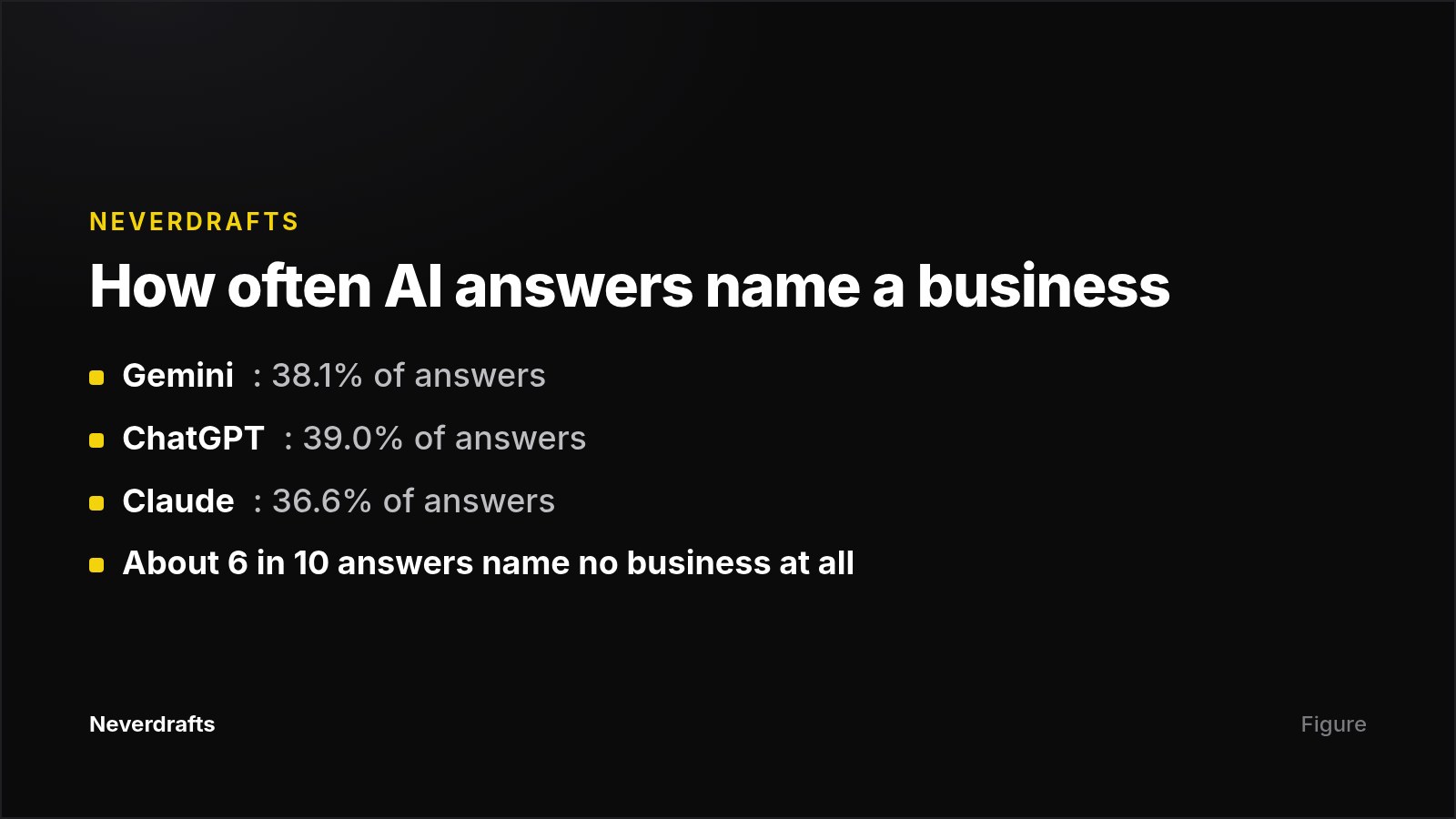
- Engine coverage matters because each engine answers differently. In Rank.ai's analysis of 11,726 answers, Gemini named a business in 38.1% of answers, Claude in 36.6% and ChatGPT in 39.0%.
- Paid entry plans run from $25-29/month (Otterly.AI Lite) to roughly $295-499/month (AthenaHQ Starter, Profound's pilot tier). AthenaHQ also has a free tier, and Profound and AirOps sell their top tiers through sales.
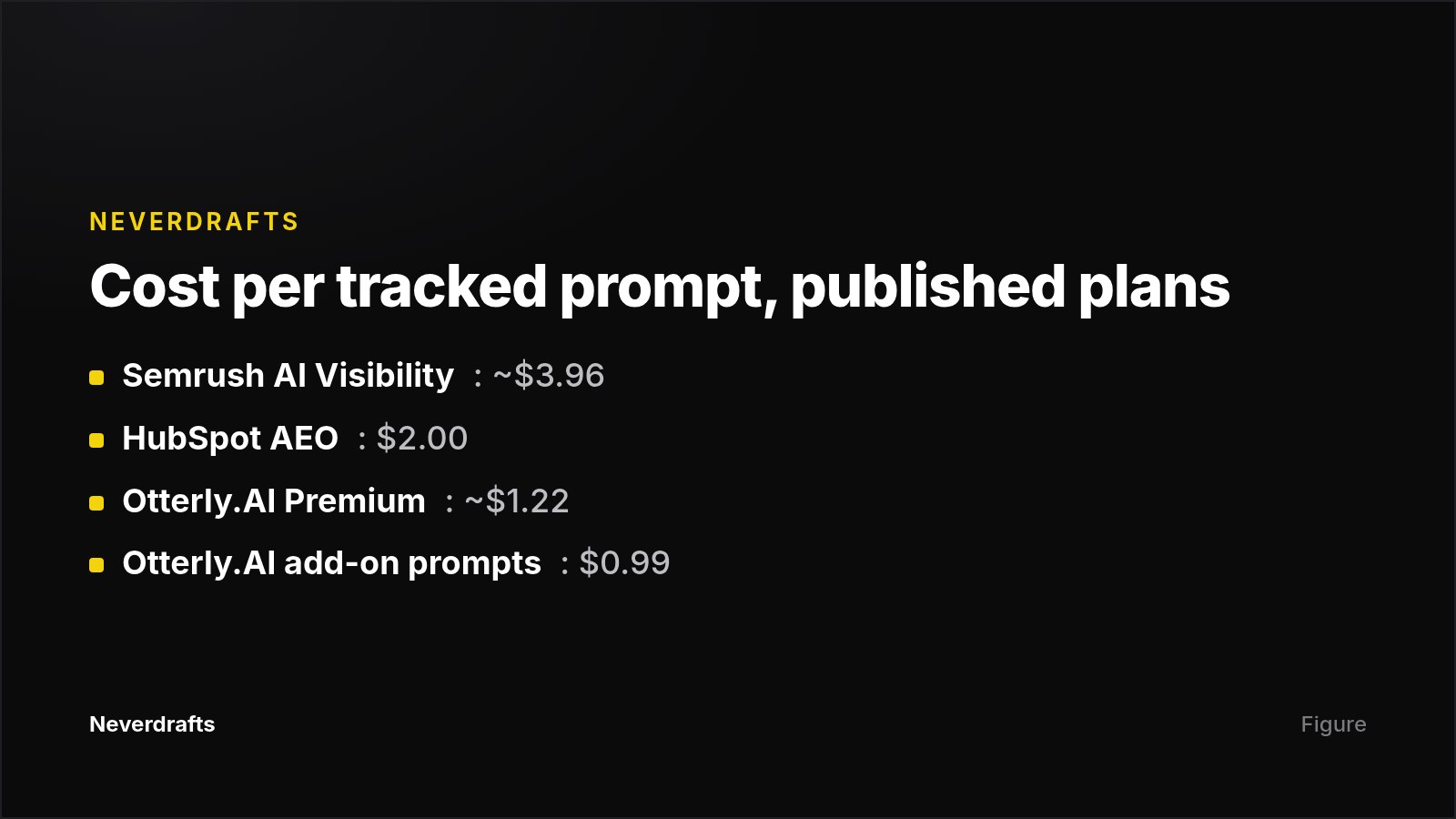
- Prompt volume is the main cost driver. On published plans, a tracked prompt costs roughly $0.80 to $4 per month (our arithmetic below), and brand or workspace limits change what that price actually buys.
- Security posture varies. Eight of 17 tools reviewed by AirOps publicly state SOC 2 Type II, and Ahrefs says SOC 2 is planned but not yet certified.
What does an AEO tool actually do?
Answer engine optimization (AEO) tools check whether ChatGPT, Gemini, Perplexity, Claude and Google's AI features name your brand when buyers ask a question. They also show which pages those answers cite and help you publish content that gets you named. Rank.ai breaks the category into three jobs:
| Job | What the tool does | What you get |
|---|---|---|
| Measure | Runs a fixed set of prompts against AI engines on a schedule | Brands named, pages cited, your share of answers over time |
| Write and publish | Turns lost questions into articles or page updates, sometimes publishing to your CMS | Content aimed at questions competitors win |
| Technical readiness | Checks whether AI crawlers can reach and parse your pages | Robots rules, rendering, schema and llms.txt fixes |
Marketer Hire groups tools along similar lines: citation tracking (Profound, Scrunch AI), content optimization (Goodie AI, Semrush AI Toolkit) and brand-mention monitoring (Otterly.ai, Ahrefs Brand Radar). Writesonic uses a two-part split instead: "watchers" that only monitor citations, and "movers" that help you change them.
The category is young. Most AEO tools launched between Q4 2024 and Q2 2026, so pricing and features still change often. HubSpot's State of AEO research found 58% of marketers say their businesses already optimize content for answer engines.
AEO does not replace SEO. Google says its foundational SEO best practices still apply to AI Overviews and AI Mode. AEO tools add visibility into prompts, mentions and citations that rank trackers don't measure.
Why does the engine list change what you see?
The same question gets different answers from different engines. Rank.ai sent 102 buyer questions from 15 customer accounts to ChatGPT, Claude and Gemini with web search on, and kept 11,726 fresh answers between May and October 2026:
| Engine | Answers | Named any business | Named the customer's brand | Cited the customer's site | Avg. citations per answer |
|---|---|---|---|---|---|
| Gemini | 3,918 | 38.1% | 11.0% | 7.5% | 7.38 |
| Claude | 3,878 | 36.6% | 8.1% | 4.5% | 5.40 |
| ChatGPT | 3,930 | 39.0% | 6.4% | 3.7% | 6.34 |
The "named the customer's brand" and "cited the customer's site" columns are aggregated across all 15 accounts in the dataset, not the results for one brand. Still, the spread is large enough to matter for a buying decision:
- Single-engine tracking gives you a partial view. Across Rank.ai's accounts, customers' own brands were named in 11.0% of Gemini answers but only 6.4% of ChatGPT answers, so a one-engine tool can over- or understate your real visibility. Rank.ai
- Track questions that produce shortlists. About six in ten answers name no business at all. When an answer does name businesses, it usually names several, and about one answer in five named five or more. That shortlist is what your buyer sees.
Which engines does each tool track?
Vendors advertise "multi-engine coverage," but the entry tier and the top tier often cover very different ground. This matrix shows what's included at the lowest paid tier and what you get by upgrading, based on the same vendor pages our sources checked.
If your main constraint is budget, our guide to AI search optimization tools that fit small business budgets narrows this list by price.
Best AEO tools compared at a glance
Twelve tools cover the main use cases below, from $25/month monitors to sales-led enterprise platforms. Prices come from vendor pages as reported in our sources, and sources sometimes disagree; where they do, we show both figures. Check the vendor's page before you buy.
| Tool | Best for | Standout feature | Starting price |
|---|---|---|---|
| Otterly.AI | Solo marketers and lean teams | Daily tracking, unlimited seats, GEO audits | $29/mo ($25 annual) |
| Peec AI | Analytics-focused teams | Visibility, position, sentiment and gap analysis | $95/mo |
| Profound | Enterprise multi-engine tracking | Up to 9 engines; agent that rewrites pages | $99/mo to $499 pilot |
| HubSpot AEO | Teams already on HubSpot | AI visibility tied to CRM data | $50/mo ($45 annual) |
| AirOps | Enterprise content teams | Tracking connected to content production | Sales-led |
| Neverdrafts | B2B SaaS, agencies, product teams | Monitor, diagnose, generate and publish fixes | $99/mo |
| Writesonic | Writing plus tracking in one tool | AI article writer with CMS publishing | $79/mo annual |
| Scrunch AI | Agencies and multi-brand programs | Share-of-voice benchmarking, Agent Pages | $250/mo |
| Semrush AI Visibility Toolkit | Existing Semrush users | AEO data inside an SEO suite | $99/mo per domain |
| Ahrefs Brand Radar | Existing Ahrefs users | Index of AI answers for any brand | From $50/mo custom prompts |
| AthenaHQ | Teams needing compliance plus content | Free tier; publishes to 7 CMSs | Free; Starter $295/mo |
| Goodie AI | Content libraries needing rewrites | Page-level AI-extraction scoring | $199/mo to $495/mo |
Otterly.AI: best for affordable daily monitoring
Otterly.AI is an AI search monitoring tool with prompt research and GEO page audits. It suits solo marketers and small teams who want daily data without a large contract.
Strengths
- Daily tracking frequency, unlimited team members, and brand visibility and sentiment analysis on every plan.
- Four engines included as standard, with Claude, Google AI Mode and Gemini as paid add-ons.
- Standard and Premium add API access, MCP access, agent analytics and a Data Studio connector.
- A Beta n8n workflow turns recommendations into WordPress article drafts.
- 4.8/5 on G2 across 54 reviews.
Limitations
- Lite includes 1 workspace and 3 recommendations per week, thin for several brands.
- Content creation depends on a beta workflow, so it works mainly as a monitor.
- SOC 2 status is not publicly stated.
Pricing: Lite $29/month (15 prompts), Standard $189/month (100 prompts), Premium $489/month (400 prompts), Enterprise custom from 1,000 prompts. Annual billing saves 15% ($25, $160 and $422), and extra prompts cost $99 per 100.
Peec AI: best for analytics-focused tracking
Peec AI is an AI search analytics platform covering visibility, position, sentiment, sources and gap analysis. It suits analysts who want to see why a competitor wins a prompt, not just whether it does.
Strengths
- Flexible engine choice: pick 3 of 6 engines at entry, rising to 11 on Enterprise.
- An MCP use case drafts a post and publishes it to WordPress via the API.
- Free trial available, and 4.8/5 on G2 across 18 reviews.
Limitations
- Three engines at entry won't cover every buyer channel.
- SOC 2 status is not publicly stated, and the G2 review count is small.
Pricing: $95, $245 or $495 per month; Enterprise custom. Writesonic reports $80/month on yearly billing.
Profound: best for enterprise citation data
Profound is the most-cited specialist AEO platform in enterprise SEO programs, according to Marketer Hire. It runs thousands of prompts per project and attributes citations down to the source URL, and it now includes an "AI Marketer" agent that researches, writes and reports, rewriting pages with citation decay and staging them in your CMS.
Who it's for: B2B SaaS, financial services and DTC brands with marketing budgets above $1M annually.
Strengths
- Up to 9 answer engines on Enterprise.
- Competitor citation breakdowns and engineering-grade APIs for BI tools.
- SOC 2 Type II, and 4.5/5 on G2 across 1,128 reviews, one of the larger review bases among AEO-first platforms.
Limitations
- Entry tiers are narrow. Starter covers only ChatGPT.
- Pricing reports conflict. AirOps lists a $99/month start, and Writesonic lists $99 Starter and $399 Growth. Rank.ai describes a free 7-day trial then custom Enterprise for brands, and $99/month plus $399 per client workspace for agencies. Marketer Hire cites a $499/month pilot climbing to five figures.
HubSpot AEO: best for teams already running HubSpot
HubSpot AEO tracks your brand in AI answers, suggests prompts and gives prioritized recommendations, such as when to create a page, publish a video or reach out to third-party sites. Its main advantage is that AI visibility sits next to your CRM data.
Strengths
- Included with Marketing Hub Pro/Enterprise, so many teams already have access.
- SOC 2 Type II.
- The free AI Search Grader gives a one-time baseline across ChatGPT, Perplexity and Gemini before you commit.
Limitations
- Three engines on all tiers: ChatGPT, Gemini and Perplexity. No Claude or Google AI Overviews.
- G2 shows 5.0/5 from only 2 reviews, too few to judge.
- It recommends actions but does not write the content for you.
Pricing: $50/month for 25 prompts ($45 billed annually).
AirOps: best for enterprise content execution
According to AirOps, the platform connects AI visibility data to content execution and measurement in a single system: when a citation rate drops on a high-value topic, it says the tool can handle the brief, the draft, the brand check and the follow-up measurement.
Who it's for: Enterprise content teams that need to act on visibility data, not just report it.
Strengths
- SOC 2 Type II since January 2023.
- 4.7/5 on G2 across 134 reviews.
- Multi-engine tracking on Pro across Google, Perplexity, OpenAI and Google AI Studio.
Limitations
- Sales-led pricing on all tiers and no free tier or trial, so you can't test it before a sales conversation.
- The strongest claims about AirOps come from AirOps' own comparison, which lists itself first and says so.
Neverdrafts: best for closing the loop from lost prompt to published fix
Disclosure: Neverdrafts is our product.
Neverdrafts monitors which AI models recommend your competitors instead of you, then generates and publishes content aimed at winning those answers back. It tracks real answers from ChatGPT, Claude, Google AI Mode and Perplexity daily, without extrapolated scores.
Who it's for: B2B SaaS, agencies and product teams whose buyers vet tools by asking AI.
Strengths
- Covers monitor, diagnose (citing the sources AI uses when it recommends competitors), fix (remediation content targeted at the exact prompts you're losing) and prove, in one tool.
- One-click publishing to WordPress, Webflow, Shopify and Framer, in 150+ languages.
- Tracks AI bot traffic to confirm crawlers visited the new pages.
- Position-weighted visibility scoring (0-100 per answer), sentiment reporting, and share of voice against named competitors.
Limitations
- Four engines tracked. No Gemini, Google AI Overviews or Microsoft Copilot, so teams that depend on those surfaces need another tool alongside it.
- CMS publishing covers four platforms; teams on Contentful, Sanity or Ghost need to publish manually.
- No public SOC 2 statement and no G2 rating in our sources.
- Prompt caps top out at 500 on the Agency plan, well below enterprise tools that run thousands per project.
Pricing: Starter $99/month (1 brand, 50 prompts, 30 articles), Growth $199/month (3 brands, 150 prompts, 100 articles), Agency $399/month (10 brands, 500 prompts, 300 articles). See pricing or our comparison with Profound.
Writesonic: best for combining AI writing with tracking
Writesonic pairs AI search visibility tracking with an AI article writer and site audits. Its own review calls it the top pick for end-to-end AEO, so treat that ranking as vendor-authored.
Strengths
- 15 AI articles a month on Starter, pushed to WordPress, Sanity, Contentful, Webflow or Ghost.
- SOC 2 Type II, a free trial with no card, and 4.7/5 on G2 across 2,124 reviews.
- Scales from 3 engines on paid tiers to 10 on Enterprise.
Limitations
- Entry engines are ChatGPT, Gemini and Google AI Overviews; Perplexity and Claude require Enterprise.
- The GEO-focused plan costs more than the entry price suggests.
Pricing: $79/month billed annually at entry. Writesonic lists its Professional (GEO) plan at $249/month ($199 billed annually).
Scrunch AI: best for agencies and multi-brand programs
Scrunch AI covers AI monitoring and citations, site audits, and Agent Pages that deliver an optimized experience to AI agents. Marketer Hire praises its prompt discovery, agency-friendly multi-client dashboards and transparent methodology.
Who it's for: Agencies and in-house teams running 3-10 brand programs.
Strengths
Limitations
- Content help is light: one page optimization a month and basic content generation on Core.
- Engine counts conflict across sources: Rank.ai lists 4 engines at entry, while AirOps reports 7 on all tiers. Confirm with the vendor before buying.
- Enterprise reporting is still maturing relative to its prompt-discovery strength.
Pricing: Core $250/month; Enterprise custom. AirOps lists $300/month, or $250/month annual.
Semrush AI Visibility Toolkit: best for existing Semrush users
Semrush adds AI visibility reports, 25 daily prompts, and competitor and prompt research to its SEO suite, covering ChatGPT, Google AI, Gemini and Perplexity at entry.
Strengths
- No second vendor for teams already on Semrush.
- The largest review base on this list: 4.4/5 on G2 across 4,029 reviews, plus a 7-day free trial.
- A Semrush One bundle starts at $199/month.
Limitations
- Writing is a separate Content toolkit at $60/month billed annually.
- 25 prompts per domain is a small set for broad category tracking.
- SOC 2 status not publicly stated.
Pricing: $99/month per domain.
Ahrefs Brand Radar: best for Ahrefs users who want market-wide data
Brand Radar combines custom prompt tracking with an index of AI answers for any brand, letting you look up competitors you aren't actively tracking.
Strengths
- Broad coverage: AI Overviews, AI Mode, ChatGPT, Perplexity, Gemini and Copilot, with Claude using 8 checks per update.
- A free limited account and a free AI visibility checker.
- 4.5/5 on G2 across 713 reviews.
Limitations
- No content writing listed on the Brand Radar page.
- Not SOC 2 certified; certification is stated as planned.
- Costs stack up: index pricing comes on top of a $129/month Ahrefs Lite base.
Pricing: Custom prompts from $50/month; AI Visibility Index from $199; $699 for all models.
AthenaHQ: best for governance-minded teams that also publish
AthenaHQ tracks AI visibility, then optimizes and publishes content. Writesonic positions it for enterprise teams needing AEO plus compliance and governance.
Strengths
- A real free tier, noted by AirOps as including $25 in credit.
- The widest CMS list here: WordPress, Webflow, Contentful, Sanity, Framer, Wix and Payload CMS.
- SOC 2 Type II and 4.9/5 on G2 across 38 reviews.
Limitations
- Self-serve pricing is credit-metered, so monthly cost can vary with usage.
- Engine counts conflict: Rank.ai lists 5 engines free, 11 models on Starter, while AirOps reports 5 on free rising to 8 on paid. Confirm the current count before buying.
- The jump from free to $295 is steep for small teams.
Pricing: Essential free; Starter $295/month.
Goodie AI: best for optimizing an existing content library
Goodie AI optimizes content rather than tracking it. It scores existing pages for AI-extraction readiness, flags missing schema, weak answer blocks and entity inconsistencies, and recommends specific rewrites.
Who it's for: In-house content teams with a library of 200+ posts.
Strengths
- Page-level recommendations and integration with most CMS platforms.
- High-volume prompt coverage across 12 LLMs.
Limitations
- Citation tracking is thinner than Profound or Scrunch AI, so it works best paired with a tracker.
- Sources disagree on price: $199/month versus $495/month.
AEO tools for agencies and multi-client teams
Agencies have different needs than a single in-house team: per-client workspaces, white-label-friendly dashboards and enough prompt headroom to run several brands at once.
- Profound charges agencies $99 a month plus $399 per client workspace, which scales cleanly as you add clients but adds up fast past a handful of accounts.
- Scrunch AI is built for agencies and in-house teams running 3-10 brand programs, with multi-client dashboards Marketer Hire calls agency-friendly.
- Otterly.AI gives unlimited workspaces on Standard and Premium, plus a dedicated agency partner program with its own pricing track.
- Neverdrafts caps at 10 brands on its Agency plan, the smallest ceiling of the three, but bundles monitoring and remediation content for each brand rather than selling them separately.
None of our sources publish a detailed agency-specific methodology (seat limits, white-labeling, client reporting exports), so confirm those details directly with sales before committing a multi-client book of business to one platform.
Integrations and API access
Most AEO tools publish data to a dashboard; fewer connect cleanly to the rest of a marketing stack.
- Otterly.AI offers API access and MCP access on Standard and Premium, with 2,000 API requests and 2,000 MCP requests a month on Standard, rising to 5,000 of each on Premium, plus a Data Studio connector and a Beta n8n workflow that drafts WordPress articles from recommendations.
- Peec AI uses an MCP workflow to draft a post and publish it to WordPress via the API, rather than a built-in writer.
- CMS publishing targets vary widely: AthenaHQ reaches WordPress, Webflow, Contentful, Sanity, Framer, Wix and Payload CMS; Writesonic pushes to WordPress, Sanity, Contentful, Webflow or Ghost; Neverdrafts publishes to WordPress, Webflow, Shopify and Framer; and Promptwatch integrates with Webflow, Framer and WordPress.
- Profound offers engineering-grade APIs for pulling data into BI tools, aimed at teams that want raw citation data rather than a built-in dashboard.
If API or MCP access matters to your evaluation, check request limits per tier directly — most vendors quote them only on paid plans, and overage pricing isn't always published.
How to measure AI visibility
The tools above report on a similar set of underlying metrics, even when the dashboards look different. HubSpot describes six components that show up across the category:
- AI visibility tracking — whether a brand appears in responses to tracked prompts, and how that changes over time.
- Citation detection — which pages and domains an answer references, separate from whether your brand is merely named.
- Sentiment analysis — whether a response describes a brand positively, neutrally or negatively.
- Model coverage — because the same prompt can produce different brands and sources across engines, as Rank.ai's data above shows.
- Crawler analytics — which AI-related bots visit a site, and where technical access is restricted.
- Optimization recommendations — turning visibility, citation and competitor data into prioritized next steps.
Writesonic adds a distinction worth checking for directly: whether a mention is a real, linked citation or a hollow mention that builds no trust. Marketer Hire's "share of voice" metric compares your citation rate against named competitors on the same prompts, which is the number most agencies use to show a client whether a change affected only their brand or the whole category. Position-weighted scoring, used by tools such as Neverdrafts, goes a step further by scoring where in an answer a brand appears, not just whether it does — but this is a vendor-specific approach rather than an industry standard, since none of our other sources describe a comparable method.
Other AEO tools worth a short look
- Gauge: visibility plus content execution, $99/month, covering ChatGPT, Gemini, Perplexity, Copilot and AI Overviews/Mode.
- GetCito: open-source visibility audits, $299/month, covering ChatGPT, Gemini, Perplexity and AI Overviews.
- BrightEdge: built for Fortune 500 SEO programs adding AI visibility, custom pricing with no public tier, 3 named engines, SOC 2 (type unspecified) plus ISO 27001:2022, and 4.4/5 on G2 across 842 reviews.
- Conductor: aimed at large enterprises unifying AEO with an existing SEO/content stack, custom usage-based pricing via AI Response Credits, 3 named engines (ChatGPT, Google AI Overviews, Perplexity), a 3-week free trial, SOC 2 Type II, and 4.5/5 on G2 across 788 reviews.
- Frase: question-based research and drafting, $49/month ($39 annual), 2 to 5 engines, SOC 2 Type II.
- Surfer SEO: optimizes content structure for AI extractability, from $49/month annual; 0 engines on Discovery, 5 on Pro and above.
- Rankshift: dedicated answer engine tracking, from $82/month annual, 9 engines on all tiers, 30-day free trial.
- SE Visible: $99/month, 5 engines, 10-day free trial.
- AIclicks.io: $59/month, 3 to 6 engines.
- Nightwatch: for SEO teams adding AEO, $39/month covering ChatGPT, Claude and Gemini.
- Promptwatch: visibility tracking, crawler logs and a content agent, $95, $245 or $579 a month.
For a wider look at the tools that diagnose problems as well as track them, see our guide to the best GEO tools for tracking, diagnosing and fixing.
What does AEO software cost per tracked prompt?
Monthly fees are hard to compare across plans with different prompt counts and brand limits. Pricing is driven mostly by prompt volume, so cost per prompt is a fairer yardstick — though it ignores differences in engine count, brand limits and content output. The table divides each published price by its prompt allowance and notes how many brands that price covers.
| Plan | Monthly price | Prompts | Cost per prompt | Engines included | Brands included |
|---|---|---|---|---|---|
| Semrush AI Visibility | $99 | 25 daily | ~$3.96 | 4 | 1 domain |
| HubSpot AEO | $50 | 25 | $2.00 | 3 | Not specified |
| Neverdrafts Starter | $99 | 50 | ~$1.98 | 4 | 1 brand |
| Otterly.AI Lite | $29 | 15 | ~$1.93 | 4 | Unlimited |
| Otterly.AI Standard | $189 | 100 | $1.89 | 4 | Unlimited |
| Neverdrafts Growth | $199 | 150 | ~$1.33 | 4 | 3 brands |
| Otterly.AI Premium | $489 | 400 | ~$1.22 | 4 | Unlimited |
| Otterly.AI add-on prompts | $99 | 100 | $0.99 | 4 | Unlimited |
| Neverdrafts Agency | $399 | 500 | ~$0.80 | 4 | 10 brands |
Sources: Rank.ai, Otterly.AI, Neverdrafts pricing. Note: Neverdrafts is our product, and its Agency row reflects a 10-brand plan, which isn't directly comparable to the single-domain or single-brand rows above it.
Some patterns stand out:
- Per-prompt cost falls with volume. Otterly's per-prompt cost drops by about a third from Lite to Premium.
- Bundled features change the math. Semrush includes an SEO suite, HubSpot sits inside a CRM, and the Neverdrafts plans include articles (30 to 300 a month). A pure price-per-prompt comparison understates those plans.
- Brand limits matter as much as prompt counts. Otterly's unlimited brands on every paid tier makes its per-prompt cost more directly comparable across plans than Neverdrafts', where the cheapest per-prompt cost comes from the plan with the most brands bundled in.
- Add-on engines raise real cost. On Otterly, Claude, AI Mode and Gemini cost extra, so a seven-engine setup costs more than the table shows.
Which AEO tools publicly state SOC 2 Type II?
If procurement requires a security review, filter the list early. AirOps checked all 17 tools in August 2026:
- SOC 2 Type II stated: AirOps, HubSpot AEO, Profound, Scrunch AI, AthenaHQ, Writesonic, Frase, Conductor.
- SOC 2 (type unspecified) plus ISO 27001:2022: BrightEdge.
- Not certified, SOC 2 planned: Ahrefs Brand Radar.
- Not publicly stated: Otterly.AI, Peec AI, Semrush AI Toolkit, SE Visible, Surfer SEO, Rankshift, AIclicks.io.
"Not publicly stated" means only that AirOps found no explicit claim on the vendor's site. It doesn't mean the vendor lacks controls, so ask before you rule a tool out. Otterly, for example, lists enterprise-grade compliance and single sign-on on its Enterprise plan.
How to choose an AEO tool
We judged the tools on six criteria, drawn from the overlap between our sources' methods and the gaps they leave.
1. Engine coverage that matches your buyers
Our sources agree on this one. Marketer Hire excluded single-engine tools entirely and required at least three of ChatGPT, Perplexity, Google AI Overviews, Gemini and Claude. Check the engines on the plan you'll actually buy, because many tools add engines only on higher tiers — and, as the matrix above shows, sources sometimes disagree on what a given tier includes.
2. Data freshness
Citation data should refresh at least weekly, because a one-time crawl can't show trends. Daily tracking, offered by Otterly.AI and Neverdrafts, catches changes sooner than weekly refreshes.
3. Prompt depth, brand limits and cost per prompt
Marketer Hire wants support for hundreds of branded and non-branded prompts per project. Work out how many prompts and brands you need, then compare cost per prompt alongside brand or workspace limits rather than headline price alone.
4. Citation tracking, not just mentions
HubSpot recommends looking for visibility into which domains and pages answer engines cite, not only whether your brand appears. Writesonic adds a related test: whether citations are real (linked, attributed) or hollow mentions.
5. Watcher or mover
Decide whether you need measurement alone or help acting on it. Monitoring-only tools suit teams with writers already in place. Teams short on content capacity get more from tools that write and publish, such as AirOps, Writesonic, AthenaHQ, Profound's agent or Neverdrafts.
6. Fit with your existing stack
If you already pay for HubSpot, Semrush or Ahrefs, test their AEO features before adding a vendor. HubSpot notes that teams with existing SEO software may not need another platform. Also check CMS publishing targets and API or MCP access if you plan to pipe data into dashboards or automation tools like n8n.
A simple decision path
- Under $100/month, monitoring only: Otterly.AI Lite or HubSpot AEO.
- Analytics depth on a mid budget: Peec AI or Scrunch AI.
- Enterprise with security review: Profound, AirOps or Conductor.
- Small team that needs content shipped: Writesonic, AthenaHQ or Neverdrafts.
- Agency running multiple client accounts: Scrunch AI, Otterly.AI's agency program, or Profound's per-client workspaces.
- Already on an SEO suite: Semrush AI Visibility Toolkit or Ahrefs Brand Radar.
If you only need a tracker, our roundup of the best AI visibility monitoring tools goes deeper on that group.
Next step
Before you buy, find out which prompts you're already losing and to whom. Neverdrafts offers a free audit with no credit card that checks real answers from ChatGPT, Claude, Google AI Mode and Perplexity. Use that baseline to decide which engines and how many prompts your tool needs to cover, whichever vendor you choose.
Frequently asked questions
What is the difference between AEO and SEO tools?
SEO tools measure rankings, clicks, impressions and organic traffic in traditional search. AEO tools measure brand mentions, citations, share of voice and sentiment inside AI-generated answers from ChatGPT, Perplexity, Gemini, Claude and Google's AI features. The two work together. Google says its foundational SEO practices still apply to AI Overviews and AI Mode, and AEO tools add the prompt-level data that rank trackers miss.
How much do AEO tools cost?
Entry plans start around $25-29 per month (Otterly.AI Lite) and $50 per month (HubSpot AEO). Mid-market plans run roughly $95 to $250 per month (Peec AI, Scrunch AI), and AthenaHQ Starter is $295. Profound and AirOps sell their higher tiers through sales. Prompt volume and brand limits drive most of the cost, so compare price per tracked prompt as well as the monthly fee.
Are there free AEO tools?
Yes, with limits. AthenaHQ has a free Essential plan covering several engines. HubSpot's AI Search Grader gives a free one-time assessment across ChatGPT, Perplexity and Gemini. Ahrefs offers a free AI visibility checker, and several vendors, including Otterly.AI, Peec AI, Scrunch AI and Writesonic, offer free trials. Free tools work well for a baseline, but ongoing tracking usually needs a paid plan.
Which AI engines should an AEO tool track?
Track the engines your buyers use, and at least three. In Rank.ai's dataset, customers' own brands were named in 11.0% of Gemini answers but only 6.4% of ChatGPT answers, aggregated across 15 customer accounts — a reminder that one engine's rate doesn't predict another's. Common starting points are ChatGPT, Perplexity, Gemini and Google AI Overviews. Add Claude, Copilot or AI Mode if your audience uses them.
How often should AEO tools check AI answers?
At least weekly, since a one-time crawl can't show whether your visibility is growing or slipping. Several tools, including Otterly.AI and Neverdrafts, track daily, which surfaces changes sooner than a weekly refresh. Look for tools that store answer history so you can see when a competitor started winning a prompt and which cited source likely caused it.
Sources
- Rank.ai — AEO tools: 11 answer engine optimization tools compared (2026)
- Writesonic — 13 Best Answer Engine Optimization (AEO) Tools in 2026
- AirOps — 17 Best Answer Engine Optimization (AEO) Tools for AI Search in 2026
- Marketer Hire — Best Answer Engine Optimization Tools: 9 AEO Platforms for 2026
- Otterly.AI — Pricing
- HubSpot — 11 best answer engine optimization tools for content strategists