

The most effective way to see how AI chatbots talk about your brand is to run buyer-style prompts through them repeatedly and track the results as data, not anecdotes. Several tools now do this automatically. llmeknow is strongest for audience-segmented research and brand characterisation, SE Visible for high-volume sampling with sentiment scoring, Neverdrafts (our product) for teams that want monitoring tied to content fixes, and Profound for enterprises that want broad coverage (up to 10 engines) on an enterprise plan. Budget buyers should look at Beamtrace (from $20/month, ChatGPT only), Otterly.AI ($29/month), or LLM Pulse ($50/month). Rankscale covers the broadest engine list at 17. These tools repeatedly run buyer-style prompts through ChatGPT, Claude, Gemini, Perplexity and others, then report whether you were named, how you were described, and which sources shaped the answer.
Key takeaways
- AI answers are not crawlable pages. Social listening, rank trackers and web analytics cannot see them, so you need a purpose-built tracker.
- Single checks are unreliable because the same prompt returns different answers on each run. Read results as trends across many samples.
- Dedicated trackers start around $20/month. Mid-range tools (roughly $60–$100/month) add sentiment, competitor benchmarking and citation-source analysis.
- "How AI talks about you" covers more than mention counts. Look at characterisation, recommendation position, sentiment, cited sources and audience-segment differences.
- Most "best of" lists are written by vendors, including this one. Verify engine coverage and pricing on each provider's site before buying.
Which AI brand monitoring tools are worth comparing in 2026?
The table groups the tools by what they do best. Prices are entry-level as stated in the sources. Several are quoted on annual billing, and pricing in this category changes often.
| Tool | Best for | Standout feature | AI engines covered | Entry price |
|---|---|---|---|---|
| llmeknow | Research-grade brand perception | Questions asked per audience segment | ChatGPT, Claude, Gemini, Grok, Perplexity, DeepSeek, Kimi | Pay per AI response; 30 days with no subscription fee |
| SE Visible | Volume sampling plus sentiment | ~27,000 answers/month on Starter | Not specified in sources | Not stated |
| Neverdrafts | Monitoring tied to content fixes | Monitor → diagnose → publish → re-measure loop | ChatGPT, Claude, Google AI Mode, Perplexity | $99/month |
| Profound | Enterprise teams | Up to 10 AI engines | Up to 10 | Not stated |
| Otterly.AI | Lowest-friction entry | Mentions plus link citations | ChatGPT, Perplexity, AI Overviews, Copilot | $29/month |
| LLM Pulse | Share of voice on a budget | Mention rate and share of voice at entry price | ChatGPT, Perplexity, Gemini, Google AI Mode, AI Overviews | $50/month |
| Beamtrace | ChatGPT-first SMBs | Full responses, alerts, citation sources | ChatGPT (others announced) | $20/month |
| Rankscale | Broadest coverage | 17 engines, credit-based | 17 | $20–$99/month |
| Trakkr | Perception tracking at flat price | All 8 major engines | 8 | $83/month |
| Omnia | Small teams wanting next steps | Action layer on top of tracking | 7 (3 on request) | $63/month |
| Yotpo Discover | E-commerce brands | Autonomous agents for schema, content, activation | ChatGPT, Gemini, AI Overviews | Waitlist |
| Semrush / Ahrefs | Teams already on an SEO suite | AI visibility inside existing platform | Varies | Not stated |
Sources: pricing and engines for Beamtrace, Otterly.AI, LLM Pulse, Omnia, Trakkr and Rankscale from Elfsight's comparison; llmeknow from its product page; SE Visible and Profound from Rivo; Yotpo Discover from Yotpo; Neverdrafts from our pricing page.
Why does monitoring AI chatbot answers matter for your brand?
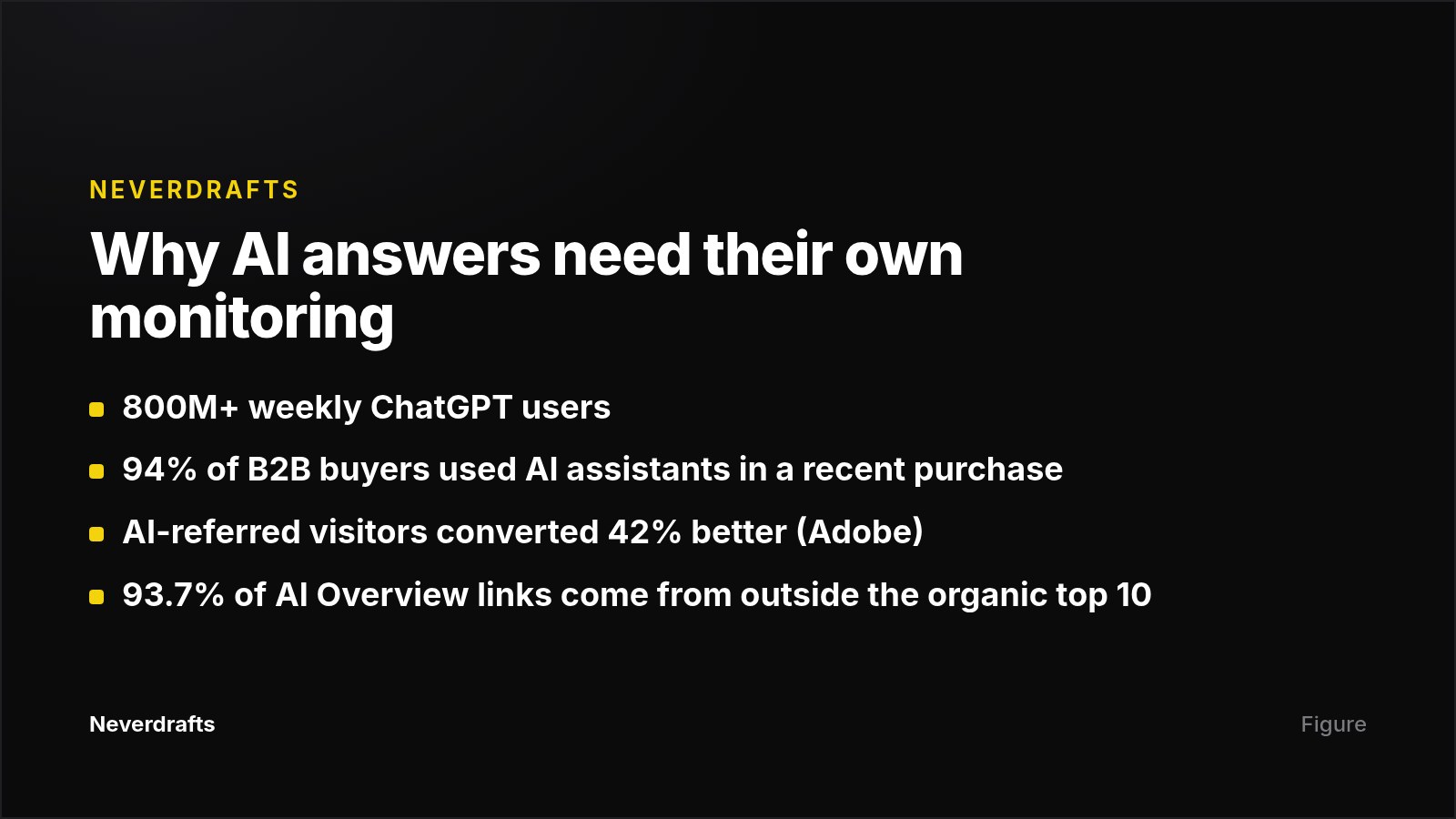
Buyers now build shortlists inside chat windows before they reach your website. ChatGPT alone passed 800 million weekly users, and in one B2B survey 94% of buyers said they used AI assistants during a recent purchase. About half of ChatGPT messages are people asking for information or advice, which is exactly when a brand gets named or left out.
The traffic that does arrive is valuable. In Adobe's analysis of US retail traffic, AI-referred visitors converted 42% better than other visitors, with higher revenue per visit and longer time on site.
Strong Google rankings don't carry over automatically. 93.7% of links in AI Overviews come from pages outside the top 10 organic results. Yotpo calls this the "Visibility Gap": brands that dominate traditional SEO can be missing from AI answers.
What does "how AI talks about my brand" actually measure?
A mention count tells you whether you showed up. It doesn't tell you what the model said. Elfsight separates three metrics that often get blurred:
- Mention: your brand name appears in the answer text.
- Citation: the answer links to a source.
- Recommendation: the answer actively suggests you.
Many mentions carry no link, so click-based analytics miss them entirely. Tools that go further also report:
- Characterisation: the attributes a model attaches to your brand compared with competitors, a dimension llmeknow is built around.
- Top-of-mind recall: which brand a model names first on open-ended questions.
- Sentiment and positioning: whether a mention is positive or negative, and whether it sits in the main answer or a footnote. Yotpo lists these alongside "Citation Provenance," the specific source URL behind a claim.
- Segment differences: the same question asked by different audiences reshuffles brand rankings. A student and a retiree asking about insurance can get different recommendations.
Every tool also has to handle non-determinism. Ahrefs, as quoted by Elfsight, notes that "ChatGPT responses aren't deterministic. Run the same prompt twice and you'll get totally different answers." Good tools use multi-sampling, running the same prompt many times to build a baseline instead of relying on one snapshot.
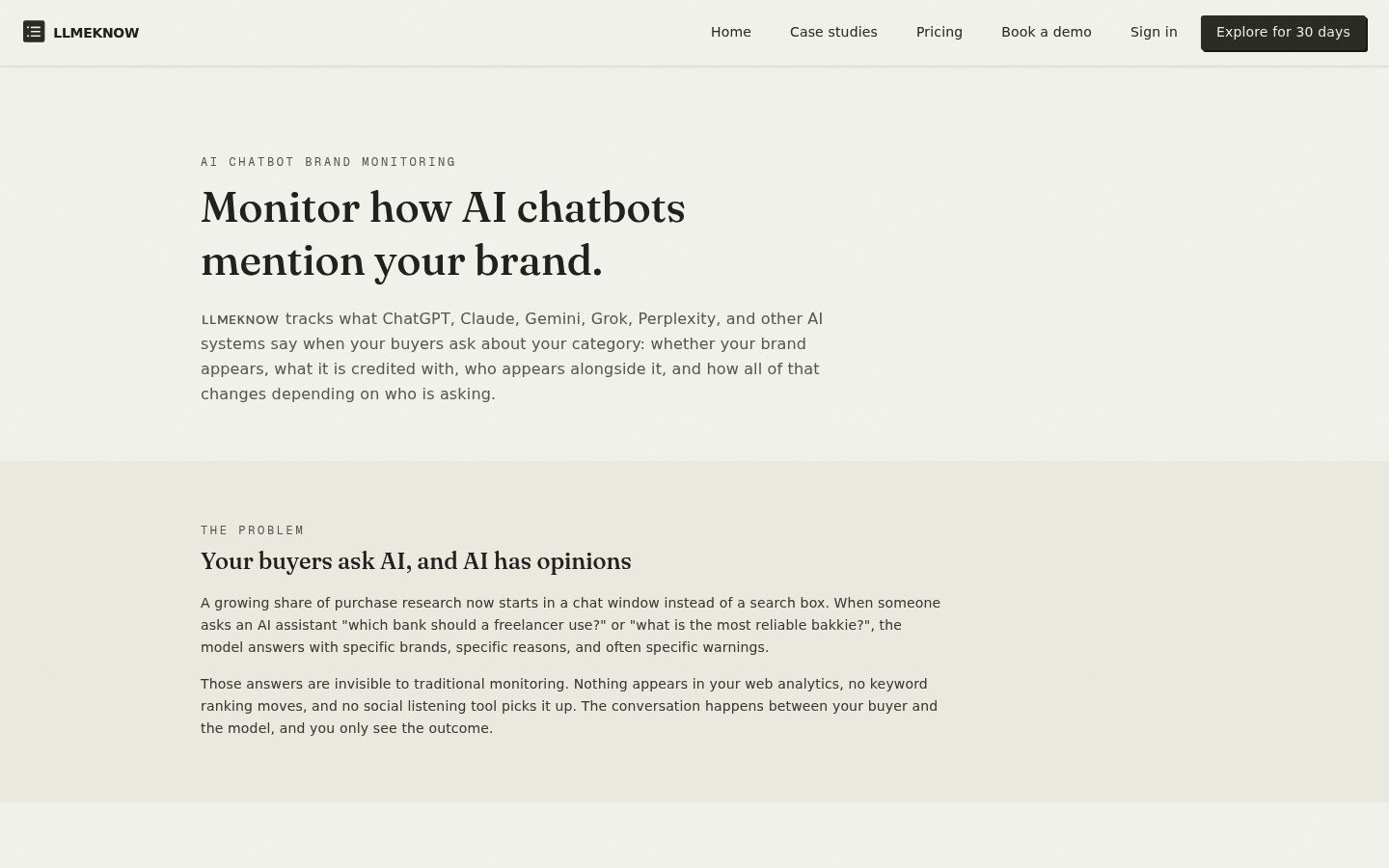
llmeknow: best for research-grade brand perception
llmeknow treats AI monitoring like market research. It runs your questions live through ChatGPT, Claude, Gemini, Grok, Perplexity, DeepSeek and Kimi, with no cached snapshots.
Who it suits: brand, insights and agency teams that need to explain how AI describes a brand, not only whether it appears.
Strengths:
- Asks each question in the context of audience segments you define, plus a no-segment baseline.
- Reports share of voice, top-of-mind recall, characterisation, cited sources and wave-over-wave trends.
- When a model searches the web, it captures the search queries the model ran as well as the sources it cited.
- Keeps every response, with brand mentions highlighted, and compiles results into reports you can send to clients or a board.
Limitations: the product page describes wave-based studies and reports rather than content generation or publishing; confirm alerting frequency with the vendor if you need faster-than-wave checks.
Pricing: you can explore for 30 days with no subscription fee and no card, paying only for the AI responses you generate. The estimated cost is shown before anything runs.
SE Visible: best for volume sampling with sentiment scores
SE Visible appears in round-ups of dedicated AI visibility trackers. Its main selling point is sample size: the Starter plan samples roughly 27,000 AI answers monthly across 450 prompts.
Who it suits: marketers who want statistically steadier numbers and a single sentiment figure to report upward.
Strengths:
- High sampling volume reduces noise from run-to-run variation.
- Sentiment scoring gives a compact, trackable number for tone over time, reported in some coverage of the AI visibility tracking category on a –100 to +100 scale.
Limitations: no published source has tested whether automated sentiment scores match how humans read the same answers. Treat the score as a trend line and spot-check the underlying responses. Engine coverage and pricing weren't specified in the sources we reviewed, so confirm both directly.
Neverdrafts: best for monitoring tied to content fixes
Disclosure: Neverdrafts is our product.
Neverdrafts monitors where ChatGPT, Claude, Google AI Mode and Perplexity recommend your competitors instead of you. It then generates content aimed at winning those prompts back and re-measures to show whether the fix worked.
Who it suits: small businesses, marketers and agencies that want to act on what they find without adding a separate content tool.
Strengths:
- Checks real answers daily on tracked prompts. Each response gets a position-weighted visibility score from 0 to 100 based on the answer text.
- Reports share of voice against competitors and identifies the source domains AI cites when it names them.
- Generates remediation content in 150+ languages and publishes with one click to WordPress, Webflow, Shopify, Framer or via API.
- Tracks AI bot traffic to your site as evidence that a fix had an effect.
Limitations: it covers four engines, fewer than Trakkr, Profound or Rankscale. Gemini app, Grok, Copilot and DeepSeek aren't on the list. Entry pricing sits above the budget trackers. Teams that only want a read-only perception study may find llmeknow's segment analysis closer to what they need.
Pricing: Starter is $99/month (1 brand, 50 prompts, 30 articles). Growth is $199/month (3 brands, 150 prompts, 100 articles). Agency is $399/month (10 brands, 500 prompts, 300 articles). Billing is monthly with no contract, and a free audit needs no card.
Profound: best for enterprise coverage
Profound tracks up to 10 AI engines, more than the 3–5 typical of self-serve plans. It's also one of the names Perplexity, Claude and ChatGPT all recommend as an entry point into dedicated AI-answer tracking.
Who it suits: larger brands and enterprise marketing teams that need wide engine coverage in one platform.
Limitations: pricing isn't published in our sources, and enterprise platforms usually cost well above self-serve tools. If you're weighing it against lighter options, our comparison of AI brand monitoring tools by engine coverage and price sets out the trade-offs.
Otterly.AI: best low-friction starting point
Otterly.AI is described as one of the lowest-friction ways into AI mention tracking. It monitors brand mentions and link citations across ChatGPT, Perplexity, Google AI Overviews and Copilot.
Who it suits: small teams running their first AI visibility test.
Strengths: low entry price. Copilot coverage is less common among budget tools.
Limitations: Gemini and Claude aren't on its listed engines.
Pricing: $29/month on annual billing.
LLM Pulse: best for share of voice on a budget
LLM Pulse offers mention rate and share of voice at an entry price, across ChatGPT, Perplexity, Gemini, Google AI Mode and AI Overviews.
Who it suits: marketers who need competitive benchmarks without a mid-range budget.
Strengths: covers both of Google's AI surfaces plus Gemini. Share of voice is a core metric across these tools.
Limitations: Claude isn't on its listed engines. Sources don't describe sentiment or action features.
Pricing: $50/month on annual billing.
Beamtrace: best for ChatGPT-first small businesses
Beamtrace is built by the Elfsight team, so read Elfsight's guide with that in mind. It targets SMBs and website owners who want an affordable view of whether LLMs name them.
Strengths:
- Shows complete AI responses, so you see context and framing.
- Tracks mention trends over time and sends alerts when your brand appears in new answers.
- Surfaces citation sources that influence mentions.
Limitations: as of July 2026 it tracks ChatGPT only. Gemini, Claude, Perplexity, DeepSeek and Grok are listed as coming soon. The entry tier checks every three days.
Pricing: three tiers at $20, $40 and $100/month, scaling from 10 to 60 prompts and from three-day to daily checks. A 14-day free trial needs no card. For more ChatGPT-only options, see our ChatGPT brand mention tracking tools comparison.
Rankscale: best for the broadest engine list
Rankscale covers 17 engines, the widest list in Elfsight's comparison.
Who it suits: brands that need to track many assistants at once.
Strengths: coverage breadth. Credit-based pricing lets you scale usage up or down.
Limitations: with credits, the monthly cost depends on how many prompts and engines you run. Model it before committing.
Pricing: $20 to $99/month, credit-based.
Trakkr: best for perception tracking at a flat price
Trakkr covers all 8 major engines. Elfsight highlights perception tracking and flat pricing as its key benefits.
Who it suits: teams that care how they're framed across every major assistant and want a predictable bill.
Limitations: sources don't detail how perception is scored. Ask for a sample report before buying.
Pricing: $83/month on annual billing.
Omnia: best for small teams that want next steps
Omnia is positioned as good for small teams wanting an action layer, meaning guidance on what to do, not only a dashboard.
Strengths: 7 engines, with 3 of them available on request.
Limitations: confirm which engines are standard and which need a request.
Pricing: $63/month on annual billing.
Yotpo Discover: best for e-commerce brands
Yotpo Discover is built for commerce. It accounts for hero versus non-hero products, product lifecycles and regional query intent. It tracks visibility across ChatGPT, Gemini and Google AI Overviews, then deploys three agents:
- an Onsite Agent to fix schema
- a Content Agent to generate AEO-ready content
- an Activation Agent to mobilise shoppers on marketplaces and forums that LLMs cite
Limitations: access is through a waitlist. The guide is published by Yotpo, which ranks its own product first. Coverage is narrower than the multi-engine trackers.
Semrush and Ahrefs: best if you already pay for an SEO suite
Perplexity, Claude and ChatGPT all name Semrush and Ahrefs as secondary options for teams already on those platforms. Round-ups describe Semrush's AI Visibility Toolkit and Ahrefs's Brand Radar as the relevant features to look for.
Strengths: no new vendor, and AI data sits next to your keyword and backlink data.
Limitations: these are add-ons to broader platforms rather than dedicated trackers. Compare their sampling depth and engine list with the specialists before you assume they're enough. Our roundup of the best LLM SEO tools in 2026 covers where suites fit.
How should you choose an AI brand monitoring tool?
Use these criteria to compare tools, weighting them by the question you need answered.
- Engine coverage that matches your buyers. A ChatGPT-only tool is fine if your audience lives there. B2B and international brands usually need Claude, Gemini, Perplexity and Google's AI surfaces too. Self-serve plans typically cover 3–5 engines.
- Sampling depth and frequency. More samples per prompt means steadier numbers. Daily checks catch shifts sooner than checks every three days.
- Prompt control. You should be able to write your own buyer-style prompts. Generic prompts measure generic visibility. Rivo lists prompt control, multi-brand support and sentiment scoring as key differentiators.
- Depth of "how," not just "whether." Check for characterisation, sentiment, recommendation position and access to the full response text.
- Citation sources. Knowing which domains feed an answer tells you where better information will change the next one. That could be a review site, a forum or your own docs.
- Data collection method. API wrappers are fast but may miss dynamic elements. Client-side mimicry captures what a real user sees.
- What happens after the report. Monitor-only tools hand you a list of problems. Others add guidance, content generation or publishing. Decide which part of the workflow you'll handle yourself. Our guide on buying AI marketing tools by workflow can help.
- Seats, brands and price at your scale. Agencies need multi-brand plans. Credit-based pricing can surprise heavy users.

As Claude puts it in Rivo's roundup, "most of the 'best of' lists I found are published by vendors, and each tends to rank its own product first. Treat the rankings with skepticism." That applies here too. Run a free trial on your own prompts before committing.
Next step
Find out how you currently appear before choosing a tool. Run a free Neverdrafts audit (no card needed) to see which tracked prompts name competitors instead of you and which sources AI cites for them. Then compare those findings against a trial of one or two tools from the table above.
Frequently asked questions
Can I check what AI chatbots say about my brand for free?
Yes, with limits. You can type buyer-style questions into ChatGPT, Claude, Gemini and Perplexity yourself, but answers vary between runs, so a few manual checks are unreliable. Several tools offer free access to start: Beamtrace has a 14-day trial with no card, and llmeknow offers 30 days with no subscription fee, charging only for responses generated.
Why does ChatGPT give different answers about my brand each time?
Large language models are probabilistic. They predict likely next words, so the same prompt can return different brands, order and wording on each run. Answers can also change with who is asking, since models tailor responses to context. Good monitoring tools run each prompt many times and report rates and averages instead of single results.
How often should I monitor AI answers about my brand?
Daily checks suit competitive categories or active campaigns, because shifts show up sooner. Checks every few days work for smaller brands on a budget, which is the entry-level cadence Elfsight describes for Beamtrace's cheapest tier. Research-style tools like llmeknow run periodic "waves" and compare results between them. Whatever the frequency, judge trends over several weeks rather than reacting to one day's numbers.
If I rank first on Google, will AI chatbots recommend me?
Not necessarily. Yotpo reports that 93.7% of links in Google AI Overviews come from pages outside the top 10 organic results. LLMs weigh semantic relevance and structural clarity, and the same source notes they often cite forums and detailed reviews over established rankings. Strong SEO helps, but you need to measure AI visibility separately to know where you stand.
Can I change how AI chatbots describe my brand?
Indirectly. Models draw on the sources they cite and retrieve, so improving those sources changes future answers. Useful levers include clearer content on your own site and accurate information on the review sites, forums and publications models reference. Monitoring tools that report citation sources, like llmeknow and Beamtrace, show you where to focus.
Are AI sentiment scores accurate?
Treat them as directional. Tools covered in round-ups such as SE Visible report a sentiment score on a scale like –100 to +100, but no published study we found checks those scores against human judgement or sales impact. Use the score to spot changes over time, then read the underlying responses to confirm what actually shifted.