
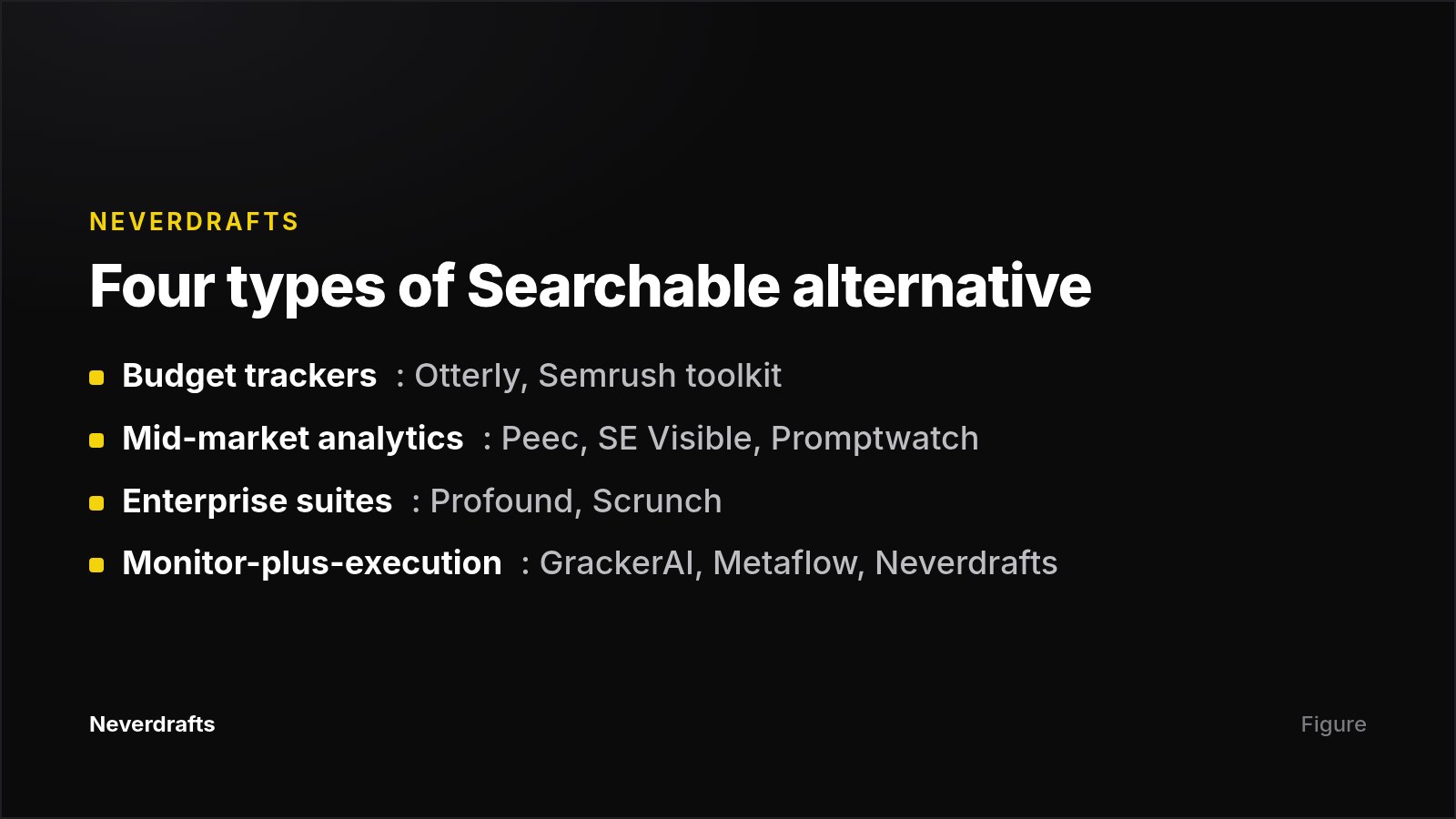
The best Searchable alternatives in 2026 are Peec AI for mid-market teams that want clean, daily tracking (about $95/month), Otterly AI for budget buyers ($29/month), and Profound for enterprises that treat AI visibility as a strategic program. If you are leaving Searchable because it shows gaps but does not close them, consider tools that add an execution layer: GrackerAI, Metaflow, and Neverdrafts. Disclosure: Neverdrafts is our product.
By the Neverdrafts editorial team. Pricing and features come from vendor pricing pages and published third-party comparisons dated June to October 2026. Confirm current rates before you buy.
Key takeaways
- Searchable has three main limits. Its entry tier is $50/month for 1 domain and 50 prompts, Pro at $125/month is capped at one project, and it is a monitoring-first tool with no in-platform publishing.
- Peec AI is the most common mid-market replacement. Otterly AI is the cheapest validated entry point. Profound is the enterprise default, but enterprise deployments run $30,000–$100,000+ per year.
- Sticker prices understate real cost. Peec charges roughly $20–30/month each for Claude, Gemini, Grok and DeepSeek, and Scrunch puts Claude, Gemini, Meta AI, Grok and AI Mode behind Enterprise.
- Scrunch AI was acquired by Sitecore on 3 June 2026. Its future roadmap is tied to Sitecore's DXP, so factor that into any multi-year commitment.
- If you need content produced and published, not just a dashboard, shortlist tools with an execution layer (GrackerAI, Metaflow, Neverdrafts, Promptwatch's Content Agents). Pure trackers will leave that work to your team.
Why do teams look for a Searchable alternative?
Searchable is a credible product. It tracks brand mentions and citations across up to nine answer engines, benchmarks share of voice against competitors, runs technical site audits, and generates AI-optimized articles. It also launched with strong momentum: it raised a £40M seed and hit six figures in ARR within 24 hours of its invite-only launch. Its founding team includes Chris Donnelly of Verb Brands, Arya Nagabhyru, and founding AEO engineer Sam Hogan.
Two design choices count in its favor. You select engines during onboarding rather than unlocking them by tier, which several competitors do not offer. It also includes unlimited seats on every tier.
Teams that switch usually cite one of these problems:
- Project and domain caps. Sources describe Searchable's pricing differently. Metaflow lists a $50/month starter with 1 domain and 50 prompts. GrackerAI says Pro at $125/month gives you one project and pushes you to Scale at $400/month if you run two products or two regions. Either way, multi-brand teams outgrow the entry plan quickly.
- Generic recommendations. Searchable serves e-commerce, B2B software, agencies and enterprise from the same models. GrackerAI reports that teams in technical categories find the guidance reads like it was written for a retail catalog.
- Thin execution layer. Searchable generates AI-optimized articles, but there is no in-platform publishing, content automation, or campaign workflows. In GrackerAI's words, the link between "here is a gap" and "here is who fixes it" is thin.
- Thin third-party validation. At the time Metaflow reviewed it, Searchable had no G2 or Capterra presence and limited documented case studies.
If none of these affect you, staying on Searchable is a reasonable choice. If one or more do, the alternatives below each address a specific gap.
Searchable alternatives at a glance
| Tool | Best for | Standout feature | Starting price (per sources) |
|---|---|---|---|
| Peec AI | Mid-market SEO teams | Daily tracking, unlimited seats | ~$95/mo (50 prompts) |
| Otterly AI | Budget buyers, solo marketers | Multi-country tracking across 50+ markets | $29/mo (15 prompts) |
| Profound | Enterprise, Fortune 500 | Broad engine coverage in the base platform | Custom; Lite ~$499/mo reported |
| Neverdrafts | Small teams that want monitor-to-publish | Auto-generated content plus one-click CMS publishing | $99/mo (1 brand, 50 prompts) |
| GrackerAI | B2B SaaS and cybersecurity | Vertical-tuned diagnosis plus task routing | $99/mo (100 prompts weekly) |
| Metaflow | Growth operators who want execution | Agentic content, CMS and Reddit workflows | 15-day free trial; no published price |
| Scrunch AI | Mid-market persona analysis, Sitecore shops | Crawler and agent analytics | $250/mo (Core) |
| Promptwatch | Agencies needing crawler logs | UI-based daily tracking plus visitor analytics | $95/mo (Essential) |
| SE Visible | Strategic overviews across projects | Real browser-session collection | $99/mo (200 prompts, 3 projects) |
| Ahrefs Brand Radar | Existing Ahrefs users | Large AI index, brand-centric view | $129/mo bundled; $199 standalone |
| Semrush AI Visibility Toolkit | Existing Semrush users | AI layer on an SEO suite | $99/mo per domain |
| AthenaHQ | Teams wanting 11-model coverage | Credits-based GEO analytics plus outreach | Free tier; $295/mo Starter |
Peec AI: is it the best mid-market Searchable replacement?
What it is. Peec AI is an AI visibility analytics tool that tracks how often your brand appears in AI answers, where competitors beat you, and which sources models cite. Across Google AI Mode, Perplexity and ChatGPT answers to this question, Peec is the most frequently recommended Searchable replacement for agencies and mid-market teams.
Who it suits. SEO teams that want a simple, fast analytics layer and will review a dashboard weekly. Stork.AI calls it the best value of the three (alongside Profound and Otterly) for an established mid-market brand.
Strengths
- Daily tracking on the Starter plan, with unlimited team members.
- A 7-day free trial with no credit card. Metaflow lists the trial as 14 days, so check the current terms.
- Positioned by Metaflow for global brands needing multilingual tracking.
- Clean UX. SE Ranking describes it as easy multi-engine tracking.
Limitations
- Core tracking covers ChatGPT, Perplexity and Google AI Overviews. Claude, Gemini, Grok and DeepSeek cost roughly $20–30/month each. One agency reports Claude as an extra at $35 to $165 or Enterprise-only.
- It stops at monitoring. It will not flag a blocked GPTBot or attribute AI-referred sessions.
- It does not generate content.
Pricing. Starter is ~$95/month for 50 prompts and 3 models, Pro ~$245/month for 150 prompts, and Advanced ~$495/month. Metaflow lists a $85/month starting price, and Enterprise reportedly expands coverage to 13 engines.
Otterly AI: what is the cheapest credible way to replace Searchable?
What it is. Otterly is the most affordable full monitoring platform in this category. Zapier ranks it best for affordability. ChatGPT, Perplexity and Google AI Mode repeatedly recommend it as the low-risk way to test whether AI visibility monitoring pays off before you spend more.
Who it suits. Solo marketers, small agencies tracking client brands, and anyone validating the category on a small budget.
Strengths
- $29/month for 15 prompts across ChatGPT, Perplexity, Gemini and Copilot, with multi-country tracking across 50+ markets.
- Detailed GEO audits covering 20+ factors.
- The Standard tier adds API, MCP and a Looker Studio connector.
- Fast setup and a trial that does not ask for a card. Metaflow lists the trial as 14 days.
Limitations
- 15 prompts is a small sample, and the cheapest tier is tracking-only.
- Google AI Mode and Gemini are billed as extras ($9–149 depending on plan). One agency reports that Gemini and Claude add-ons lag 7 days and treats Otterly data as "weekly-ish." Sources differ on whether Gemini ships with Lite or is billed as an add-on; confirm before buying.
- No traffic attribution on the cheap tier.
Pricing. Lite $29/month (15 prompts), Standard $189/month (100 prompts), Premium $489/month (400 prompts).
Profound: when is enterprise pricing worth it?
What it is. Profound is the name most people cite first for enterprise AI visibility. It offers deep dashboards, agent and crawler analytics, and conversation-topic breakdowns. SE Ranking highlights enterprise-grade insights plus CDN integration.
Who it suits. Large marketing organizations where AI visibility is a funded strategic initiative.
Strengths
- Broad coverage of ChatGPT, Claude, Gemini, Perplexity and Google AI Overviews. Profound is the only tool in Stork.AI's comparison that includes broad coverage in the base platform.
- Analytics depth that smaller tools do not match.
Limitations
- Pricing is opaque and inconsistent across sources. Stork.AI reports no free trial and no true self-serve signup. GrackerAI lists a free trial covering 1 engine. One agency describes a Starter at $99 on annual billing that tracks ChatGPT only, plus Growth at $399, with the full engine list being "a sales conversation."
- No content generation.
- For a founder who just wants to know what ChatGPT says about them, Stork.AI calls it wildly oversized.
Pricing. A published Lite tier sits around $499/month for 3 seats and roughly 24,000 responses analyzed monthly. Enterprise deployments run $30,000–$100,000+ per year.
Neverdrafts: what if you want monitoring and publishing in one tool?
Disclosure: Neverdrafts is our product.
What it is. Neverdrafts monitors which AI systems recommend your competitors instead of you. It then generates and publishes content aimed at the exact prompts you are losing, and tracks AI crawler visits to show whether that content is being picked up. It targets Searchable's execution gap directly: Searchable generates briefs and articles but has no in-platform publishing, while our loop runs from detection through drafting and publishing to crawler confirmation in one tool.
Who it suits. Small businesses, content teams and agencies that have no spare writer capacity to act on a visibility report and want the fix produced automatically.
Strengths
- Daily monitoring of real ChatGPT, Claude, Google AI Mode and Perplexity answers on tracked prompts.
- Position-weighted visibility scoring from 0–100 per response, based on how prominently you appear, not just whether you are mentioned.
- Remediation content generated for the prompts you are losing, with one-click publishing to WordPress, Webflow, Shopify, Framer, or via API.
- AI bot traffic tracking on your site as evidence that content is being fetched.
- Competitor citation detection, sentiment scoring (positive, neutral, negative), and delivers results in 150+ languages.
- Multi-brand plans at lower cost than Searchable's tier jump. Growth covers 3 brands at $199/month.
Limitations
- Engine coverage is four engines (ChatGPT, Claude, Google AI Mode, Perplexity). Gemini, Copilot, Google AI Overviews, Grok and DeepSeek are not listed. Teams that need nine or more engines should look at Searchable, Profound or AthenaHQ.
- No named customers are published, and none of the third-party comparisons reviewed for this article tested it independently.
- The content-volume model (30 to 300 articles per month) suits teams that want automated output. Brands with strict editorial review should plan time to approve drafts.
- Prompt counts are 50 on Starter, which is comparable to Peec Starter but smaller than SE Visible's 200.
Pricing. Starter $99/month (1 brand, 50 prompts, 30 articles), Growth $199/month (3 brands, 150 prompts, 100 articles, competitor diagnosis), Agency $399/month (10 brands, 500 prompts, 300 articles, client reporting). A $1 trial gives 3 days of full access. Billing is monthly with no contracts.
GrackerAI: is a vertical-tuned tool better for B2B SaaS?
What it is. GrackerAI is an AEO and GEO platform built for cybersecurity and B2B SaaS. It uses vertical-tuned analysis models, a cybersecurity prompt library, and diagnostic agents that explain why a page lost a citation. Note that the most detailed source on GrackerAI is its own blog, which ranks itself first.
Who it suits. Technical B2B teams who find Searchable's recommendations too generic for buyers of SIEM, zero trust or identity software.
Strengths
- Tracks up to 10 engines, including Claude, DeepSeek, Grok and Brave Leo (all 10 on Enterprise only).
- Prompt Mining surfaces real buyer questions with estimated volume. Visibility Diagnosis returns a content brief or a prioritized gap report.
- Built-in tasks sync to Asana, ClickUp, Notion and Jira, plus a read-only MCP connector and Reddit citation rollups by subreddit.
- A content engine that writes new articles and rewrites pages that fail to earn citations.
Limitations
- Starter tracks 100 prompts weekly on 3 engines with 3 articles per month; daily tracking starts at Scale.
- The trial requires a credit card, though it is not charged during the 7-day period.
- It is narrowly focused. Retail and consumer brands will not benefit from the vertical tuning.
Metaflow: what if you want an execution engine more than a dashboard?
What it is. Metaflow is an agentic marketing automation platform. Marketers build AI agents and workflows across SEO, AEO, content creation, programmatic publishing, Reddit community engagement and LinkedIn thought leadership. It frames the problem plainly: pure-play monitors "show you a gap. They don't close it."
Who it suits. Growth operators, founders and agency owners who already run content programs and want them faster and more citation-ready.
Strengths
- Direct CMS publishing and batch programmatic SEO.
- Reddit and community monitoring with AI-assisted responses. Metaflow calls third-party presence the biggest driver of AI citation share.
- A persistent knowledge layer, so agents retain brand voice and positioning across work.
- Vendor-reported results include 10x AI citation growth in commercial queries for customers. Treat this as a vendor claim.
Limitations
- Its own comparison lists its AI platform tracking as "Indirect (SEO/AEO content engine)". It is not a prompt-level answer tracker, so you may still need a monitor alongside it.
- No published pricing. You contact sales after the trial.
- Building agents and workflows takes operator time. It is less turnkey than a dashboard.
Pricing. 15-day free trial. Plans on request.
Scrunch AI: should you still buy it after the Sitecore acquisition?
What it is. Scrunch is a prompt-level, multi-engine monitor whose distinguishing feature is crawler and agent analytics. It shows which AI bots actually fetch your pages, not just which answers name you. Before the acquisition it had raised a $15M Series A and served 500+ brands and agencies.
Who it suits. Mid-market teams needing persona-based analysis, and organizations already invested in Sitecore.
Strengths
- Core includes ChatGPT, Perplexity, Google AI Overviews and Copilot with 5 audits a month.
- Growth scales to 8 engines and 700 prompts.
- Backing from a large DXP vendor.
Limitations
- Sitecore acquired Scrunch on 3 June 2026. Bloomberg reported the price at roughly $225 million, which neither company has confirmed. Stork.AI says its future is "a DXP roadmap, not a standalone one". No source documents whether standalone customers will be migrated.
- Stork.AI reports that Claude, Gemini, Meta AI, Grok and Google AI Mode sit behind Enterprise, while SE Ranking's comparison lists Claude, Gemini and Meta AI as part of Core's engine set at $250/month. The two sources disagree; confirm current engine coverage at your plan before buying.
- One agency describes the $250 annual plan as a weekly Excel export, not a team tracker with seats.
Pricing. Core $250/month (125 prompts), Growth $500/month.
Promptwatch: which tool covers crawler logs and visits?
What it is. Promptwatch tracks ChatGPT, Gemini, Claude, Perplexity and Overviews from the UIs, daily. It adds citation analytics, visitor analytics via a script or GTM, and crawler logs on higher plans. The agency behind this source operates Promptwatch itself, so weigh its framing accordingly. We cover the wider field in our best Promptwatch alternatives for 2026 guide.
Who it suits. Agencies and teams whose brief includes AI crawler activity and AI-referred visits, not just mentions.
Strengths
- Same $95 price as Peec Starter, but Essential already includes citation analytics and visitor analytics.
- Content Agents can draft into Webflow or Framer, with a review inbox required before anything publishes.
- Connects to DataForSEO. The Kick-off and Business agency plans include unlimited projects.
Limitations
- For single brands, crawler logs start at Professional ($245/month); the agency Kick-off plan ($199/month) also includes them, so it can be the cheaper route to crawler data if you qualify for an agency plan.
- Essential is limited to one project.
- Content Agents drafts require a review inbox before they go live, which adds a manual step compared with fully automated publishing tools.
SE Visible: is browser-based tracking more accurate?
What it is. SE Visible, from SE Ranking, tracks visibility, average position, sentiment and sources across ChatGPT, Gemini, AI Mode, AI Overviews and Perplexity. It collects answers through a real browser session on the same interface a person uses, not through API calls.
Who it suits. Marketing leads who want a strategic, at-a-glance view across a few projects.
Strengths
- 200 prompts and 3 projects on the $99/month Basic plan. That is a high prompt and project allowance for the price, and it addresses Searchable's single-project cap.
- UI-based collection. Zapier notes that methods that mimic real user behavior can produce more accurate results.
- Ready-made metrics that need no technical setup.
Limitations
- Claude and Copilot are not listed among its engines.
- It is a measurement tool, not a content or publishing tool.
- The detailed review comes from SE Ranking's own blog.
Pricing. From $99/month.
Ahrefs Brand Radar: worth it if you already pay for Ahrefs?
What it is. Brand Radar is Ahrefs' AI visibility module. It offers brand-centric insights from a massive AI index covering up to 6 engines.
Who it suits. Teams already running Ahrefs who want AI visibility next to backlink and keyword data. Zapier picks it for existing Ahrefs users.
Strengths
- One login and one bill for SEO and AI visibility.
- Engine coverage that includes ChatGPT, Google AIO, Claude and Gemini.
Limitations
- No content generation.
- Expensive as a standalone purchase compared with dedicated trackers.
Pricing. $129/month bundled, $199/month standalone.
Semrush AI Visibility Toolkit: the cheapest add-on for Semrush shops?
What it is. An AI visibility layer on top of the Semrush SEO suite, tracking ChatGPT, Google AIO, AI Mode, Gemini and Perplexity.
Who it suits. Existing Semrush customers. Zapier names it the pick for existing Semrush users.
Strengths
- AI visibility next to an established SEO suite.
- Semrush's broader content tools are available if you also hold the suite. Metaflow lists the suite at $199/month.
Limitations
- 25 prompts and 1 domain on the toolkit. It is billed per domain, so it carries the same single-project pain as Searchable.
- No Claude or Copilot listed.
Pricing. $99/month per domain.
AthenaHQ: which alternative tracks the most models?
What it is. A GEO analytics platform with a built-in content and outreach layer, covering 11 models: ChatGPT, Perplexity, Google AIO, AI Mode, Gemini, Claude, Copilot and four more.
Who it suits. Teams for whom broad engine coverage matters more than per-prompt simplicity.
Strengths
- One of the widest listed model sets (11) with a free tier to start, though Goodie AI is reported to cover up to 13 engines at a higher price point, so AthenaHQ is not the single widest option in these sources.
- A free tier to evaluate before you pay.
Limitations
- Credit-based pricing is harder to forecast than prompt-based plans.
- Starter at $295/month costs more than most mid-market trackers.
Pricing. Free tier (300 credits); $295/month Starter (3,600 credits).
Which other Searchable alternatives are worth a look?
These tools appear in the sources but fit narrower needs:
- Knowatoa: $59/month, 3 to 7 engines, AI agent drafting. A budget multi-engine option for small teams.
- Goodie AI: $399/month, 5 to 13 engines, aimed at enterprise retail, travel and commerce brands.
- ZipTie: Zapier's pick for deep analysis and reporting. It tracks responses using methods that mimic real user behavior.
- AI Peekaboo: $50/month Starter (40 prompts) to $200/month Grow (100 prompts), targeting agencies and small brands.
- Promptmonitor: $29/month across 8 platforms including Claude, Grok, DeepSeek and Meta AI. Wide coverage for a low price.
- Rankscale AI: $20/month for 480 responses, the lowest paid plan among the tools in these sources. Free tiers also exist elsewhere, including Promptwatch Explore and AthenaHQ's 300-credit tier.
- AirOps: free to start, task-based, with workflow-driven content for large-scale content teams.
What does a Searchable alternative really cost once add-ons are included?
Base prices are only part of the bill. Before comparing tools, list the engines your buyers actually use, then price each tool with those engines included:
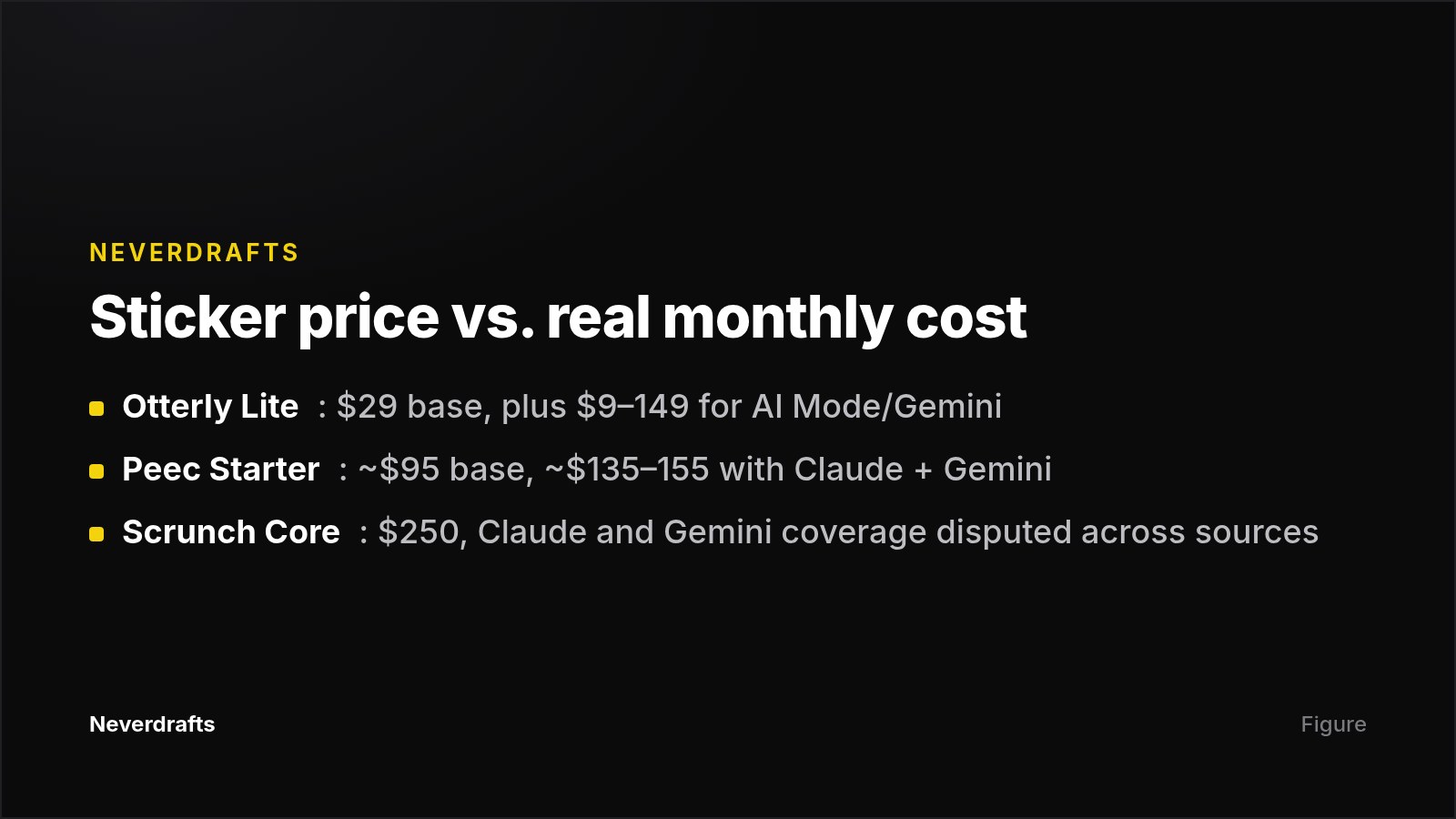
- Peec Starter is ~$95. If you add Claude and Gemini at ~$20–30 each, you pay roughly $135–155/month for 50 prompts.
- Otterly Lite is $29. Adding AI Mode or Gemini costs $9–149 depending on plan, and you still have only 15 prompts.
- Scrunch Core is $250. Stork.AI reports Claude and Gemini are Enterprise-only, though SE Ranking's listing suggests Core already includes some of these engines; confirm which version applies to your quote.
- Searchable lets you pick engines at onboarding instead of paying per engine. For multi-engine buyers on a single project, that is a real reason to stay.
Also count the people cost of a monitoring-only tool. If a dashboard flags 20 losing prompts a month, someone has to write, publish and update content for them. Execution-layer tools fold some of that labor into the subscription. Pure trackers do not. If you sell AI visibility to clients, our guide to building AI visibility monitoring into an SEO retainer covers how to price that work.
How to choose the right Searchable alternative
We grouped tools using the criteria that most often decide a switch away from Searchable. Work through them in order.
1. Which of Searchable's limits are you escaping?
- Project caps: look at SE Visible (3 projects at $99), Promptwatch Kick-off (unlimited projects), or multi-brand plans like Neverdrafts Growth. Our guide to AI search visibility tools for multiple client websites goes deeper on this.
- Generic recommendations: look at GrackerAI for B2B SaaS and cybersecurity, or Goodie AI for commerce.
- No execution: look at Neverdrafts, Metaflow, GrackerAI, or Promptwatch's Content Agents.
2. Which engines are included at your tier?
Check coverage at the plan you will actually buy, not on the Enterprise feature page. Profound's entry tier may be ChatGPT only, Peec charges for Claude, and sources disagree on whether Scrunch's Core plan includes Claude and Gemini or locks them behind Enterprise.
3. How often is data refreshed?
Daily tracking (Peec, Promptwatch, Neverdrafts, GrackerAI Scale) shows movement faster than weekly tracking (GrackerAI Starter, Scrunch's export). If you report to a client weekly, weekly data may be enough. If you are testing content changes, daily data shortens the feedback loop.
4. How does the tool collect answers?
LLM output is non-deterministic. The same prompt on the same engine at the same time can return different answers, so expect some fluctuation in any tool. UI- or browser-based collection (SE Visible, Promptwatch, ZipTie, Neverdrafts) reflects what users see more closely than API calls. No source has published a head-to-head accuracy test, so treat this as a direction rather than proof.
5. Can it prove impact beyond mentions?
Mentions are a leading indicator. AI crawler logs and AI-referred visits are closer to proof. Scrunch, Promptwatch (visitor analytics from Essential, crawler logs from Professional or the agency Kick-off plan), Profound and Neverdrafts report bot or visitor activity in some form. Peec and Otterly's cheapest tiers do not.
6. How stable is the vendor?
The category is young. Searchable itself has thin third-party validation, and Scrunch's roadmap now belongs to Sitecore. Favor monthly billing and trials until a tool has proven itself on your prompts.
7. Do you need a subscription at all?
Stork.AI notes that every tool here is a recurring subscription built for teams who will act on a dashboard weekly. If you only need a one-time baseline, use a free tier or a short trial, export the data, and cancel. For a broader view of the category beyond Searchable switchers, see our roundup of the strongest AI visibility monitoring tools in 2026.
Next step
If Searchable's one-project cap or its lack of publishing is the reason you are looking, compare it directly with Neverdrafts on our Neverdrafts vs Searchable page. To test it on your own prompts, the $1, 3-day trial gives full access to monitoring, content generation and CMS publishing. Run 10 to 20 of your highest-value buyer prompts and check which ones you are losing before you commit.
Frequently asked questions
What is the cheapest alternative to Searchable?
Among the tools covered here, Rankscale AI has the lowest listed paid plan at $20/month for 480 responses. Free tiers also exist elsewhere, including Promptwatch's Explore plan (ChatGPT only, 10 prompts) and AthenaHQ's 300-credit free tier. Among paid, full-featured platforms, Promptmonitor and Otterly AI both start at $29/month. Otterly is the most commonly recommended budget pick because it is a full platform with multi-country tracking. Its Lite plan includes only 15 prompts, though, and AI Mode and Gemini can cost extra, so the real monthly cost may be higher.
Which Searchable alternatives create and publish content, not just monitor?
GrackerAI generates and rewrites articles and routes fixes to task tools. Metaflow runs agentic content workflows with direct CMS publishing and Reddit engagement, but it does not track answers at the prompt level. Neverdrafts generates content for losing prompts and publishes to common CMSs. Promptwatch's Content Agents draft into Webflow or Framer, with a review inbox before anything goes live. Peec, Otterly, Profound and Scrunch focus on monitoring.
Is Scrunch AI still a safe choice after Sitecore bought it?
Scrunch still sells standalone plans from $250/month, and its crawler analytics are useful. Sitecore acquired it on 3 June 2026, and commentators expect its roadmap to follow Sitecore's DXP rather than run independently. No public source confirms plans for standalone customers. Sources also disagree on which engines Core includes versus which sit behind Enterprise, so confirm your quote directly. If you are not a Sitecore customer, prefer monthly terms over a long contract.
Why do AI visibility tools show different results for the same prompt?
Large language models are non-deterministic. The same prompt on the same engine can produce different answers depending on timing, phrasing and session context. Tools also differ in collection method (API calls versus real browser sessions), refresh frequency, and location settings. Compare trends over several weeks rather than single readings, and keep your prompt list fixed so the results are comparable.
Which alternatives track Claude without expensive add-ons?
Profound includes Claude in its broad base coverage, but at enterprise prices. AthenaHQ lists Claude among its 11 models. Promptwatch's paid plans and Neverdrafts both track Claude on standard tiers. Peec charges extra for Claude, and sources disagree on whether Scrunch's Core plan includes it or reserves it for Enterprise. GrackerAI includes Claude among its 10 engines, but all 10 are available only on Enterprise.
Should I replace Searchable or run two tools side by side?
Run two tools only if each fills a distinct gap. For example, pair a tracker with a tool that adds crawler logs or content execution. Avoid paying twice for overlapping prompt tracking. If Searchable's engine selection and unlimited seats work for you and only publishing is missing, adding an execution tool may cost less than a full migration.
Sources
- Zapier: The 9 best AI visibility tools in 2026
- GrackerAI: Best Searchable Alternatives for AI Visibility Monitoring
- Stork.AI: Profound vs Otterly vs Peec
- Metaflow: Searchable alternatives
- 1001 SEO Media: AI search visibility prompt tracking tools (Otterly, Profound, Peec AI, Scrunch) 2026
- SE Ranking: Best AI visibility tools
- Neverdrafts pricing
- Neverdrafts vs Searchable