
To get your brand mentioned by ChatGPT, other trusted sources need to mention you first, and your own site has to be crawlable and easy to quote. ChatGPT draws on what it learned in training and on live web results. Both reward brands that are discussed on Wikipedia, Reddit, Quora, YouTube, review sites, and the roundup articles it already cites. The work is mostly off-site: earn third-party mentions, then publish evidence on your own pages that is worth citing.
Key takeaways
- In Ahrefs' study of 75,000 brands, branded web mentions predicted AI citation better than backlinks, domain rating, or content volume.
- About 60 percent of ChatGPT responses come from training data and 40 percent use live lookups through Bing's index. You need to work on both.
- On-page optimization covers roughly 25 percent of the citation equation. The other 75 percent depends on what happens off your site.
- Allow OAI-SearchBot in robots.txt, or your site will not appear in ChatGPT search answers.
- The strongest practical move is getting mentioned on the specific pages ChatGPT already cites for your category prompts.
- No tactic guarantees a mention. The aim is to make your brand eligible and credible for the prompts that matter.
What you need before you start
You need the following:
- A prompt list. These are the questions buyers actually type, such as "best [category] for [audience]" or "[competitor] alternatives."
- Access to your robots.txt and server or CDN firewall settings.
- A way to record answers. A spreadsheet works at first: date, prompt, engine, brands mentioned, URLs cited.
- A realistic timeline. Live search eligibility can change within a day. Shifting what the model learned in training depends on coverage that builds up over time.
It also helps to know how traditional SEO overlaps with this work. We cover that in does traditional SEO help you show up in ChatGPT answers.
Step 1: Define the prompts that shape buying decisions
Start with the questions your buyers, journalists, and partners ask. Gigawatt Group recommends organizing prompts around discovery, comparison, validation, risk, reputation, and purchasing intent. A starter set looks like this:
- Which companies solve [specific problem]?
- How does [your brand] compare with [named competitor]?
- Which providers have experience in [regulated industry]?
- What do customers say about [your brand]?
- What risks should I consider before choosing [category] provider?
Add regional modifiers, use cases, and natural follow-up questions. One user question can set off several searches in the background. ChatGPT Search can rewrite a prompt into one or more targeted searches, so a single service page rarely covers everything the answer draws on.
What good looks like: a prompt set that covers every intent group, each with a baseline note on who gets mentioned today.
Common mistake: tracking only your brand name. Most valuable prompts never include it.
Step 2: Can ChatGPT actually reach your site?
ChatGPT cannot cite pages it is not allowed to fetch. OpenAI runs separate crawlers, and each robots.txt setting is independent:
| Crawler | Purpose | What blocking it does |
|---|---|---|
| OAI-SearchBot | Surfaces sites in ChatGPT search | Your site is excluded from ChatGPT search answers, though it can still appear as a navigational link |
| GPTBot | Crawls content that may be used to train foundation models | Signals your content should not be used for training |
| OAI-AdsBot | Checks the safety of landing pages submitted as ChatGPT ads; only visits pages submitted as ads | Prevents ad landing-page validation; has no effect on organic search or training (data not used for training) |
| ChatGPT-User | Fetches pages when a user's request triggers it | Not used for automatic crawling or search eligibility; robots.txt may not apply |
A minimal configuration that allows search visibility looks like this:
User-agent: OAI-SearchBot Allow: / OpenAI also recommends allowing requests from its published IP ranges; check that CDN or bot-protection rules aren't blocking them even when robots.txt allows the crawler. After you change robots.txt, it can take about 24 hours for OpenAI's systems to pick up the change.
Then confirm the basics. Priority URLs should return successful status codes, contain indexable content, appear in your XML sitemap, and show their important text in rendered HTML rather than images, widgets, or PDFs. If you publish a PDF report, also create a permanent HTML page with the findings, methodology, author, and date.
Common mistake: blocking GPTBot without thinking it through. Since most responses draw on training data, opting out of training is a real trade-off.
Step 3: Get mentioned on the pages ChatGPT already cites
This is the strongest practical move, according to Contently's synthesis of 2025–2026 citation research. Run your prompts from Step 1 through ChatGPT, Perplexity, and Google AI Mode, and note which domains and URLs get cited. Those pages are your outreach list. A mention on a roundup ChatGPT already pulls from is worth more than a backlink from a blog it never cites.
How to work the list:
- Comparison and roundup pages. Search "best [category] tools" and "[competitor] alternatives." Contact the authors of the articles AI cites repeatedly, and send a clean factual product description, not a sales pitch.
- Co-marketing. Generative engines notice co-occurrence. Being mentioned alongside an established brand through joint webinars, co-authored research, or guest podcasts strengthens your own signal.
- Referring domain diversity. Link breadth still matters. SE Ranking found that sites with up to 2,500 referring domains averaged 1.6 to 1.8 ChatGPT citations, while sites with over 350,000 averaged 8.4. Citation rates nearly doubled, from 2.9 to 5.6, at around 32,000 referring domains.
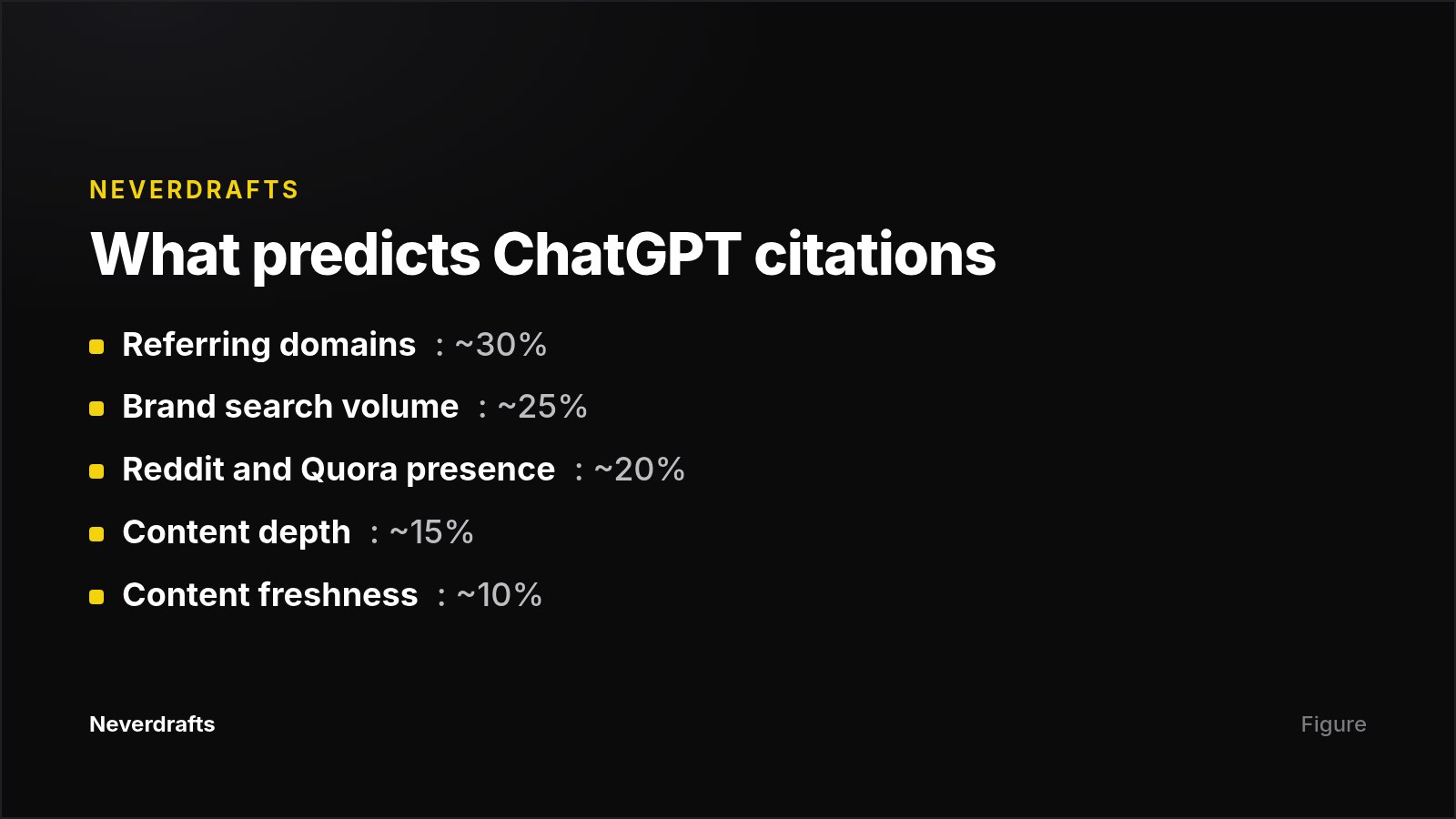
These weights come from ConvertMate's analysis of more than 10,000 domains. They are approximations, but they show where effort tends to pay off.
Common mistake: pitching generic "write about us" requests to sites that never appear in AI answers.
Step 4: How do you build presence on Reddit and Quora without spamming?
Community platforms show some of the largest effects in the data. Domains with millions of Reddit brand mentions averaged 7 ChatGPT citations versus 1.8 for domains with minimal presence, a 3.9x multiplier. Quora showed a 4.1x multiplier.
Both platforms remove promotional content quickly, so the approach is participation, not posting links:
- Have practitioners on your team, such as engineers, support leads, and consultants, answer real questions under their own accounts.
- Share specific product experience, including limitations.
- Credit competitors when they are the better fit for a question.
- Focus on threads that match your Step 1 prompts.
What good looks like: a few people who are recognized as helpful in the subreddits and Quora topics your buyers read, with brand mentions that come up naturally.
Common mistake: creating new accounts that only mention your product. Moderators and users spot this, and the posts disappear.
Step 5: Earn coverage on YouTube and review platforms
YouTube. In Ahrefs' December 2025 data, YouTube mentions had a 0.737 correlation with AI Overview visibility, the strongest single signal measured. Branded web mentions overall scored 0.664. These figures measure Google AI Overviews, not ChatGPT directly, but they point the same way. Generative engines read transcripts, and video reviews can often be earned through creator outreach more reliably than top-tier press. Offer creators who review your category product access, a demo, or data they can use.
Review platforms. Domains listed on multiple review platforms (G2, Capterra, Trustpilot, Sitejabber, Yelp) earn 4.6 to 6.3 citations on average, versus 1.8 for those absent. Get listed on the major three review platforms for your category. The research doesn't show which platform matters most for which industry, so check which review sites ChatGPT cites for your Step 1 prompts and prioritize those.
Common mistake: creating a review profile and leaving it. Contently's research recommends responding to reviews actively; unanswered complaints remain public on platforms AI engines treat as authoritative.
Step 6: Publish evidence other sites want to cite
AI systems have little reason to cite another generic summary. Brands earn citations by adding new, defensible information to the public record:
- Original research with a transparent methodology
- Benchmarks built on disclosed samples or operating data
- Named expert analysis with relevant credentials
- Case studies that explain conditions, actions, and results
- Current product, pricing, location, and policy information
Original research does double duty. A single study can earn mentions across ten or twenty independent publications, and those mentions feed the off-site signals from Steps 3 through 5. Ahrefs shows how this works: its brand mentions study is now cited whenever people discuss AI visibility, including in this article.
State the scope of every claim: geography, time period, sample, and limitations. That gives publishers a defensible reason to reference it.
Step 7: Structure your pages so answers are easy to extract
When ChatGPT cites your own site, page structure affects whether it uses you. The data is specific:
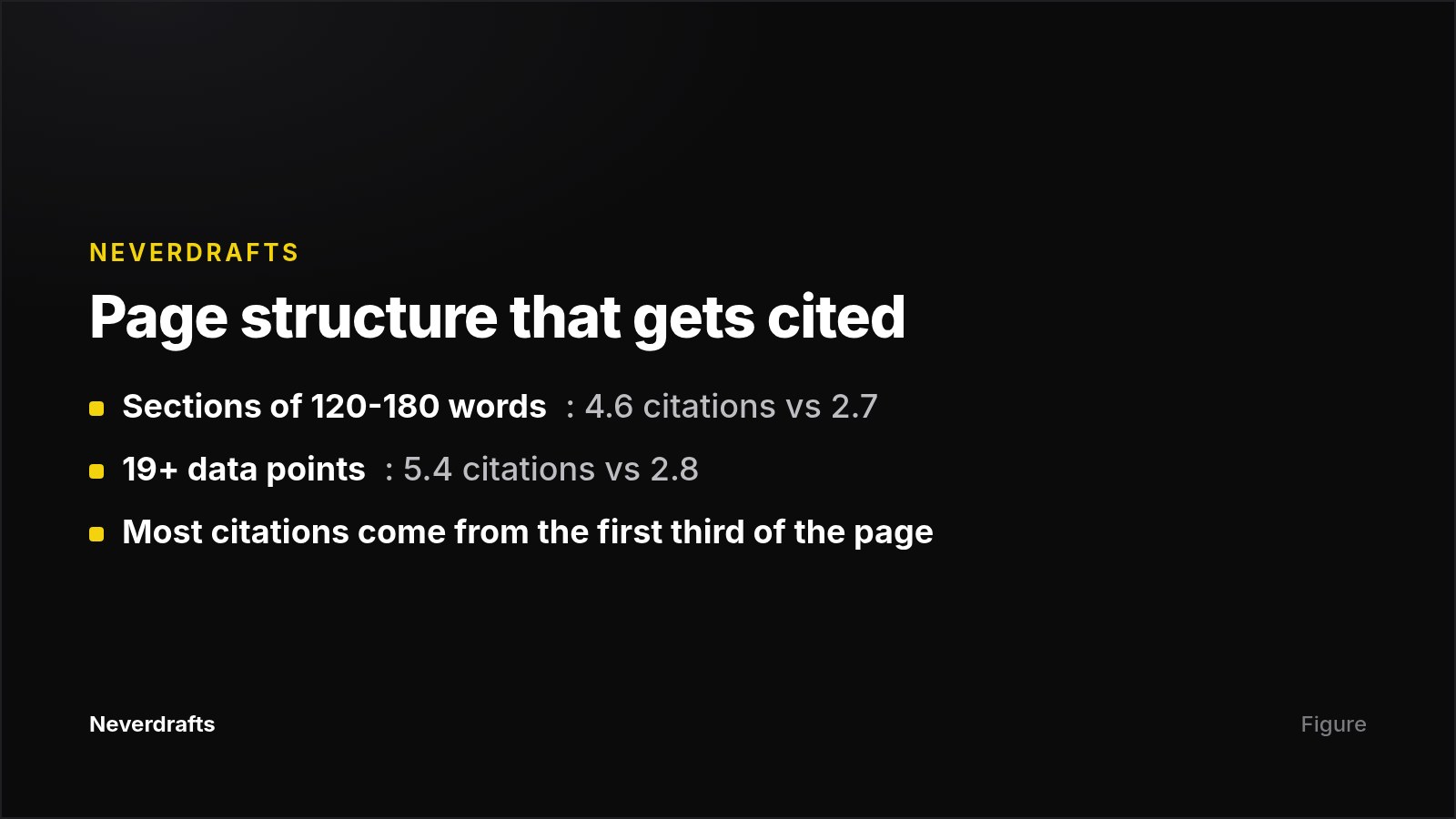
- Pages with 120 to 180 words between headings averaged 4.6 citations, versus 2.7 for sections under 50 words.
- Pages with 19 or more statistical data points averaged 5.4 citations, versus 2.8 for sparse pages.
- Most AI citations come from the first third of a cited page.
In practice:
- Put a direct answer immediately after each descriptive heading.
- Follow it with evidence, qualifications, and examples.
- Use comparison tables, numbered processes, and labeled findings where they fit the content.
- Lead with your strongest, most quotable claim. Don't save it for paragraph four.
- Add structured data only when it accurately reflects visible content.
Common mistake: breaking pages into dozens of 30-word fragments in the name of "AI optimization." Clear writing matters more than artificial fragmentation.
Step 8: Strengthen your entity signals, including Wikipedia
ChatGPT needs to know clearly what your brand is, what it does, whom it serves, and which experts are connected to it. Keep your organization, leadership, author, service, and location details consistent across your site, social profiles, directories, and Wikidata.
Wikipedia carries particular weight. It accounts for 7.8 percent of all ChatGPT citations and roughly 22 percent of its training data. If you have a Wikipedia entry, its wording will heavily shape how ChatGPT describes you. If you don't, treat it as a long-term project. Don't write the page yourself, because that gets reversed. Build the independent secondary-source coverage that makes a future page possible; Steps 3 through 6 help build that coverage.
Step 9: Measure presence, citations, and accuracy, then repeat
Track three things separately, because they carry different business value:
- Presence: how often your brand appears for priority prompts.
- Citation: how often your pages, research, or experts are used as sources.
- Narrative: whether the answer describes you accurately.
Re-run your prompt set on a fixed schedule. Compare the results against your Step 1 baseline. Then send effort where you are losing: outreach for prompts where competitors dominate, new evidence pages for prompts where nobody is cited well.
At Neverdrafts, we built our platform for this loop. It tracks real ChatGPT, Claude, Google AI Mode, and Perplexity answers across 50 to 500 daily prompts, scores visibility per answer, and drafts content aimed at the prompts you are losing. It doesn't do the off-site work in Steps 3 through 5, which still needs people. For other options, see our comparison of ChatGPT brand mention tracking tools.
Mistakes to avoid
- Treating it as an on-site project. Most of the predictive weight is off-site.
- Blocking OAI-SearchBot by accident. Check CDN and firewall rules as well as robots.txt.
- Astroturfing Reddit or Quora. Promotional posts get removed and can damage your reputation.
- Ignoring narrative accuracy. A mention that describes you wrongly can do more harm than no mention.
- Expecting guarantees. Answers vary by question, location, freshness, and retrieval system.
For a longer sequence focused on building brand authority, see Improve AI Visibility: A 10-Step Sequence for Brand Authority.
Next step
Begin with a baseline. Neverdrafts offers a $1 three-day trial with full access, which is enough time to load your Step 1 prompts, see which competitors ChatGPT and other engines recommend instead of you, and identify the cited URLs to target in Step 3. Plans start at $99/month for one brand and 50 prompts.
Frequently asked questions
How long does it take to get mentioned by ChatGPT?
It depends on which path you are working on. Changes to robots.txt for ChatGPT search take about 24 hours to register. Search-based mentions can improve once your pages and third-party coverage are indexed. Changing what the model learned during training is slower, because roughly 60 percent of ChatGPT's responses come from training data, which only shifts as coverage builds up and future training updates incorporate it.
Can I pay to get my brand mentioned in ChatGPT answers?
You cannot buy an organic recommendation. OpenAI's crawler documentation describes ad landing-page validation separately from search eligibility, using OAI-AdsBot for ads and OAI-SearchBot for search. Organic mentions depend on eligibility, third-party mentions, and evidence, and no optimization tactic guarantees one.
Should I block GPTBot if I want ChatGPT to mention my brand?
Blocking GPTBot signals that your content should not be used for model training. It does not affect ChatGPT search eligibility, which OAI-SearchBot controls independently. Since roughly 60 percent of responses rely on training data, blocking GPTBot may reduce your influence on that side. Weigh this against your content licensing preferences.
Do backlinks still matter for ChatGPT visibility?
Yes, though Ahrefs found branded mentions are a stronger predictor than backlinks or domain rating. Referring domains account for roughly 30 percent of predictive weight in ConvertMate's analysis, and citation rates jumped at about 32,000 referring domains. Prioritize linked and unlinked mentions on trusted sites.
Does my brand need a Wikipedia page to show up in ChatGPT?
No, but it helps. Wikipedia makes up 7.8 percent of ChatGPT citations and roughly 22 percent of its training data. Editors enforce notability strictly, and self-written pages get reverted. Focus first on earning independent press, research citations, and reviews, which also help in their own right.
Which matters more, my website or third-party mentions?
Third-party mentions. On-page optimization covers roughly 25 percent of the citation equation. Referring domains, brand search volume, and community presence on Reddit and Quora make up most of the rest. Your website still needs to be crawlable and well structured so ChatGPT can cite it when it searches.