
The top tools for tracking brand mentions in ChatGPT in 2026 are Otterly AI (best low-cost entry point, from $29/mo), Peec AI (daily tracking with sentiment and position, from $95/mo), Semrush AI Visibility Toolkit (for teams already on Semrush, $99/mo), and Profound (enterprise, custom pricing). If you need to diagnose and fix the prompts you lose, not just report on them, look at GrackerAI or Neverdrafts (our product). For the widest engine coverage at a low price, look at LLMrefs or Mangools.
Key takeaways
- 51% of B2B software buyers now start purchase research in an AI chatbot, up from 29% a year earlier, according to a March 2026 G2 survey of 1,076 buyers. ChatGPT alone handles over 2.5 billion prompts a day.
- Entry prices range from $29/mo for Otterly AI to custom engagements starting around $20K/mo for done-for-you services like Petra Labs.
- Most tools track ChatGPT plus other engines, but coverage varies a lot. Check whether Gemini, Claude, Perplexity, and Google AI Overviews are included or sold as add-ons.
- Mention frequency alone can mislead you. Position in the answer, the cited sources, and sentiment tell you whether a mention actually helps.
- Pricing in this category changes fast. Confirm current tiers on each vendor's pricing page before you commit.
Which ChatGPT brand mention tools are worth comparing?
Eleven tools cover most needs, from Otterly AI at $29/mo to custom-priced Profound. The table compares them by best use, standout feature, and entry price. Prices come from the sources cited and were current as of their publication. Superframeworks re-checked its listed prices on October 10, 2026.
| Tool | Best for | Standout feature | Starting price |
|---|---|---|---|
| Otterly AI | Best overall, budget teams | Full answer text, GEO URL audits | $29/mo (Lite, 15 prompts) |
| Peec AI | Daily tracking | Pick 3 of 7 models; visibility, position, sentiment | $95/mo ($80/mo annual) |
| Semrush AI Visibility Toolkit | Existing Semrush users | 317M+ AI prompt and response database | $99/mo |
| Neverdrafts (ours) | Teams that want monitoring plus content fixes | Position-weighted scoring, auto-drafted content | $99/mo (Starter) |
| Profound | Enterprise | Prompt volume data, SOC 2 | Free 7-day trial, then custom |
| GrackerAI | Cybersecurity and B2B SaaS | Visibility diagnosis, citation intelligence | $99/mo ($79/mo annual) |
| Geoptie | Agencies with multiple brands | Any 4 of 7 engines at every tier | $41/mo |
| LLMrefs | Broadest coverage | 11 engines including Claude and Grok | $79/mo (limited-time pricing) |
| Mangools AI Search Watcher | Tight budgets | Runs each prompt multiple times | $49/mo ($418.80/yr) |
| SE Ranking AI Visibility | SE Ranking users | 200 prompts as an add-on | $89/mo add-on |
| Scrunch AI | Brand safety | Misinformation detection | $250/mo (Core) |
How do ChatGPT brand tracking tools actually work?
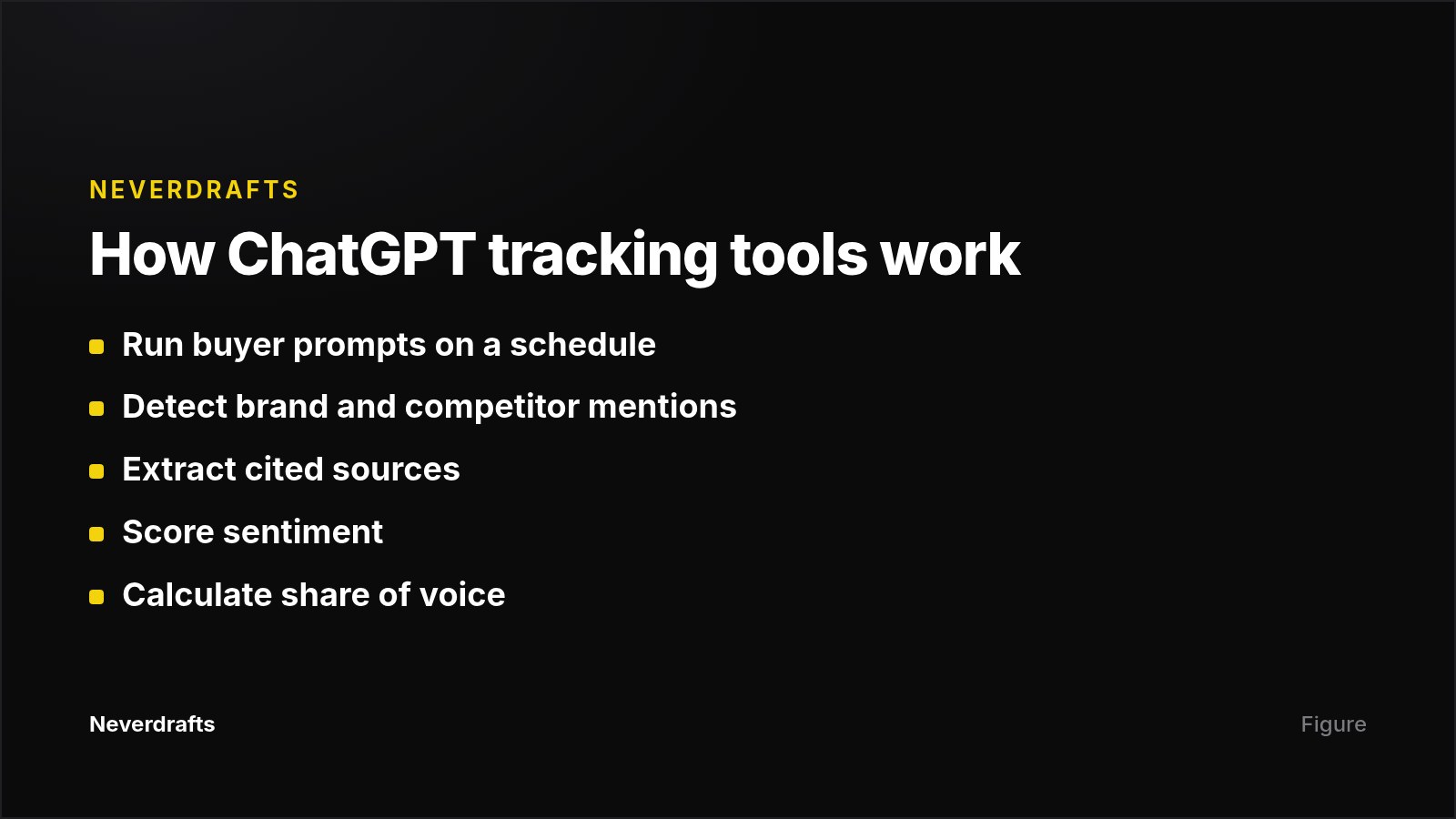
Most tools in this category follow the same basic pipeline, though the depth of each step varies. LLM Pulse breaks it into six stages:
- Prompt execution. The tool sends a set of buyer-style prompts to ChatGPT on a schedule, such as "best CRM tools for startups."
- Response parsing. It detects whether your brand or competitors appear. That includes handling abbreviations, product names, and indirect references.
- Citation extraction. It catalogs the URLs and sources ChatGPT cites.
- Sentiment analysis. A secondary model classifies each mention as positive, negative, or neutral.
- Share of voice. It calculates how often you appear relative to competitors. If your brand shows up in 35 of 100 responses and a rival in 50, your share of voice is 35% versus 50%.
- Trend reporting. It aggregates results into dashboards that show change over time.
This matters because ChatGPT responses vary by user, session, and context. A single manual check tells you very little. Scheduled, repeated prompts are what turn a snapshot into data.
Otterly AI: the best all-around starting point at $29/mo
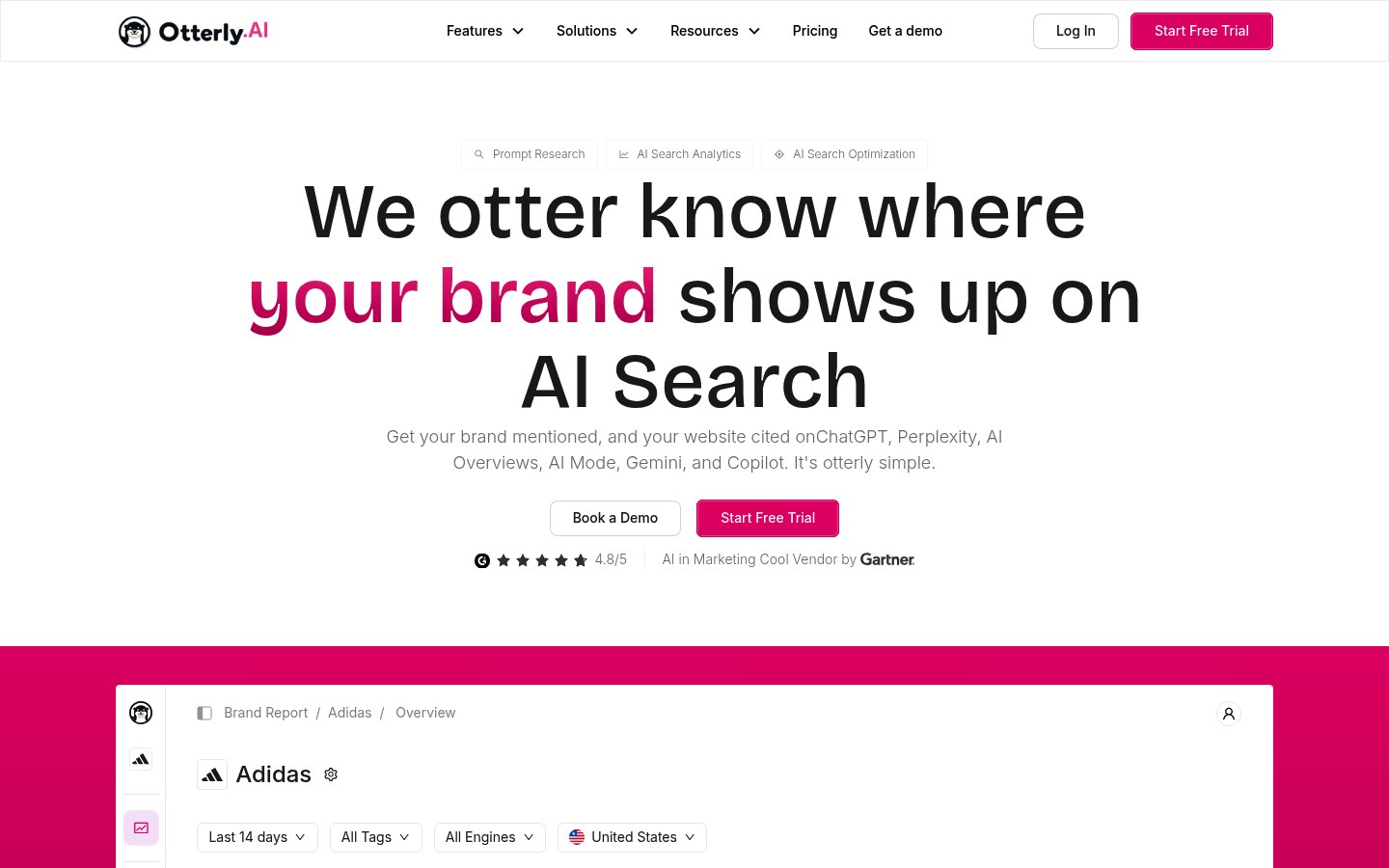
Otterly AI is a monitoring and content-audit platform. It shows whether your brand is mentioned and your site cited in AI answers. Superframeworks ranks it best overall, and it appeared as a top or budget pick in all three AI assistant answers we reviewed for this topic.
Who it's for: startups and small marketing teams that want reliable ChatGPT tracking without an enterprise contract.
Strengths:
- Every plan includes ChatGPT, Google AI Overviews, Perplexity, and Microsoft Copilot. Gemini, Google AI Mode, and Claude are paid add-ons.
- It shows the exact answer each engine gave for each prompt, so you can read what was actually said rather than just a score.
- GEO URL audits (1,000–10,000 per month), 50+ countries, and unlimited team members.
- A content audit with predictive scoring and content briefs that explain why AI skips a page.
- Named a Cool Vendor in the 2025 Gartner Cool Vendors for AI in Marketing. Otterly's own site says it is trusted by 40,000+ marketing pros (Superframeworks' October 2026 review cited 30,000+).
Limitations: The Lite plan covers only 15 prompts, which is enough for a pilot but thin for a full category. It does not generate content, and Google AI Mode costs extra.
Pricing: $29/mo Lite, $189/mo Standard, $489/mo Premium.
Peec AI: best for daily visibility, position, and sentiment tracking
Peec AI is an AI search analytics platform built around three metrics: visibility (share of chats where your brand is mentioned), position, and sentiment. Superframeworks calls it the best tool for daily tracking.
Who it's for: marketing teams that want clean competitive benchmarks and are comfortable choosing a focused set of AI models.
Strengths:
- You pick 3 models from a list of 7. A ChatGPT-first team can pair it with the two engines that matter most in its market.
- Its dashboards benchmark you against competitors: Peec's own demo shows a brand with 63% visibility, a sentiment score of 90, and an average position of 2.6 next to rivals.
- AI-suggested prompts and search volumes, prompt tagging, and country-level tracking.
- Exact answer text, sentiment, and citations are all included.
- Peec says it is trusted by 3,500+ brands and agencies.
Limitations: The three-model cap means broader coverage requires a higher tier or add-ons. Peec does not generate content.
Pricing: Starter $95/mo (50 prompts, 3 models), or $80/mo billed annually; Scale $499/mo.
Semrush AI Visibility Toolkit: best if your SEO team already lives in Semrush
Semrush's AI Visibility Toolkit adds AI mention tracking to the SEO suite many teams already pay for. It draws on a database of 317M+ AI prompts and responses.
Who it's for: SEO teams that want AI visibility reporting next to rankings and backlinks instead of in a separate tool.
Strengths:
- Tracks ChatGPT, Gemini, Google AI Overviews, and AI Mode across Visibility Overview, Prompt Research, and Prompt Tracking.
- Shows exact answer text, sentiment, and citations.
- A free AI visibility checker (3 checks a day, no account) lets you try it before buying.
Limitations: Perplexity appears only in Brand Performance reports, and Claude and Grok are not listed. Teams that don't already use Semrush pay for a suite they may not need.
Pricing: $99/mo for the AI Visibility Toolkit.
Neverdrafts: best for teams that want monitoring tied to content fixes
Disclosure: Neverdrafts is our product.
Neverdrafts monitors which AI systems recommend your competitors instead of you. It then auto-generates content that targets those exact prompts and publishes it. It is built for B2B SaaS companies, product teams, and agencies.
Who it's for: small teams that know they're losing ChatGPT answers and don't have the writing capacity to respond prompt by prompt.
Strengths:
- Monitors real answers from ChatGPT, Claude, Google AI Mode, and Perplexity daily on your tracked buyer prompts. All four engines are included at the base tier.
- Position-weighted visibility scoring (0–100 per response). Appearing first counts for more than appearing last.
- Shows the sources AI cites instead of you, so you can see why you're absent.
- Auto-drafts content targeting the prompts you're losing, with one-click publishing to WordPress, Webflow, Shopify, and Framer in 150+ languages.
- An AI crawler tracker shows whether bots actually visit the new pages.
- Competitor share-of-voice tracking, plus white-label dashboards for agencies.
Limitations: It does not track Gemini, Microsoft Copilot, or Google AI Overviews, which tools like Otterly and Geoptie cover. The $99 entry price is higher than Otterly's or Mangools'. If you only need reporting, you'd be paying for a content engine you won't use. Auto-drafted content still needs editorial review before it represents your brand.
Pricing: Starter $99/mo (1 brand, 50 prompts, 30 articles/month); Growth $199/mo (3 brands, 150 prompts, 100 articles); Agency $399/mo (10 brands, 500 prompts, 300 articles). Billing is monthly with no contracts, and a free audit is available with no credit card. See our comparison with Profound for a side-by-side.
Profound: best for enterprise teams with compliance requirements
Profound is an enterprise-oriented AI visibility platform. GrackerAI's comparison highlights its prompt volume data and SOC 2 compliance.
Who it's for: larger brands with procurement and security reviews, and with the budget for a sales-led contract.
Strengths:
- Tracks ChatGPT, Gemini, and Google AI Overviews, with exact answer text, sentiment, and citations.
- A free trial runs 50 prompts daily for 7 days on those three engines.
- Prompt volume data helps you prioritize which questions matter.
Limitations: Perplexity and Claude are Enterprise-only. Content generation is limited. Pricing is opaque. GrackerAI's April 2026 review listed a $99/mo Starter plan covering one platform, but by October 2026 Profound had stopped listing self-serve brand tiers.
Pricing: Free 7-day trial, then custom.
GrackerAI: best for diagnosing why you lose specific prompts
GrackerAI was built for cybersecurity and B2B SaaS vendors. Its focus is on finding out why you aren't cited and what to publish next. Note that the most detailed review of it comes from GrackerAI's own blog.
Who it's for: security and B2B SaaS marketers who need diagnosis, not just a dashboard.
Strengths:
- Visibility Diagnosis: For a lost prompt, it searches your site for a matching page, scores how well it fits, and pulls the competitor pages AI cited over the last 30 days. It then writes a content brief or a gap report.
- Citation intelligence: Shows top citing domains, new and lost citation sources, and a Reddit view grouped by subreddit.
- Position distribution: Buckets your placement from Hero (first third) to Tail (last third).
- Grounds prompts in real buyer behavior through Google Search Console and Bing Webmaster integration.
- An AEO audit scores pages for structure, evidence, freshness, schema, and AI-crawler access.
Limitations: Multi-region tracking requires Enterprise, and team seats are limited to 1–5 depending on plan. The security-vendor focus may matter less outside that niche.
Pricing: $99/mo Starter ($79/mo annual), $499/mo Scale ($399/mo annual), custom Enterprise.
Geoptie: best for agencies tracking several brands
Geoptie gives every tier access to the same 7 AI engines: ChatGPT, Claude, Perplexity, Gemini, Copilot, Google AI Mode, and Google AI Overviews. You pick 4 per brand, so engine choice isn't tied to price.
Who it's for: agencies and multi-brand companies that want flat pricing and flexible engine selection.
Strengths:
- Engine choice is the same at every tier.
- Unlimited GEO audit reports and 2–50 brands depending on plan.
- A $333/mo tier supports unlimited brands and 400 monitoring prompts.
Limitations: You still track only 4 engines per brand. There is no content generation.
Pricing: $41/mo Starter, $83/mo Professional, $166/mo Enterprise.
LLMrefs: broadest engine coverage for the money
LLMrefs covers 11 AI engines, including Claude and Grok, on a single plan.
Who it's for: teams that care about coverage across every assistant their buyers might use, not just ChatGPT.
Strengths:
- ChatGPT, Perplexity, Gemini, AI Overviews, Claude, and Grok are all included.
- Shows exact answer text and tracks citations.
- 500 prompts at the entry tier is generous compared with most competitors.
Limitations: Sentiment scoring is not published, and the $79 price is listed as limited-time, so it may rise.
Pricing: All in One $79/mo (500 prompts, all engines).
Mangools AI Search Watcher: the budget pick
Mangools AI Search Watcher runs every prompt multiple times across ChatGPT, Gemini, Claude, Grok, and Google AI Overviews. Repeated runs help smooth out the session-to-session variance in AI answers.
Who it's for: solo marketers and small businesses that want a credible signal for under $50/mo.
Strengths:
- Low price with five engines covered.
- Repeated runs per prompt give a more stable read than one-off checks.
- A free AI Search Grader lets you test it first.
Limitations: No Perplexity. Exact answer text and sentiment are not published.
Pricing: $49/mo, or $418.80/yr.
SE Ranking AI Visibility: best value inside an SE Ranking plan
SE Ranking sells AI visibility as an add-on to its SEO platform. It also offers a standalone product, SE Visible.
Who it's for: existing SE Ranking customers who want AI tracking without another vendor.
Strengths:
- Tracks ChatGPT, Perplexity, Gemini, and AI Overviews, with citations.
- 200 prompts in the add-on is a solid volume for the price.
Limitations: Claude is listed as "coming soon." Answer text is cached, and sentiment is partial, with a dedicated AI Brand Sentiment report also listed as coming soon. The add-on requires a base plan.
Pricing: $89/mo add-on (200 prompts) on top of Core $129/mo or Growth $279/mo; SE Visible from $99/mo.
Scrunch AI: best for brand safety and misinformation monitoring
Scrunch AI's standout feature is misinformation and brand-safety detection, aimed at inaccurate AI statements about your brand.
Who it's for: regulated or reputation-sensitive brands. For them, an inaccurate price or discontinued feature in a ChatGPT answer is a real risk.
Strengths:
- Covers ChatGPT, Perplexity, Google AI Overviews, and Copilot on Core, with sentiment and citations.
- SOC 2 compliance on higher tiers.
Limitations: Gemini, Claude, and Grok are Enterprise-only. Sources disagree on pricing: GrackerAI's April review listed $25/mo, while Superframeworks' October 2026 check found $250/mo.
Pricing: Core $250/mo (125 prompts, 4 LLMs).
Other ChatGPT tracking tools worth knowing
These didn't get full sections, but each fills a specific gap:
- GenRank: a ChatGPT-focused tracker. Essential $69/mo (1 brand, 25 prompts). It no longer lists a free plan.
- AIclicks: GEO strategy focus. Starter $59/mo (30 prompts, 3 models).
- Petra Labs: a done-for-you AEO partner with custom attribution tying AI visibility to revenue, from ~$20K/mo. It does not publish an engine list.
- Gauge: tracks ChatGPT ads and sponsored content, from $99/mo.
- AthenaHQ: Shopify revenue attribution and citation-probability scoring, from $295/mo.
- LLM Pulse: prompts, mentions, citations, and sentiment from €49/mo. LLM Pulse ranks itself first in its own review.
For a deeper side-by-side on engines and pricing, see our AI brand monitoring engine coverage and price comparison.
How to choose a ChatGPT brand mention tool
Use these criteria to compare tools, and weight them by what you actually need.
Engine coverage beyond ChatGPT
ChatGPT is the headline engine, but your buyers also use Perplexity, Gemini, Claude, and Google AI Overviews. Gartner had predicted a 25% drop in traditional search volume by 2026 as users shift to AI assistants. Check whether the engines you need are included, sold as add-ons, or locked to Enterprise.
Prompt volume per dollar
Plans range from 15 prompts (Otterly Lite) to 500 prompts (LLMrefs). Map your category first: core "best X" queries, comparisons, use-case questions, and your brand name. Then buy the tier that covers them.
Position and citations, not just frequency
Two brands can share a 40% mention rate while one opens the answer and the other closes it. Prefer tools that report position (Peec, Otterly, GrackerAI, Neverdrafts) and show which sources ChatGPT cited. Citation data reveals the content gaps you can actually close.
Exact answer text
Scores are summaries. Reading the full response is how you catch outdated pricing, wrong feature claims, or a competitor framed as the safer choice. Check the capability matrix: some tools show answer text, and others don't publish whether they do.
Reporting versus action
Most tools stop at measurement. If your bottleneck is producing the content that wins answers back, choose a tool with diagnosis and content workflows, or plan for that work separately. Our guide to 13 LLM SEO tools sorted by track, optimize, or execute breaks down that split.
Pricing stability and compliance
Vendors change tiers often. Superframeworks found that GenRank dropped its free plan, Profound stopped listing self-serve tiers, and AIclicks raised its Starter price between updates. If you need SOC 2, shortlist Profound or Scrunch's higher tiers.
A quick decision guide
- Under $50/mo: Otterly AI Lite or Mangools.
- Already on an SEO suite: Semrush or SE Ranking add-ons.
- Agency with many brands: Geoptie, or Neverdrafts Agency (ours) if you also deliver content.
- Enterprise with compliance needs: Profound or Scrunch AI.
- Losing specific prompts and need fixes: GrackerAI or Neverdrafts (ours).
Once you're tracking, the next job is improving what you see. Our nine steps to get your brand mentioned by ChatGPT covers that side.
Next step
Neverdrafts offers a free audit with no credit card so you can see where you stand before paying for any tracker. Use it to decide how many prompts and which engines you actually need to track.
Frequently asked questions
Can I track brand mentions in ChatGPT for free?
Yes, with limits. Semrush offers a free AI visibility checker with three checks a day and no account required. Mangools has a free AI Search Grader, and several vendors offer trials of 3 to 14 days. Profound's trial runs 50 prompts daily for seven days. You can also run your buyer prompts manually, but answers vary by session, so manual checks are a rough signal rather than reliable data.
Why do ChatGPT answers about my brand change between checks?
ChatGPT responses vary by user, session, and context. The same prompt can produce different brand lists on different runs. That's why tracking tools run prompts on a schedule, and why some, such as Mangools, run each prompt multiple times. Look at trends across many runs instead of reacting to a single answer.
How many prompts should I track?
Start with the questions buyers ask when choosing a product in your category: "best X for Y," competitor comparisons, use-case queries, and your brand name. The right number depends on your category size and the plans you're considering: entry tiers range from Otterly's 15 prompts to LLMrefs' 500, so map your core prompts first and then match a tier to that list.
What's the difference between visibility and share of voice?
Visibility measures the share of AI responses that mention your brand. Share of voice compares that rate with competitors across the same prompt set. If you appear in 35 of 100 responses and a rival appears in 50, your share of voice is 35% versus their 50%. Tracking both shows whether gains come from your progress or from competitors slipping.
Do I need to track engines other than ChatGPT?
Usually, yes. Buyers don't only use ChatGPT, and tool coverage varies widely: some include Perplexity, Gemini, and AI Overviews, while others sell them as add-ons or Enterprise-only. Pick a tool that covers the two or three engines your buyers use most, then expand as budget allows.
Is mention frequency enough to measure AI visibility?
No. Where you appear matters: a brand named first in an answer gets more attention than one listed last, even at the same mention rate. Sentiment and citations matter too. A mention that calls your product outdated or cites a negative review can hurt more than no mention at all.