
ChatGPT typically skips a company for one of three reasons: its search crawler can't reach the site, nothing on the web clearly ties the company to the category the buyer described, or competitors appear far more often in the third-party sources ChatGPT retrieves. OpenAI says ChatGPT ranks results using "multiple factors intended to help users find relevant, reliable information" and that placement is not guaranteed. Semrush's research suggests AI engines name brands they've seen consistently across the web, so independent reviews, roundups and discussions matter alongside your own site.
Key takeaways
- Access comes first. If you block OAI-SearchBot, your site will not be shown in ChatGPT search answers, though it can still appear as a navigational link.
- Being cited is not the same as being recommended. In Semrush's study, 61.7% of AI appearances were "ghost citations" — the site was linked but the brand was never named.
- ChatGPT leans heavily toward citations. When a domain appeared in a ChatGPT answer, it was cited 87% of the time but named only 20.7% of the time.
- Familiarity drives mentions. AI engines mention brands they've already seen consistently across the web, so Reddit threads, news coverage and listicles matter.
- Phrasing changes the result. Short, conversational queries produced 30x to 50x more brand mentions than long prompts.
- No one has the ranking formula. OpenAI hasn't published one, so treat any "top ranking factors" list with caution.
What does ChatGPT actually do when someone asks for "products like mine"?
ChatGPT doesn't look up a fixed ranking. It rewrites the question, searches, reads a set of pages and builds an answer from what it found. OpenAI's documentation describes a web-search response as consisting of search, open_page and find_in_page actions, plus url_citation annotations and a separate sources list.
Two details matter for brands:
- Query rewriting happens before retrieval. The buyer's words are reformulated before ChatGPT searches. If the rewritten query uses category language your site and coverage don't use, you can be filtered out before any page is read.
- The consulted-URL list is larger than the citation list. ChatGPT may read more pages than it cites. Your page might be consulted and still leave no visible trace in the answer.
So "ChatGPT doesn't recommend us" can mean several different failures: failing to retrieve you, retrieving you without using you, or using you without naming you. Each has a different fix.
Can ChatGPT even reach your website?
If OAI-SearchBot is blocked in robots.txt or at the firewall, ChatGPT can't include your site in search answers, however good your product is. This is the cheapest problem to rule out, so check it first.
OpenAI runs four separate agents, easily confused:
- OAI-SearchBot is the only one that decides search inclusion. Sites opted out of it "will not be shown in ChatGPT search answers".
- GPTBot crawls content that may be used to train foundation models. Blocking it doesn't remove you from search.
- ChatGPT-User fetches pages when a user or Custom GPT asks for them, and is not used to determine whether content may appear in Search.
- OAI-AdsBot only visits pages submitted as ads.
A broad block on OpenAI agents, meant to keep content out of training, can also remove you from search. OpenAI says the settings are independent: you can allow OAI-SearchBot and disallow GPTBot.
Why robots.txt alone may not be enough
Eligibility is a two-part check: robots.txt permission and network access from OpenAI's published IP ranges. A CDN or bot-protection rule can block the crawler even when robots.txt allows it.
There's also a trap for teams that block GPTBot by IP address. Loudscale found that six of GPTBot's 18 IPv4 prefixes also appear in the 39-prefix OAI-SearchBot list, so blocking those ranges blocks search traffic too. Use robots.txt to separate training from search; it handles that split cleanly and IP blocking does not. After a robots.txt change, allow about 24 hours for OpenAI's systems to adjust before you retest.
Does ChatGPT know which category you belong to?
Often it doesn't. When your homepage, product pages and third-party coverage describe you in different terms, ChatGPT has no stable reason to connect you to the category a buyer named. "Workflow intelligence platform" won't match a buyer who typed "project management tool for agencies."
Common patterns that weaken category association:
- Clever positioning over plain language. Your homepage avoids the standard category term to sound different.
- Inconsistent descriptions. Your G2 profile, LinkedIn page and press releases each describe the product differently.
- Claims without support. Pages say "best-in-class" without stating what the product does or how it compares. Loudscale recommends claim-level content structure, where each claim is clear and backed by evidence a machine can extract.
- No comparative content. Comparative content produces 2.4x more brand mentions than informational content. If no page puts you next to the alternatives, ChatGPT has no frame for recommending you instead of them.
Google's guidance asks a related question: if someone researched your site, would they come away thinking it is well trusted or widely recognized as an authority on its topic? Written for Search, it fits AI answers too. A vague site gives a model little to work with.
Why do competitors get named when you don't?
Competitors usually get named because the web talks about them more, in more places, in consistent terms. AI engines mention brands they've already seen consistently across the web, reinforced by PR, community discussion and clear brand language.
The underlying study covered 3,981 domain appearances across 115 prompts in 14 countries and four engines. It found two distinct patterns:
- Strong brands get named, often without a citation. Google was named 2.78 times for every 100 citations of a Google URL. Apple was named nearly twice as often as it was cited.
- Aggregators and publishers get cited, often without being named. Medium.com was cited 16 times and never named; Wikipedia, Wired and Harvard showed the same pattern.
When a buyer asks "what's the best X for Y," the answer often comes from roundups, review sites and forum threads. The brands repeated there are the ones ChatGPT lists. For consumer brands, Semrush recommends tracking unlinked mentions on Reddit, in news coverage and in listicles, alongside backlinks — both feed an engine's familiarity with your brand.
Could ChatGPT be citing you without recommending you?
Yes, and often. Across the Semrush dataset, 61.7% of appearances were ghost citations (linked, not named), 13.2% were both cited and mentioned, and 25.1% were mentions with no citation. Overall, 74.9% of appearances included a citation but only 38.3% included a brand mention.
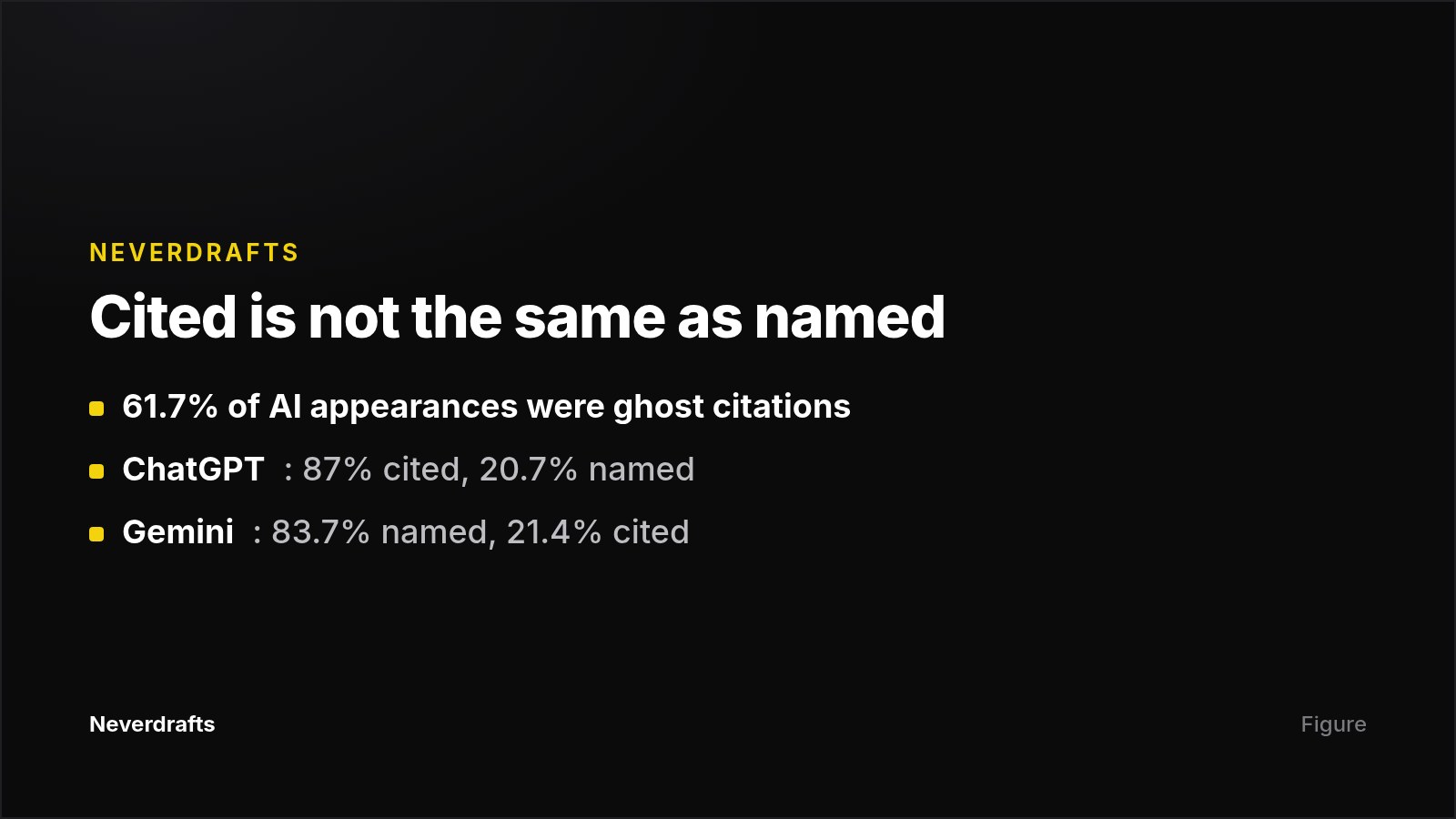
ChatGPT leans heavily toward citations: when a domain appeared in a ChatGPT answer, it was cited 87% of the time but named in only 20.7% of answers. Gemini showed nearly the reverse. Kevin Indig, who coined the term "ghost citation," calls the two engines "different behavioral systems" — there was almost no overlap between the brands ChatGPT cited and the brands Gemini named for the same prompts.
If you check the sources panel and find your blog post linked under an answer that recommends three competitors, ChatGPT can access your site and considers it relevant. What you're missing is the familiarity that would lead it to name you.
Does the way people phrase the question change the answer?
Yes, a lot. Short, conversational queries produced 30x to 50x more brand mentions than long prompts, which instead produce more citations and fewer named brands. Country matters too: brands were mentioned in 50% of AI answers in India and Sweden but only 18–22% in Italy, Brazil and the Netherlands. Across 454 prompt-and-domain pairs, engines disagreed on the same brand 22% of the time.
Since ChatGPT reformulates the prompt before it retrieves anything, the vocabulary your buyers use, and the vocabulary ChatGPT turns it into, should both appear in pages about you. One test of one prompt tells you little — you need a set of prompts that reflects how real buyers ask, run repeatedly.
Is ChatGPT simply biased toward bigger brands?
Partly, though no published source puts a number on it. Brands with strong public identities, like Google and Apple, get named more often than they're cited, suggesting a well-known name carries weight even without a supporting source.
For a newer company, the realistic conclusion is this: you won't get named by default, so you need third-party coverage that explicitly places you in the category. Market leaders benefit from years of accumulated mentions; a challenger has to earn mentions in the specific sources ChatGPT retrieves for its category — a narrower, more achievable goal than "becoming as famous as the leader." No source addresses how long visibility changes take to appear, or whether recent coverage counts more than older coverage.
How do you work out which reason applies to you?
| What you observe | Likely cause | What to check |
|---|---|---|
| Your site never appears, even for branded prompts | OAI-SearchBot blocked in robots.txt or at the CDN/firewall | robots.txt rules; firewall logs for OAI-SearchBot and published IPs |
| Your pages appear in sources, but competitors get named | Ghost citation; weak brand familiarity | Whether you're mentioned in the roundups and reviews ChatGPT cites |
| You appear for long, specific prompts but not short ones | Short queries favor familiar brands | Third-party mentions on review sites, Reddit, listicles |
| You're named in Gemini but not ChatGPT (or vice versa) | Engines reward different signals | Track each engine separately rather than averaging |
| ChatGPT describes you in the wrong category | Inconsistent category language across the web | Homepage, directory profiles, press descriptions |
| You appear in some countries but not others | Country-level variation in mention rates | Local-language coverage and regional review sites |
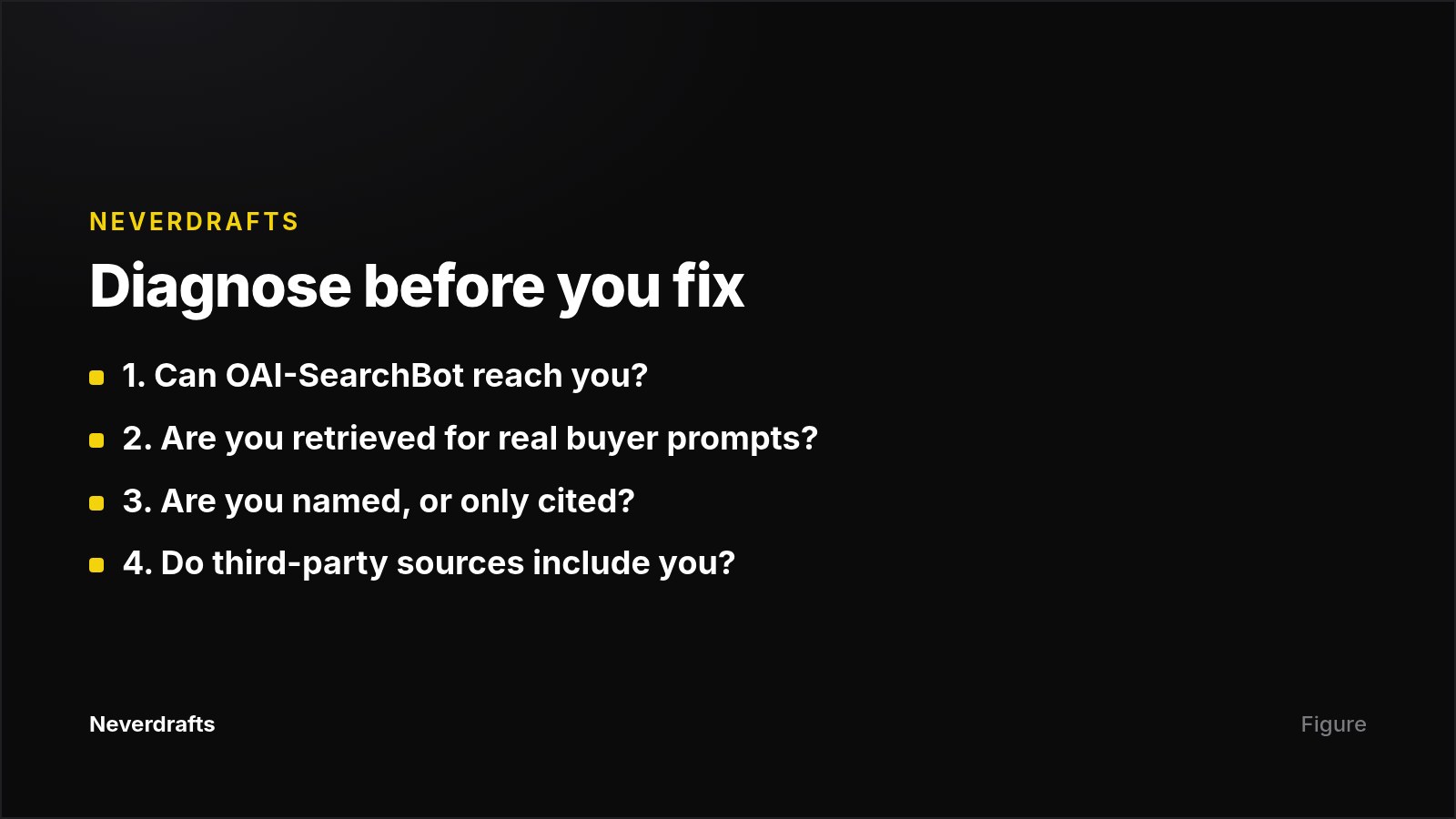
A five-step diagnostic checklist
- Confirm crawl access. Search your server logs for OAI-SearchBot. OpenAI adds a
robots.txtmarker to its user agent when fetching robots.txt, helping you separate policy checks from content fetches even if your logs drop paths. - Build a realistic prompt set. Include short and long versions, comparison prompts ("X vs Y") and use-case prompts ("best X for agencies").
- Run each prompt with search on, and record who is named, which URLs are cited, and whether your domain appears in either list.
- Open the cited sources. For each roundup or review ChatGPT relies on, note whether you're included and how you're described.
- Repeat over time, since answers vary and a single snapshot can mislead you.
Doing this by hand for a few prompts is manageable. Neverdrafts automates the repetitive part: it tracks real daily answers from ChatGPT, Claude, Google AI Mode and Perplexity, identifies the buyer prompts you're losing and which competitors are cited instead, and provides receipts showing when AI crawlers visit the pages you publish through it. Our roundup of ChatGPT brand mention tracking tools covers the options if you're comparing ways to monitor this.
What won't fix the problem?
Many popular tactics have no documented basis. Loudscale points out that lists of ChatGPT ranking factors, including "llms.txt adoption," "schema markup depth" and others, are presented as if OpenAI shared them, but no such list exists.
- Cosmetic freshness. Google warns against changing page dates without substantially changing the content; nothing suggests ChatGPT rewards this either.
- Optimizing only your own site. If the gap is third-party familiarity, more homepage copy won't close it.
- Chasing one engine's results. Because ChatGPT and Gemini behave so differently, a win in one doesn't carry over to the other.
Once you know which failure applies, our guide on nine steps to get your brand mentioned by ChatGPT covers the remediation side. If you're wondering how much your existing search work helps, see does traditional SEO help you show up in ChatGPT answers.
Next step
Neverdrafts offers a free audit with no credit card required. The platform tracks real daily answers from ChatGPT, Claude, Google AI Mode and Perplexity and identifies the buyer prompts you're losing to competitors, so you can confirm which of the causes above applies to you before you spend on fixes.
Frequently asked questions
Does blocking GPTBot stop ChatGPT from recommending my company?
No. GPTBot governs training data, not search inclusion. OpenAI's robots.txt settings are independent, so you can disallow GPTBot and still allow OAI-SearchBot, which is the agent that decides search inclusion. Use robots.txt rather than IP blocks to separate the two, since some IP ranges are shared between the bots.
How long after fixing robots.txt will ChatGPT pick up my site?
OpenAI says it can take about 24 hours after a robots.txt update for search eligibility to adjust. That only restores eligibility — whether ChatGPT actually names you also depends on relevance, category clarity and third-party coverage, and no published source gives a reliable timeline for those signals to change.
Why does ChatGPT link to my blog but recommend a competitor?
That's a ghost citation. Semrush found 61.7% of AI appearances were citations without a brand mention, and ChatGPT names brands in only about 20.7% of the answers where they appear. ChatGPT can reach your content and finds it useful, but doesn't treat your brand as familiar enough to recommend by name.
Are reviews and "best of" lists really that important?
For recommendation-style prompts, yes. AI engines mention brands they've seen consistently across the web, and comparative content produced 2.4x more brand mentions than informational content, which is why roundups carry so much weight.
Is there an official list of ChatGPT ranking factors?
No. OpenAI says ChatGPT ranks results using multiple factors aimed at relevant, reliable information and that placement is not guaranteed. It has not published the factors. What it does document is crawler behavior, user-agent strings, IP ranges and robots.txt handling, so focus first on what is documented.