
The best AI visibility tools for SEO agencies in 2026 are Peec AI for multi-client tracking on flexible credit-based tiers, Semrush for agencies already running SEO on Semrush that want recommendations alongside tracking, and OtterlyAI for budget-conscious agencies, with plans from $29/month. Profound and Brandlight suit large agencies with enterprise rosters. Neverdrafts, Temso AI and AthenaHQ suit agencies that want the tool to produce content and briefs, not only charts. Disclosure: Neverdrafts is our product.
Key takeaways
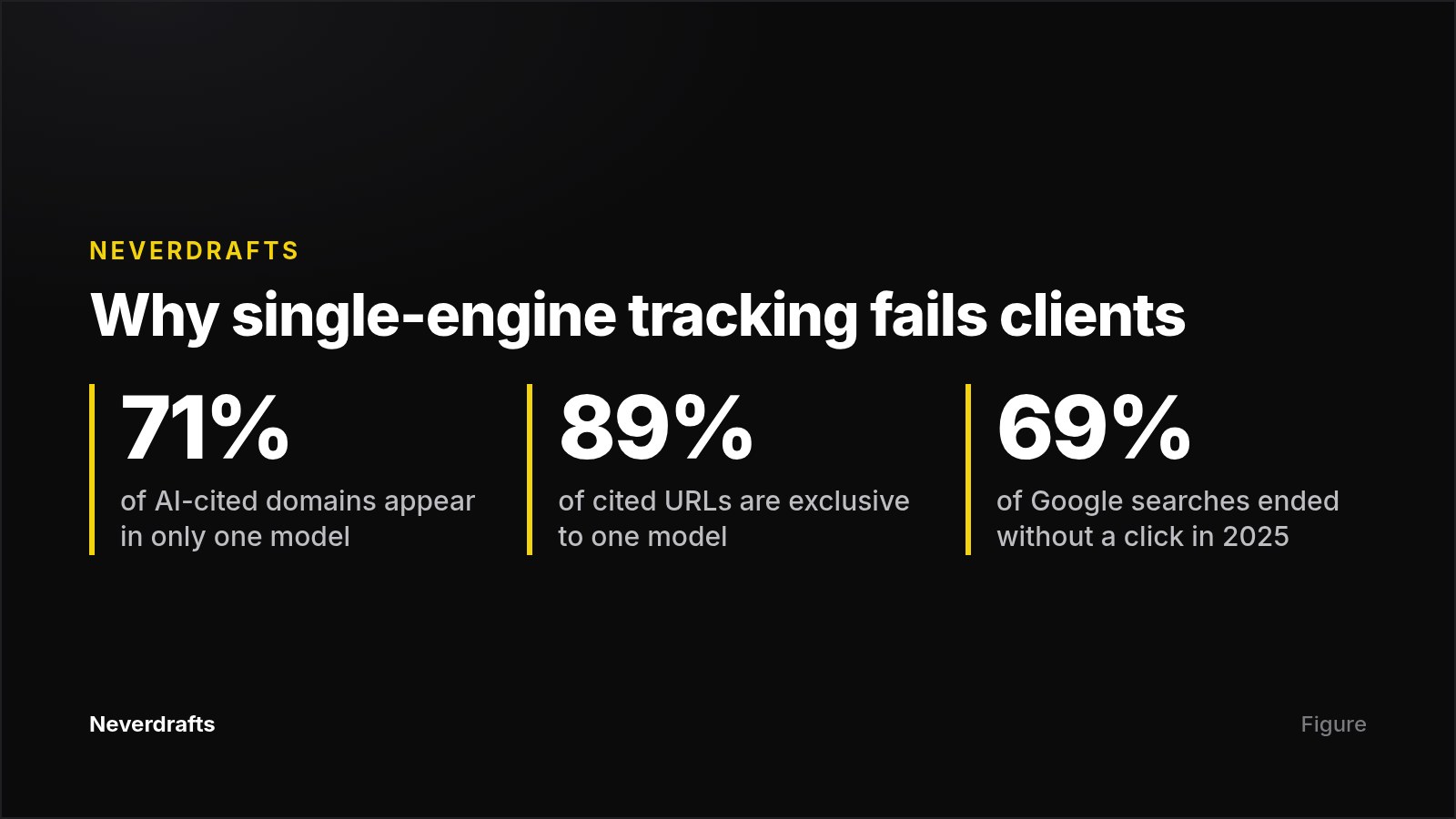
- Track several engines. 71% of domains cited by AI appear in only one model's responses, and 89% of cited URLs are exclusive to one model. A single-engine tracker misses most of what clients care about.
- Use agency criteria, not brand criteria. For agencies, the deciding factors are cost at scale, separate client workspaces, white-label reporting and pitch environments. A long feature list matters less than how the tool's price and structure hold up as clients are added.
- Pricing models differ widely. Semrush charges $99/month per domain. OtterlyAI sells prompt bundles from $29 to $489/month. Peec AI uses a credits system tied to models, frequency and prompt count.
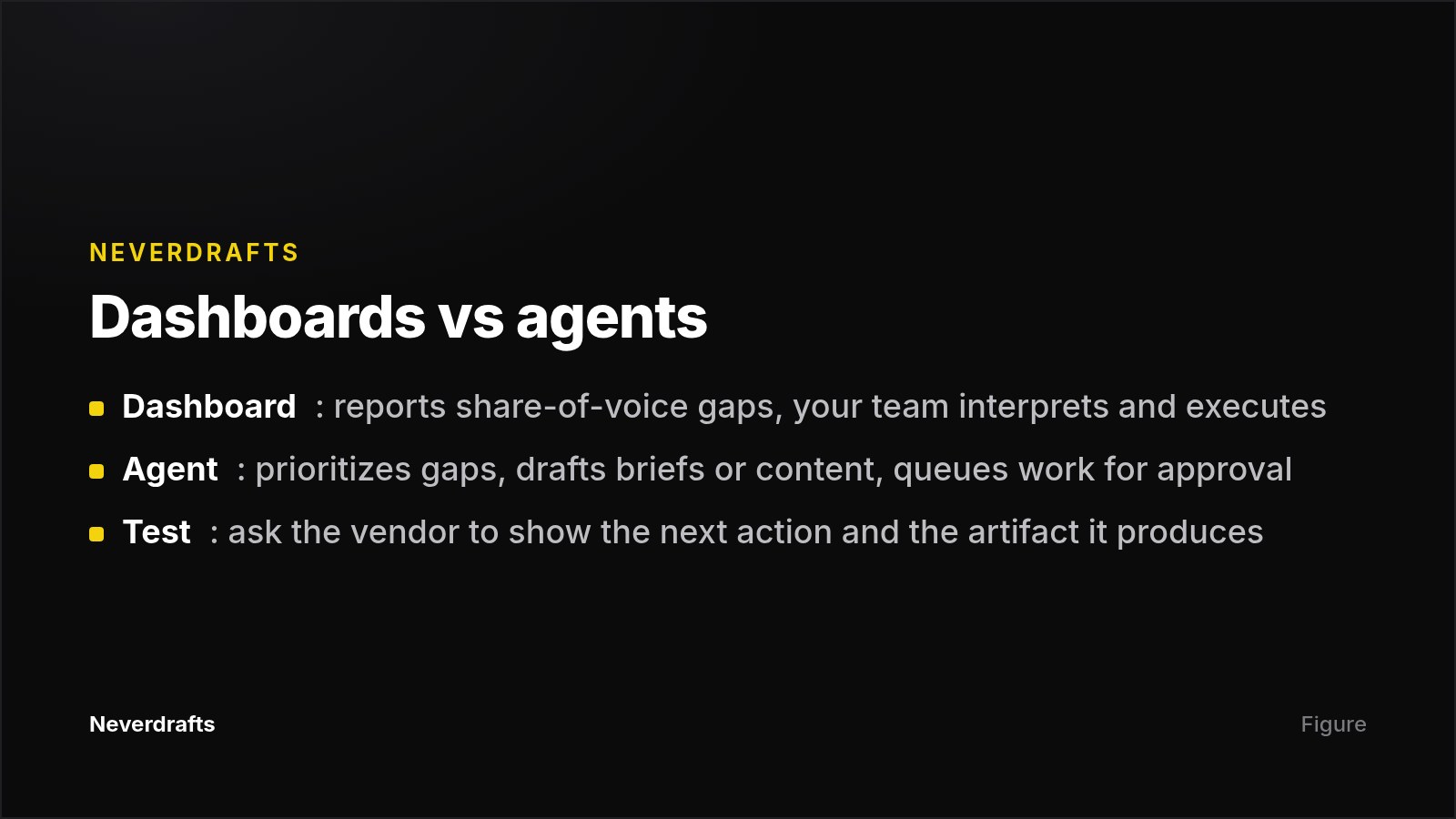
- Tools split into dashboards and agents. Dashboards report gaps. Agents draft the briefs and content to close them. Your delivery capacity should decide which you need.
- Check who wrote each ranking. Both of the most-cited rankings we reviewed (Semrush and Temso AI) are published by vendors that rank themselves first. This article is no exception, so we flag it.
Which AI visibility tools are best for SEO agencies at a glance?
The table below summarizes each tool's agency fit, standout capability and published starting price. Prices come from vendor pricing pages and two vendor-authored round-ups (Semrush and Temso AI). Where sources disagree, both figures are shown.
| Tool | Best for | Standout feature for agencies | AI engines tracked | Starting price (per sources) |
|---|---|---|---|---|
| Peec AI | Agencies with fluctuating client rosters | Free pitch projects that convert to paid client projects | 6+ | €85/mo (Temso) or $245/mo Essential (Semrush) |
| Semrush | Agencies selling monitoring plus improvement work | Topic and source opportunity reports, urgency-ranked recommendations | 5 (Toolkit), 11 (Enterprise AIO) | $99/mo per domain |
| OtterlyAI | Budget-conscious agencies adding AI tracking | Unlimited team members on all tiers; unlimited workspaces from Standard | 4, plus 3 add-ons | $29/mo (Lite) |
| Profound | Large agencies offering full AI visibility management | Broad engine coverage, exec-grade reporting | 9 | $99/mo (Agency Growth) |
| Neverdrafts | Agencies that need remediation content shipped, not just tracked | Monitor, diagnose, auto-generate and one-click publish, then re-measure | 4 | $399/mo (Agency, 10 brands) |
| AthenaHQ | Agencies growing their roster, ecommerce clients | GA4 and Shopify revenue attribution | 6+ | Free (Essential), $295/mo (Starter) |
| Scrunch | Agencies building custom multi-metric client reports | White-label reporting plus AXP delivery layer for AI bots | 4 (Core), 9 (Enterprise) | $500/mo Agency Core (Semrush) or $250/mo (Temso) |
| Temso AI | Teams without a dedicated AEO analyst | Agent that drafts briefs, action plans and outreach targets | 8+ | $89/mo (Starter) |
| Brandlight | Large agencies with enterprise clients | Co-pitching and site audits | Not stated in sources | Custom |
| Ahrefs Brand Radar | SEO-first agencies already on Ahrefs | Monitoring inside an existing SEO stack | 6 | $199/mo (standalone) |
Why do SEO agencies need dedicated AI visibility tracking in 2026?
Agencies need dedicated AI visibility tracking because a Google ranking does not predict whether a client is named in AI answers, and traditional rank trackers can't measure it. Clients are asking agencies a new question: "Do we show up when someone asks ChatGPT?" A page-one Google ranking tells you nothing about whether that same brand gets named when a buyer asks an AI assistant the same question.
The numbers explain the urgency. According to Similarweb data cited by Temso AI, 69% of Google searches ended without a click in 2025, up from 56% in 2024. ChatGPT reached 900 million weekly users as of February 2026, up from 800 million in October 2025. When an AI returns three to five named brands for a "best [category]" query, every brand outside that list is effectively invisible, and the client has no way to see that loss without a dedicated tracker.
The fragmentation finding matters most to agencies. Temso AI's analysis of more than 2 million citations across ChatGPT, Google AI Overview, Gemini, Grok and Copilot found that 71% of cited domains appear in only one model, and 89% of URLs are exclusive to one model at the page level. A client that wins on ChatGPT can still be absent from Copilot or Gemini. Engine breadth is therefore part of the service you are selling, not a technical detail to skim past when comparing vendors.
What metrics should an agency report to clients?
Most tools in this round-up report a similar core set. Temso AI groups them into five metrics:
- Mention rate: the percentage of tracked prompts where the brand appears.
- Share of voice: how often the brand appears compared with competitors on the same prompts.
- Citation rate: which URLs the AI links to when it mentions the brand.
- Placement: whether the brand appears first, in a list, or only as an aside.
- Sentiment: whether the AI describes the brand positively, neutrally or negatively.
Since most tools cover these, the real differences for agencies lie in how they handle many clients at once and what they help you do after the report goes out.
How did Temso AI benchmark these tools?
Because this round-up leans heavily on Temso AI's independent benchmark alongside Semrush's self-published guide, it's worth knowing how Temso built its ranking. Temso AI scored each tool against five weighted criteria: analytics coverage (25%), covering the number of engines, surfaces and locale depth; recommendation quality (20%), covering whether a share-of-voice gap turns into specific direction; action execution (15%), covering whether the tool produces the deliverable that closes the gap; usability (20%), covering whether a non-analyst can read the dashboard in under two minutes; and pricing accessibility (20%), covering whether the entry tier returns useful insight without a sales call. Tools that gated basic share-of-voice data behind enterprise pricing scored lower regardless of feature parity, and tools that stopped at the dashboard scored lower than tools that shipped a finished brief. Knowing this weighting helps explain why some tools with deep feature lists, like Scrunch or Evertune, rank below lighter tools with clearer entry tiers.
What is generative engine optimization (GEO) and how does it relate to these tools?
Generative engine optimization, usually shortened to GEO, is the practice of improving how often and how favorably a brand appears inside AI-generated answers, as distinct from traditional SEO's focus on ranking pages in a search results list. Several tools in this round-up build GEO work directly into their platforms rather than treating it as a separate service. OtterlyAI includes a Generative Engine Optimization Audit and a Quarterly GEO Health Check on its paid tiers, alongside crawlability and content checks. The practical distinction for agencies is that GEO work often means producing or restructuring content so an AI model is more likely to cite it, which is why the dashboard-versus-agent split matters: a dashboard tells you where a GEO gap exists, while an agent-style tool moves toward closing it.
1. Peec AI: best for agencies with fluctuating client rosters
Peec AI is an AI search analytics platform with a dedicated agency pricing structure built for multi-brand tracking. Peec says it is trusted by more than 3,500 brands and agencies. Semrush's round-up names it the best pick for agencies with fluctuating client rosters and tracking needs. Temso AI ranks it as the pick for agencies running AI visibility for multiple clients.
Who it is for
Peec AI fits boutique and mid-sized agencies whose client count changes from quarter to quarter. The agency tiers are labeled by roster size:
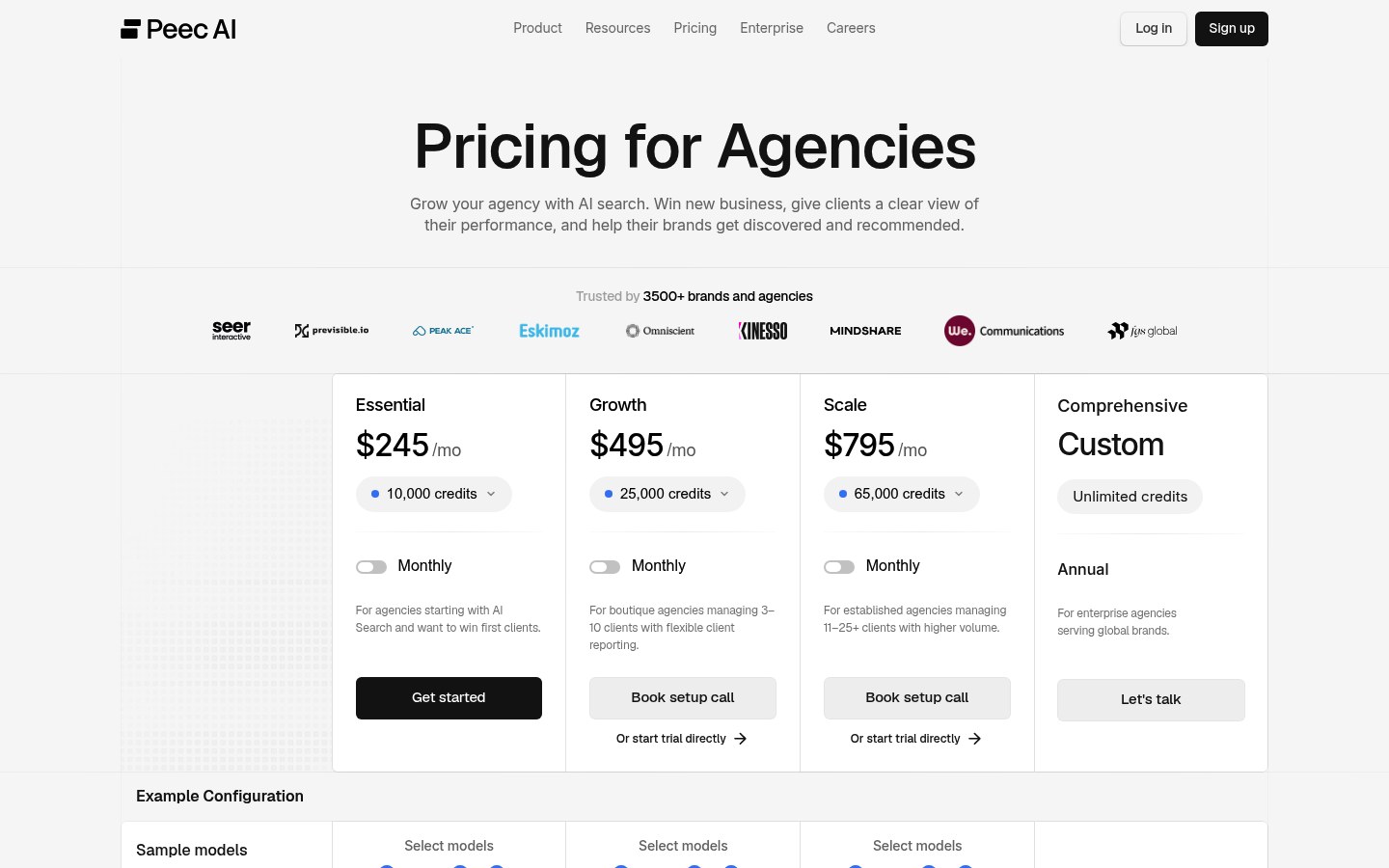
- Essential: 10,000 credits per month, "for agencies starting with AI Search and want to win first clients"
- Growth: 25,000 credits per month, for boutique agencies managing 3–10 clients
- Scale: 65,000 credits per month, for established agencies managing 11–25+ clients
- Comprehensive: custom, unlimited credits, annual, for enterprise agencies serving global brands
Strengths
- A credit-based setup that flexes. Prompt capacity depends on which models you select and how often you track. The example configurations on the pricing page show roughly 111 daily prompts on Essential, 277 on Growth and 722 on Scale. Scale also offers weekly tracking, which stretches credits further for low-priority clients.
- Pitching tools. Peec offers free "pitch projects" for running audits on prospects before they sign, with data available instantly and an option to convert a pitch into a paid client project. For agencies that win business through audits, this removes a real cost.
- Client reporting options. These include view-only shareable dashboards limited to charts you choose, Data Studio templates cloned per client and shared without a login, CSV exports, and automated client reporting sent on a schedule through its MCP or Agent.
- Agency operations. Plans include client projects, team user seats, client user seats and consolidated billing, which puts every client project on a single invoice.
- Prompt intelligence. Prompt volume is scored 1–5 for relative demand. Prompts are classified as branded or non-branded and by intent (informational, commercial, transactional). Prompt suggestions are drawn from brand context and coverage gaps, and prompts can be generated in bulk, from keywords, or mapped to personas.
- Specialist modules. Peec includes an ads library showing which prompts carry sponsored placements, Local GEO, and AI Shopping with product catalog upload from Shopify or CSV and SKU-level visibility tracking, including position and win rate on a per-product basis.
Limitations
- Credits need forecasting. Credits make cost estimates harder than a flat per-client price. You need to model how many prompts, models and tracking runs each client requires.
- Published prices conflict. Temso AI lists a starting price of €85/month. Semrush lists Essential from $245/month, Growth from $495/month and Scale from $795/month. The agency pricing page excerpt shows credits, not prices. Confirm current pricing directly before quoting clients.
- The action layer is task-based. Temso AI describes Peec's action layer as an owned/earned task split. It organizes work for you rather than producing finished content.
2. Semrush: best for agencies offering monitoring plus improvement work
Semrush packages AI visibility in two tiers. The AI Visibility Toolkit serves small and mid-sized agencies. Enterprise AIO offers broader tracking for multi-market clients, per Semrush's agency guide. Semrush places its own product first in that guide, so read the ranking with that in mind.
Who it is for
Semrush fits agencies already paying for Semrush for traditional SEO. Adding AI visibility keeps data, logins and reporting in one place. Temso AI's ranking makes the same call: Semrush is the pick for teams already using Semrush for traditional SEO.
Strengths
- Fast reporting. Semrush reports that entering a domain into Visibility Overview returned mention, citation and cited-page data in under three seconds, with mentions broken down by country.
- Opportunity reports. The "Topics & Sources" section shows performing topics, topic opportunities (prompts where competitors are mentioned but your client isn't), cited sources, source opportunities (domains cited for competitors but not your client), and the client's own cited pages. Topic and source opportunities are what turn a report into a list of work to sell.
- Prioritized recommendations. The Brand Performance report covers share of voice and sentiment, and adds strategy recommendations categorized by urgency.
- Many clients without extra setup. Visibility Overview can be run for an unlimited number of clients. Enterprise AIO adds separate projects per client.
- Enterprise depth. Enterprise AIO draws from a database of more than 289 million prompts and monitors 11 AI search platforms. It tracks 500 to 15,000 prompts per month depending on setup, and adds AI Automations for forecasting, content audits, auditing brand strengths and weaknesses, and finding URLs that drive negative sentiment.
Limitations
- Per-domain pricing grows with every client. At $99/month per domain, costs rise in a straight line as clients are added.
- Small default prompt allowance. The Toolkit tracks 25 prompts by default. Extra prompts are an add-on.
- Reporting extras cost more. The subscription includes two PDF reports. Additional reports and white-labeling are paid add-ons.
- Recommendations are lighter than in agent tools. Temso AI counts 5 engines for the Toolkit and describes its recommendations as "limited". Enterprise AIO, at custom pricing, is where the deeper automation sits.
3. OtterlyAI: best for budget-conscious agencies adding AI tracking
OtterlyAI is a prompt-based AI search monitoring tool with simple, published tiers and an agency partner program offering special pricing. Semrush's guide names it the best fit for budget-conscious agencies adding AI visibility tracking to their service offerings.
Who it is for
OtterlyAI suits agencies testing whether clients will pay for AI visibility, and smaller agencies that want predictable costs. It is also a reasonable choice for freelancers moving into agency work.
Pricing and limits
OtterlyAI's pricing page lists four tiers, with a 15% discount on annual billing:
| Plan | Monthly price | Annual (per month) | Search prompts | Workspaces |
|---|---|---|---|---|
| Lite | $29 | $25 | 15 | 1 |
| Standard | $189 | $160 | 100 | Unlimited |
| Premium | $489 | $422 | 400 | Unlimited |
| Enterprise | Custom | Custom | From 1,000 | Unlimited |
Extra prompts cost $99 per 100 on Standard and Premium.
Strengths
- Unlimited team members on every tier. Agencies don't pay per seat, which helps as account teams grow.
- Unlimited workspaces from Standard up. Each client can get its own workspace without extra cost; Lite is limited to one.
- Integrations for agency stacks. Standard includes a Data Studio connector, 2,000 API requests and 2,000 MCP requests per month. Premium raises API and MCP requests to 5,000 each, along with 1 million agent analytics events per month.
- Audit tooling. Plans include a GEO audit, crawlability audit, content check, a query fan-out tool and an AI prompt research tool. Premium includes 10,000 GEO URL audits per month, and Enterprise adds a Quarterly GEO Health Check plus a dedicated Customer Success Manager.
- Daily tracking on all plans, plus brand sentiment, share of voice, citation source tracking and link citation analysis.
Limitations
- Four engines in the base plan. Base plans track ChatGPT, Google AI Overviews, Perplexity and Microsoft Copilot. Claude, Google AI Mode and Gemini are paid add-ons. Clients asking about Claude or Gemini will raise your costs.
- Lite is too small for agency use. It has one workspace, 15 prompts and 3 recommendations per week.
- Prompt budgets get tight across clients. Premium's 400 prompts split across 10 clients leaves 40 prompts each. That works for focused tracking but is thin for clients with several product lines.
- No published agency workflows. The pricing page doesn't describe client logins, white-label templates or pitch tooling. Semrush credits OtterlyAI with a pitch environment, but check the details with the vendor.
4. Profound: best for large agencies running full AI visibility programs
Profound is positioned in both round-ups as the enterprise-grade choice. Semrush names it best for large agencies offering comprehensive AI visibility management services. Temso AI calls it the pick for enterprise teams that need broad coverage and exec-grade reporting.
Who it is for
Profound fits agencies with analysts on staff and enterprise clients who expect board-ready reporting. The output is detailed, and getting value from it requires people who can interpret it.
Strengths
- Broad coverage. Temso AI counts 9 engines.
- Content automation and a pitch environment. Semrush lists both as Profound's agency strengths.
- Agency-specific plans. Profound offers Agency Growth at $99/month and Agency Enterprise at custom pricing.
Limitations
- The entry tier is limited. Temso AI marks the $99/month starting price as "limited". Expect the full agency feature set to sit in the custom-priced tier.
- It produces snippets, not full briefs. Temso AI describes Profound's action layer as "agent snippets, no full briefs". Your team still writes the content.
- It needs analyst time. Profound pays off when someone owns the data. Smaller agencies may pay for depth they can't use.
If Profound's enterprise pricing is out of reach, we've compared cheaper AI visibility tools than Profound in a separate piece.
5. Neverdrafts: best for agencies that need remediation content shipped
Disclosure: Neverdrafts is our product.
Neverdrafts monitors which AI systems (ChatGPT, Claude, Perplexity and Google AI Mode) recommend a client's competitors instead of the client. It then auto-generates and publishes content aimed at winning those answers back. We built it around a full loop: monitor, diagnose, fix, prove.
Who it is for
Neverdrafts suits small and mid-sized agencies whose bottleneck is production rather than measurement. If your team already knows where clients are losing AI answers but can't write and publish fixes fast enough, this is the job we built Neverdrafts to do.
Strengths
- Daily monitoring of real answers. Neverdrafts checks ChatGPT, Claude, Google AI Mode and Perplexity daily for tracked prompts. It scores visibility on a position-weighted 0–100 scale per answer, measured on real interfaces rather than APIs.
- Diagnosis. It shows which sources the AI cites when it recommends a competitor, so you know why a client is losing.
- Auto-generated remediation content. Content is written for the exact prompts a client is losing, with one-click publishing to WordPress, Webflow, Shopify, Framer or via API. Published content supports 150+ languages.
- Proof of results. Before-and-after re-measurement shows whether citations climbed. An AI bot-traffic tracker shows which AI crawlers visited the new pages.
- White-label reporting for agencies.
- Monthly billing. No contracts, cancel anytime, and a free audit with no credit card required.
Pricing and limits
| Plan | Monthly price | Brands | Tracked prompts | Remediation articles/month |
|---|---|---|---|---|
| Starter | $99 | 1 | 50 | 30 |
| Growth | $199 | 3 | 150 | 100 |
| Agency | $399 | 10 | 500 | 300 |
Full details are on our pricing page.
Limitations
- Four engines. We track ChatGPT, Claude, Perplexity and Google AI Mode. We don't list Microsoft Copilot, Gemini or Google AI Overviews. If clients need those engines covered, Profound, Peec AI or Semrush Enterprise AIO cover more.
- The Agency plan caps at 10 brands. Agencies with 11–25+ clients will need more than one plan or a tool designed for higher volume, such as Peec AI's Scale tier.
- Some agency features aren't in our published plans. Pitch projects, client login seats and Data Studio connectors are not part of our published plan details. If you depend on them, confirm with us before buying.
- Generated content still needs review. Auto-generated articles speed up production, but brand voice, claims and regulated-industry compliance still need a human check before publishing.
For a comparison against the enterprise option, see our Neverdrafts vs. Profound page, or Neverdrafts vs. Searchable if you're weighing a smaller competitor.
6. AthenaHQ: best for agencies growing their roster, especially with ecommerce clients
AthenaHQ appears in both round-ups with slightly different emphasis. Semrush names it best for agencies actively growing their client roster, citing its agency partner program, content optimization and white-label reporting. Temso AI ranks it third overall and the leader for Shopify ecommerce with GA4 revenue attribution.
Who it is for
AthenaHQ fits agencies with ecommerce clients who ask what AI visibility is worth in revenue. Of the tools in this round-up, AthenaHQ is the one sources credit with GA4 and Shopify revenue attribution, which gives agencies a direct answer when a client asks what their AI visibility spend is actually returning.
Strengths
- GA4 and Shopify revenue attribution connect AI visibility work to commercial outcomes.
- Autonomous draft workflows. Temso AI describes this as its action layer, which puts AthenaHQ closer to the agent camp.
- Coverage of 6+ engines, according to Temso AI.
- A free entry tier. Semrush lists Essential as free, Starter at $295/month and Enterprise at custom pricing.
- An agency partner program and white-label reporting.
Limitations
- A big jump from free to paid. The step to $295/month is significant for agencies with one or two AI visibility clients.
- Attribution value depends on the client. Revenue attribution helps most when clients run Shopify and GA4. Lead-gen and B2B clients may get less from that feature.
7. Scrunch: best for agencies building custom multi-metric client reports
Scrunch is named by Semrush as best for agencies that deliver custom client reports covering AI visibility and other performance metrics. Its listed agency strengths are white-label reporting, a pitch environment and content optimization.
Who it is for
Scrunch fits agencies whose monthly client report blends AI visibility with other channels. It also fits technical SEO agencies that want to control how client sites are served to AI crawlers.
Strengths
- White-label reporting built for combined client reports.
- An AXP delivery layer. Temso AI describes Scrunch as the pick for sites that want to control how content is served to AI bots. That technical capability sets it apart from tracking-only tools.
- A pitch environment and content optimization.
Limitations
- Core coverage is narrow. Temso AI reports 4 engines on Core and 9 on Enterprise. Agencies needing broad coverage will likely end up on Enterprise.
- Price signals conflict. Semrush lists Agency Core at $500/month. Temso AI lists a $250/month starting price, which may refer to a non-agency plan. Verify before budgeting.
8. Temso AI: best for agencies without a dedicated AEO analyst
Temso AI describes itself as an agent rather than a dashboard. It monitors visibility, perception, citations and accuracy across major models, then ships briefs, action plans and outreach targets to close the gaps. Temso AI ranks itself first in its own 12-tool benchmark, so treat that ranking accordingly.
Who it is for
Temso AI suits agencies that sell AI visibility but lack someone who can turn share-of-voice charts into a prioritized plan. It also suits agencies that want outreach targets for earned-media work, not only on-site content.
Strengths
- Agent-driven workflow. It prioritizes gaps, drafts briefs and suggests outreach targets, then queues the work for approval.
- Coverage of 8+ engines.
- An accessible entry price of $89/month on the Starter plan.
- Original research. The 2M+ citation study behind the single-model exclusivity finding comes from Temso.
Limitations
- Agency features aren't documented in our sources. The excerpt we reviewed doesn't detail multi-client workspaces, white-label reporting or pitch environments. Confirm these before committing client work.
- Self-assessed performance. Its top ranking comes from its own benchmark. We haven't seen independent validation.
9. Brandlight: best for large agencies managing enterprise clients
Brandlight is listed by Semrush as best for large agencies managing AI visibility for enterprise clients. Its listed strengths are an agency partner program, co-pitching opportunities and site audits.
Who it is for
Brandlight suits large agencies that win enterprise accounts through joint pitches and want a vendor that will join the sales process with them.
Strengths
- Co-pitching. Semrush lists co-pitching opportunities as a Brandlight strength.
- An agency partner program and site audits.
Limitations
- Pricing is custom only. There is no published price, which slows evaluation.
- Our sources lack detail. Engine coverage and action-layer details aren't given in the sources reviewed here, so plan for a longer discovery process.
10. Ahrefs Brand Radar: best for SEO-first agencies already on Ahrefs
Ahrefs Brand Radar is Temso AI's pick for SEO-first agencies already on Ahrefs. It tracks 6 engines and costs $199/month standalone.
Who it is for
Brand Radar fits agencies whose whole delivery process runs through Ahrefs and who want AI visibility data next to backlink and keyword data.
Strengths
- Fits an existing stack. No new vendor or login for teams already on Ahrefs.
- Coverage of 6 engines.
Limitations
- Monitoring only. Temso AI describes it as "monitoring only". Recommendations and content are left to your team.
- The standalone price is high for a monitoring-only tool. At $199/month, it costs more than several tools that include recommendations.
Which other AI visibility tools should agencies know about?
Four more tools from Temso AI's benchmark don't fit most agencies as a primary platform, but each solves a specific problem.
- Gumshoe AI is the only tool in the benchmark with true pay-as-you-go pricing, at $0.10 per conversation. It tracks 11 engines and includes a content generator aimed at persona gaps. It is useful for agencies running one-off audits for prospects without a monthly commitment.
- Gauge is a YC-backed agent built around a content engine that publishes 3 to 18 articles per month. It tracks 7 engines and starts at $100/month. It suits agencies that want article production bundled with tracking.
- LLMrefs is a keyword-first AI tracker with 11-engine coverage at a flat price. It starts at $79/month and has a free tier. Auto-generated fan-out prompts help agencies build prompt sets from existing keyword research.
- Evertune offers CMO-grade reporting at million-prompt statistical scale across 10+ engines. It is reporting only, with custom quotes. It fits enterprise clients who need statistical confidence more than recommendations.
For a broader view beyond agency use cases, see our round-up of best AI visibility monitoring tools in 2026, or our comparison of best LLM SEO tools in 2026 across 12 platforms if your agency is evaluating the category more broadly. If your clients care more about answer-engine optimization specifically, our AEO tools comparison covers that angle.
How should an SEO agency choose an AI visibility tool?
Choose against agency criteria, not brand criteria. Semrush's guide lists five agency-relevant factors, and we add three more based on the gaps in current tools.
1. Cost at scale
Model the price at your expected client count in 12 months, not your current one. The pricing models behave very differently as you grow:
- Per-domain (Semrush AI Visibility Toolkit at $99/month per domain): rises in a straight line, but is easy to pass through to clients.
- Prompt bundles (OtterlyAI): fixed price, with prompts shared across clients. Premium's 400 prompts across 10 clients works out to about $49 per client per month at the $489 list price.
- Credits (Peec AI): flexible, but depends on models selected and tracking frequency. Weekly tracking for low-priority clients can stretch budgets.
- Brand tiers (Neverdrafts Agency at $399/month for 10 brands): about $40 per brand, including remediation articles.
- Pay-as-you-go (Gumshoe AI at $0.10 per conversation): best for irregular audit work.
2. Multi-client monitoring
Each client's data should live in its own workspace or project. OtterlyAI offers unlimited workspaces from Standard up. Peec AI includes client projects, client user seats and consolidated billing. Semrush Enterprise AIO offers per-client projects. Check whether clients can log in themselves, and whether that costs extra.
3. Actionable recommendations
A tool that only reports gaps leaves your team to work out what to do next. Ask every vendor the question Temso AI recommends: "show me the next action you would have me take, and the artifact you would produce to do it." If the answer is a CSV export, you are buying a dashboard.
4. AI search platform coverage
Coverage counts vary widely: 4 engines for OtterlyAI base plans and Neverdrafts, 11 for Semrush Enterprise AIO, LLMrefs and Gumshoe AI. Given that 89% of cited URLs are exclusive to one model, check which engines are covered, not just how many. A tool tracking Google AI Overviews and Copilot serves a different client than one tracking Claude and Google AI Mode.
5. White-label reporting
Most agency-oriented tools offer some form of white-label output, but the details differ. Semrush charges for white-labeling as an add-on. Peec AI offers shareable view-only dashboards and per-client Data Studio templates. OtterlyAI includes a Data Studio connector from Standard. Scrunch, AthenaHQ and Neverdrafts list white-label reporting directly.
6. Pitch environments
Free or low-cost prospect audits help agencies close new business. Peec AI's pitch projects convert directly into paid client projects. Semrush credits OtterlyAI, Profound and Scrunch with pitch environments, and Brandlight with co-pitching.
7. Integrations and automation
Check API access, MCP support and reporting connectors. OtterlyAI publishes exact API and MCP request limits per tier. Peec AI supports automated client reporting through its MCP or Agent. If your agency builds custom dashboards, these limits matter more than the number of engines tracked.
8. Prompt management at volume
Agencies track hundreds of prompts across clients, so prompt tooling saves real hours. Look for bulk import, prompts generated from keywords, intent classification and fan-out. Peec AI (bulk import, prompts from keywords, intent classification), OtterlyAI (query fan-out tool) and LLMrefs (auto-generated fan-out prompts) document these features.
Which tool fits which type of agency?
Most agencies fall into one of a few profiles. Here is how the tools map to them.
Solo consultant or two-person shop with 1–3 AI visibility clients
Start small and keep costs predictable. OtterlyAI Standard ($189/month, unlimited workspaces) or Neverdrafts Growth ($199/month, 3 brands, with content included) are sensible choices. Lite plans with one workspace will feel limiting quickly.
Boutique agency with 3–10 clients
This is the most crowded segment. Peec AI's Growth tier is built for this roster size. OtterlyAI Premium works if 40 prompts per client is enough. Neverdrafts Agency fits if your gap is content production rather than analysis. Agencies already on Semrush can add the AI Visibility Toolkit per domain and pass the cost through.
Established agency with 11–25+ clients
Peec AI Scale is designed for this volume, with weekly tracking options to control credit use. Semrush Enterprise AIO suits agencies with multi-market clients needing 500 to 15,000 prompts per month.
Large agency with enterprise rosters
Profound, Brandlight and Evertune are built for this tier. Expect custom pricing, longer sales cycles and more depth than smaller teams can use. Budget for analyst time to get the value.
Ecommerce-focused agency
AthenaHQ's GA4 and Shopify revenue attribution is the clearest differentiator. Peec AI's AI Shopping module with SKU-level tracking is the other strong option.
What do current AI visibility tools still not do well for agencies?
Current tools are weakest at proving ROI, measuring how much agent output needs human editing, validating competitor detection and tracking non-English prompts accurately. Agencies should know these gaps before making promises to clients.
- ROI proof is still weak. Outside AthenaHQ's revenue attribution, none of the sources compare how visibility gains turn into client retention or higher fees. Plan to build that case yourself.
- Agent output still needs people. No source measures what share of recommended actions agent tools complete end to end versus what still needs human editing. Assume review time.
- Competitor detection isn't independently tested. Competitor suggestions appear in several tools, but no source tests their accuracy.
- Non-English accuracy is unclear. Many tools claim multi-language support. OtterlyAI lists unlimited countries and languages, and Neverdrafts publishes in 150+ languages. But none of our sources compare tracking accuracy for non-English prompts.
- Rankings come mostly from vendors. The two most-cited round-ups in this category come from Semrush and Temso AI, and each ranks itself first. Run trials on your own client prompts before committing.
For a tool-by-tool view of the diagnose-and-fix side of the market, see our guide to the best GEO tools in 2026.
Next step
If your agency already knows which prompts clients are losing but can't produce fixes fast enough, run a free Neverdrafts audit for one client. It shows which competitors ChatGPT, Claude, Perplexity and Google AI Mode recommend instead. No credit card is required. You can then compare the Agency plan ($399/month for 10 brands) against your current stack on our pricing page.
Frequently asked questions
What is the best AI visibility tool for a small SEO agency?
For agencies with fewer than ten clients, OtterlyAI Standard and Peec AI's Growth tier are sensible starting points. OtterlyAI offers unlimited workspaces and team members at $189/month for 100 prompts. Peec AI's Growth tier is built for 3–10 clients and includes pitch projects. Choose based on whether you need predictable flat pricing (OtterlyAI) or flexible credits and new-business tooling (Peec AI).
How many AI engines should an agency track for each client?
Track every engine your client's buyers use. ChatGPT, Perplexity and Google's AI surfaces are a common baseline. Temso AI's citation study found 71% of cited domains appear in only one model, so single-engine tracking misleads. Tools covering 9–11 engines include Profound, Semrush Enterprise AIO, LLMrefs and Gumshoe AI.
How much does AI visibility tracking cost per client?
It depends on the pricing model. Semrush charges $99/month per domain. OtterlyAI Premium works out to about $49 per client if you split 400 prompts across 10 clients. Peec AI's cost depends on credits, models and tracking frequency. Pay-as-you-go tools like Gumshoe AI charge $0.10 per conversation, which suits occasional audits rather than ongoing retainers.
What is the difference between an AI visibility dashboard and an agent?
A dashboard reports metrics such as mention rate, share of voice and citations, and leaves your team to decide what to do. An agent also prioritizes the gaps and produces deliverables like briefs, content or outreach targets, then queues them for approval. Dashboards suit agencies with analysts. Agents suit agencies where production capacity is the bottleneck.
Do AI visibility tools offer white-label reports for agencies?
Many do, with different terms. Scrunch, AthenaHQ and Neverdrafts list white-label reporting directly. Semrush sells white-labeling as an add-on. Peec AI provides view-only shareable dashboards and per-client Data Studio templates. OtterlyAI includes a Data Studio connector from its Standard plan, which lets you build branded reports in your own reporting environment.
Can I use my existing SEO tool for AI visibility instead?
Yes, if you already use Semrush or Ahrefs. Semrush's AI Visibility Toolkit adds topic and source opportunity reports, and Ahrefs Brand Radar adds monitoring across 6 engines. The trade-off is depth. Temso AI describes Semrush's recommendations as limited and Ahrefs Brand Radar as monitoring only, so dedicated tools usually offer more agency features.
What's the cheapest way for an agency to start testing AI visibility tracking?
The lowest-cost entry points are OtterlyAI's Lite plan at $29/month for 15 prompts, or Gumshoe AI's pay-as-you-go pricing at $0.10 per conversation for one-off audits. Neither is built for ongoing multi-client agency work. For a first paid client project with room to grow, Peec AI's pitch projects let you run a free audit before a prospect signs, and OtterlyAI Standard at $189/month covers 100 prompts across unlimited workspaces once you're ready to scale past a single test client.